Have you ever been in a meeting where a client asks if [insert whatever trending GEO tactic of the week] will help them show up in AI search, and you have to take a deep breath before crushing their hopes?
We’ve all been there. The AI search landscape has everyone looking for a magic bullet, but the reality of what actually moves the needle is far more complex. And unfortunately there is such a massive disconnect right now between what we think drives AI search and what actually works that misinformation has taken root and spread faster than we can debunk it.
There is an organizational behavior theory from back in the day that I feel like can actually work really well in explaining why some strategies help you win at AI search and some don’t seem to make any difference, despite everyone claiming it will.
It’s called Two-Factor theory.
Enterprise AI Discoverability Series
Buyers are discovering, evaluating, and comparing brands through AI. 97th Floor CEO, Paxton Gray, is joining WordPress VIP CMO, Jodi Cerretani, for a three-part series on what that means for enterprise brands.
What exactly is two-factor theory?
If you’ve never heard of two-factor theory, here’s the tl:dr
It was introduced in 1959 by Frederick Herzberg and posits that employee workplace satisfaction and dissatisfaction are driven by two different sets of factors, hygiene factors (or dissatisfiers) and motivators (satisfiers).
Hygiene factors are factors that when absent or not enough or done poorly, employees become dissatisfied (hence the name). But fixing and/or providing only prevents dissatisfaction, it doesn’t actually inspire and motivate employees to do better work. These are typically outside of the work of a job itself, and are things like working conditions, coworker relationships, good supervisors, and believe it or not, salary.
Motivators on the other hand, are typically intrinsic to the actual work and job. They're the things that drive people to perform their best, to innovate and be creative, to go the extra mile, and truly feel committed to their jobs. They’re less tangible typically too - stuff like opportunities for growth, doing meaningful work, a sense of accomplishment, being recognized and valued, being trusted and given responsibility.
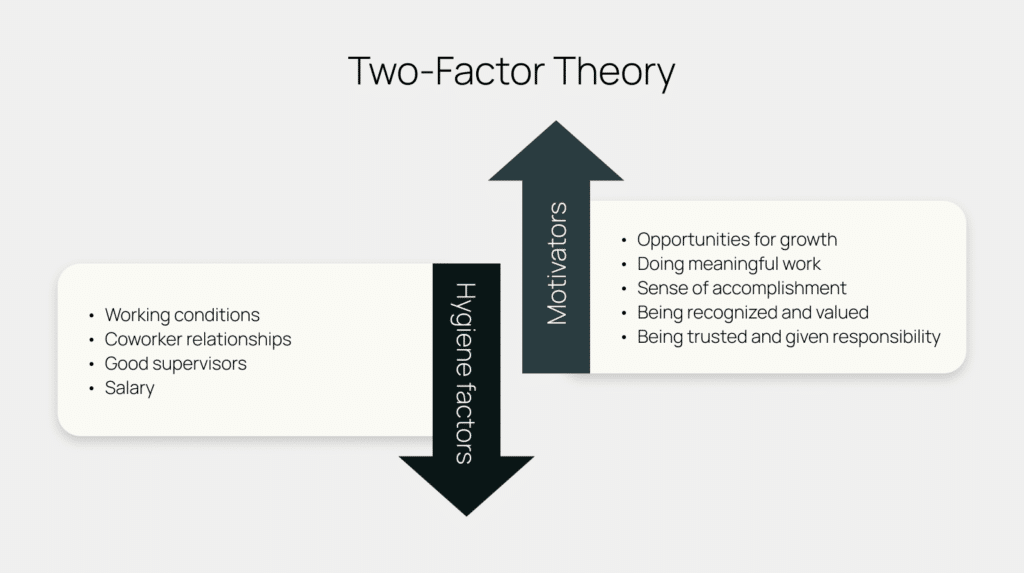
Herzberg theorized that both must be taken care of, eliminating dissatisfiers and focusing on creating satisfiers, in order to have motivated employees.
So How Does Two-Factor Theory Help You Understand AEO/GEO Better
Whether you agree or disagree with the theory, it's a really interesting way of looking at things. The more I’ve thought about it, the more I’ve realized that it can be extended to contextualize things outside of human behavior.
In particular, I feel as if many AEO/GEO tactics become a lot clearer (and why you don't always get the results you want) when viewed through the lens of two-factor theory.
Now keep in mind that this is just an analogy. It's not a perfect one to one. Just like people who are more complex than two factors, so is search in today’s modern landscape.
The Hygiene Factors: Why your brand isn’t showing up in AI
So what are the hygiene factors for AI?
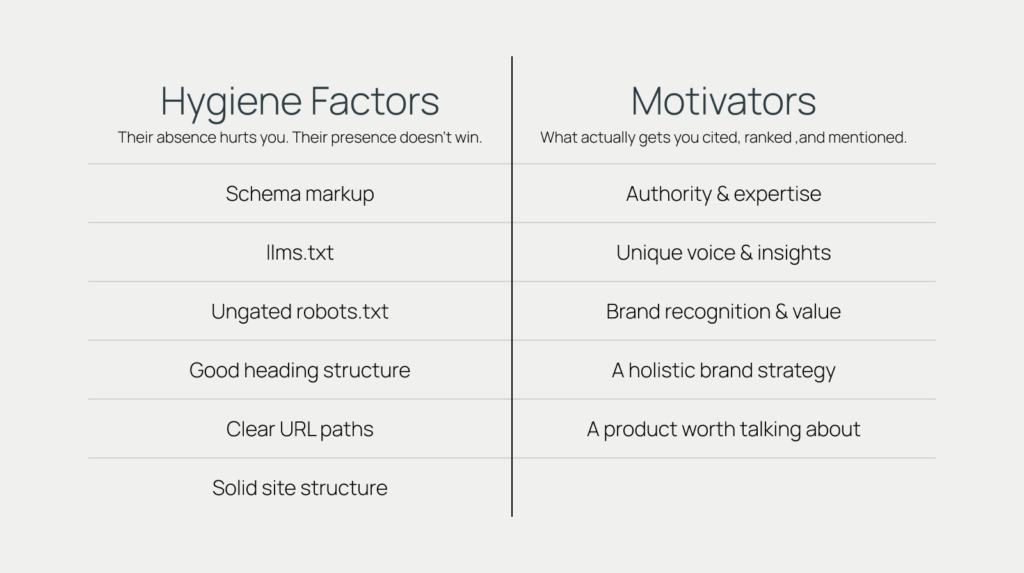
Think of them as the things that, if not present or done poorly, literally bottleneck an LLM's crawling behaviors and make it harder for AI to parse your site. Things like schema, llms.txt, ungated robots.txt, good heading structure, clear URL paths, optimized meta descriptions, and a solid technical site architecture. Basically, anything that establishes a clean semantic layer—the stuff that delivers your content clearly and cleanly so the machine can actually read it.
When people are searching for a magic bullet, often it feels like hygiene factors are the things that get recommended. Typically because they’re a lot easier to implement and feel more tangible. However, months later, after tests have been run, and we don’t see an uptick in traffic or mentions or citations, everyone throws their hands up and says well that clearly doesn't work, and moves on to the next shiny new magic bullet.
And well, yeah, of course it didn't work the way you wanted it to. It's a hygiene factor! You essentially just paid the entry fee to get parsed. It's only going to cause problems if it's not there (or done poorly), but it's not going to motivate the model to choose you.
The Motivators: What Actually Gets You Cited in AI
The things that actually are going to get you cited, ranked, mentioned, whatever, are never going to be quick fixes. Just like with humans, they’re going to take a little more effort and time to cultivate.
An AI obviously doesn't feel brand loyalty; it relies on mathematical weights, entity recognition, and semantic relationships. So when we talk about motivators for AI, we're talking about authority, expertise, unique voice and insights, and brand recognition. Essentially, a holistic brand strategy.
It means actually having a product or service that's worth talking about and not just a copycat. If your content just regurgitates the exact same points as everyone else, an LLM has no mathematical incentive to cite you over the original sources. Unique insights create novel semantic connections, giving the model a reason to pull your specific perspective into a generated answer. These motivators are so much harder to replicate and cultivate. But truly, it's what's going to get you the win far more than any hack out there.
The Question to Ask About Every Tactic
The next time you hear about a new GEO tactic , or a client asks if a specific tweak will guarantee them a spot in AI overviews, ask yourself: Is this just making it easier for the machine to read us, or is this giving the model a reason to actually care about us? Or essentially …is it just good hygiene or is it an actual strategy?
If it’s only the first, you’re just preventing dissatisfaction, not actually winning AI search.