



"Most webinars feel like corporate hostage situations—you're trapped with no escape, desperately looking for that 'leave now' button," says Matt Murdoch, VP of Marketing at Franklin Covey and author of "The Webinar Manifesto."
In B2B marketing today, webinars have grown from occasional tools to essential conversion machines. They connect awareness with revenue impact, serving as key touchpoints for buyers. Yet despite how common they've become, most marketers are still getting webinars painfully wrong.
The numbers don't lie: while webinar sign-ups continue to climb—engagement and conversion rates often disappoint. The gap between a webinar that drives millions in pipeline and one that wastes calendar space isn't just about content—it's about completely rethinking how we approach these events.
If you're still treating webinars like glorified PowerPoint presentations, it's time for a reset. What makes truly effective webinars different from time-wasters? How can you transform your virtual events from boring information dumps into dynamic, revenue-generating experiences? Drawing on insights from Matt Murdoch, who's been ahead of the curve for over a decade, we'll explore how to revolutionize your webinars.
When webinars first showed up, they were basically "PowerPoint marathons"—long, boring presentations with almost no engagement that left viewers wondering why they'd wasted an hour of their day.
Today, things look very different. Presentations are more visual, hosts use multiple video feeds and branded graphics, and the overall quality often feels more like a professional broadcast than a corporate meeting.
The trend is moving toward shorter, more energetic formats. People's attention spans aren't what they used to be, and content needs to grab them quickly and keep them interested throughout.
Technology has made webinars accessible to everyone. Where they once required technical producers and specialized equipment, now anyone with a laptop can host one. This means only the truly excellent webinars stand out from the crowd.
Great webinars begin with smart planning, but this is exactly where most marketers stumble. Here are the key pitfalls to avoid:
Many marketers assume that simply scheduling a webinar means people will show up. This rarely happens. You need strategic promotion across all your channels to drive attendance. Without aggressive marketing, even the best webinar content goes unwatched.
Nothing irritates attendees more than signing up for what promised to be valuable information, only to sit through an hour-long sales pitch. This destroys credibility fast. The best webinars prioritize genuine value over immediate sales messaging. Build trust first, and the sales will follow naturally.
Too many marketers rush through content creation and skip crucial testing. Murdoch suggests treating your webinar like a real product that requires beta testing and feedback loops. Would you launch a new product without testing it first? Apply the same standards to your webinars.
As Paxton Gray of 97th Floor puts it, ask yourself: "Is your webinar good enough that people would almost pay for it?" While that's a high bar, aiming for that level of value is what separates exceptional webinars from forgettable ones.
According to Murdoch, truly successful webinars consistently feature three essential components:
Your content must immediately connect with what your audience needs. It should feel urgent, valuable, and directly applicable to their work or lives. Generic information won't cut it—you need insights they can't easily find elsewhere.
Knowing your material isn't enough—you need to deliver it with energy and clarity. If your presentation style is flat or boring, people will multitask (best case) or leave (worst case). You don't need to be a professional entertainer, but you do need to bring energy, tell stories, and present in a way that keeps people's attention.
This is where most webinars fail completely. Passive listening doesn't work in virtual settings. Use polls, Q&A, chat features, and even live dialogue to transform listeners into active participants. This is where real learning happens—when people engage with the material rather than just hearing it.
One of Murdoch's most valuable insights addresses the fundamental challenge of virtual events: in physical rooms, we're naturally accountable to each other. We can see if someone is checking their phone or zoning out. In virtual settings, that accountability vanishes.
To solve this problem, Murdoch developed a three-part "virtual accountability" framework:
Set expectations upfront by telling attendees you'll be calling on people by name and asking for input. This prevents the "movie theater mentality" where people assume they can just watch passively.
One of Murdoch's favorite techniques is the "Hang 10" rule: when you ask a question, wait a full 10 seconds of silence for answers. It will feel uncomfortable at first, but the pause gives people time to think and greatly increases participation.
People don't remember bullet points—they remember stories and images. Replace text-heavy slides with bold, memorable visuals. Tell stories instead of presenting data points. And make sure your slides look professional and current—outdated graphics signal that your content might be outdated too.
Newton's first law applies to webinar attendees: objects at rest stay at rest. To keep people engaged, create movement—both mentally and physically.
Give attendees short tasks or problems to solve. Use interactive tools like polls and whiteboards liberally—aim for some form of interaction every five minutes. Murdoch even suggests having participants stand up, find an object in another room, and return to discuss it—something that would never happen in typical webinars but creates memorable engagement.
Creating a great webinar is only half the battle—you also need people to attend. Here's how to fill those virtual seats:
Instead of generic descriptive titles like "A Comprehensive Review of Fiscal Q3 Metrics," try something that addresses specific pain points: "The Top Three Metrics Secretly Costing Your Marketing Budget Millions." Your title should make people feel they can't afford to miss what you're sharing.
Use every channel at your disposal—email, social media, partner networks, and more. Send multiple reminders right up until the event starts, since registration doesn't guarantee attendance.
Here's where Murdoch's approach differs dramatically from common practice: when someone registers for your webinar, that's their moment of need. They're saying, "I have a problem, and I think you might have the solution."
Don't wait until after the webinar to follow up. Have your sales team contact them immediately. As Murdoch explains, "Three things can happen if you wait: they'll forget about it, they'll get pulled into another meeting, or worst case, they'll find their solution through another vendor."
Rather than choosing between live and on-demand formats, use both strategically. Live webinars provide interactive energy and urgency that's hard to replicate, while on-demand extends your content's lifespan and meets viewers' desire for convenience.
For maximum impact, host live webinars and then create condensed on-demand versions (typically 20 minutes instead of 45). Just remember that live attendance may signal stronger buying intent than on-demand viewing.
As virtual events continue to evolve, several trends are emerging:
Attention spans continue to shrink—as one of Murdoch's colleagues put it, "If your webinar lasts longer than my coffee, you've lost me." There's growing demand for micro-webinars that deliver value quickly.
That said, longer formats aren't dead. Murdoch recently ran successful 90-minute webinars by using the engagement principles outlined above. The key is design, not duration.
New technologies are transforming what's possible in webinars: automated Q&A, intelligent chatbots, real-time analytics, and more. These tools can make webinars more responsive and personalized while reducing the technical burden on hosts.
On-demand content continues to reshape audience expectations. Just as streaming services trained viewers to expect content when and how they want it, B2B audiences increasingly expect similar flexibility with professional content.
The most effective webinars aren't presentations—they're carefully crafted experiences that engage audiences and move them toward conversion. By avoiding common planning mistakes, building in the three types of accountability, and treating registration as the moment of need, you can transform your webinars from boring obligations into powerful revenue drivers.
The days of PowerPoint marathons are over. It's time to create webinars people actually want to attend—and that deliver real business results.
Between the cost of tools, the time and resources needed to create tailored content, the investment in marketing ops, and the challenge of aligning with sales reps, ABM can be seen as a high-risk, high-reward strategy for many organizations. And that's all before you even get to measurement.
Many companies find proving the ROI of ABM campaigns to be somewhat complex. However, when done properly, ABM can be one of the most effective ways to guide high-value accounts down the funnel. But there's a lot that goes into it—ABM is one of those things that is easier said than done. On paper, it's quite simple, but in practice, it can become much more complex.
One of the biggest challenges with ABM is that companies often think they're doing ABM when they're actually doing demand generation. As Madelyne Oliver, Senior Marketing Operations Manager, ABM at Cloudflare explains, "The biggest difference is that ABM is single-handedly account-centric. It focuses on the journey of the account, whereas DemandGen is leads, contacts, all of those people touchpoints... their journey is the typical lead scoring journey becoming an MQL and all of that."
This distinction is critical for effective implementation. When you're thinking about demand generation, you're focusing on individual leads and contacts. But with ABM, you're looking at the account holistically—considering the entire buying committee, the account's overall engagement, and its progression through the funnel as a unified entity.
This perspective shift fundamentally changes how you approach everything from content creation to campaign design. Your ABM marketing materials aren't designed to attract individual leads; they're crafted to appeal to specific accounts and to engage multiple stakeholders within those accounts. When marketers fail to make this distinction, particularly in one-to-many ABM programs, they often end up with ineffective hybrid approaches that miss the mark on both fronts.
Successful ABM strategies typically follow a tiered framework that allows for different levels of customization and resource allocation based on account value. Oliver outlines a three-tiered approach that has proven effective:
The most resource-intensive tier focuses on high-value enterprise clients that require a highly customized approach. These accounts typically receive:
"One-to-one is the very high-touch enterprise clients that really require this very custom journey, custom fit, custom outreach, like a lot of custom content," notes Oliver. This tier typically includes 50-100 accounts at most, given the intensive resources required.
The challenge with one-to-one ABM often lies in content creation. Many organizations struggle to deliver the fast turnaround, dynamic, and fluid content these high-value prospects require. Without dedicated content resources aligned to ABM initiatives, this tier can falter despite its potential for significant returns.
The middle tier balances personalization with scale, typically targeting around 1,000 accounts. This approach includes:
This tier allows for deeper segmentation of target account lists by different verticals and behavioral signals that indicate intent to buy. Companies can create more tailored experiences while maintaining efficiency, making this tier the workhorse of many successful ABM programs.
The broadest tier typically encompasses 3,000-5,000 accounts and represents the bridge between traditional marketing and ABM. While still account-focused, campaigns at this level are more scalable:
This is where the line between ABM and demand gen often blurs. The key differentiation is maintaining account-centricity even at scale, rather than reverting to lead-focused approaches.
The foundation of any successful ABM program is selecting the right accounts. This process begins with building a target account list, but it doesn't end there.
"I think the most common place [where organizations go wrong] is when they don't align with sales," Oliver points out. While marketing can develop the initial target account list, validating it with sales is crucial for success. Without this alignment, you risk targeting accounts that your sales team isn't equipped to pursue effectively, creating a disconnect that undermines the entire ABM strategy.
The account selection process should incorporate:
Once established, these target account lists should not remain static. Oliver recommends quarterly reviews to evaluate what's working, what's not, and which accounts should be added or removed based on changing market conditions and account behavior. This ongoing refinement ensures your ABM efforts remain focused on the accounts with the highest potential value.
Data quality makes or breaks ABM initiatives. According to a study by Validity, 44% of companies surveyed say they have lost 10% of revenue due to CRM data decay. In ABM, where you're working with a smaller pool of targeted accounts, poor data quality has an outsized impact.
"It's really important to make sure that data is clean, it's reliable, it's deduped, it's standardized," Oliver emphasizes. "Especially with Salesforce, there can be parent accounts, there could be child accounts. And you really want to make sure that the data is clean so that your lists are clean because that impacts what kind of campaigns you enter them in."
The consequences of poor data hygiene can range from embarrassing targeting mistakes to complete program failure. When accounts are miscategorized, you risk:
Implementing effective data governance requires both automated and manual approaches. Organizations should establish clear suppression criteria, ensure proper data collection processes, and implement regular cleansing practices. It's particularly important to verify that third-party data is correctly appended to your CRM fields to prevent targeting errors based on incorrect information.
Building an effective ABM tech stack depends heavily on your organization's size, maturity, and budget. Not every company needs to invest in expensive enterprise platforms to get started with ABM.
For enterprise organizations, platforms like Demandbase and 6sense offer comprehensive solutions that integrate account identification, intent monitoring, and campaign orchestration. These platforms typically provide:
For mid-market companies or those with more limited budgets, leveraging existing tools while strategically adding ABM-specific capabilities is often the most practical approach. Even without dedicated ABM platforms, organizations can implement ABM principles by:
"I know not everyone has the budget to go out and get 6sense or Demandbase," Oliver acknowledges. "Sometimes you're just focused on crafting your targeted account lists in Salesforce or from your CRM, validating it with sales. And if that's where you are in your maturity level, that is fine too."
Artificial intelligence is transforming ABM, making personalization at scale more achievable while reducing the manual workload on marketing teams.
Oliver sees AI's impact on ABM as both making things harder and easier simultaneously: "I think harder and easier at the same time. It gets more complicated when you're a large company and you have a large tech stack... But then on the flip side, it can be easier because AI can fill those data gaps."
The most promising applications of AI in ABM include:
The key is distinguishing between tasks best suited for AI and those requiring human intelligence. AI can handle the heavy lifting of personalization and content creation, allowing marketers to focus on higher-value activities like strategy development and relationship building. This strategic division of labor enables marketers to concentrate on areas where human judgment and creativity add the most value, while AI handles repetitive tasks that benefit from automation and scale.
Despite the increasing adoption of ABM, measurement remains a challenge. According to a 2023 study by ITSMA, only 52% of companies measure account-based marketing ROI. Even among those who do measure, proving value can be complex.
Oliver's team takes a pipeline and revenue-driven approach to measurement, focusing on metrics that directly demonstrate business impact:
"We are very pipeline and revenue driven... We're trying to showcase what makes the most impact from an ABM perspective. And so when you're focusing on the percentage of your total pipeline and revenue, is it coming from those ABM targeted accounts or not?"
Key metrics that demonstrate ABM effectiveness include:
For companies with longer sales cycles, pipeline velocity becomes particularly important. The goal is to shorten the sales cycle by engaging with accounts earlier in the process and measuring the time it takes for an account to move from first engagement to closed deal.
Account-based marketing represents a significant shift from traditional lead-focused approaches, but when implemented effectively, it can dramatically improve marketing efficiency and sales outcomes for B2B organizations.
The keys to success include:
The most successful ABM programs aren't static implementations but evolving strategies that continuously adapt based on performance data and market changes. By maintaining a cycle of review and refinement, organizations can realize the full potential of ABM to accelerate high-value deals and drive meaningful business growth.
Marketing is changing faster than ever. AI is reshaping workflows and content strategy, budgets are tighter, attribution needs to be crystal clear, and more companies are competing for the same audiences. This is especially true in highly technical industries like cybersecurity, where buyers want real expertise, real insights, and proof that you understand their challenges.
Most marketing teams lack the technical expertise to produce content that resonates with a technical audience. They need subject matter experts (SMEs) who understand the complexities of the industry. Yet according to the Content Marketing Institute, 33% of marketers say getting time with SMEs is their number one blocker to producing effective content.
In cybersecurity, this challenge is magnified. Two-thirds of organizations report talent shortages, and half of cybersecurity professionals expect to burn out next year. With fewer experts carrying heavier workloads, getting their time for content creation becomes increasingly difficult.
Companies that figure out how to tap into SME expertise will win in the long term. Let's explore practical frameworks for collaborating with SMEs to create content that's both accurate and engaging.
Using SMEs in content creation establishes trust between your brand and your audience. This is especially critical in technical fields where credibility determines marketing success.
For marketers without technical backgrounds—which is most of us—finding confidence in your content can be challenging. As Maria Velasquez, Chief Growth Officer and co-founder of Cybersecurity Marketing Society, puts it: "As a marketer, you usually have a hard time finding confidence in your content if you don't come from a technical background. And let's face it, most marketers don't."
In a world where AI creates "sameness," SME-driven content provides a critical differentiator. When everyone can produce generic content with a few AI prompts, the unique insights from your technical experts become invaluable.
When technical buyers see content that resonates with their daily experience and challenges, they're more likely to trust your solutions. This authenticity builds credibility that generic content simply cannot match.
If you have internal SMEs, identify which ones are best suited for content collaboration. Are they on the product team? Engineering team? Do they prefer being on camera or writing blogs?
For organizations without the right technical talent in-house, build an external bench. "I'd find a freelancer," recommends Velasquez. "There are plenty out there that are marketers, true marketers. They understand content strategy... There are those marketers out there that are also technical and understand cybersecurity."
Develop a diverse bench of talent with different expertise and content preferences. Velasquez advises: "Why not have a bench of different types of talents and skills? Because of course there's bandwidth, there's availability."
Look for self-identifying SMEs within your organization. Velasquez notes: "Sometimes they self-identify and they say, yeah, actually, I love writing about that or I love writing technical blogs... Or they just write on their own and just say, hey marketing, by the way, I wrote this. I didn't know what to do with it. Do you want it on the website?"
Another effective strategy is building relationships with team leaders in technical departments. These leaders can often recommend team members who would be well-suited for content collaboration.
When engaging with SMEs, start small and be mindful of their time constraints. Overwhelming them with an entire year's content strategy is a common mistake that can damage the relationship before it begins.
Instead, set realistic expectations with manageable requests. Start with a one-time collaboration and if they enjoy it, they'll likely return for future projects.
A video-first approach yields the most content from a single session. From one webinar, you can create blogs, social media snippets, and cheat sheets—maximizing their time investment.
Be clear about time commitments. Velasquez suggests asking for "a couple hours once a quarter" with the promise that you'll make the most of their limited time.
Build authentic relationships through casual interactions and personal connections. These relationships make SMEs more likely to prioritize your requests.
Many SMEs want to build their personal brand, and as Velasquez notes, "marketing is that perfect vehicle" for them to do so.
When sitting down with an SME, preparation is key. Don't begin by asking them what to write about—come with data, audience insights, and trending topics that align with their expertise.
Focus on topics they're already passionate about and familiar with. When SMEs discuss subjects they genuinely care about, the content becomes more engaging and authentic. Consider topics they've previously presented on at conferences or internal meetings where they already have developed thoughts and confidence.
The most valuable content often comes from capturing authentic "day in the life" insights that can't be found through a simple Google search. Velasquez shares an example: "If they say, 'I am so stressed from the amount of alert fatigue that I get from my security tech stack over the weekend, and it's prevented me from having good quality time with my family.' That's marketing content right there."
These emotional realities of your target audience create compelling angles for your content. "We are selling to humans. Sure, we're in B2B, but it really is human behind that computer screen," Velasquez reminds us.
As buying committees expand in technical fields, consider developing content for different stakeholders. If your analytics show CFOs downloading ROI-focused content, develop more content targeted to financial decision-makers. This might mean engaging with financial SMEs in your organization.
Once SMEs have contributed to your content, ensure they see the impact of their time investment. Internal marketing is crucial for showing appreciation and demonstrating results.
Create regular communication channels to highlight SME contributions, whether through internal newsletters, Slack updates, or team meetings. These efforts not only show appreciation but also help SMEs build their internal reputation.
When possible, connect their content contributions directly to business outcomes. As Velasquez puts it: "Shout out to so and so. Thank you for helping us on the webinar. We had this many attendees and the sales team was able to book two meetings from that. I mean, look, you tie it to revenue. That's gold right there."
Avoid common mistakes that can damage SME relationships. Don't overwhelm them with requests, waste their time with poorly planned sessions, or fail to follow through on content they helped create. Remember that their primary responsibilities lie elsewhere.
Building a sustainable cadence for SME engagement ensures long-term success. Be clear about time commitments, follow through on your promises, and make the collaboration as efficient and painless as possible.
In an AI-driven world where generic content is increasingly easy to produce, SME-driven content provides a crucial differentiator. As Velasquez puts it: "If they can find what's in your content with a simple Google search and everybody else is writing the same thing, then it's not valuable." Successfully engaging SMEs requires understanding their preferences, respecting their time, building authentic relationships, and showing appreciation for their contributions. Remember that even in B2B marketing, we're ultimately selling to humans, and the authentic experiences of your SMEs create connections that generic content cannot match. Start building your SME relationships today—the future of your content strategy depends on it.
Let's face it: case studies matter more than ever in B2B marketing. Recent research shows that 80% of B2B buyers look at case studies while researching purchases—making them one of the most powerful tools for winning new business. But here's the challenge: while most companies know they need customer stories, many struggle to create them consistently and effectively.
"I actually don't love the words case study because I think it's a bit dated and I think it's become so diluted from the academic world and it conjures up this bias of like, well there's this one very specific format," Klettke explains. The first step to improvement? Start thinking about customer stories that capture real transformation. This shift in mindset opens up possibilities for creating varied, channel-specific content that resonates with different audience segments throughout their journey.
The biggest barrier to creating effective customer stories isn't a lack of success stories—it's a lack of infrastructure. Most companies, regardless of size, don't have dedicated programs or clear accountability for customer story creation. Instead, they rely on a reactive approach where marketing is tasked with producing case studies on demand, without the necessary foundation for success.
Think of it like telling one player on a basketball team to "just go do a dunk" without any supporting plays or team coordination. Just as in basketball, customer stories require teamwork and strategy to execute effectively.
The most successful companies treat customer stories as the natural byproduct of strong customer relationships rather than isolated tasks. They build systems that make these stories inevitable, not occasional.
The key to transitioning from ad-hoc to always-on is developing a strong Standard Operating Procedure (SOP). Here's what your SOP should include:
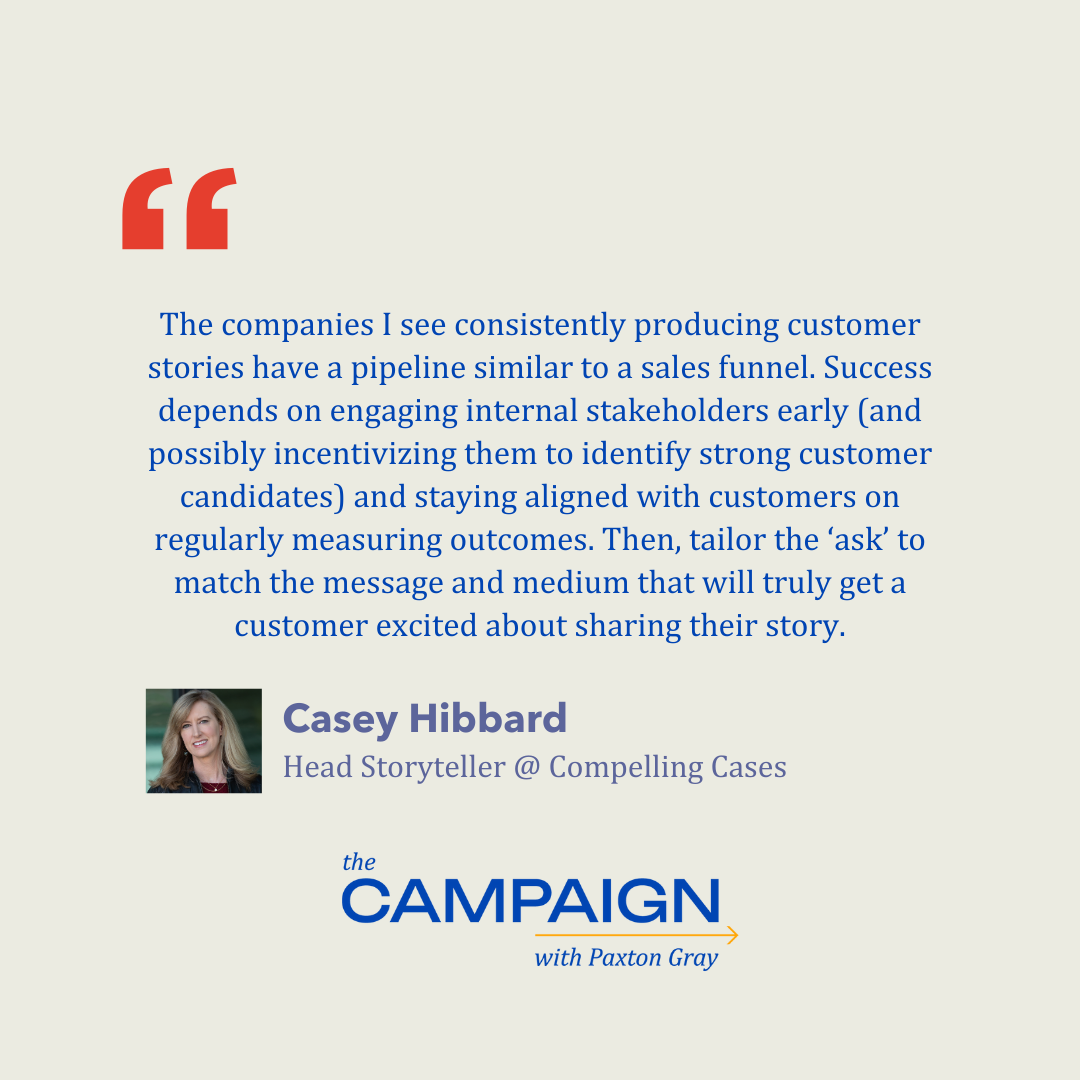
As Joel Klettke explains, "no smart marketer sits down and goes, okay, I think I just need a blog post about anything. You've got to have some sort of overarching strategy that ties up and rolls up into business KPIs. That's why you're doing it. Otherwise you're just making noise and bashing a keyboard." Consider these strategic approaches:
Instead of reactively responding to every request, build a proactive story pipeline aligned with your organization's strategic goals. This approach ensures you're not just creating content—you're creating assets that drive business results.
Success in securing customer participation starts long before you make the request. Here are key principles for increasing your success rate:
"People publish these things once and forget about them and it's like driving a Ferrari only on Sundays. Like you bought the thing, you made the investment, use it," Klettke points out. Here's how to maximize their impact:
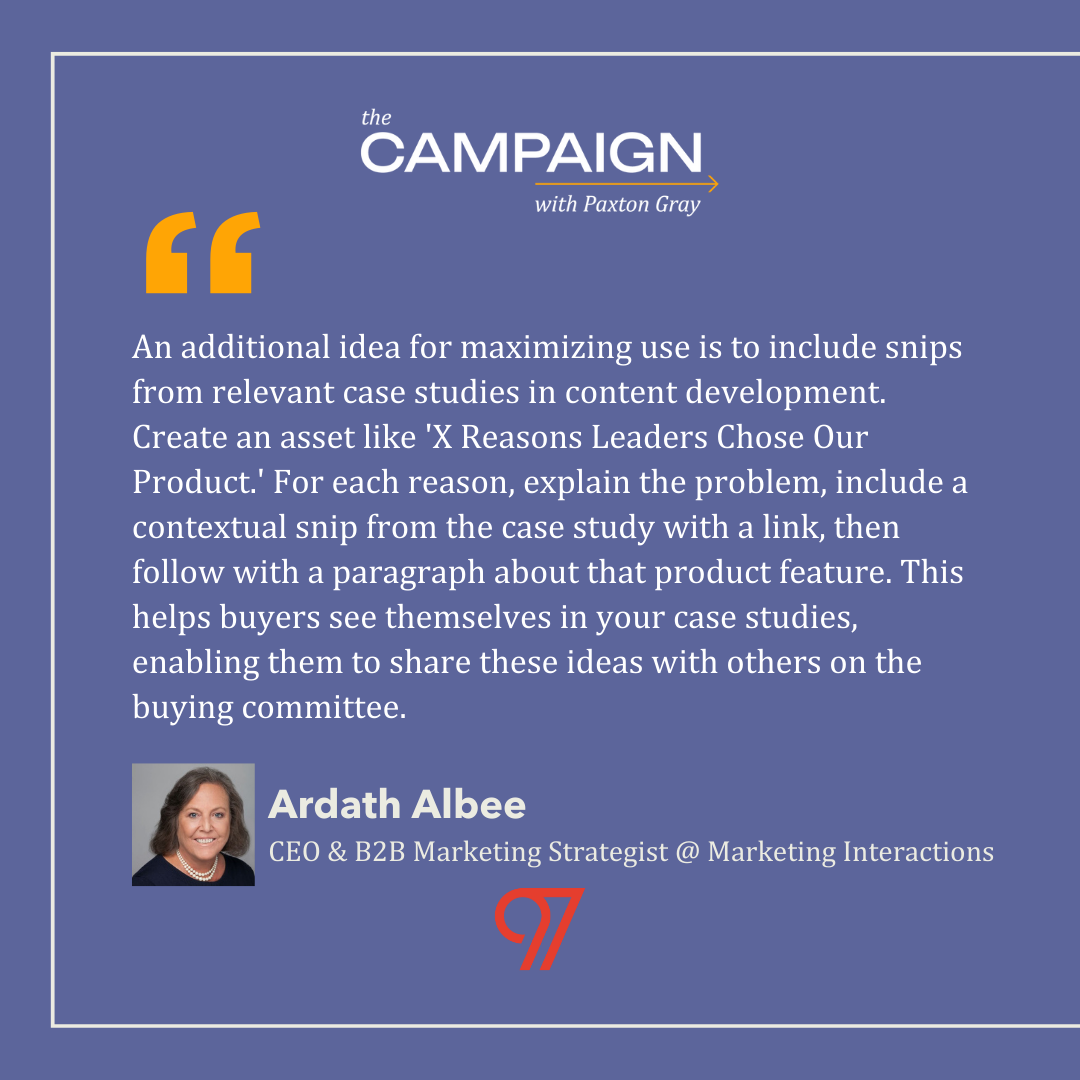
"The companies who are going to win are going be the companies who realize, they can steal our features, they can poach our people, they can copy our design, they can mimic our messaging, the one thing they can't take away from us that are ours to lose are our advocates, our customer stories," explains Klettke.
The companies that will win are those that make customer advocacy a strategic priority. But remember: a poorly told customer story benefits no one. Focus on authentic narratives that put the customer's transformation at the center.
By building the right infrastructure, taking a strategic approach to story selection, and maximizing the impact of each story, you can create a sustainable engine for generating compelling customer stories that drive growth.
The time to prioritize customer stories is now. Start by documenting your process, opening dialogues with other teams, and treating these stories as the valuable assets they are. Your future pipeline will thank you.
Here's a quick exercise: Take a look at your competitors' ads. Now remove their logos. Can you tell them apart? If you're like most B2B companies, probably not. This striking similarity in B2B marketing isn't just a missed opportunity – it's a weakness in an increasingly competitive landscape.
While many B2B marketers focus on optimizing channels and tweaking conversion rates, they're overlooking one of the most powerful tools: storytelling. And contrary to what you might think, this isn't just fluffy marketing speak. Recent research has shown that storytelling in B2B advertising has an even stronger effect on C-level decision-makers than on other buyers, particularly in building trust and fostering long-term brand advocacy.
Think of your customer journey as a story – because that's exactly what it is. From the first touchpoint to the final sale, you're not just moving prospects through a funnel; you're engaging them in a narrative about transformation and possibility.
High-funnel brand touchpoints – whether they're bus shelter ads, digital campaigns, or conference presentations – act as your story's "book cover." They're not meant to tell the whole tale but to intrigue and invite your audience to learn more. As Tara Ramroop, Director of Content Marketing at Braze, explains, "It's like the blurb that you see when you're kind of shopping for something to read. Or maybe you weren't shopping for it at all... but there was something about it – the brand, the tagline, the copywriting, the voice – that drew you in."
But here's where many B2B companies falter: they start strong with brand awareness, jump straight to the hard sell, and leave a massive gap in between. The result? Sales teams complaining about tepid leads and prospects who aren't ready for conversations. When this happens, it's often because the story didn't make sense – the chapters were out of order, or worse, missing entirely.
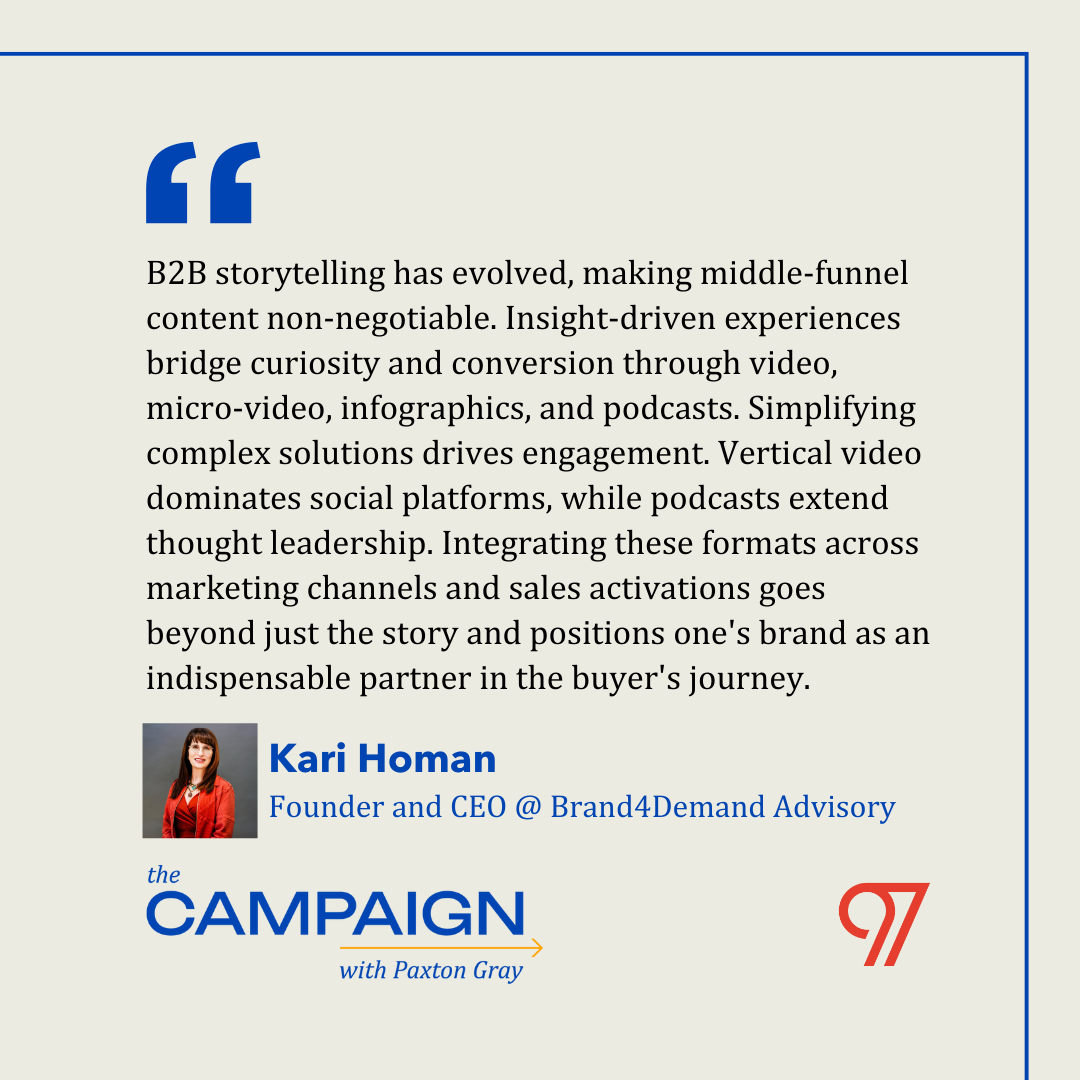
Traditional B2B marketing follows a familiar pattern: company blog → CTA → gated asset → sales funnel. While this approach has worked in the past, it's becoming less effective as buyers grow more sophisticated and their journeys more complex.
The solution isn't to abandon these tools but to rethink how we use them. Instead of leading with what we want to say, we need to start with what our audience needs to hear. This means taking an audience-focused approach rather than a content-focused one.
"Companies always have something to say," Ramroop notes, "but it doesn't do service to the story that is connective or inspiring to lead with yourself." The key is demonstrating that you understand what keeps your prospects up at night and showing how you can help them work better, live better, and lead better.

Modern B2B purchases rarely involve a single decision-maker. Instead, you're typically dealing with a buying group – a cast of characters, each with their own concerns, priorities, and perspectives. The IT manager, marketing director, and legal counsel might all be involved in the same purchase decision, but they're looking at it through very different lenses.
This is where deep audience analysis becomes crucial. Instead of segmenting purely by demographics or firmographics, focus on understanding behaviors, desires, and pain points. What keeps each stakeholder up at night? How do they collaborate with others in their organization? What does success look like from their perspective?
The phrase "operationalizing storytelling" might sound like an oxymoron, but it's essential for scaling your narrative approach. This means establishing processes and systems that help you tell consistent, compelling stories across all touchpoints.
Some key components include:
Tools like Asana for project management, a robust digital asset management system, and analytics platforms like GA4 can help you manage and measure your storytelling efforts. However, remember that the tools themselves matter less than having everyone aligned on using them consistently.
If you're thinking this all sounds great but impossible to implement with your current resources, take heart. You don't need perfect conditions to start improving your storytelling strategy. Start small, measure what works, and build from there.
Begin by analyzing your current content performance. What stories are resonating with your audience? Where are you seeing engagement drop off? Use these insights to inform your next steps, and don't be afraid to get scrappy with your implementation.
Remember, you can build your storytelling infrastructure while maintaining your current marketing operations. As Ramroop advises, "Crawl, walk, run. You'll get to a place where you'll have your process and it runs like clockwork, and then you can tweak that process as you go."
In today's B2B landscape, standing out means more than having the right features or the best price. It means telling a story that resonates with your audience on both rational and emotional levels. By taking a systematic approach to storytelling while maintaining flexibility and creativity, you can create marketing that doesn't just inform or persuade – it inspires.
Start by examining your current customer journey. Where are the gaps in your story? Which chapters are missing? Then, begin filling those gaps with content that demonstrates genuine understanding of your audience's challenges and aspirations. Remember, the goal isn't just to tell any story – it's to tell the right story to the right person at the right time.
When it comes to B2B marketing success, personalization isn't just a buzzword – it's a proven strategy. According to McKinsey, 77% of B2B companies that implement personalized experiences see an increase in market share. Yet many organizations struggle to effectively segment their markets, particularly in the B2B space where the rules of engagement differ significantly from B2C.
While consumer marketing can often rely on broad demographic data and personal preferences, B2B segmentation requires a more nuanced approach. Today's B2B buyers expect personalized experiences that speak directly to their unique challenges and pain points. But how do you deliver that personalization at scale while avoiding the pitfalls that derail many segmentation efforts? Let's explore a practical approach to industry segmentation that drives real results.
The B2B landscape presents unique challenges that make traditional segmentation approaches less effective. First, the decision-making process is inherently more complex than in B2C. Instead of convincing a single consumer, you're often dealing with multiple stakeholders, each with their own priorities and concerns.
Adding to this complexity is the reality of smaller audience sizes. While B2C companies might target millions of potential customers, B2B markets often consist of much smaller pools of qualified prospects. This makes traditional statistical approaches to segmentation less reliable and requires a more focused strategy.
Then there's the "95-5 rule" – a fundamental principle of B2B marketing that states only 5% of your potential market is actively looking to buy at any given time. This means your segmentation strategy needs to account for both immediate opportunities and longer-term relationship building.
Finally, B2B products themselves tend to be more complex, often requiring different approaches for different use cases. A solution that works perfectly for a small business might need significant modification for an enterprise client, even within the same industry.
Before diving into complex segmentation models, smart B2B marketers start by understanding the natural segmentation that already exists within their business. Take Bill, a financial operations platform, as an example. They serve two distinct markets: direct companies and accounting firms. These audiences solve similar problems using the same software but in fundamentally different ways.
This natural segmentation often emerges from how sales teams operate. Sales professionals instinctively adjust their approach based on company size, industry, and specific use cases. As Rick Golan, SVP of Growth Marketing at Bill, notes, "Sales will naturally segment in order to best communicate with, best set expectations for, and best sell the product that you have."
Company size frequently serves as a proxy for needs and complexity. A manager at a 2,000-person organization has very different requirements and decision-making processes compared to a small business owner. These natural divisions provide a foundation for more sophisticated segmentation strategies.
Success in B2B segmentation requires balancing rigorous data analysis with real-world sales insights. While large organizations might have teams of PhDs analyzing customer data, smaller companies often rely more heavily on sales team feedback and market testing.
The key is adopting an "explore and exploit" methodology. This means continuously testing different segments while being ready to double down on opportunities that show promise. The story of Divi (now part of Bill) illustrates this perfectly. While the platform wasn't initially built for accounting firms, the team discovered through market exploration that it solved a crucial pain point for accountants and their clients. This discovery led to a highly profitable segment that might have been missed with a more rigid segmentation approach.
To identify and validate segments effectively:
Once you've identified your key segments, the challenge becomes creating targeted messaging that resonates without crossing into what customers might perceive as "creepy" territory. According to research from Smarter HQ, 63% of consumers would stop purchasing from companies whose marketing feels too invasive.
One common challenge is the homepage dilemma – how do you speak to multiple audiences through a single asset? Rather than forcing visitors to self-identify through "Are you X or Y?" buttons, consider a "choose your own adventure" approach. Present key benefits and features that naturally appeal to different segments, allowing visitors to gravitate toward what matters most to them.
Small networks often provide the best opportunities for targeted messaging. When you can speak directly to the specific challenges of a niche industry or role, word-of-mouth marketing – still the most powerful driver of B2B growth – happens naturally.
Implementing effective segmentation requires the right tools and approaches. Popular options include:
The key is working closely with sales teams to identify momentum and amplify success. As Golan puts it, "Great creative work is born out of constraints," and specific segment targeting provides the perfect constraints for creating impactful marketing.
Remember to balance personalization with accuracy. While tools can help identify company characteristics, being wrong about personal details can damage credibility. Instead, focus on business challenges and industry-specific needs that resonate even if some assumptions are slightly off.
Effective B2B segmentation isn't about perfect data analysis – it's about taking action on insights and continuously refining your approach. Start with your natural business segments, validate them through sales team feedback, and test messaging in small networks before scaling.
Remember: "You can't hyper-segment your homepage," but you can create targeted experiences that speak to specific business challenges. Focus on understanding and solving real problems for defined segments, and the results will follow.
The key is to stop overthinking and start testing. Connect with your sales team, identify opportunities, and move quickly to exploit them. In B2B marketing, success often comes from finding and serving smaller networks exceptionally well rather than trying to be everything to everyone.
SEO is facing its biggest change in 15 years. With AI summaries and LLMs taking over parts of search, traditional metrics need a complete rethink. The surprise? Flat or declining traffic numbers may signal success in 2025.
"If it's not expensive, time-consuming, or taking resources, it won't provide value for SEO," says consultant Nick LeRoy. While traffic drops from AI and LLMs taking market share, revenue often stays stable or grows. "It's hard to pay electric bills with sessions."
Take HubSpot - their blog traffic fell from 10 to 2 million monthly visits. Yet this doesn't spell failure. Instead, it shows better targeting and engagement with their core audience. Companies succeeding in 2025 focus on quality traffic that converts, not just high numbers.
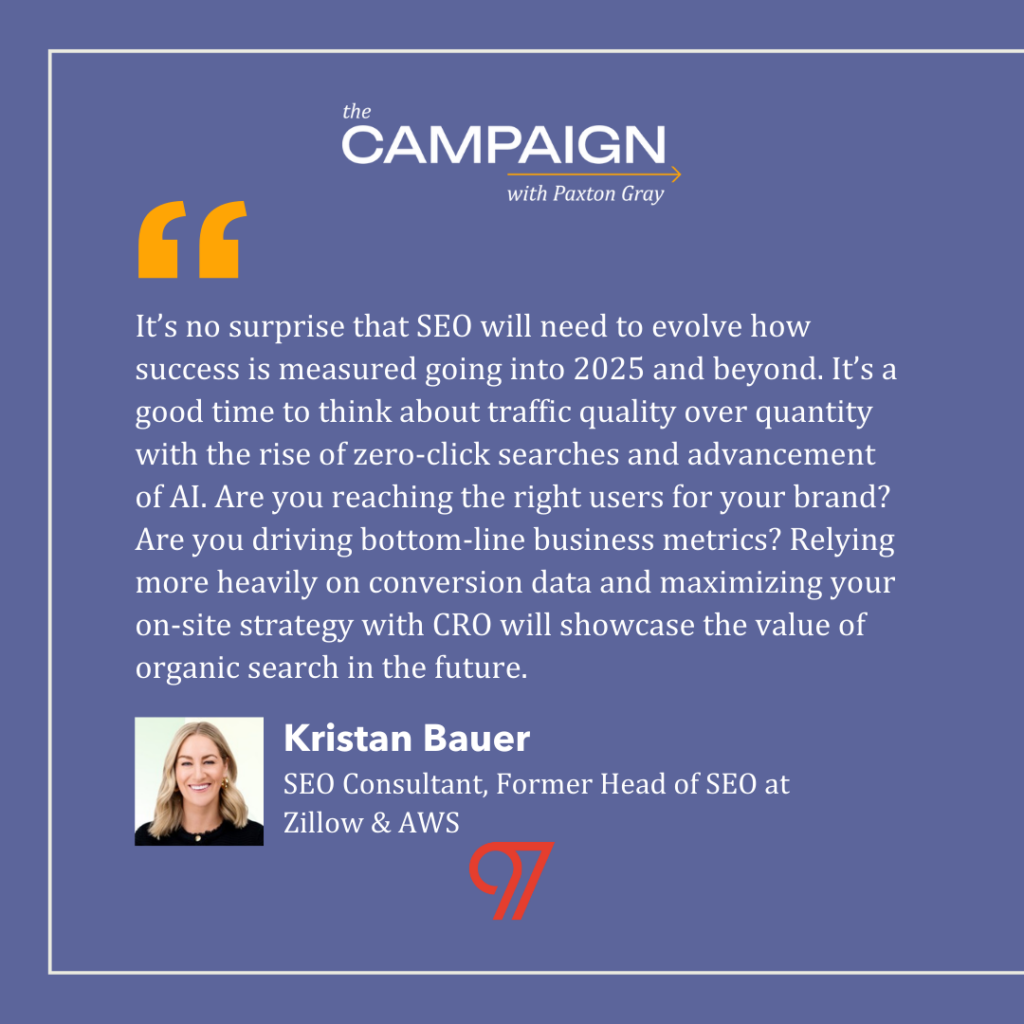
The era of mass AI-generated content is ending. While some brands still succeed with volume, engagement metrics increasingly determine rankings. Companies need to invest in fewer, better pages that truly serve their audience.
Some brands still create content like "motivational quotes for Tuesday" followed by "uplifting quotes for Thursday" with CTAs for complex B2B software. This approach brings traffic but few results. The winners in 2025's search environment focus on content that connects directly to their products and services.
Smart companies now start with messages, not channels. They understand their audience's needs first, then create content that works across their entire marketing mix. This approach means:
Large Language Models are changing how we optimize content. Like early SEO practices, brand mentions on authority sites matter more than ever. But LLMs present new challenges:
Forward-thinking companies are moving SEO teams to product development instead of marketing. This structural change:
The shift reflects SEO's evolution from a marketing tactic to a core business function. SEO professionals now influence product development, ensuring search optimization is built into products rather than added later.

Traditional channel-based metrics are becoming obsolete. Modern companies need new frameworks that:
SEO teams need dedicated testing budgets, just like paid search teams have had for years. As one marketing leader noted, "If you know your audience well, you know they'll love something even if it's new."
Successful innovation in SEO requires:
Companies often hesitate to innovate in SEO because they can't predict exact returns. But waiting for perfect forecasts leads to inaction. The key is balanced risk-taking backed by solid audience understanding.
To succeed in the new search environment:
Companies that win in 2025 will focus on quality over quantity and real business results over traffic numbers. They'll:
The fundamental goal remains unchanged: connect the right people with the right solutions when they need them. But the path to success now requires deeper investment in quality, understanding, and integration across the business.
Remember LeRoy's key insight: if maintaining your traffic levels in 2025 means you're actually growing your real impact. Focus on building value for your audience, and the metrics that matter will follow.
Marketers have a lot going on in 2025.
Marketing budgets are at an all-time low post-pandemic. At companies feeling especially strained, what little budget remains is controlled by a CFO whose concern is for immediate ROI instead of long-term strategy.

Search is undergoing its own metamorphosis as AI continues to dominate SERP results and Google pushes out more algorithm changes than ever before. Gartner predicts that search engine volume will drop 25% by 2026 as audiences turn to AI chatbots and social platforms for information.

To sum up, marketers are expected to do more with less budget, grow at the whims of Google, and learn how to use AI while also combatting AI.
The response to the chaos is to focus on the core tenets of marketing–aligning our messaging to the audience and our CTAs to a robust full-funnel strategy.
Brands that will reach their audience across the entire funnel know that a message is more important than the channel through which it is sent.
Dollar Shave Club (DSC) came onto the scene in 2011 with a pioneering direct-to-consumer subscription model for high-quality razors delivered monthly for just a few bucks. The startup's messaging positioned themselves as the long-sought-for alternative to overpriced razors loaded with gimmicky features. DSC was scrappy, smart and spoke directly to their audience’s desire to save money.
Unilever bought DSC in 2016 for $1 billion cash, surely with intentions to turn the brand into a profit machine. But Unilever misunderstood DSC’s audience.
DSC was cool precisely because it wasn’t part of a massive conglomerate. Its audience loved a rugged brand born out of a viral YouTube video that offered them an alternative to $35 shaving kits.

But all that Unilever could see was the sexy world of commercials. In 2019 Unilever produced a new video for their brand DSC, inviting men and women of all kinds to “join the club.” Actually, Unilever made a slew of commercials with the same deadpan style as the 2011 hit that made DSC go viral. But it wasn’t shirtless bodybuilders squeezing shampoo bottles or sphynx cats in a shave butter heaven that made DSC successful. Okay, well kind of.
DSC subscribers love funny videos. But if the funny video doesn't have the right messaging, it still misses the mark. Unilever was too focused on channels to really understand the audience and message that DSC customers were so fanatical about.
In an effort to maintain profit margins in retail, Unilever expanded DSC’s offerings to include products such as hair cream, cologne, face moisturizer, and sunscreen. But these products cost anywhere from $10-50.
The same customer that wants quality razors for just a few bucks isn’t going to spring for a $50 bottle of cologne.
In 2023 Unilever sold their majority stake in DSC after seven fumbling years trying to grow their profit margins.
Don’t be Unilever. Know your audience. Listen to them. Create messaging that speaks to their core desires and don’t be distracted by flashy new channels.
That last part is the trap. "Flashy new channels" are usually demand channels in their prime — which means they're also the channels that will plateau, saturate, and eventually stop delivering. Udi Ledergor, former CMO at Gong, warns that every demand channel has a lifespan, and brands that build their entire growth engine on today's working channel are building on borrowed time. This short video captures what it looks like when a channel stops working — and what smart teams are already doing about it.
Something is happening to the marketing funnel. It’s waist? The core middle section that holds all those essential organs? Itty bitty. Hourglass. Nearly invisible for far too many brands.
Top of funnel content is fun! It’s exciting, it’s new, it’s engaging. Bottom of funnel strategy gets the bulk of the resources. “Leads leads leads,” we hear the CEO chanting as we ask for more SEO spend. And the mid-funnel? Forgotten.
Developing a strong mid-funnel strategy is the most crucial effort that marketers can make to increase engagement in 2025.
Mid-funnel content is the heavy hitter—or it should be—in helping your audience to trust you, become true experts in the solutions that can address their problem, and feel prepared to make a decision. This is where your audience wants to hang out.
B2B buyers are self-navigating their way to purchases. They’re not including sales people; they’re doing extensive research on their own. The brands that deliver robust early and mid-funnel content to these B2B buyers will win engagement and ROI.
A report published by Demand Gen reveals that B2B buyers consider the following to be characteristics of early- and mid-funnel content memorable enough to warrant a sales call:

The report also identified interactive content as important in the mid-stages of the buyer’s journey. This content can look take many forms, but respondents prefer:
Build mid-funnel content that allows your audience to do the research that they want to do anyway, but with you.
Ever read an article with a title like “Ten Motivational Quotes for a Tuesday” only to be hit with a “try our complicated SaaS platform” CTA?
All over the internet we’re seeing bottom-of-funnel CTAs slapped on top-of-funnel content. It’s jarring.
In 2025, engagement will hinge on how well marketers align their CTAs with the specific stage of the buyer’s journey.
Marketers should judge every single CTA against two factors: value and relevance.
First, a CTA should continue offering value to your audience. They should get something or learn something that continues to guide them on their journey and help them solve their problem.
Second, a CTA needs to be relevant to the content it appears with. A motivational quote article doesn’t need a CTA for a demo, but maybe a CTA for a productivity guide? That’s closer.
CTAs should mirror the knowledge and intent of your audience. Ask yourself this: if I were engaging with this content what would I want to know or do next that would get me closer to a resolution? That’s your CTA.
Successful marketing strategies employ multiple CTAs, each tailored for their audience’s specific needs at each stage in the funnel.
If marketing is undervalued, brand marketing is the poster child for it. Convincing leadership to lend a budget for top-of-funnel awareness plays can feel impossible in the face of a recession scare.
But marketers know the truth: having a strong brand protects performance dips in every other channel–especially organic and paid.
A strategic brand campaign can have massive ROI that rolls in new business for a long time after the campaign concludes.
One of the most overlooked brand channels is already built into your product. Former Slack CMO Bill Macaitis explains why every free user is quietly acting as a member of your marketing team, spreading awareness and pulling your brand into new organizations. This short video breaks down why your free users may be your most underutilized marketing asset.
Back to the earlier point about the mid-funnel, building strong mid-funnel strategies and CTAs along the full funnel mitigates some of the risk of investing in top-of-funnel brand marketing. Put in different terms, if you want the buy-in for your top-of-funnel dream campaigns, build the mid-funnel first and connect the dots for upper leadership.
A brand marketing campaign should not be a drop-off.
Create a journey. Make your upper-funnel content work for you by hooking your audience on valuable content that logically follows through a whole network of truly useful resources and touch points.
If we had published this article even a year ago it may have felt elementary. Of course we need mid-funnel and multiple CTA. Of course we need to focus on messaging that hits home with our audience!
But in 2025, it feels necessary to re-center on these core tenets of building a brand that audiences trust.
This year we're giving you the tools to succeed by digging into the strategies that top B2B leaders use to turn marketing challenges into meaningful wins. Subscribe wherever you enjoy podcasts.
Let's talk about gated content - you know, those forms you have to fill out to get an ebook or whitepaper. It's 2025, and B2B marketers are still divided on whether it's the right way to go. Some say it's essential for generating leads, while others argue it just frustrates potential customers. But maybe we're getting caught up in the wrong debate. Instead of arguing about whether to gate content or not, shouldn't we focus on creating exchanges that actually work for both sides - our businesses and our audiences?
"It is so easy to grab onto that pendulum and let it swing over into 'I'm just delivering leads,'" Jonathan Riemer, Director of Global Content Experience at ServiceNow. This mindset often leads to gating everything in sight, with success measured solely by form fills rather than genuine engagement or audience value. The opposite extreme – removing all gates – might work for retail or smaller B2B companies with instant-purchase products, but enterprise solutions require a more nuanced approach.
The reality is that most B2B organizations need some way to identify and nurture potential customers. However, the traditional "gate everything" approach increasingly fails to meet modern buyer expectations. The key lies in understanding when information exchange makes sense and when it creates unnecessary barriers.
Consider this scenario Riemer presents: Someone's kitchen sink is spewing water everywhere. Do they want an immersive 3D experience explaining water valve mechanics, hidden behind a form? Of course not – they need immediate, actionable information to solve their crisis. "When you're trying to solve a basic problem that someone has, you don't form it," Riemer emphasizes. This principle applies broadly across B2B content strategy: When addressing immediate, critical needs, remove the barriers.
Once you've solved the immediate problem, you've earned the right to offer additional value. Want contacts for reliable plumbers in your area? That might be worth a form fill. Interested in DIY plumbing tutorials? That could be gated content too. The key is solving the initial problem first, then offering relevant, valuable next steps.
When you do gate content, it needs to feel special. "News organizations are probably at the forefront of figuring out how to create content that is digital still, but feels special enough to warrant someone giving information," Riemer observes. "Shame on us from a B2B standpoint not to consider that as well. Some things should be free, some things are 'no, if you want to find this out, you're going to have to give me something for it.'"
This is where the concept of "agentic content" comes into play. Imagine allowing users to specify not just their contact information, but their preferred format for consuming content. An HR executive at a medical institution might prefer their insights in PowerPoint format for an immediate presentation, while another user might want an in-depth PDF report for careful analysis. Modern AI makes this level of personalization possible and increasingly expected.
Artificial intelligence is transforming how we think about content delivery. New tools can convert long-form content into various formats – from podcasts to presentations – while maintaining quality and relevance. This isn't about replacing human content creators but augmenting their capabilities to serve audiences better.
"From a content strategy and experiential standpoint," Riemer explains, "if I don't know how you prefer to engage with me and get information from me, the power of being able to say, 'Hey, tell us how you would prefer to consume this fantastic information' – that's where AI is going to be so amazing and incredible for demand generation."
"When people fill out a form in the B2B world," Riemer notes, "they are admitting that they're getting ready to have someone, a door-to-door salesman come to them and interrupt them... That's why people put false information or never put their phone number." The solution isn't to abandon lead capture but to create more valuable, less intrusive follow-up experiences.
For mid-funnel content, focus on clear communication of value before asking for information. "Make sure that whatever it is that is inspirational or threatening thing, you have clearly communicated that there are answers and next steps for it," advises Riemer, "and not something wishy-washy."
When deciding whether to gate content, consider these key factors:
Looking ahead, AI agents will play an increasingly important role in content delivery and personalization. "That's where AI is going to be so amazing and incredible for demand generation," Riemer predicts, "is to respect our audiences better and provide them the information that they want in the formats that they want."
These AI team members can help:
"Know that if someone is truly interested in finding out more about your products and solutions... they will not be afraid to give you information," Riemer emphasizes. The key is earning that trust through consistent value delivery and understanding your audience's needs.
The future of gated content isn't about choosing between all or nothing – it's about creating intelligent, value-based exchanges that benefit both parties. As AI continues to evolve, we'll see more sophisticated approaches to content delivery and personalization.
The most successful B2B marketers will be those who master this balance, using technology to create personalized experiences while respecting their audience's time and attention. The question isn't whether to gate your content – it's how to create enough value that your audience gladly opens the gate themselves.
In 2025 and beyond, the winners won't be those who collect the most form fills, but those who create the most valuable, trusted relationships with their audiences. By focusing on value first and using technology to deliver it effectively, we can transform gated content from a necessary evil into a welcome exchange of value.
It's almost time to kick off Mastermind 2024 and we're excited to see you all in Park City very soon! Below are event details, including travel info, a packing list, and agenda.
If you haven't already taken our 5-minute Mastermind Welcome Survey, please click here to fill that survey promptly.
We have prepared an in-depth agenda for Mastermind—check it out HERE. Everything kicks off with registration opening at 11am on Tuesday, November 19th and Lunch being served at 1pm.
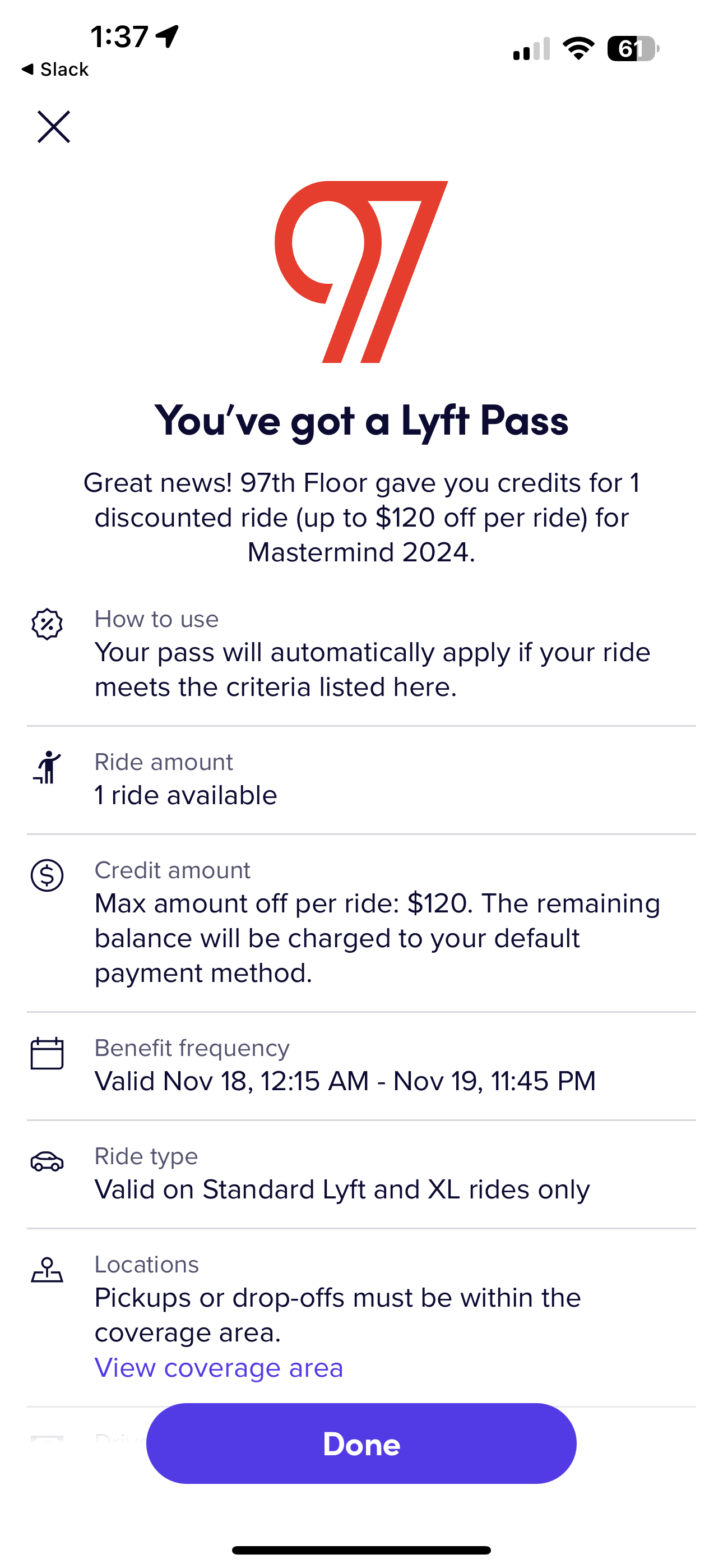
Arrival: If you're flying in, you will be taking a Lyft ride from the Salt Lake City Airport up to Park City. Each attendee has one Lyft voucher to travel from the Salt Lake City Airport to Pendry in Park City. The Lyft pickup area is located in the middle traffic lane on the ground level outside of the terminal (follow signs as you exit the terminal). To use the voucher, make sure you have the Lyft app installed on your phone and an account created. Go to https://lyft.com/lp/97THRIDE and log in to your Lyft account to add the voucher using code 97THRIDE. You will then see a Lyft Pass called "Mastermind 2024" in your Payment section. This is only valid at the beginning of the event as people are arriving (11/18 or 11/19).
Otherwise, you can also select a ride from the airport to Park City and in they payment section, select "Add promo code" using "97THRIDE".
Departure: We have prepared shuttles to take all attendees from Park City back to the Salt Lake City Airport on the final day of Mastermind, Thursday November 21st. These shuttles will be leaving every few hours to make sure you're back to the airport in time for your flight.
Parking: If you're driving to Mastermind this year, please follow the signs to Pendry's guest parking underneath the resort.
Pendry Park City
Located in: Canyons Village at Park City
Address: 2417 W High Mountain Rd, Park City, UT 84098
When you arrive at the Pendry Resort, you should be dropped off on the west side of the resort. Members of the 97th Floor team will be roaming around and the Pendry staff will also direct you.
Each year, we create a Mastermind slack group where attendees can find all the information they need, introduce themselves, connect with other attendees, and share links to helpful resources.
We invite you to join the Slack group ahead of time by clicking here. Start by jumping into the #introductions channel to share a picture, your name, company, title, and maybe a fun fact or two!
Weather update: The forecast is looking like we might have fresh snow and the temperatures will be cold (high of 35° F), so be sure to pack a coat!
We want to make sure you’re comfortable during the event. Here’s a quick packing guide:
Indoor:
Outdoor:
Everything else should be taken care of in the way of food, lodging, materials, etc.
We're very excited to have Greg McKeown joining us as our Keynote this year—if you haven't picked up a copy of Essentialism, we highly recommend it! Here's a little more about him:

Author, Public Speaker, Leadership and Business Strategist
Greg McKeown has dedicated his professional life to uncovering counterintuitive ways to be very successful–without burning out. He has written two New York Times bestsellers, “Essentialism: The Disciplined Pursuit of Less”, which has sold over one million copies and “Effortless: Make It Easier to Do What Matters Most”.
McKeown has spoken to hundreds of audiences as he has traveled to 40 countries around the world, including Apple, Facebook, Google, Microsoft and Nike.
He’s the host of The Greg McKeown Podcast which has been ranked in the Top 5 of all Self Improvement podcasts (out of 11,000) and his work has been covered in print media including in The New Yorker, The New York Times, Time, Fast Company, Fortune, Politico, Inc., and Harvard Business Review.
Organizations, teams, and individuals have benefited from McKeown’s innovative perspective, which challenges conventional wisdom and defines how to break through to the next level of success and profitability. In a compelling way, Greg Mckeown’s Essentialism keynotes will ignite a conversation that revolutionizes the way your organizations think and work.
We're looking forward to meeting and learning from you at Mastermind this year!
"When I’m showing off our program to Sr. Leadership and the C-team, those are the metrics I turn to…I'm really thrilled with the results we're seeing and hope you guys know you’re killing it!" – Head of Organic Marketing, Point of Contact at B2B SaaS
Our client is a B2B SaaS customer management software used by small- and medium-sized healthcare businesses.
Our client needed an SEO strategy to break into four target verticals.
We conducted vertical-focused keyword research and created topic clusters for each of the client’s four focus areas. Based on our research, we began delivering 20 content briefs to the client each month.
Traffic and inquiries have increased in each of our four targeted verticals, with a 39% increase in organic traffic YoY; 28% increase in ranking keywords; and 77% increase in organic traffic YoY.
Maveneer is a design consultancy creating effective supply chains from the ground up.
When Maveneer first came to 97th Floor, they did not have any SEO authority or organic content on their site. They needed a partner to guide strategy and get them started.
After completing extensive research, the 97th Floor team build a hub-and-spoke content strategy with “warehouse automation” and “order picking” as the top two priorities. 97th Floor delivered dozens of content briefs to Maveneer while also working closely with the Maveneer team to prepare for an upcoming site migration where the new content went live.

In just five months, Maveneer’s DR skyrocketed from 3 to 34.
886% Increase in search impressions YoY
101% Increase in non-branded organic traffic YoY

