



Tome is an AI assistant for sales. "Trained on your playbook and CRM data, Tome can identify strategic initiatives and key decision makers to help you break into large accounts with a message that resonates."
When Tome came to 97th Floor they were getting the majority of their traffic from users signing up for the free version of their product. They needed a strategic partner to help them increase overall business revenue and increase the number of users that were signing up for the paid premium version of their tool.
To reach Tome's goals, we wanted to focus on creating content that would attract paid customers. Through our conversations with the client, we knew that sales and marketers were two of the main audiences that would likely be paying for the premium version. Creating customer journey maps enabled us to identify the types of questions this audience would be asking that would lead them to Tome.
We then used these insights as we were crafting our SEO strategy and doing our keyword research to go after keywords related to those audiences needs. We prioritized optimizing templates that were relevant to these audiences (case study templates, marketing plan templates, ai presentations, etc.) to help us get in front of these users and help Tome start to quickly grow their organic traffic.
67% increase in average organic traffic in the US
234% increase in ranking keywords in the US
212% increase in keywords ranking in positions 1-3 in the US

On all counts, the Oil and Gas market is more volatile than most. Globally, prices fluctuate, regulations evolve, and supply and demand shift. Regionally, each market has unique dynamics, all dependent on macroeconomic variables like rising material costs and high interest rates, not to mention unique location-specific changes in supply and demand. Being a marketer in this arena demands a solid foundation in industry trends to make the smartest marketing decisions. Maintaining a clear Oil and Gas marketing strategy is the blueprint that guides every touchpoint between your brand and your potential buyers. It outlines who you’re targeting, the channels you’ll use, the messaging that resonates strongest, and the tactics needed to generate meaningful revenue.
However, most brands in Oil and Gas haven’t refreshed their marketing strategies in years. This leaves an opportunity wide open for savvy digital marketers.
We've dug deep into the most recent industry data and our own two decades of experience to provide you with a how-to guide on how to take advantage of this exponentially growing market. We’ll walk through the core components of building that strategy — from segment analysis and target market selection to developing a strong brand position that resonates in this complex landscape. We’ll also break down how to build a comprehensive marketing plan and how to leverage digital channels that drive measurable growth for Oil and Gas companies. With the right foundation, your team can stand out in a market that’s more competitive and more opportunity-rich than ever. Let's get right into it.
The oil and gas market is broken down into segments. If you haven’t yet, a good first step is to analyze each to find where your brand best fits in the flow. This allows for targeted marketing, laser-focused on which part (or parts) of the market you’re planning to win. Whether you and your team choose to focus on:
You’ll need a full understanding of each segment's needs and challenges to build the marketing strategies that place your brand in an optimal position and maximize your ROI. Each market has specific advantages and drawbacks.
Evaluate the potential ROI and align your marketing goals with the most promising markets. Choosing the target can make or break your marketing efforts. Trust us, taking the time to do the research will be the difference between a major win or a budget-crushing fail.
Customer Profiling and Targeting
Always know who you’re selling to. In the oil and gas industry, this could mean large corporations, smaller service providers, or even local governments. Carefully identify these key players and tailor your marketing efforts to meet their specific needs. It’s your job to connect as deeply as possible with your target audience. Potential customers are looking for personal connections with the brands they buy from, currently an uncommon occurrence in this market. This opens a window for you to step in and step up.
That window stays open only as long as your competitors remain comfortable. Marketer Sterling Snow calls this advantage "creating the channel" — and the brands that claim it first rarely give it up. When every player in your category is competing for the same keywords, the same trade media, and the same conference floors, the real leverage is in the channel nobody's thought to build yet. This short video captures why owning an uncrowded distribution channel — before your market wakes up — is one of the most durable advantages in B2B marketing.
Once you've identified your customers, the next step is to understand their behaviors. What drives their purchasing decisions? What are their pain points? What motivates them? What risks are they concerned about? Think about every step they’ll take on the buying journey, how they make decisions, and how you can meet their specific needs.
Once you’ve identified and worked to understand your audience, create a persona to represent your research. A clear, thought-out buyer persona will guide all your subsequent marketing efforts. Keep your persona in mind as you plan strategies and build campaigns. The more personalized and specific you are, the more likely your messaging will resonate with potential buyers. Here's an example Buyer Journey/Persona our team at 97th Floor recently created for General Kinematics.
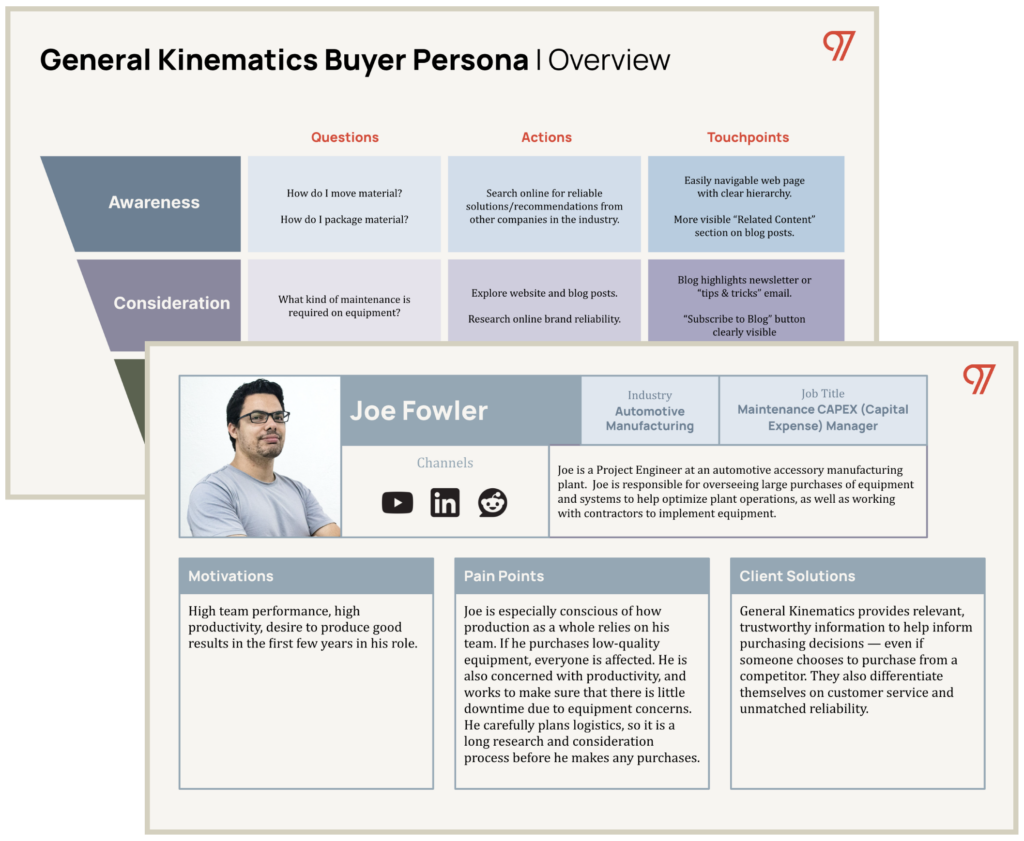
Your brand identity is what sets you apart. Think it through – what makes you different from other businesses in the industry? What are your specialized offering points? Focus on what makes your company unique, whether it's innovative technology, exceptional service, or a strong commitment to sustainability. If you’re looking for a place to start, begin by collecting reviews or interviewing previous customers for their opinions on what you do best.
With your identity in mind, work to position your brand in a way that highlights these strengths to appeal to your target audience. Clear, consistent messaging across all marketing channels is key. To pinpoint what messaging resonates best, you can give A/B testing a shot. Most importantly, always look for new opportunities to demonstrate your value through every medium. Case studies, visual data representations, and customer reviews are common ways to do this.
The battle’s not won yet, sustaining your hard-earned digital clout isn’t an easy process. Building a strong brand reputation takes time and effort. Maintain transparency, deliver on promises, and engage with your audience consistently to keep your brand's reputation positive. This needs to be an integral part of your marketing efforts.
Developing a Comprehensive Marketing Strategy
Supported by your clear brand identity and ideal customer targeting, it’s time to build out a digital marketing strategy. First, define clear, achievable marketing objectives. Whether it's increasing brand awareness, generating leads, or boosting sales, having specific goals helps measure success. Keep track of your goals and efforts to achieve them to celebrate success and identify opportunities for improvement.
A well-developed marketing strategy, especially in Oil and Gas, involves sub-strategies including
Marketers across the field agree, almost every part of digital marketing revolves around a well-optimized website. It's no different in Oil and Gas, your website is your digital storefront – the place all potential customers will navigate to on their path toward a purchase. It needs to be user-friendly, informative, and most of all, optimized for search engines to attract organic traffic. Use tools like Google Analytics, Search Console, and HubSpot CRM to track visitor behavior and optimize performance. Learn more about SEO strategies here.
Social media platforms offer a space to connect with your audience, share industry insights, and showcase your company’s culture. Regular, engaging content helps build a loyal following. Depending on your business, goals, and strategies, social media may or may not be a place to focus your budget and time.
Quality content drives traffic and builds trust. Create valuable content that addresses your audience's pain points and positions your company as an industry thought leader. Publishing content also drives your SEO. Learn more on how to set up a consistent content strategy here.
Regularly analyze your marketing efforts to measure ROI. Use analytics tools to track performance and adjust strategies as needed for continuous improvement. Keep in mind that metrics like impressions and leads can be a great start, but the end-goal of marketing is to generate conversions. Successful marketers make money. If ROI is stagnant, the marketing strategy is too.
By targeting the right segments, fine-tuning your strategies, and focusing on persona-specific messaging, you can position your brand as a leader in this digitally stagnant market. In Oil and Gas, staying ahead requires a laser focus on your goals and your audience's needs. Find ways to set yourself apart and continuously refine your strategies. With a well-crafted Oil and Gas marketing strategy, you’re ready to take advantage of the market and win contracts like never before. Good luck!
Want to kickstart your marketing dreams? We're here to help.
Search Engine Marketing (SEM) is an important part of digital marketing, where our primary goal is to increase a website's visibility in search engine results pages (SERPs) through both paid and organic strategies. SEM includes a range of activities including paid search advertising, search engine optimization (SEO), and pay-per-click (PPC) campaigns, all aimed at amplifying a brand's presence in search results.
To return profits, SEM leverages the power of search engines like Google and Bing, allowing marketers to place their ads in front of motivated customers who are ready to buy at the right time to make conversions happen. This makes SEM a highly targeted, effective, and measurable form of marketing.
SEM bridges the gap between businesses and their potential customers. With millions of people turning to search engines like Google, Youtube, and Microsoft Bing every day to find answers, products, and services, SEM places your brand directly in their line of sight. It’s all about targeted visibility, reaching individuals who have already expressed an interest in what you offer.
SEM offers a level playing field for businesses of all sizes. Whether you're a startup or a Fortune 500 company, SEM allows you to compete for the same space in SERPs, based on the relevance and quality of your content and ads (not just on the size of your budget).
This aspect offers a unique opportunity for growth and expansion.
Lastly, SEM is measurable, generating results in concrete, quantifiable data. This data enables businesses to understand their audience, refine their strategies, and continually improve their marketing efforts for better ROI.
Like most marketing strategies, SEM offers a mix of immediate results and long-term gains. Here are a few specific advantages you can expect in your SEM efforts when performed correctly.
While both Search Engine Marketing (SEM) and Search Engine Optimization (SEO) aim to increase a website's visibility in search engine results, their approaches and outcomes differ.
SEM is like renting out the top spots in the SERPS, offering immediate but temporary visibility. SEO could be compared to building equity in a property by improving its value over time, leading to lasting visibility. Both strategies are complementary and, when used together, can enhance the overall online presence and effectiveness of a marketing campaign.
Search Engine Marketing (SEM) operates on a blend of technology, strategy, and creativity. It involves multiple steps and components working together to increase a website's visibility in search engine results. Here are five recommended steps to take as you begin your SEM efforts.
JK Moving is the largest independent mover in North America, having made over half a million moves. Their residential services include local, long-distance, and international moves. They offer commercial services including office and facility relocation, biotech and lab services, and warehousing and archival services.
JK Moving came to 97th Floor after a previous agency failed to deliver cost-effective leads through JK Moving’s search advertisements.
JK Moving needed a strong partner to take control of disorderly ad accounts and execute a strategy that would consistently deliver leads at a low cost.
97th Floor immediately took a deep dive into the client’s ad accounts, reviewing the entirety of the account history to own a complete understanding of previous and current campaign results.
Based on this audit, 97th Floor’s goal for the account was to maintain and increase JK Moving’s ad’s high conversion rate while decreasing costs and using budget more efficiently to ultimately increase the return on investment.
97th Floor’s meticulous fine-tuning produced a 190% increase in new users to the site, and a 108% increase in leads overall, while lowering JK Moving’s cost per lead by 50%.
Want the details? Read more to get the full picture.
In Search Engine Marketing (SEM), success hinges on understanding and utilizing various methods and metrics. Here’s a quick overview of the ones we’ve found most effective.
Understanding and leveraging these methods and metrics will lead to targeted SEM campaigns, boosting your ROI in digital marketing.
A well-developed SEM strategy ensures your brand keeps pace with and stands out from competitors. Key Elements of an Effective SEM Strategy include:
By focusing on these key elements, you can develop an SEM strategy that reaches your target audience and drives meaningful results, contributing to the overall success of your digital marketing efforts.
In Search Engine Marketing (SEM), the way you structure your account and campaigns matters. A well-organized account is easier to manage, optimize, and scale. It also provides clearer insights into performance, allowing for more strategic decision-making.
A strategic account and campaign structure not only improve the performance of your SEM efforts but also provide a strong foundation for scaling your campaigns as your business grows.
The right targeting strategies can significantly improve campaign performance, increase conversions, and enhance ROI. These strategies involve selecting specific parameters to provide Google with signals to optimize for the highest visibility by your target audience. Here are a few of what we’ve found to be the most effective.
The following tools offer a wealth of data and insights, helping you make informed decisions, track performance, and stay ahead in the competitive digital marketing landscape. Be sure to research which tools will best fit the needs of your campaign.
Each of these tools offers unique functionalities that can enhance different aspects of your SEM campaigns, from keyword research to performance tracking.
SEM is a digital marketing strategy aimed at increasing a website's visibility in search engine results pages (SERPs) through paid advertising and sometimes combined with organic search tactics like SEO.
SEM primarily involves paid advertising (like PPC ads), offering immediate visibility in SERPs, whereas SEO focuses on optimizing a website to rank higher in organic search results over time.
The key components include keyword research and selection, ad creation and optimization, bid management, targeting strategies, and performance monitoring and analysis.
Keyword research is crucial as it helps identify the terms and phrases your target audience is searching for, allowing you to tailor your ads to match their search intent.
Quality Score is a metric used by search engines to assess the relevance and quality of your ads and keywords. A higher Quality Score can lead to better ad positions and lower costs.
The ad auction process determines the placement of ads in SERPs. It considers the advertiser's bid amount and the ad's Quality Score. Ads are ranked and placed accordingly.
Effective strategies include geographic targeting, demographic targeting, device targeting, time-based targeting, and audience targeting (like remarketing).
Yes, SEM can significantly enhance brand awareness by placing your brand at the top of SERPs, thus increasing visibility to a relevant audience.
Success is measured using metrics like click-through rates (CTR), conversion rates, return on ad spend (ROAS), and overall traffic and engagement levels on the website.
SEM can be beneficial for most businesses, especially those seeking immediate visibility and targeted reach. However, the approach should be tailored to fit the business size, industry, and specific marketing goals.
Search impression share shows how often your ad pops up in search results compared to how often it could appear. It’s a percentage that reveals the visibility of your ad and its effectiveness in grabbing attention.
Every time your ad gets displayed, that’s an impression. Whether someone clicks it or not, it counts. Platforms like Google and Meta run ads based on a bidding system. You’re competing with all your competitors for those prime ad spots. Your impression share is the slice of the pie you get from all possible impressions. It’s an indicator of how much of the market your ad is reaching.
Search Impression Share is a key metric for understanding how well your ads are performing. A high impression share means your ad is out there more often than your competitors. It’s a sign of a healthy, strong campaign. On the flip side, a low impression share means it’s time to make some improvements in your ad’s content, targeting, or budget.
A high impression share means your ad is being seen by more people, giving you a better chance to attract potential customers. It’s a clear indicator that your campaign is on the right track. Conversely, a low impression share is a wake-up call to make some changes in your strategy It tells you that your ads are not performing as well as they could be, and it’s time to pinpoint weak spots and perform optimizations.
There are two primary types of impression share: Search Impression Share and Display Impression Share. Understanding both can help you tailor your strategies for different advertising platforms.
This type pertains specifically to ads shown in search engine results. It measures how often your ads are displayed compared to the total number of times they could have been shown, based on your target keywords. This metric is especially important for businesses focusing on search engine marketing (SEM) as it offers insights into the visibility and reach of their ads on platforms like Google and Bing.
Unlike search impression share, this display impression share measures the visibility of ads on display networks. These networks include websites and apps that show ads, where your ad is displayed in various formats like banners or videos. Display Impression Share is an important metric for businesses leveraging display advertising as it indicates the frequency and reach of their ads across a wide range of internet locations.
Now you know what impression share is and why it matters, let’s talk about how to boost it. Here are some best practices and tips to help you get more eyes on your ads.
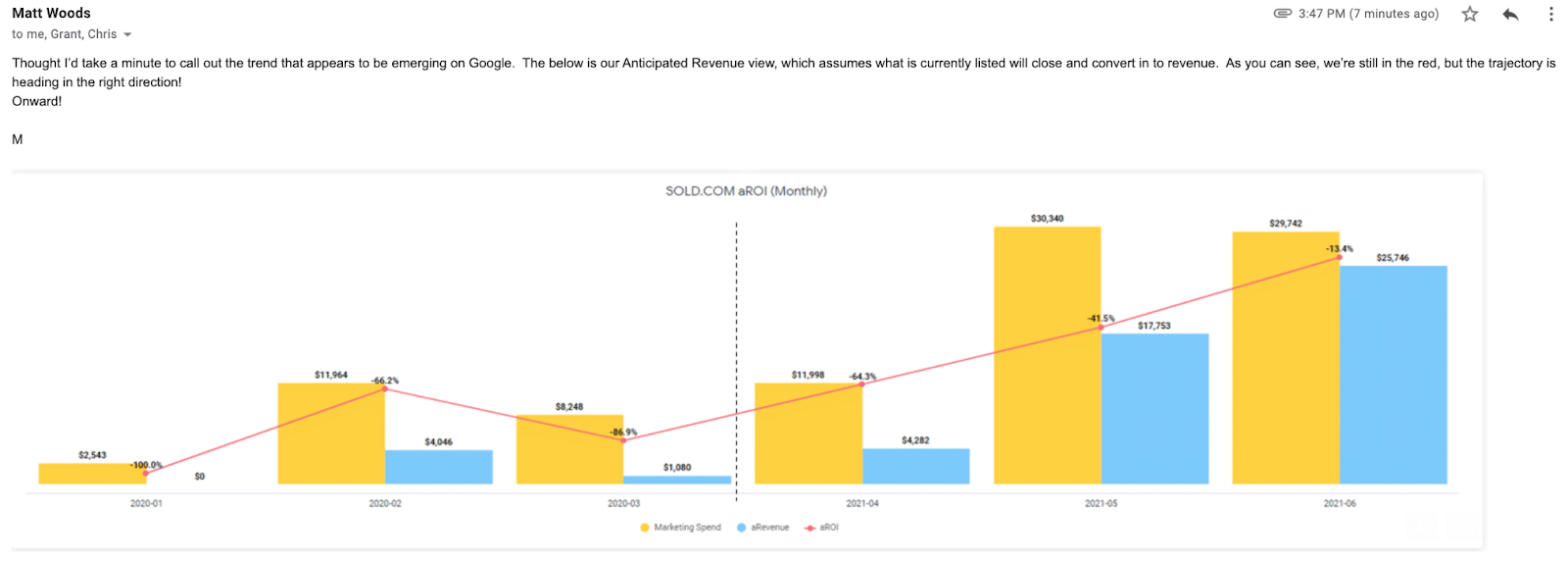
Here’s a real-life example of what results from ad quality improvement look like.
Sold.com simplifies buying and selling a home by matching customers with a real estate agent. Sold.com knew that Google ads would be a great way to reach new customers, but its ads targeted generic keywords and sent users to the sold.com homepage, handicapping what could’ve been a killer tool for winning business.
97th Floor created a strategy to pull new leads and increase conversion while lowering cost. 97th Floor first began targeting focused search terms such as “how much is my home worth,” and “how to sell my home.” To retain these high-intent leads, our team also changed the ad landing page to the Seller’s Quiz where users can get a customized seller report. We then analyzed reports to cut underperforming ads and prioritize the most effective campaigns.
97th Floor’s efforts boosted ad quality scores and brought ROI and anticipated revenue to levels sold.com has never seen before.
It's important to consider impression share in conjunction with other Key Performance Indicators (KPIs). These related metrics provide a more comprehensive view of your campaign's overall health:
Impression share helps marketers understand the reach and visibility of their ads. It also serves as a barometer for ad competitiveness in the digital marketplace. A robust impression share signifies a strong presence in your target market, while a lower share signals an opportunity for strategic adjustments.
Improving impression share involves a mix of creative ad design, strategic keyword management, intelligent budget allocation, and continuous performance monitoring. By focusing on ad quality, targeting precision, and leveraging data-driven insights, you can take your advertising impact to the next level.
Search Impression Share is a metric that represents the percentage of times your ads were shown out of the total number of times they could have been displayed, based on your target keywords and campaign settings, in search engine results.
It gives insights into how often your ads are seen in search results, indicating the effectiveness of your keyword targeting, ad relevance, and competitiveness in auctions.
A higher impression share often correlates with increased visibility and potential customer engagement, which can lead to more conversions and a better return on investment (ROI).
Key factors include ad quality, keyword relevance, bidding strategy, budget allocation, and overall competition in the ad auction space.
Yes, a low impression share might suggest that your ads are not as competitive, either due to insufficient bidding, budget constraints, or poor ad relevance and quality.
Google calculates it by dividing the number of impressions your ad received by the estimated number of impressions it was eligible to receive, based on your current ads' targeting settings and bids.
While theoretically possible, achieving a 100% impression share is extremely difficult due to variables like budget limitations, competitive bidding, and fluctuating search volumes.
Investigate the cause – it could be due to reduced bids, budget cuts, lower ad quality, or increased competition. Respond by adjusting these factors and optimizing your ad strategies.
Yes, most ad platforms like Google Ads provide tools and analytics for monitoring impression share and offer suggestions for improvement based on campaign data.
Regularly monitoring impression share is key. Depending on your campaign's scale and dynamics, reviewing this metric weekly or bi-weekly can help in making timely adjustments for optimal performance.
Search engine algorithms are the backbone of how we discover information on the internet. These sophisticated systems analyze and rank web pages, giving users the most relevant and authoritative content for their queries. They function as keyword matchers and assessors of a variety of factors like page quality, user experience, and content relevance. Ultimately, these algorithms control what gets seen and what doesn't.
Google’s algorithms are always evolving. They reflect and adapt to changing user behaviors, technological advancements, and the ever-growing internet. Google’s approach to search algorithms impacts how businesses and content creators strategize their online presence.
Over the past two decades, Google's algorithm updates have consistently reshaped the SEO landscape. Each update has refined how search works, making it more user-friendly and intuitive. Here are the most significant changes that have happened over the past 20 years.
The Florida Update was a seismic shift in SEO, targeting manipulative tactics like keyword stuffing. It marked the dawn of a new era where quality content began to trump over-optimized, spammy practices.
Panda aimed to weed out low-quality content and content farms. This update prioritized high-quality, user-focused content, affecting a significant portion of search results and changing the way content creators approached SEO.
Penguin cracked down on link spam and unnatural backlink profiles. It penalized websites with dubious link-building strategies, pushing for more organic and credible backlinks, and cleaning up the web from manipulative link practices.
Hummingbird revolutionized search by focusing on the meaning behind queries rather than individual keywords. This update enhanced Google's ability to understand the intent behind searches, making results more relevant and precise, especially benefiting conversational and voice search.
With the surge in mobile internet use, the Mobilegeddon update ensured mobile-friendly websites received a ranking boost. It emphasized the importance of responsive design and a seamless mobile user experience, encouraging webmasters to optimize their sites for mobile users.
RankBrain, an extension to the 2013 Hummingbird update, introduced machine learning into Google's algorithm. This update helped Google better understand complex queries and provided more relevant search results by analyzing past searches. It became one of the most critical factors in ranking, highlighting the importance of high-quality, user-centric content.
The Medic update significantly impacted health, wellness, and YMYL (Your Money, Your Life) sites. It stressed the importance of expertise, expertise, authoritativeness, and trustworthiness (E-E-A-T) in content, ensuring that users receive accurate and reliable information on crucial topics.
BERT, which stands for Bidirectional Encoder Representations from Transformers, enhanced Google's understanding of natural language. This update allowed Google to comprehend the context of words in a query better, making search results more accurate and relevant for complex and conversational queries.
The Page Experience Update introduced Core Web Vitals, focusing on user experience metrics such as loading performance, interactivity, and visual stability. It emphasized a more holistic view of user experience, beyond just content quality, encouraging sites to improve overall usability.
This update targeted content created primarily to rank in search engines rather than to help users. It promoted high-quality, user-first content, reinforcing the principle that content should be valuable and engaging for real people, not just search algorithms.
It’s not over yet – Google's regular core updates continually refine the search algorithm to better evaluate content quality and relevance. These updates highlight the need for websites to maintain high standards of content, user experience, and E-E-A-T principles to stay competitive in search rankings.
Each of these updates has pushed the SEO community to innovate and adapt, ensuring that the web remains a valuable, user-friendly resource.
When Google releases an algorithm update, websites might experience a range of symptoms indicating how the update has impacted them. Some common signs include:
Our Head of SEO Trent Howard outlines six critical steps to take in the event of a suspected algorithm update in “The SEO’s Algorithm Emergency Response Guide”
1. Gather trusted industry reports
2. Assess bottom-line impact on rankings and traffic
3. Investigate the SERPs
4. Review page-level ranking factors
5. Review domain-level ranking factors
6. Roll out a communication and execution plan
The March 2023 Core Update was a big change in Google's algorithm. Core updates are significant because they entail comprehensive modifications to Google's search algorithms and systems. These updates are designed to enhance the overall relevance and quality of search results. For websites, this can mean noticeable changes in search rankings. The best response to such updates, as advised by Google, is to continue focusing on producing high-quality, relevant, and user-centric content.
The September 2022 Core Update followed Google's tradition of regularly refining its search algorithms to better meet user needs. Like other core updates, it impacted a wide range of factors that determine how websites are ranked in search results. These updates often necessitate a review and adjustment of SEO strategies, as they can significantly influence a website's visibility and traffic.
The May 2022 Core Update was another critical adjustment in Google's continuous effort to improve search quality. These updates are a reminder of the dynamic nature of Google's search algorithms. They demand constant vigilance and adaptability from SEO professionals and website owners. Staying abreast of these changes is crucial for maintaining competitive search rankings.
The November 2021 Core Update was another significant adjustment in Google's algorithm. Core updates like this often bring broad changes to the search engine's ranking processes, impacting a wide range of websites and industries. These updates are a reminder of the ever-evolving nature of search algorithms and the need for constant vigilance and adaptability in SEO strategies. As with other core updates, the focus remained on providing high-quality, relevant, and user-focused content.
Each of these core updates underscores the importance of aligning with Google's guidelines and focusing on creating content that genuinely serves the user's intent. It's essential for digital marketers to not only react to these updates but also anticipate and integrate best practices in content creation and SEO strategies proactively.
In February 2023, Google released an update specifically targeting product review content. This update emphasized the importance of providing in-depth, insightful reviews rather than superficial information. Google aimed to reward content that offers original research, thorough analysis, and useful insights – characteristics of expert and enthusiast reviews. This update highlights the growing significance of quality and depth in reviewing content for better search rankings.
The September 2022 Product Reviews Update continued Google's focus on enhancing the quality of review-based content in its search results. This update further clarified what Google considers to be high-quality review content. It underscored the need for reviews to be detailed, include evidence of product testing, and offer comparative analysis with similar products. This shift reinforced the importance for marketers and content creators to invest in creating comprehensive and informative review content.
The March 2022 Product Reviews Update was one of the earlier steps in Google's efforts to prioritize high-quality review content. This update was a clear signal to content creators that merely aggregating product specifications or providing thin content was not sufficient. Instead, reviews needed to be well-researched, demonstrate expertise and provide valuable insights to the reader. This update was a pivotal moment for businesses relying on product reviews, pushing them to elevate their content strategies.
These updates to product reviews are part of Google's broader goal to ensure that users find genuinely useful and reliable content in their search results. For businesses and digital marketers, adapting to these updates means focusing on creating high-quality, in-depth, and user-centric product reviews.
The December 2022 Helpful Content Update was a significant move by Google to further refine its search results. This update specifically targeted content that seemed to prioritize search engine rankings over user value. Google aimed to promote content that genuinely helps and informs the user, rather than just serving the algorithm. The key takeaway for content creators and digital marketers was to focus on creating content that addresses the needs and questions of users, offering real value and insights.
Earlier, in August 2022, Google introduced the Helpful Content Update as a part of its commitment to enhance user experience. This update was designed to reward content that provides a satisfying, informative, and helpful experience to users. It discouraged practices like generating content en masse with little regard for quality or user engagement. The update was a clear message to website owners and content creators: prioritize the user's needs and experiences in content creation.
These Helpful Content Updates emphasize Google's dedication to ensuring that the content ranking high in search results is not just SEO-friendly, but also genuinely useful and engaging for users. For businesses and marketers, these updates serve as a reminder to align their content strategies more closely with user intent and satisfaction.
Staying informed about Google's algorithm updates will give you a step-up when designing your SEO strategies. These updates, ranging from core changes to specific aspects like product reviews and user experience, dictate the dynamics of online visibility and search rankings.
A Google Algorithm Update is a change or modification to the complex set of formulas and processes Google uses to rank web pages in search results. These updates can affect how websites are evaluated and ranked, impacting their visibility and traffic.
Google continuously updates its algorithms, with minor changes happening daily. Major updates, such as Core Updates, occur several times a year and often come with significant impacts.
You can tell if your site is affected by monitoring your website's analytics for significant changes in traffic or rankings. Tools like Google Analytics and Google Search Console can provide insights into these metrics.
If your site is negatively impacted, review Google’s guidelines and assess your website's content quality, user experience, and SEO strategies. Focus on improving these areas in line with Google's recommendations.
To prepare for future updates, focus on creating high-quality, relevant content, ensure a good user experience, and stay updated with Google's guidelines. Adapting to a user-first approach is key.
Algorithm updates can be retroactive, affecting both new and existing content. It's crucial to continually monitor and update your site to align with the latest guidelines.
Yes, recovery is possible. It involves identifying areas of improvement, making necessary changes, and waiting for Google to re-crawl and re-evaluate your site.
While keywords remain important, their relevance has shifted from mere frequency to context and user intent. Quality content that seamlessly incorporates keywords is key.
Some updates may target specific types, such as those with low-quality content or spammy backlinks. However, most updates aim to improve overall search quality and user experience.
Official information about algorithm updates can be found on Google’s Search Central Blog, Google’s Webmaster Central Blog, and through their social media updates.
Hub and Spoke is an SEO strategy where a central hub page is surrounded by spoke pages covering specific aspects of the central theme. This structure creates a network of related content, improving search engine and user navigation.
Hub and Spoke shifts focus from individual keywords to broader topics, aligning with modern search algorithms that prioritize topical authority and relevance. This strategy enhances site visibility by creating a comprehensive content network, demonstrating your experience, expertise, authoritativeness, and trustworthiness (E-E-A-T) in a field.
This approach encourages a broader content perspective, ensuring comprehensive topic coverage. It enhances user experience by addressing various user queries, increasing page views and reducing bounce rates as users explore interconnected, valuable content.
Select a broad, relevant topic that acts as the central hub. This topic should be pertinent to your industry and broad enough to generate multiple subtopics for thorough coverage.
Conduct thorough keyword research to identify subtopics related to the core topic. Use tools like Ahrefs or SEMrush to understand how your audience searches for information, guiding targeted, relevant content creation.
Create comprehensive hub content covering the core topic, with spoke pages delving into specific subtopics. The hub page serves as an awareness piece, while spoke pages target users further down the buyer funnel.
Write engaging, informative content optimized for readers and search engines. Incorporate relevant keywords, optimize meta tags, and ensure mobile-friendliness.
Establish robust internal linking between the hub and spoke pages and among spoke pages where relevant. This enhances user navigation and signals the hierarchical relationship to search engines, boosting SEO performance.
Gympass is an employee benefit providing access to a huge selection of gyms and wellness apps. They came to 97th Floor with a goal of becoming a major info hub for HR specialists. In order to do that, they needed to build tons of content. They also needed to rank and capture backlinks for high-difficulty keywords.
A hub and spoke strategy would allow us to create strategic content groups to maximize internal linking potential and boost key pages faster.
We selected high volume keywords to extend our reach as far as possible. We crafted each piece of content with multiple on-page syntactical optimizations; internal links; and schema markup to match the SERP and maximize the ranking potential.
Together, we built out a content calendar combining Gympass’ priorities with our SEO recommendations.
Working with Gympass to adjust strategy as needed, we created quality content ranking high in the SERP for strategic, competitive keywords.
Gigamon is a leader in the highly competitive network security space that sought to increase sales pipeline by attracting prospects through a high-profile, short-tail keyword. After 6 months, the page still wasn’t ranking. Gigamon was experiencing the frustration of following the right protocol, but still not seeing the impact or results they wanted.
By building a hub-and-spoke content creation and promotional strategy (combined with large site architecture modifications), 97th Floor was able to help Gigamon win a series of longer-tail keyword variations and prove its authority on the subject. In time, the “big fish” keyword that would unlock major traffic and conversion increases.
The content hierarchy and hub and spoke method led Gigamon to position #1 for one of its industry’s most important keyword.
Hub and Spoke is a powerful SEO strategy that aligns with modern search engine algorithms and user behavior. By focusing on broad topics and creating interconnected content, businesses can significantly improve search rankings, user engagement, and authority in their industry.
Hub and Spoke is an SEO strategy where a central hub page is surrounded by spoke pages covering specific subtopics. This structure helps search engines and users easily navigate and understand the content.
This strategy improves SEO by organizing content for easy search engine indexing and user navigation, enhancing site authority and organic traffic.
Yes, it’s versatile and applicable to any industry. The key is identifying broad, relevant topics and creating in-depth subtopic content.
There’s no fixed number. Aim for comprehensive coverage, which could range from 5 to 20+ spoke pages, depending on the topic's breadth.
Select a relevant topic broad enough to generate multiple subtopics and pertinent to your business and audience.
Hub content provides a broad overview, while spoke content delves into specific subtopics. The hub page targets awareness, and spoke pages target users further along the buyer journey.
Internal linking is crucial for navigation and signaling content hierarchy to search engines, boosting SEO performance.
Regular updates are essential to keep content accurate and relevant. The frequency depends on industry changes and new information.
Yes, it enhances user trust and credibility, leading to higher engagement and conversions.
Google Analytics, SEMrush, and Ahrefs are invaluable for keyword research, performance tracking, and user behavior analysis.
OTT, or "Over-The-Top", refers to the streaming of video content directly to viewers over the internet, bypassing traditional cable or satellite TV services.
This type of advertising is unique because it offers brands the opportunity to reach cord-cutters – individuals who have foregone traditional television in favor of streaming services – as well as a younger, tech-savvy audience.
As traditional TV viewership declines, more and more people are shifting towards streaming services for their entertainment needs. This migration has made OTT advertising an attractive proposition for brands looking to capture a dedicated and engaged audience. OTT offers precise audience targeting, rich data insights, and the ability to deliver a more personalized ad experience.
OTT ads aren't restricted to just the middle of a show or movie. They can appear pre-roll (before the content begins), mid-roll (during breaks similar to traditional TV commercials), or post-roll (after the content concludes). This variety in ad placements allows brands to position their content strategically, ensuring optimal viewer engagement. Furthermore, OTT ads can appear across various devices, from smart TVs and desktops to tablets and smartphones, widening their reach.
When we talk about OTT platforms, names like Netflix, Amazon Prime, Hulu, and Disney+ might come to mind. However, while some of these services are strictly subscription-based and ad-free, others like Hulu offer an ad-supported version. Other emerging platforms, such as Roku, Peacock, and HBO Max, also offer OTT ad slots.
Purchasing OTT ads varies by platform, but many platforms provide self-service portals where advertisers can directly buy and manage their ad campaigns. Other platforms might work through partnerships with media buying agencies or programmatic advertising platforms. These collaborations provide advertisers with the flexibility to bid for ad space in real time and target their audience with precision.
OTT video content should be engaging and relevant. Since viewers have the option to skip or close out of ads, it's essential to capture their attention in the first few seconds. High-quality visuals, clear messaging, and a compelling call to action are key. Additionally, OTT ads should be optimized for different screen sizes and devices, ensuring a seamless viewing experience.
OTT advertising is revolutionizing the way brands reach audiences by offering advanced targeting options and precise measurement tools that give you much more control than linear TV ads ever could. Here’s how OTT stands out:
Behavioral Targeting: OTT platforms can track what shows or movies users watch, allowing advertisers to serve ads to those with specific viewing habits. So, if someone binge-watches cooking shows, they might see ads for new kitchen gadgets.
Interest-Based Targeting: Ads can be tailored to what viewers are into. Love sports? You’ll likely see ads for the latest fitness gear. This keeps the ads relevant and engaging.
First-Party Data: OTT platforms use their own collected data (like subscription details and viewing history) to personalize ads. Brands can also bring in their own customer data to retarget users who’ve visited their sites.
Retargeting: Ever feel like an ad is following you? That’s retargeting. OTT ads can be served to users who interacted with your brand but didn’t convert, keeping your product top of mind across different devices.
Geolocation Targeting: Ads can target viewers based on where they are. Whether you’re a local shop or a national chain, you can make sure your message reaches people in the right places.
Metrics That Matter
View-Through Rate (VTR): This shows how many people watched your ad all the way through. High VTR? Your ad is a hit!
Conversion Tracking: Tools like Google Analytics help track what actions viewers take after seeing your ad—like visiting your website or making a purchase.
Cross-Device Tracking: Track how viewers interact with your ads across different devices. Using IP addresses, you can see a complete picture of the user journey from TV to mobile to desktop.
Audience Insights: OTT platforms give detailed reports on who’s watching your ads. Use these insights to tweak your strategy and improve future campaigns.
Return on Ad Spend (ROAS): This measures the revenue generated from your ad spend, helping you see if your OTT campaigns are paying off.
OTT advertising is all about engaging the right viewers with precision and measuring the impact. By using these advanced targeting and measurement tools, you can create more personalized ad campaigns that truly connect with your audience.
Like any emerging medium, OTT advertising has its set of challenges. Ad fraud, fragmented viewership, and data privacy concerns are among the top issues faced by advertisers. However, the future is bright. As technology evolves and platforms become more sophisticated, these challenges will be addressed. With innovations in interactivity and immersive ad experiences on the horizon, OTT advertising is set to redefine the way brands connect with their audiences.
The shift from traditional cable TV to Over-The-Top (OTT) platforms has opened up a plethora of opportunities for advertisers. These platforms allow for more targeted and interactive ad campaigns, leveraging the expansive reach of television with the precise targeting capabilities of digital advertising. Here's a detailed breakdown of the steps involved in crafting a successful OTT advertising campaign:
OTT advertising, particularly when broadcasted on television screens, combines the immersive experience unique to TV with the measurable impact akin to direct response channels. With the right steps, advertisers can craft campaigns that not only engage but also drive desired outcomes.
OTT (Over-The-Top) advertising is transforming the advertising landscape by merging the broad appeal of traditional TV with the precision and flexibility of digital marketing. This makes it a must-have for modern marketers looking to spice up their media mix.
OTT advertising captures the essence of TV’s grandeur but adds the magic of digital marketing. You get the immersive, wide-screen experience of TV ads combined with the real-time measurability and flexibility of digital ads. This blend allows for sophisticated targeting and immediate adjustments, ensuring your ads hit the right audience at the right time.
One of the standout features of OTT advertising is its ability to make real-time tweaks. If an ad isn't performing well on one platform, it can be quickly adjusted or shifted to another, optimizing performance on the fly. This level of control and responsiveness is something traditional TV simply can't offer.
Unlike passive TV commercials, OTT ads can be interactive. Viewers can click on products, watch additional content, or even make purchases without leaving their screens. This interactive element engages audiences in a way that traditional ads can't, making your campaigns more memorable and effective.
The OTT ecosystem involves a dynamic interplay between content creators, platforms, advertisers, and viewers. OTT platforms stream content directly over the internet, bypassing traditional TV channels. This setup allows advertisers to insert their ads easily into the streaming content, ensuring targeted delivery.
OTT advertising excels in targeting specific audience segments with precision. Use analytics to understand your audience’s demographics, interests, and viewing habits. Tailor your ads to resonate with different segments for higher engagement and conversion rates.
Ensure your OTT ads are optimized across all devices, from smartphones to smart TVs. Consistent messaging and responsive design are crucial to maintain effectiveness across platforms.
Regularly track key metrics like viewer engagement, ad completion rates, and conversions. Use this data to refine your strategy and improve campaign performance continually.
OTT advertising costs can vary based on platform selection, ad format, and targeting specifics. Continuous measurement and optimization ensure that campaigns remain cost-effective and deliver high ROI.
With the rise of high-speed internet and streaming services, OTT advertising spend is increasing. Brands are keen to leverage the engaged audiences on these platforms for effective marketing.
Expect to see more integration with e-commerce, immersive AR/VR ad experiences, and advanced automated ad buying processes driven by AI.
By understanding and leveraging the unique strengths of OTT advertising, marketers can create compelling campaigns that captivate modern viewers and drive significant results.
OTT advertising refers to the delivery of video ads through "Over-The-Top" platforms, which allow users to stream video content over the Internet, bypassing traditional cable or satellite TV services.
Unlike traditional TV advertising, which broadcasts ads to a general audience, OTT advertising leverages user data to deliver targeted ads to specific demographics, interests, or viewing habits.
OTT advertising combines the broad reach of TV with the precision of digital targeting, offering personalized ad experiences that can lead to higher engagement and conversion rates.
Popular platforms include YouTube, Hulu, Roku, and Amazon Prime Video, among others. The best platform for your brand depends on your target audience and campaign goals.
Key metrics to monitor include video completion rates, click-through rates, engagement metrics, and conversion metrics. Advanced analytics on many OTT platforms also offer insights into audience demographics and behavior.
The cost varies based on factors like platform choice, ad format, duration, audience targeting, and content type. It's essential to consult individual platforms for specific pricing.
OTT platforms offer sophisticated targeting capabilities. By using platform analytics and integrating third-party data, you can tailor your ads to specific audience segments.
While some OTT platforms offer skippable ads, many provide non-skippable ad formats, ensuring that your message gets seen. Additionally, the immersive nature of OTT content often leads to higher ad engagement compared to other digital ads.
Absolutely! With geo-targeting capabilities, local businesses can serve ads specifically to viewers in their region or city, making OTT a powerful tool for localized campaigns.
Predictions include a rise in interactive ads, increased integration with e-commerce, growth in AR and VR ad experiences, and more automation in ad buying, leveraging AI and machine learning.
BOFU, or "Bottom-of-Funnel," is the final stage in the customer journey. At this point, potential customers have recognized a problem, explored solutions, and are ready to make a purchase. BOFU marketing strategies aim to guide and persuade them to take that final step, like making a purchase or signing up.
The marketing funnel represents a customer's journey from awareness to purchase. It starts with top-of-funnel (TOFU) content that generates awareness, followed by middle-of-funnel (MOFU) content that educates potential customers. Finally, the bottom-of-funnel (BOFU) focuses on conversion and sales, targeting leads who are already interested and need a final push to make a decision.
BOFU strategies target warmed-up leads who are close to making a purchase. These aren’t just random visitors; they’re people who already know your brand and are almost ready to buy. This makes BOFU marketing incredibly effective for boosting conversion rates.
Focusing on BOFU marketing can be more cost-effective than continuously pouring resources into the top or middle of the funnel. Since you're targeting leads already interested in your product, the Return on Investment (ROI) is often higher.
At this stage, potential customers are looking for reassurance. Delivering the right content solidifies their trust, ensuring not just a one-time sale but potentially long-term relationships.
BOFU allows for highly personalized marketing. By understanding what the lead has interacted with previously, you can tailor your marketing efforts to resonate better with their specific interests and needs.
While TOFU and MOFU play foundational roles in building awareness and interest, BOFU directly impacts sales. Properly executed BOFU strategies can lead to a significant increase in sales, contributing directly to your bottom line.
Most visitors won’t purchase on their first visit. Retargeting helps you reach out again, reminding potential customers of your products and nudging them toward a final purchase decision.
Leads at this stage often seek to understand how a product works. Offering demos or trial versions can help them experience the benefits firsthand.
Potential customers might be evaluating multiple options. Providing comparison charts that highlight the superior features and benefits of your product can sway their decision in your favor.
Creating a sense of urgency can be a compelling motivator. Limited-time discounts or bonuses can encourage leads to make a purchase decision sooner.
Social proof is powerful in BOFU marketing. Showcasing genuine testimonials or reviews builds trust and alleviates any lingering doubts.
At the bottom of the funnel, customers may require in-depth information about a product before purchase. Offering detailed specifications, FAQs, and other relevant data can be beneficial.
Ensure your landing pages are optimized for search to cater to leads actively seeking specific products or solutions. Focus on keywords that users would search for when they’re close to making a decision.
Based on previous interactions, send personalized emails addressing the potential customer's interests. This makes them feel valued and more inclined to purchase.
Real-time support can address any last-minute queries or concerns, offering immediate solutions and making the transition from lead to customer smoother.
Once a customer is ready to purchase, suggesting complementary products or higher-tier options can enhance the sale's value.
Your potential customers are looking for solutions. Create content that shows how your product or service solves their problems or fulfills their needs.
Engage your audience with videos, infographics, and interactive content to effectively convey your product's value proposition.
Address common questions and concerns to build trust and reduce friction in the buying process.
CTAs should be clear, persuasive, and compelling. Encourage your leads to take that final step, whether it's "Buy Now," "Book a Consultation," or "Get Started."
Offer detailed guides that provide insights into your product’s features, benefits, and applications. This helps customers understand its full potential.
Real-world applications and success stories offer powerful testimonials. They provide social proof and show potential customers the tangible benefits of choosing your product.
Tools like price calculators, product configurators, or quizzes can offer personalized recommendations, boosting confidence in purchase decisions.
Ensure your content is responsive and optimized for mobile devices, as many users might be reviewing it on the go.
Encourage satisfied customers to share their experiences. Reviews, photos, or videos from previous customers can be a convincing factor for potential buyers.
While BOFU marketing is an important step toward conversion, it represents only 5% of potential customers ready to make a purchase. The 95/5 Rule highlights the untapped opportunities in the remaining 95% who are not actively seeking a solution. Great marketing balances immediate gains with a long-term vision, engaging both the ready and waiting market segments. Use data to understand where customers are in their journey and how to catch their attention, making sure that today's 5% influences tomorrow's 95%.
In early 2022, eFileCabinet’s LinkedIn ads were in decline. The campaigns sporadically pulled a high volume of leads, but these leads never turned into qualified leads.
At this time eFileCabinet was also moving up-market to target larger organizations and change their USP, presenting another hurdle to qualified leads.
In June 97th Floor began working with eFileCabinet to leverage 6sense segments with LinkedIn ads to better isolate target ICPs and fill the pipe with qualified leads.
By the end of 2022, the revived LinkedIn campaigns were pulling leads that were qualified 22% of the time - a huge bump from the 1.5% qualified in 2021.
The Conference Group lacked data to make quantifiable business decisions. They enlisted 97th Floor to pair data with consumer insights and reveal promising conversion opportunities.
The Conference Group’s home page contained multiple primary calls to action, so 97th Floor started the process of A/B testing there. While running these tests, we paid careful attention to trends in the data, enabling us to pivot toward the most effective strategies. We began with a focus on one CTA vs two CTA’s but also wanted to test CTA’s promoting top-of-funnel content vs lower funnel content.
V4 was the winning variation, showing that BOFU verbiage paired with product pages led to the biggest increase in conversion rates.
BOFU marketing is about sealing the deal. It's the stage where potential customers are on the brink of making a purchase, and your strategies can tip the scales in your favor. By leveraging targeted tactics like retargeting campaigns, personalized content, and real-time support, you can guide leads to take that final step. Remember, while BOFU is important for immediate sales, balance these strategies with long-term engagement tactics that address the broader 95% of your potential market. This comprehensive approach will provide your brand with sustained growth and customer loyalty.
TOFU (Top of the Funnel) focuses on raising awareness and attracting potential customers. MOFU (Middle of the Funnel) aims to nurture these leads by providing more information and building trust. BOFU, on the other hand, targets leads who are ready to convert, using strategies to close the sale and solidify their decision.
While attracting and nurturing leads is essential, conversion is the end goal. BOFU marketing is crucial as it directly impacts a business's revenue by turning potential customers into actual buyers. It's the final push that can significantly influence a company's bottom line.
The primary goals are to eliminate any remaining purchase hesitations, reinforce the value proposition, offer personalized solutions, and persuade the lead to take the desired action, such as making a purchase, subscribing, or signing a contract.
Effective BOFU content addresses the specific concerns or questions potential customers might have at this stage. This can include product demos, comparison charts, testimonials, case studies, detailed product or service specifications, and personalized offers.
BOFU marketing and sales go hand-in-hand. Marketers can provide sales teams with BOFU content and tools to assist in their pitches, while sales teams can offer feedback from the field, helping marketers refine the BOFU strategy. Regular collaboration ensures alignment in messaging and tactics.
Key metrics include conversion rate, average order value (AOV), sales growth, time to conversion, cart abandonment rate, and customer lifetime value (CLV). These metrics directly reflect the efficacy of BOFU strategies in driving revenue.
Technology can facilitate personalized marketing, track user behavior, automate communication sequences, and retarget potential customers. Tools like CRM systems, chatbots, retargeting platforms, and analytics can significantly enhance BOFU efforts.
While there's no one-size-fits-all answer, given the dynamic nature of digital marketing, it's advisable to review BOFU strategies quarterly. Regularly assessing performance metrics and staying updated with industry trends can guide necessary adjustments.
Absolutely. While BOFU primarily focuses on conversion, strategies like post-purchase support, loyalty programs, and feedback collection can not only secure the sale but also foster long-term trust and loyalty, turning one-time buyers into brand advocates.
A recent 97th Floor survey of SEOs revealed that "not enough leadership support" is the biggest challenge SEOs face in getting projects moving. The second biggest obstacle, "not enough budget", is often a bi-product of leadership support.

Getting leadership buy-in on the long game of SEO can be hard - especially when other channels are more quickly proven.
That same tension lives in every long-game strategy, and the challenge of getting buy-in goes beyond presenting better data. Bringing a skeptical team along before results are visible is one of the most underrated leadership skills, and most practitioners figure it out the hard way.
Daniel Nisan, startup founder and operator, shares the specific approach he's used to move teams from doubt to conviction — without waiting for results to do the convincing for him. This short video breaks down how to turn your most skeptical stakeholders into your most committed advocates.
Use these three tips to win the hearts of leadership and sell your SEO strategy.
You’ll be a whole person ahead if you have someone in leadership who believes in the massive potential of SEO. Which decision maker seems the most interested in SEO? Who can be a voice for SEO in decision-making meetings?
Identify this stakeholder and then involve them in your SEO work. Consider pitching this executive first, or otherwise involving them in your strategy development. Communicate with them often and be sincere in your efforts to collaborate with them.
This individual’s enthusiasm for SEO, strengthened by their invested time with you in strategy, can make all the difference in prioritizing SEO projects and getting you budget.
To increase the resources coming towards SEO efforts, you need to create urgency by showing the consequences of neglecting SEO—the opportunity cost.
Tom Capper, Senior Search Scientist at Moz, agrees that "when dealing with larger organizations, it's common practice to spell out and estimate the positive ROI of action. What's less common is to spell out the risks of inaction, but often large, established brands, who have a lot more to lose, find it easier to act on this kind of rationale."

Low priority SEO may not sink your company, but how can you show leadership the lost potential (read: revenue) of failing to start?
We have found that competitive comparison as quantified by market share is one of the most effective ways of demonstrating the opportunity cost of neglecting SEO—market analysis is one of the most important jobs of top-level leadership.
Sam Oh, VP of Marketing at Ahrefs, says, "One of the best ways for SEOs to show value to top-level leadership is through competitive analysis. It’s best when you can show it visually in graphs and then add context to educate leadership about what’s happening and why. It may be obvious that a competitor’s organic traffic is exploding, but help leadership see what tactics and strategies would be in play and how long it realistically takes to see results like this."

You may also want to demonstrate the opportunity cost in terms of savings.
Crystal Carter, Head of SEO Communications at Wix, puts it this way, "Leadership cares about revenue, but they also care about savings. Learning your customer’s journey can reveal content that can save the business time and energy. For example, if you learn that customers often contact customer service with the same question, create content that answers that question. This way, your customer service team is addressing real needs instead of sharing basic information.This saves time and energy, while also increasing value for your users."

SEO is a long game. If you want to minimize the irritating, “are we there yet,” conversations, consider handing leadership a map.
Based on your strategy, identify what immediate wins (or signals) leadership can expect, and how long it will take for SEO efforts to reach the bottom line. Set expectations for reporting frequency and metrics.
Perhaps most important, acknowledge to leadership that SEO is impacted by many things that are not in an SEOs control.
Ancestry’s John Crockett explains, “SEO is measured based on what’s going to work and what’s not going to work. We’re only one part of that. We have to worry about how Google’s going to interpret new initiatives. We also have to worry about what our industry competitors are doing. We have to worry about what our search competitors are doing.”

It is imperative that you clarify the difference between branded and non-branded keywords. Distinguishing between the two will help you explain variation in traffic that is unrelated to your SEO work. Branded keywords are heavily dependent on external factors like PR, TV and advertising. Non-branded keywords are in the scope of SEO, so try to delineate and report the traffic, keywords and revenue for non-branded keywords.
By keeping goals specific, timelines clear, and confidently pitching SEO as an important strategy supported by your SEO stakeholder champion, you can win leadership favor and a signed check for your great work.
Inevitably, you’ve discovered technical issues that are hampering your organic growth—and you need development to tackle these optimizations. But getting the ear and time of dev teams can be extremely challenging amongst all the non-SEO initiatives they’re tackling.
Frequently, SEOs will find themselves in these scenarios:
Josh Moody, 97th Floor Executive Director of Palomar, offers five tips for reducing the friction between SEO and development:
Instead of trying to bend development to your SEO-strategy, learn how your development team operates and consider how you can amend your SEO strategy to fit into their existing process.
Get curious about your dev team:
Adjusting your strategy cadence to be more development-friendly decreases frustration for both SEOs and developers.
Before sending over a long list of optimizations, consider how development thinks about implementation. To begin, they’re using a completely different vocabulary than you use. Why in the world are we talking to developers about “optimizations?” Let’s try “bug” instead. Submit tickets, not slide decks.
Ancestry’s Director of SEO John Crockett advises, “Understand a developer’s world enough to talk to them intelligently. I don’t get too much into the solution with them, but I do know enough coding and engineering to be prepared in those meetings with an idea of how we’d accomplish it. Doing the research has taken projects from being labeled as impossible to being done.”
Be respectful of the developer’s expertise. Don’t assume you know what a fix will require from them, but come speaking in their language to show you’re ready to collaborate.
Marketers are always trying to create a story for their target audience. For SEOs, developers are your audience and you should structure your story using the following three components: user description, functionality, and benefit.
Here’s the formula:
As a [description of user] I want [functionality] so that [benefit].
For example,
“As a new or existing website visitor, I want to ensure text remains visible during the page load, so that I can have a better user experience, especially if I’m on mobile devices with a slow network.”
This reads a lot better than “make text visible while the page is loading,” and helps a developer understand why your requests are worth their extremely-limited time.
Writing like a developer is a learnable skill, not a personality trait — Whitney Goldstein makes the case. This short video breaks down what it actually takes for a marketer to close that communication gap.
Get as clear as possible about the problem you are trying to solve and the role development will play in solving the problem.
There’s a huge difference between, “Could you add Google Analytics to the site?” and “Could you add the following JS tracking code to the site via each page’s header?”
A developer’s kryptonite is scope creep—changes made to the project push schedule, budgets, or resource allocation—and every time more clarification is needed, deadlines are at risk. Get clear by helping the developer know exactly what you need from start to finish—you’ll get more accurate estimates and preserve the relationship you’re working so hard to keep with them.
Need a change and want it a certain way?
Phrases like “Add some zing” or “make it more punchy” leave way too much room for interpretation. Whatever those phrases conjure up in your head are drastically different than what it may suggest to a developer. Obviously, you’d never use “zing” or “punchy”, but maybe you’re using other terms with subjective meaning.
Sharing examples side-steps this problem altogether. The best kinds of example you can share are:
Search around Dribbble and other sites to show development what you mean by “zing.”
Bonus Tip: Once a project is completed, share wins with the development team who helped you complete them. CC the boss. CC everyone. Get excited about the ways that SEO is improving customer experience and showcase how each person contributed.
SEOs, remember that your relationship with development is a partnership. Make dev your friends by understanding their world. Developers think literally. They are also extremely busy. Make their job as easy as possible, and your SEO implementations can happen faster and with greater precision.
Organic backlinks are links from other websites that point to your pages because your content earned their attention. These links come from genuine editorial interest, not payment, link schemes, or automated tactics.
This makes them especially valuable: each link signals that your content brings something new, relevant, or useful to the industry. Search engines use these signals to evaluate trust, relevance, and authority across your site.
Organic backlinks play a critical role in long-term SEO growth because they strengthen your entire domain, not just a single page. When reputable sites link to your content, search engines recognize your brand as a trustworthy source, which boosts domain-level authority and lifts keyword rankings across competitive categories. Beyond visibility, these links also enhance your brand’s credibility within the industry and create momentum for future content to perform even better. The more relevant and high-quality backlinks you earn, the more your entire site benefits.
Manual, one-off link building campaigns are essential for going after specific "money" pages and keywords, especially for long-tail keywords with less competition. Guest posting can help in these individual URL scenarios, but this won't boost overall domain authority.
Your best play for a massive website is to run large link-building campaigns. We’re recommending full-funnel brand awareness campaigns that will earn organic links as you pull tons of visibility. But these aren't simple:
There's no formula for making these campaigns happen, but these principles put you in the best place for success.
Be curious. Ask yourself question and go through the mental exercise of finding insights in data. These link building opportunities will not arrive pre-packaged. Be constantly exploring Ahrefs' Content Explorer, Google Analytics, or any other source of valuable data. We recommend scheduling time daily or weekly to do this.
Sam Oh, VP of Marketing at Ahrefs, has great advice for SEOs ready to get started with this practice: "SEOs should be regularly looking at really good data sources and asking themselves, what’s happening here? And why did it happen? You might not always have the right answer. You might not figure anything out for the first week. You just feel like you're looking at numbers and letters, but you are exercising that muscle of exploration and curiosity. Then all of a sudden connections start to make sense. We have everything in front of us and that data is painting a story that can inspire creative link building opportunities."

The heart of any successful marketing campaign is audience.
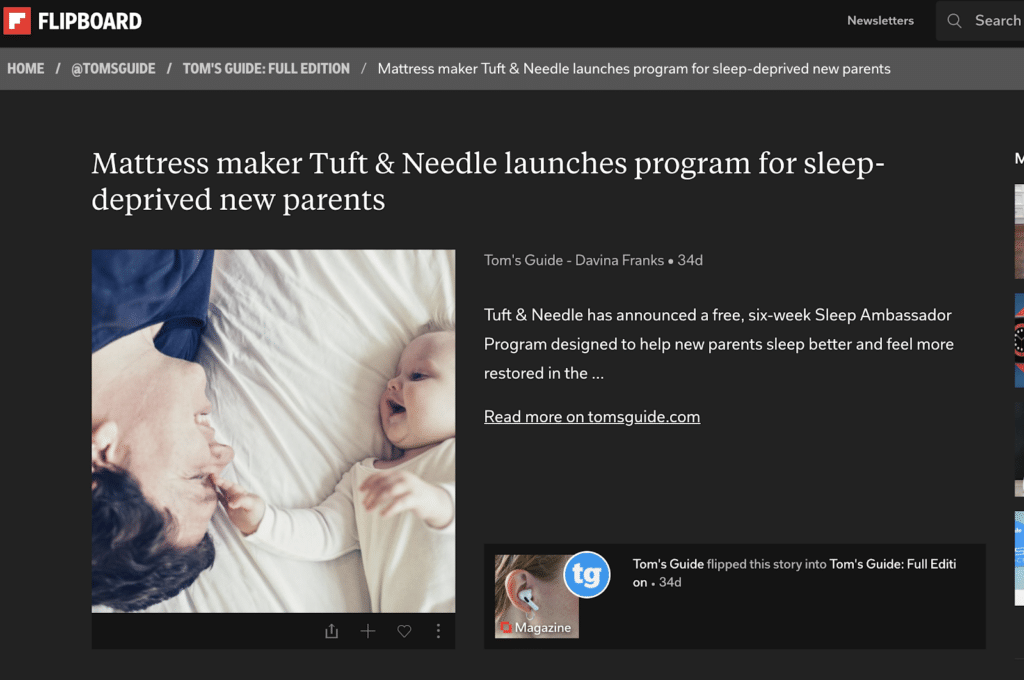
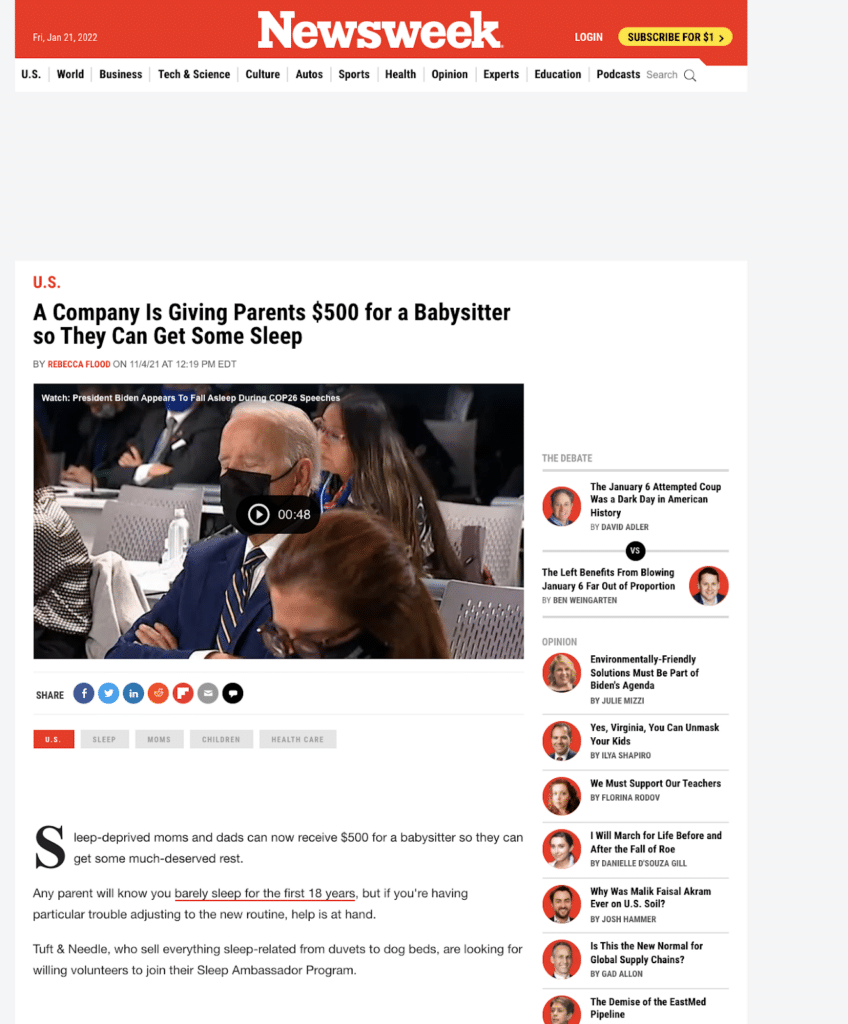
You need a pure and dedicated understanding of your audience so that you know what they care most about and can create link building campaigns combining this persona knowledge with current events and opportunities. This is where all of 97th Floor's strongest brand and linking campaigns have come from, including this one for sleep-deprived parents.
SITUATION
Our Mattress Industry Client (MIC) is an American mattress and bedding brand. At its launch in 2010, MIC was among the first online, bed-in-a-box companies to disrupt the brick-and-mortar industry.
MIC approached 97th Floor to increase organic reviews and organic market share for the online sleep space. While they do sell 3 main mattresses, they also sell bedding (blankets, pillows, duvets, etc) and other sleep-related products (furniture, noise-canceling machines).
MIC wanted their blog to generate more revenue from the high traffic numbers they were seeing. The sleep space is full of very competitive keywords which made this all the more challenging.
STRATEGY
"Sleep deprivation" is found in headlines everywhere. Large mattress companies pay lip-service to better sleep, but really only focus on getting you to upgrade your mattress.
Our teams decided to focus on possibly the most sleep-deprived group of all: parents.
With MIC, 97th Floor decided to shift the messaging by helping parents prioritize their rest and recovery so they can spend more time focusing on their family.
To accomplish this, we launched a Sleep Ambassador Program — a program where MIC would actually pay a select number of parents to improve their sleep health.
Of 331 applicants, 8 were selected. Aside from products to improve their sleep, each ambassador received a 1:1 sleep consultation with an expert and a personalized Sleep Course.

97th Floor teams then wrote 60+ newly researched, written, and designed blogs, infographics and micrographics to support parents in getting better sleep. Each piece of new content was informed by keyword research and optimized for maximum ranking and traffic potential.
Our teams created copy and design for 17 social media posts for MIC to use, and social media strategy and requirements for the ambassadors and influencers partnering with MIC for the campaign. Three separate email funnels and paid promotion and Linkedin and Meta boosted awareness and nurtured leads.
To increase the reach of this campaign, 97th Floor teams fulfilled outreach to a list of 2,000+ news media, websites, local media and blogs.
RESULTS
By taking an audience-centric approach and leaning into the power of earned media, this campaign won our client 100+ organic backlinks from authoritative and relevant websites.
And that's not all. MIC also benefited from:



You need a group who understands the value of SEO that you can bounce ideas off of. This may include SEOs, but you can also extend this group to your PPC counterpart, to someone in development, or to a highly-supportive leader.
Get everyone looking at the data and exploring opportunities.
Sam Oh says it's best to "Refine your backlink-generation ideas with a small team of people who understand the value of SEO. This process filters out less impactful ideas, and the buy-in from the individuals involved increases the likelihood that your best ideas will ultimately see execution."

SITUATION
eFileCabinet is a document management SAAS company that takes the pain out of complex filing and digitizing processes. Their software is cutting-edge and intuitive, but the document filing industry is stale.
eFileCabinet hired 97th Floor at a time when their stagnant market share was shrinking daily. Without a single marketing professional to manage the crisis, 97th Floor became the company's chief marketing force.
STRATEGY
After extensive customer research, 97th Floor teams built four target personas. We then synchronized all digital channels to target these personas, including intent-based keyword SEO campaigns; PPC on Facebook, LinkedIn and search; and content audits leading to new ebooks and blog posts. We built strong Hubspot workflows for the leads coming from this omni-channel strategy.
Our omni-channel campaigns were a success, but when eFileCabinet expressed that their trade show presence has been a little lackluster, we took that to challenge.
We dove back into personas to find out what would excite this audience. Our idea was simple: we would set up a room packed with old office equipment and a sledgehammer. Before handing these professionals the hammer, we would collect their information in Hubspot. Attendees were then unleashed to beat the ink out of printers, monitors, fax machines and copiers. In the background, Hubspot nurtured these new leads.

Our final deliverables for the campaign included:
RESULTS
The Rage Cage would go on to be an award winning campaign that would drive the highest influx in MQLs in a single month, which contributed to the following:
Not bad for one tradeshow, right?
97th Floor teams don't think in terms of tactics or services. What eFilecabinet needed was an omni-channel campaign supported by content, ads, creative, and SEO. By integrating all of these capabilities, SEO received a considerable lift as one component of this brand awareness campaign.
Organic search has continued to compound its success since we started with eFilecabinet. In the past year, leads brought in by organic traffic increased by 281%.
Want more? Here are seven link-building tips from our SEO experts.
Advanced Strategies for Scaling Backlink Acquisition
Still curious about backlink acquisition Here are seven advanced link-building tips from our SEO experts. These require a little more technical expertise to execute, but will yield great results.
Scaling your backlink strategy requires going beyond basic link-building techniques. To achieve substantial growth, you need to integrate multiple tactics and maintain a consistent focus on quality and relevance. Here, we’ll explore seven strategies for acquiring organic backlinks at scale, ensuring your website achieves a robust link profile.
By implementing these advanced strategies, you can scale your backlink acquisition efforts, ensuring your website benefits from a strong, diverse, and high-quality link profile. Consistency, creativity, and a focus on value are key to building sustainable organic backlinks that drive long-term SEO success.
Not all backlink tactics push your strategy forward. In fact, some can severely damage your long-term authority. Buying cheap backlink packages, overusing exact-match anchor text, or submitting your site to low-quality directories may seem like shortcuts, but they often trigger spam signals that weaken your domain. Link exchanges, private networks, and irrelevant guest posts can have the same effect, creating a backlink profile that looks manufactured rather than earned. Sustainable organic backlink growth happens when you prioritize consistency, relevance, and editorial value over quick fixes. By steering clear of risky tactics, you protect your authority and set the foundation for a strong, trustworthy link profile that compounds over time.
Building organic backlinks at scale takes creativity, insight, and a coordinated strategy that aligns content, PR, and audience behavior. When every channel works together, your brand earns the kind of editorial links that strengthen authority and drive long-term growth. If you’re ready to take your backlink strategy beyond the basics, 97th Floor brings the experience, data, and creative horsepower to help you make it happen. Let’s build something remarkable.
For seasonal business owners, demand rises and falls with the changing weather. While seasonality is a unique and perhaps daunting challenge, the predictable rhythm of demand means that those businesses who can sync their marketing with the mandates of sun or snow can have success year-round.
97th Floor is no stranger to seasonal marketing; we’ve executed winning strategies for businesses including pool maintenance, sports equipment, cruise lines, pest control, lawn care, solar, and moving services, just to name a few.
In this article, our resident experts in SEO, content, and advertising share five actionable tips for seasonable business marketers.
Search Engine Optimization (SEO) is a long-term game, and waiting until peak season to focus on it can be a costly mistake. It's essential to begin your SEO efforts well in advance, ideally during the off-season.
Head of SEO Mike Witham says, “You need consistent year round efforts to maintain and improve rankings. If your peak season is in March, you should be ensuring you have solid rankings for core pages by no later than December. Do not start working on it the month before your peak season!”
For businesses serving multiple states or a large region of the country, seasonal demand may be different across these various geographies.
Enterprise advertising specialist Spencer Martin uses Google Keyword Planner to anticipate search volume fluctuations in different areas.
He shares, “We launch campaigns early so that we have 2 to 4 weeks to ramp up and capture the full demand. Campaigns need time to scale and learn, so if we wait until the season starts to launch we lose out on potential profits for our clients.”
While digital marketing is crucial, seasonal businesses can see major wins by looking at more traditional advertising. Enterprise Account Executive Nathan Hooper suggests non-digital forms of advertising, such as mailers or community events to target local audiences. Advertising on community calendar pages or local business directories can put your business in front of potential customers who may be researching local services.
Understanding your buyer and their motives for buying is essential for capturing demand at the right time.
Brandon Smithwrick asks what happens to your marketing instincts when you let AI do all the thinking. He breaks down how cognitive offloading quietly erodes the skills great marketers are actually built on.
Senior Director of Campaigns Jon Hammond shares that his clients in the travel industry refer to December through February as “The Wave.” This three-month period is the biggest sales period for travel as people look forward to summer sun during the cold, dark winter months. His clients maximize their ad budget and run major deals and promotions during this time to capture the demand.
Content Marketing Specialist Kaylee Baker emphasizes the importance of targeting specific demographics, such as 18-30 or 25-40-year-old males, who are the main consumers of seasonal services. Consider the platforms they frequent, such as YouTube, to tailor your marketing efforts accordingly.
When reporting to leadership, especially in industries with high historical seasonality, like cruises, it's essential to use Year-over-Year (YoY) data rather than Month-over-Month (MoM) data. This approach provides a more accurate depiction of progress or decline in traffic or sales over the seasons. By analyzing YoY data, you can better understand trends and make informed decisions to optimize your marketing strategies.
In conclusion, marketing a seasonal business requires careful planning, adaptation, and understanding of your target audience. By implementing these five tips, you can maximize your marketing efforts and capitalize on seasonal fluctuations in demand.
