



Today, 97th Floor reintroduces its brand identity, positioning, and promise to our clients and partners, fully embracing our history while turning to the future of marketing and our place in the industry.
97th Floor began in 2005 when founder Chris Bennett set up shop from his basement. Chris had a clear vision of what 97th Floor could become, an agency serving a growing market—up in the clouds—with the best.
Thus, 97th Floor was born. An ambitious marketing operation whose name set it on a course to become what the best brands in the world are. That ambition has held. It’s evident in the internal innovation and molding of our agency that’s taken place over nearly two decades as employees thrive in a culture that empowers them to do the best work imaginable.
All this innovation and energy buzzes through 97th Floor on a daily basis. In 2022, it was time to make a move and bring our brand forward both visually and in our positioning.
Hours of reading, interviewing, brainstorming, writing and rewriting, to say nothing of the tireless work of our design team, have come to fruition today. With optimism for the future, we set our stakes in the ground as a marketing agency for the ages.
From its beginning, 97th Floor has been committed to elevating people and brands that we believe in. Our marketing has been a means to that end, but that's not all. We take pride in building growth strategies for some of the best brands in the world. We are committed to Great Marketing. These concepts have lived inside us, and now they take the stage as our Three Pillars for Great Marketing.
There are three essential criteria that combine to make Great Marketing:

Empathy: The thorough exploration of who our target personas are beyond their role as potential buyers of our products and services. Marketing that makes a profit at the expense of an audience—without truly caring about them—can make gains in the short term. But today's buyers will hold these profiteers accountable in the long run.
Innovation: The experience to know the best marketing practices, but also the guts to break out of it in just the right ways. In a market where change is so rapid, "safe" marketing will no longer yield predictable wins. Taking (calculated) risk is, in reality, the only way to grow.
Profitability: The discipline to measure and make an honest accounting of every marketing strategy by its ability to drive profitable growth. None of the metrics marketers report on matter if there is no route to long-term profitability. Impressions, clicks, leads, MQLs—without a clearly defined path to revenue—aren't enough to make marketing truly great.
Logo: Our primary logo has not changed through this brand refresh, although you may see it presented differently now and then. Our big, red Nine-Seven is the logo we associate with a never-ending chapter of innovation and exploration—and it’s the logo we’re keeping. We are introducing a secondary logo, however, that adds a little more context when needed.


Colors: 97th Floor’s colors are inspired by the nature of the Utah mountains. Their use allows us to employ our bold 97th Floor red in more tactical and creative ways throughout our brand. And to be honest, they give us a lot more to play with as we tell our story.

Imagery: At 97th Floor, people come first. Our brand reflects that! We’ve created hand-made animated scenes of everyday people in everyday life to convey our attention to, and understanding of empathy for real people—the people our clients need to connect with. Each animated character you see is based on a real human in real life—our employees, our friends, and even our clients.
97th Floor employees each get their own avatar too.


Animation
Hand-designed humans in their scenes are a great start, but we wanted to bring them to life—living their lives. Our first scenes take place in a home, an office, a downtown square, and an airport. (And you can see all of them on our homepage as you refresh the page).

The performance of our website—our ability to help our visitors find the information they're looking for—is the culmination of all our efforts. Every new design, layout, and piece of content you see was scrupulously selected in an attempt to remove friction along our buyer's journey.


We look ahead with excitement to a marketing future that's constantly changing. With a commitment to our clients and the principles we've laid out as Great Marketing, we will continue to create cutting-edge campaigns for those brands ready for sustainable growth. Thank you for coming along for the ride!
Typeface: Manrope for headlines; Cambria for body copy. We want our paragraph text to feel classic and academic, while keeping our titles bold. This mix of serif and sans-serif fonts helps us strike the perfect balance.

Mood boards:
A brand is a feeling. Thus, our brand refresh started on mood boards. Many, many mood boards. What did we want our brand to feel like? What thoughts, ideas, and emotions did we want visitors to feel when interacting with our brand? These mood boards were a playground for design and for many obscure and delightful ideas that ultimately led us to our existing brand design.


Iterations of the brand colors and scenes:
We moved through several iterations of brand design concepts, colors, and schemes. Eventually, we arrived at our current design as a perfect convergence of sophistication, confidence, empathy, and approachability.


Storybrand:
Meanwhile, a more philosophical work was taking place as internal leadership discussed our core beliefs as an agency. Many thought exercises and hours of research debated by impassioned marketers showed us that the heart of 97th Floor is strong and opinionated. One particularly impactful exercise was that of moving our hero—our client—through a hero’s journey as described by AUTHOR in Storybrand BOOK. Many of the notes on this whiteboard are translated into the copy on our website, in our brand assets and writing, and on our social media.
Wireframe to Figma Mockups:
With design ideas and taglines swirling around, it was time to start building a framework for the new website. Each page was first created in Lucidchart, offering design the elements necessary for each page on the website.
Finally, the design team transformed wireframes into a true vision on Figma and our skillful developers brought it to life at 97thFloor.com.


97th Floor specializes in full-funnel marketing strategy combining SEO, paid media, content marketing and design services. We generate sustainable growth for well-funded startups up to the Fortune 500—including AT&T, LG, Google and Celebrity Cruises.
Operating from the intersection of creative and analytical work, we deliver the results our clients want and need, like...

The award-winning campaign (featuring sledge hammers) that won 100+ closed deals for Revver (formerly eFileCabinet) from one trade show, Increasing new users by 48% with a killer SEO strategy, cutting a 240-day sales cycle to 90 days,
A 371% increase in MoM digital sales for the Utah Jazz, and a 390% increase in referral traffic.

Our ability to generate sustainable growth for our clients is impressive, but the how is quite simple. The 97th Floor advantage all comes down to team structure.
When working with a marketing agency, you almost exclusively interface with an account manager who directs strategy.
We found that this approach leaves too much room for miscommunication and errors.
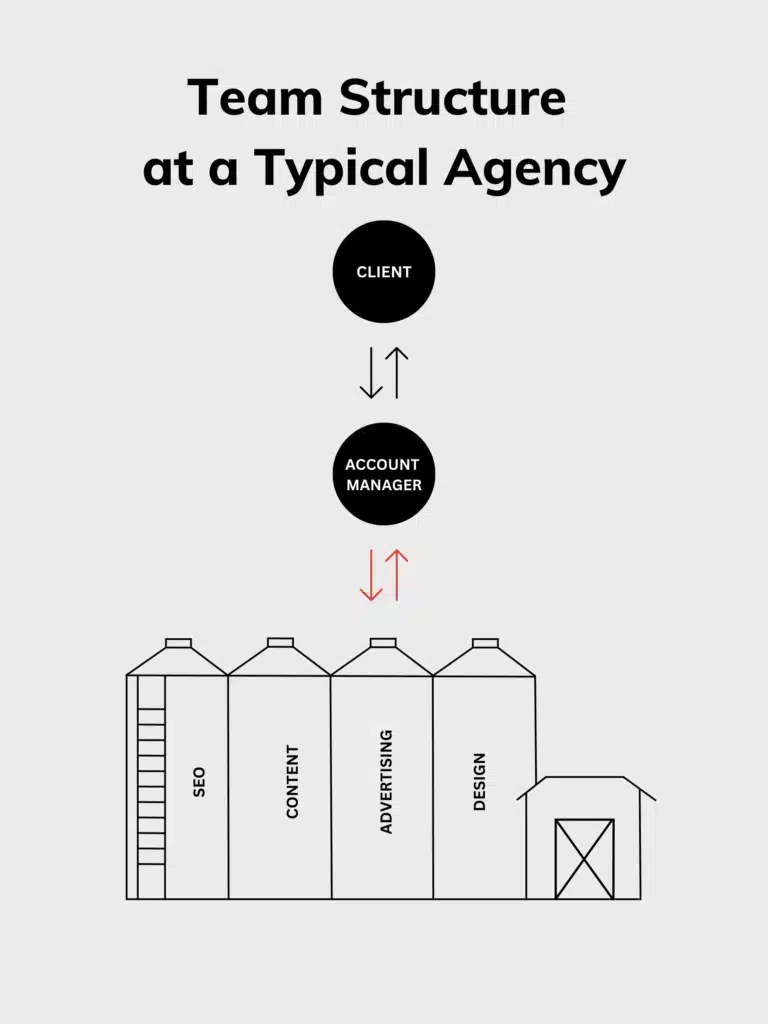
97th Floor’s approach is radically different, yet radically simple: The people who are working on an account are all on the same team, supported by off-team leadership.
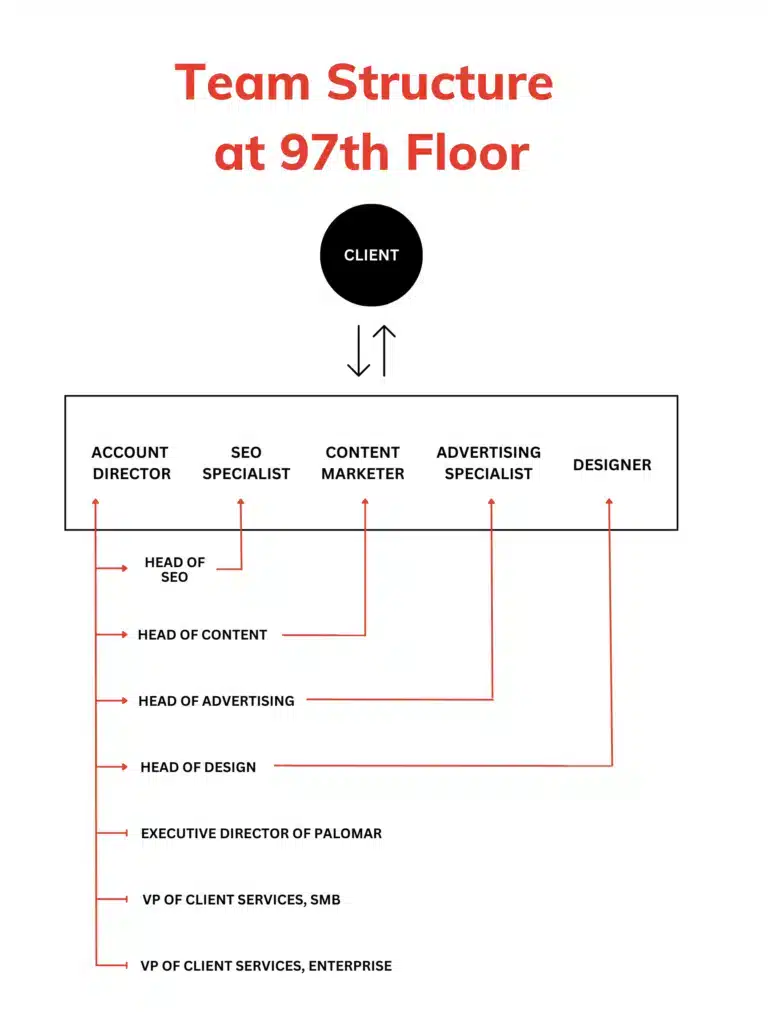
With us, there’s no relay between an account manager and the marketers executing strategy.
Our digital marketing experts have direct contact with our clients—the experts on their customers' needs—empowering our teams to deliver what our clients want and their businesses need.
What matters to you - meeting revenue goals, moving new leads into the pipeline, an upcoming site migration, proving ROI - is never repeated in a haphazard game of telephone throughout the agency.
So what do these teams actually look like? Here are the savvy experts that our clients interact with on each team:
An account director has chiefly three roles:
Because account directors oversee all of our disciplines, they work with their team members to ensure that execution is meeting strategy needs.
Most agencies use an account manager to manage a client-directed strategy. A key difference at 97th Floor is that the account director, leaning on their expertise and insights, forms a strategy and then connects with the client and the team to ensure communication and execution of the strategy is clear.
You’ve heard the phrase, “content is king,” before, right?
While certainly true, this phrase spurred thousands of organizations to produce drivel for over a decade, all to the demise of good user experience online.
Short-term thinking has ruined content marketing.
The role of a content marketer at 97th Floor is to help our clients escape this monotony by crafting content based on in-depth persona research and a customer journey.
The content marketer on each team is the “true north” when it comes to the customer’s experience and buyer journey, advocating for them and providing value across every stage.
Our content marketers bring value to our clients because they:
An SEO specialist is responsible for the client’s organic growth. Every initiative an SEO specialist takes on will fall under one of these three categories.
Everything an SEO does, be it an audit, backlink, or optimization, is tied to bottom-line results—brand awareness, traffic, and most importantly, revenue.
SEO specialists who cannot defend their tactics as revenue-generating do not have a place at 97th Floor.
Our advertising specialists are a true blend of creative and analytical, responsible for knowing:
As advertising is a huge investment for both ad creation and management, our promise is to find the best way to spend your money based on who your target audience is (or should be) and what your goals are.
Last year, we ran ads across 23 different platforms based on the custom campaign strategy we crafted for each client.
To name a few, our ad specialists have robust experience in the following areas:
Clear data coupled with responsive and creative optimizations make our advertising specialists ROI machines.
Every member of our client teams is given off-team support and training, all to our client’s benefit.
Head of Content - From buyer personas, semantic research, content production, and strategy development, Rachel Bascom ensures that each content marketer has the know-how and the tools to create winning content strategies for our clients.
Head of Advertising - Haley Riemenschneider helps our ad specialists drive client results with awareness continuums, B2B buyer journeys, and customer funnels to create cutting-edge marketing campaigns across multiple ad platforms.
Head of SEO - Trent Howard keeps our SEO specialists sharp, always exploring the best tools and techniques for uncovering the best practices to bring our clients sustainable organic growth.
Head of Design - Rian Kasner’s design team delivers beautiful and functional designs on time and in a variety of styles. The diversity of 97th Floor designers ensures that each execution team can provide a wide array of design formats and styles.
Executive Director of Palomar - Palomar is a patent-pending software suite for digital marketers developed by 97th Floor. The toolset inside Palomar analyzes large mountains of data in real-time to create a clear-cut digital strategy. Executive Director of Palomar Josh Moody monitors the latest trends in keyword research, SEO analysis, and content marketing to keep building tools that help our teams make the best decisions for our clients.
VP of Client Services - Samantha Brown fills this crucial support role for our marketing teams. She makes it possible for our teams to deliver excellent work by:
Our system follows a pattern of continuous improvement, but at its core, we believe that when our clients interface directly with a team of marketers that work together daily, both 97th Floor and our clients are better for it.
Marketers work with data every day, but it can be easy to forget that there are real people behind every number—we set out to find one of those people and help them out this holiday season. Check out how we did it .
Marketers crave data. It informs our decisions, helps us solve problems, and runs the world around us. But marketing data is more than numbers in a spreadsheet, an analytics report, or a list in your CRM—behind every number is a person.
For our 2022 holiday campaign, we challenged ourselves to find the real people behind the data we analyze every day, see what we could learn from them, and find a way to lift them up. Our friends and clients at ProAthlete (a hugely successful sports equipment company that owns JustBats, JustBallGloves, JustPaddles and Routine) eagerly partnered with us to make this possible.
For weeks and with the help of the ProAthlete marketing team, we crawled through ProAthlete’s data, layering it with other data sources to find a real customer we could help. In our search we combed through:
Finally we discovered the perfect candidate for this year's campaign—Chris Evans and his non-profit, named the I AM KING Foundation in Kansas City, Missouri.
We invited Chris and a few of his players to tour ProAthlete’s facility telling them we would be donating $1000 dollars to the foundation, but we had something much bigger planned—a $30,000 donation to the foundation to cover the costs of new equipment and to help contribute to the I AM KING scholarship funds.
What is the I AM KING Foundation?
Chris Evans founded the I Am King Foundation, a 501(c)(3) non-profit, “to educate, inspire and empower young men to become community leaders.”
“When my son was in kindergarten, I literally had to beg parents to bring their kids out to play baseball because everyone wanted to do football and basketball. I brought them out there and they loved it. We had a great time and decided to see how far we could take it” - Chris Evans
Each baseball season Chris invests 20-30 hours of his time weekly coaching little league teams, planning educational field trips, and developing the young men he works with into leaders. The I Am King Foundation accepts donations in an effort to “level the playing field in little league baseball.”
What is Pledge 1%?
Pledge 1% is a movement founded by leaders of Salesforce and Atlassian that encourages and empowers companies to donate 1% of their revenue to charitable and community-based causes. For years, as part of 97th Floor’s Pledge 1% commitment, we have been fortunate enough to elevate brands and people just like Chris Evans that we believe in.
Want to learn more about how 97th Floor elevates people?
Check out last year's project CharityLabs—an engine to help you find charities that match your values and interests.
If you saw photos of a bunch of marketers partying in early October, you got half the story.
97th Floor's Mastermind is an annual marketing leadership conference located in Park City, Utah. This year, from October 3-5, marketing leaders spent two days at The St. Regis Deer Valley participating in expert-led discussions on marketing strategy, listening to keynote speaker Ryan Holiday, and collaborating with peers.
There may or may not have also been a cooking challenge, some painting and hiking, and delicious food all against the stunning background of Park City’s colorful fall mountains.
We’ve pulled together 8 lessons from the bright minds of our attendees. Note that because each discussion leader took a different approach to their topic, each write-up will read a little differently. Here's what you're in for:
Brand-marketing-adverse leadership are armed with one argument: You can’t prove ROI. Sean Michael Colee-Addington and Tatiana Fabregas from NBCU dissolved this argument in their discussion on balancing brand and performance marketing.
But what about tracking? Tatiana is confident that the “data is getting there to give you the ROI" for brand marketing. Brand marketing can be measured; it’s just measured differently through awareness, education, values, introduction, and sustaining a competitive edge. Get creative and think about what other tangible metrics could be driven by brand marketing. You may not see any movement in revenue for the immediate next quarter, but you can see lift and trust that budget spent on brand marketing will pay out with increase in the future.
Asking someone to trust that a spend will pay out — without immediate proof — is exactly what every pitch comes down to. Whether it's a marketing budget conversation or a funding moment, the structure of the ask is the same: conviction, clarity, and a credible case for patience.
Daniel Nisan, startup founder with direct experience on both sides of the investor table, shares what he's learned about making that case when real money is on the line. This short video captures the mindset and mechanics behind a high-stakes pitch that actually lands.
Do This: Reevaluate what percentage of your marketing efforts are branded—if high-funnel, branded campaigns aren't receiving any budget, allocate a small portion of budget to test your ideas and establish a system for measuring value.
97th Floor’s unique team structure isn’t the only thing that makes us the best choice for our clients - it’s also the leadership values and style we practice in the company.
97th Floor CEO Paxton Gray led a discussion about how marketing leaders can develop a productive team. We’ve pulled key takeaways from those who participated.
- Carve out ownership for everyone on your team.
- Don’t take away an opportunity to learn or grow by just doing something yourself.
- When hiring, it's not about finding a culture fit, it's about finding a culture add.
- Embrace a diversity of approaches for the diversity in your team.
- When working with your team, be involved and mirror the passion of what excites them about the work.
Do this: Evaluate your team's feedback loops—how does each team member see and understand the impact they have on the company's bottom line? Build a system for more frequent and thorough feedback.
Sam Oh, Ahrefs' VP of Marketing, led a discussion about developing standard operating procedures that will:
Here's his team's internal process...for creating processes:

Keep in mind that there’s no such thing as a “perfect” system. Train your team to proactively notice blockers in your systems and propose optimizations.
A strong foundational systems that should free up individual contributors' time and attention to be more creative. Scaleable creativity comes from defined systems that get modified and improved on in documented, measurable ways.
Do this: Using Sam's flow and as a marketing team, take 15 minutes to create a documented system for one task your team performs regularly. Set a date for when you'll reevaluate and optimize that process.
Christina Garnett is Hubspot’s Principal Community Manager for Offline Community and Advocacy. Her discussion group benefited from learning Christina's 3 ingredients for turning customers into brand advocates.

Do this: Think about core memories you have with brands. What do these memories inspire you to do for your customers? Hold a brainstorm with your marketing team on how your brand can create core memories.
John Huntinghouse, VP of Marketing at TAB Bank, pulled from proprietary 2020 research to show the importance of thought leadership for decision-makers.
Here's some of the juice:

Put your content through these filters to determine if it will be valuable thought leadership for your space:
Do this: Use John's questions to evaluate your upcoming content calendar—it's not too late to pivot (or even scrap) content that doesn't meet standards.
97th Floor’s not-so-secret sauce for every campaign is an undying commitment to understand our client’s customers before we do anything else. Danny Allen, 97th Floor’s VP of Marketing, discussed how to use personas to create content. Consider this:
It’s no secret that we are currently living through some uncertain times. With that in mind, I thought it would be good for me to explain to our clients our level of preparation and our status during all this. This isn’t our first recession. 97th Floor was three years old in 2008 and it turned out to be a very positive, pivotal year for us and really launched us into a steady growth mode. I often felt bad as other entrepreneurial friends would ask me if I was having to lay off people and what I was doing to survive and my message was, “I am swamped and can’t hire fast enough.” However, going through that showed me that uncertainty is certain and that we should always be prepared at 97th Floor.
97th Floor has no debt. We don’t have a board of investors that are looking to line their pockets no matter what is going on in the world. For many years now, we've operated our client fulfillment teams on a specific budget that is a percentage of what the client pays us. Most of the time our teams are able to spend a bit less than that percentage on their team payroll. Instead of the company taking that difference as additional profit over the years, we've saved and built up these "buffer budgets" to withstand sudden changes in our monthly revenue. This allows us to have "bad months" from a revenue standpoint and not have to immediately lay off team members. It gives us stability to weather small storms like a client not renewing as well as huge storms like the one the world is in right now.
Because of that, we have no plans of letting anyone go due to the economic slowdown; we have never had to “ramp up” for a big influx of new clients and we’ve never had to lay off during slower months. COVID-19 is no exception. If anything, I would say we are running better than ever because our employees feel safe and secure in their jobs which is going to have an impact on the work they are doing for you.
We have been a ROWE (Results Only Work Environment) company since 2015, so going 100% work from home was nothing more than us being sad we wouldn’t get the face-to-face interaction if we wanted to. But it’s caused no issues with workflow as we were ready and equipped. In fact, last week we issued a $250 bonus per employee (even interns) to help our teams purchase equipment to better their work from home setups and to encourage what turned out to be a $25,000 boost in the economy.
We have an extensive and proactive wellness program that includes memberships to SteadyMD, a telemedicine company, enabling our employees to have access to doctors and nurses from home to make sure their families are safe and can get prescriptions and answers to their health questions. We recently added Oura Ring to our wellness program which is now in a clinical trial to prove it can predict COVID-19 and other ailments before becoming symptomatic. These two things plus everything else is another layer of security for our employees. They are not stressed, they are weathering the storm and they feel the full support of 97th Floor behind them.
Lastly, I would like to say while I am generally an optimistic person (some would say too much), I know that these times are uncertain and things are happening which are out of your control. Rest assured that your team at 97th Floor is in full effect and will make weathering this a little more positive and optimistic by providing results for your business. I would also say I learned a lot from my clients in 2008 that saw uncertain times as an opportunity to finally pass up their competitor that always seemed out of reach. Double down on email, it’s free. SEO is very cost-effective and it will pay dividends when the searches come back. Don’t be afraid to make content; we need more positive messages that have substance. It seems like we either get doom and gloom or the family reenacting Pirates of the Caribbean ride content these days. We need more and it needs to be positive. A lot of companies were started during recessions a lot of people have figured out how to thrive during uncertain times and we need to be sharing and spreading that message.
Marketing matters more now than it ever has before. If you're curious about what to do with your marketing in this landscape, we’re here to talk. We’d love to set up some time with you and one of our team members to get some ideas going. They'll run a free audit for you and offer some guidance, no strings attached.
Over the years of building 97th Floor, the hardest decisions to make were often the ones that were best for the company but not so easy for me personally. Well, today is the hardest of those decisions in that I announced to the company in our January kick off meeting that I will be transitioning from CEO to Chairman of the Board, effective June 1, 2020.
The natural evolution of 97th Floor has brought us here. I am not the best person to take it from where it is to where I would like it to go. The funny thing is that as I started to have these thoughts about a year ago, I wasn’t nervous, I didn’t feel trepidation about it. It felt right. Of course I am sad that I won’t be as involved with the people of 97th Floor. I love them all dearly. Paxton Gray, our current EVP of Operations, will be taking my place as CEO.
Paxton is the reason I have zero hesitation or fear. He loves marketing as much as I do, and he has more than proven himself in being an invaluable leader over his 7 years as an employee at 97th Floor. Wayne Sleight, our current COO and 97th Floor’s first true employee, who will be joining me on the board in January 2021, shared a story today of Paxton’s first months at the company. Paxton was new sitting in the worst possible seat (right under the Nerf basketball hoop) as an entry level employee. He didn’t let the fact that he was new stop him from getting involved, but would hash things out with Wayne and go head to head, challenging systems, processes and expectations. He has demonstrated ownership since the first day of his career. Pax is ready, and I have 100% confidence in him that he will take 97th Floor to the next level (pun absolutely intended). He will grow the company by leaps and bounds, and he won’t do it at the expense of our clients, team members, or culture. He has already been doing it out in the open--and behind the scenes--for years.
97th Floor is so much more than a marketing company; it is a living breathing thing that marches to the beat of its own drum. It was built around one idea: always do what’s best for the client. If what we do isn’t working for the client, then what are we doing? This is at the center of everything, and it has always gauged us. It’s what drives us.
I may be wearing rose colored glasses, but I believe in the power of marketing. Marketing shapes the world, it steers our collective consciousness for better or worse, and I’ve always strived to be on the right side of that. Marketing has enabled our clients to create more jobs, open new offices, launch charities, and have give-back initiatives. Marketing affects every part of our lives--from your friend posting on Instagram about her new favorite shampoo to the billboards along the highway to politicians tweeting to justify their support of a cause--, and while that can be exhausting, it can also be exciting. I truly feel every day that 97th Floor is changing the world for the better by helping our clients and supporting our team members.
I am so blessed and so lucky to have the people I have had around me my whole life. My mother and father were the best: they always supported me in my crazy ideas that changed all the time until landing on 97th Floor. They never discouraged me. My siblings have been a huge inspiration as well. We are an annoying bunch, always analyzing products and ideas. My wife, my wife, my wife: in 2004 we had twins and we were struggling and by 2005 she supported and in fact encouraged me to take the leap: quit my job and go full-time on 97th Floor. I worked in our unfinished basement in the dead of winter with my jacket on and a little space heater. I would come up in-between naps when the boys were awake and I would head back down at night after everyone was asleep. It was like that for years before we got an office and more stability. She supported me when I had to buy diapers on a credit card because we didn’t have enough in the checking account, and she celebrated when we closed a big client. She has pushed me so hard, and she is the perfect partner as I am a hopeless optimist and she is the realist that steers me in the end. My twin boys, Cove and Braxton, who are literally my best friends: thank you for inspiring me and for thinking (or at least being good at pretending) your dad is cool. In business, no one has helped me, supported me, and challenged me more than Wayne Sleight. I started 97th Floor on my own, but we wouldn’t be a formidable business without Wayne. He is truly my business partner and best friend, and we have still got a lot left to do. Thank you for not being a “Yes Man.” There was nothing I needed more.
Over the last 15 years, 97th Floor has built the foundations of what will be a legacy. We empower our 97 team members (yes, we actually have exactly 97 employees right now. That feels like it should be a sign) through trust and autonomy; we encourage the scales to be tipped in favor of life compared to work. We launched a world class wellness program that has changed lives, and we give 1% of our gross to charities and organizations that our team members choose. We love getting to work every day, we love marketing, and most of all we love our clients. Without them, we would be nothing.
I am so excited about what the future will bring for 97th Floor. I’m excited about how this change will enable the company to grow, how it will help our employees to do amazing work, and how we will make our clients even more successful. The past fifteen years have been the best in my life, and I look forward to the next fifteen -- and even fifty -- to see 97th Floor absolutely change the world.
As each year comes to an end, we all draw our minds to what’s next.
But in the twilight between today and 2020, we at 97th Floor kick off our annual #20Helps campaign. The campaign was launched five years ago with a simple challenge: Demonstrate the positive power of money by setting aside a $20 bill for good.
We love the #20Helps campaign because it allows us to fulfill our mission of giving back. Being a Pledge 1% organization gives us many opportunities to share with our local and global community. We love that we can add #20Helps to our list of charity doings!
On the fifth year anniversary of #20Helps, we thought to tackle one of the biggest problems in today’s day and age. We thought, how can we use this campaign to connect people together?
This year, #20Helps is an invitation to connect.
As the years pass us by a $20 dollar bill doesn’t go as far as it used to. But when gifted with the love and attention that only comes through a genuine human connection, $20 can impact lives.
Here are a few ideas we thought of to make the most out of #20Helps this year:
We’d love to see what you come up with! Share your story using the hashtag #20Helps and track your impact with the #20Helps app (iOS) (Android).
Today Inc. magazine revealed that, for the fourth year in a row, 97th Floor made the annual Inc. 5000 list, the most prestigious ranking of the nation’s fastest-growing private companies. The list represents a unique look at the most successful companies within the American economy’s most dynamic segment—its independent small businesses. Microsoft, Dell, Domino’s Pizza, Pandora, Timberland, LinkedIn, Yelp, Zillow, and many other well-known names gained their first national exposure as honorees on the Inc. 5000.
“The Inc. 5000 list is solely based on growth in revenue. What’s so special to me about making it four years in a row is that we focus on our customers and employees first and that directly effects our revenue as a result. Our sales team is a fraction of the size of our client fulfillment teams, yet here we are for the fourth year in a row." said Chris Bennett, CEO & Founder of 97th Floor.
97th Floor's mission is to elevate people and brands we believe in. We've found that when you put people first, the money and results naturally follow. We instill this belief not only in the way we operate as a company, but within the marketing we do for our own clients.
Big thanks to the amazing teams and clients who have made this all possible!
To see the full Inc. 5000 list, click here.
Picking an agency partner is scary.
If marketing were a jungle with wild bloodthirsty beasts and treacherous weather conditions, picking the right guide would mean life or death. In a similar sense, the success of your brand — and maybe even your job — depends on picking the right marketing guide, and you’ve been burned in the past. If your agency screws up, you’re on the chopping block. It’s easy to see why you might feel tense.
You know your business well, and you know where you want to go. On the proverbial marketing journey, you wonder if it would be easier to just grab a field guide and a map and embark alone. After all, finding a good guide who is skilled and trained and knows the lay of the land takes considerable work, and you don’t have much time to spare. It may be easier to just get going; you could maybe tackle the journey on your own.
Maybe, but maybe not.
You see, you may love your business like no one else and know where you want to go, but that doesn’t necessarily mean that you’re the one who’s most qualified to get there. Effective marketing requires more than just heart; it requires training, experience, tools, and time, all qualities possessed by an experienced guide. And that’s what you get when you bring on 97th Floor.
The world of digital marketing is a jungle, so don’t go it alone; let us be your guides.
Think of this piece as if we were sitting down with you and preparing together for your journey. Naturally, you’ll want to know what we bring to the table as your guide. Thus, this post is not meant to be a platform to boast, but rather one to help you get to know us a little better as your potential partners.
Choosing a leader to help you navigate the mysterious wilderness of marketing means having the faith that they’ll get you to your destination. Your business is precious and it takes a lot of trust to hand it over to someone else. We understand your anxiety, and we know what your brand means to you. So let us just reassure you that concern for your business is at the heart of everything we do. Digital. Marketing. Elevated — It’s more than just a cute slogan. At 97th Floor, your vision is ours, and together, we can take your business to new heights.

Without a destination, you’ll wander aimlessly through the jungle. Your desired goal is what drives us as your guide. Every company is different. Every contract should be as well. We work closely with you to clearly understand your specific pain points and desired outcomes, and together we build a customized contract with KPIs and budget laser-focused around your unique needs. Tell us your destination, and as your guide, we’ll create a map that’ll get us through the weeds to where you want to go.
Getting through the jungle is about pushing through obstacles. And in the wilderness, it’s a matter of life and death. You choose a leader knowing together you’ll make progress, and that they will safely direct you around every danger along the journey, and get you to your destination. In short, you want results, and you want to reach your goals. As your guides, our whole culture at 97th Floor is built around results. Our Results Only Work Environment (ROWE) means that every employee is held accountable to the results they achieve for clients. That’s all we focus on, because ultimately that’s what really matters. You want results, and so do we; that’s why we live and die by them. Everything we do helps achieve the results set out in the contract, but we don’t stop there. In the jungle of marketing, one success must follow another until we reach our destination.
Just as an experienced guide wouldn’t just get you to your destination alive, but rather mentor you and help you feel comfortable along the way, we go beyond simply hitting KPIs. We are your agency partner in all things digital. Whether it’s copywriting, design, SEO strategy, or anything else that might play a part in defining your digital presence, we are always available to help you find the right solutions. In addition to regular emails, we hold weekly meetings to keep you updated on everything we’re doing to get you results. Thanks to our culture of transparency and communication, you’ll never feel left out of the loop. We know the lay of the land, but we’ll help you understand it as well. At the end of our journey, you’ll emerge more seasoned and better equipped to navigate the treacherous and perplexing marketing jungles you’ll encounter in the future.

You’d never hire an untrained guide to get you through the perils of the jungle. All of our marketers are certified in Google Analytics, Hubspot Content Marketing, and Hubspot Inbound Marketing, but that’s only the beginning; they are also required to complete another marketing certification course of their choice, and are expected to remain up to date on all new advances, theories, and strategies related to digital marketing. We value education, and by evaluating trends, sharing insights, and learning the newest technologies and tools, we keep 97th Floor at the forefront of the marketing expedition.
You’ll want a guide with a proven and recognized track record of success. That’s exactly what you’ll get with 97th Floor. The proficiency of each individual employee contributes to our overall agency expertise. We’re the only agency in Utah on the Moz recommended list. We’ve been honored to receive numerous awards and accolades from business publications such as Fortune and Inc., and many of our employees have received individual recognition for their work and the results they’ve brought to clients. But even with so much recognition for the work we do, some of the awards we are most proud of relate to our culture. We’ve been featured on numerous “best place to work” lists. This gives us more than just bragging rights (and don’t get us wrong, bragging rights are pretty great), but it also enables us to retain top talent and provide our clients with the best results. When it comes to blazing trails and getting places, we’ve been through the process.
You want a guide who is a leader, not a follower. You want a guide who is organized, exceptionally knowledgeable, and mingles with other experts. We do just that. Our annual Mastermind conference brings together a speaking lineup of the industry’s best, headlined in 2018 and 2019 by author and marketing thought leader, Seth Godin. We believe that knowledge should be shared. That’s why we openly offer regular tips on advanced digital marketing tactics and technical SEO strategies. In our Mastermind Interview Series, we interview key influencers from the biggest and brightest up-and-coming brands to uncover the most groundbreaking marketing strategies. Our leaders and employees have spoken in conferences all over the world.
A good guide understands their relationship to the earth and gives it the respect and gratitude it is due. Just as the land provides him with water and food, so he gives back. We pledge 1% of our revenue to charitable causes and let each employee individually decide to which charity their portion of the funds will be allocated. We sponsor the AF Canyon Run Against Cancer and invite our clients to run with us free of charge. We run the board for the Silicon Slopes marketing chapter, and our VP of Operations sits on the board of the Utah Digital Marketing Collective. We give back to the marketing world that has given us so much.

Getting through the jungle with a guide is the experience of a lifetime. Just so, working with an agency should be an elevating experience in every way. That’s why we treat our clients to experiences that go beyond just elite-level results. The “wow” factor isn’t just something extra; it’s what drives us. In everything we do, we deliver the best. From corporate ski passes to priority access to our annual Mastermind conference, we take every available opportunity to delight our clients. After all, customer satisfaction is only the first step. At 97th Floor, we embrace the idea of an experience economy, and when it comes to how we treat our clients, “good enough” is never good enough. We’ll get you through the jungle and to your journey’s end better than you were when you started and you’ll have some unforgettable experiences along the way.
Simply put, when you take 97th Floor as your guide, something just feels different.
We spend time doing the dirty work. In the crazy jungle of marketing, we are your boots on the ground, your trailblazers in the weeds. Your vision is our vision and we will help you get there. The online marketing world is a vast and complicated one, but we will be your guides.
Let’s start our journey today!
At first glance, comparing value is pretty easy. For example, if one restaurant is offering a $13.00 burger and another has one for $7.00, then it doesn’t take an economist to see which is the better option.
But there's usually more to it than just price. Maybe the $13.00 burger comes with a drink and your choice of sides. Maybe it’s made from higher quality beef. Maybe it’s assembled by a skilled chef, who puts their own unique artisan touch into every bite… and maybe the $7.00 burger fell on the floor.
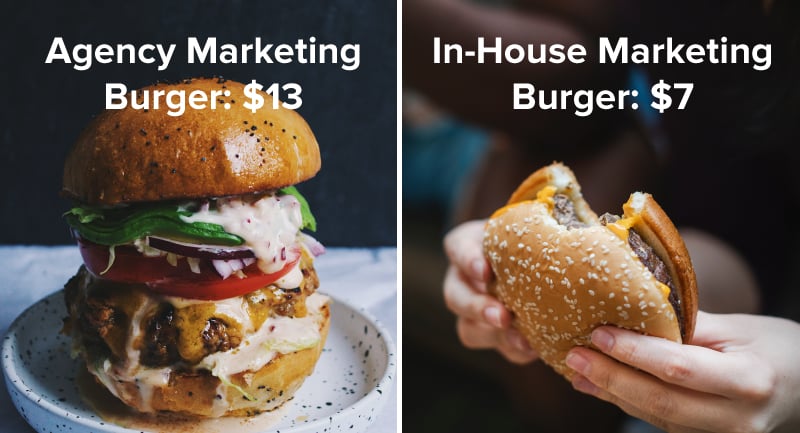
The point here is that there’s more to value than just the initial price tag.
When figuring out a marketing strategy, a business usually has two options: building their own in-house marketing department, or hiring an agency. And often the deciding factor is cost — which option will save the company more money right now? But like burgers, marketing options are made up of a lot of factors, and when it comes to value, initial cost is only the tip of the bun.
So, before you put in your order, let’s do a quick breakdown/comparison of the actual costs, and shine a heat lamp on the the other ingredients that an effective marketing agency brings to the table.
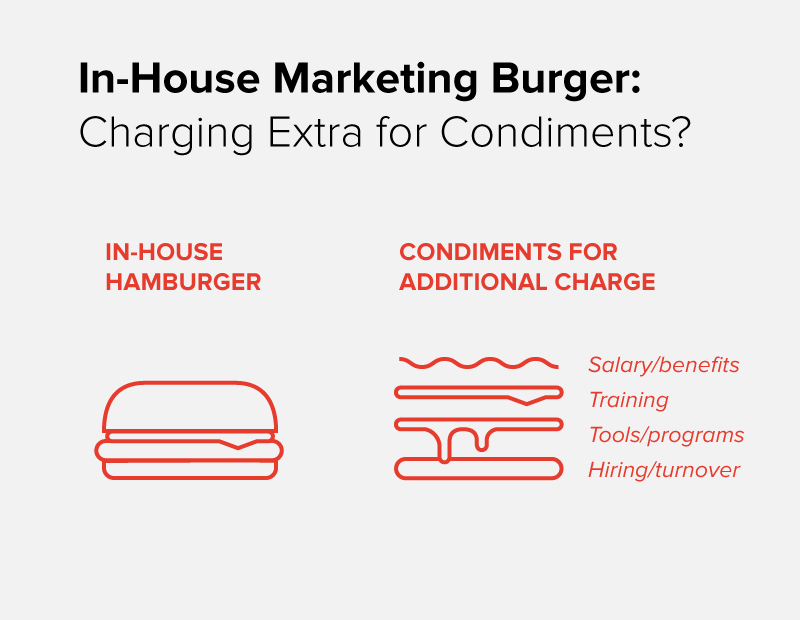
Let’s be clear on one point before we dive into things: There are some advantages to keeping your marketing in-house. Your team probably won’t have to deal with as much of a learning curve regarding your products, services, and brand, and they’ll be able to focus all of their energies on marketing for a single client (i.e. you). What we’re trying to say is that the comparison to the less-than-appetizing $7.00 burger isn’t totally accurate.
However, at the same time, cost isn’t quite as clear cut either. Sure, the hourly rates associated with marketing are generally lower when you keep everything in the family, but hourly rates don’t tell the whole story.
For every employee on your marketing team, you’ve got an entire host of associated costs. Salary and benefits are two obvious ones, but what about training expenses? What about expensive tools and analytics programs? What about the hiring costs, particularly when you’re trying to assemble a talented team from scratch? Don’t forget that “marketing” is an umbrella term that includes specializations in SEO, content and copywriting, analytics, design, link development, strategy, paid search and paid social ads; just finding the right people is going to cost you time and money, and keeping them up to date on best practices is going to cost you even more of both.
And once you’ve got your team assembled, there’s always the threat of turnover. Hey, just because you brought them on and trained them up, it doesn’t necessarily mean that they won’t leave and take their new skill sets with them. That means the possibility of recurring costs, and no clear idea of how much you’ll be needing to invest until the money is already leaving your pockets.
So maybe an in-house marketing department isn’t a floor burger, but it is a burger that costs an undefined heck of a lot to make, may end up costing you an undefined heck of a lot more as you go, and that still might not satisfy your marketing hunger.
So, how does that compare to the cost of hiring an agency?
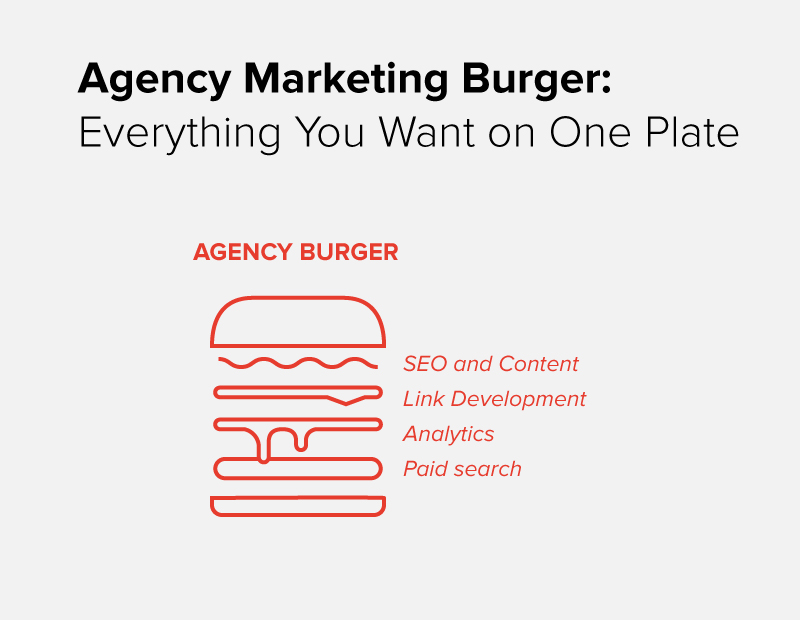
Big companies looking for aggressive growth are usually allocating $25 – $40k/mo in digital marketing spend with agencies, while small and medium sized businesses are investing between $5 – $15k/mo into digital marketing. That probably sounds like a lot, but what’s worth recognizing is that it’s all-inclusive.
With the right marketing agency, everything is so much more concrete, and that goes double for cost. The hourly rates are probably higher than what you’d be spending with an in-house marketing department, but the hidden costs are non existent. It’s a burger with everything on it, and you’re not going to get billed extra for your pickles somewhere down the line. No to mention the sides, not just french fries—we have the premium sides, all-inclusive.
You don’t have to worry about hiring specialists or assembling a team, because the agency takes care of all of that on their end. The same goes for training and tools. All you have to do is pick from a menu of services, and you’ll always know exactly how much those services are going to be impacting your budget. And if contract-renewal time rolls around and you want to switch things up, scaling to meet your changing needs is just as easy. With agency marketing, you only pay for what you want.
To top it all off, let’s not forget the real value that comes from experienced digital marketing. As the co-founder of SEOmoz, co-founder of Sparktoro, and all-around marketing and SEO thought leader, Rand Fishkin enjoys a uniquely informed perspective on marketing agency services, and this is what he has to say:
I think a lot of web marketing agencies are undervaluing their work, or perhaps competition is getting more cutthroat. Back when SEOmoz was an agency (2005-2009), we were generally charging in that $10-$25K/month bucket, and were by no means the most expensive group on the market.
The best agencies enjoy a time-tested, intimate understanding of the marketing universe — what’s come before, what’s happening right now, and what’s around the corner — so that they can tailor a marketing strategy to fit your business and your industry. And, with multiple clients, agencies also have nearly limitless opportunities to test and evaluate new ideas, advancing their capabilities with every new contract. In short, you end up getting back more than you give out.
Clear-cut costs, proven expertise, and ever-expanding skill sets — now that's a burger you can sink your teeth into.
Sometimes the less expensive option isn’t really the less expensive option. So, when you’re looking over the marketing menu and trying to decide which option is the best fit for your business (and your budget), consider all the costs. After all, you probably wouldn’t want to buy a burger without knowing exactly how much it’s going to set you back, and with a qualified marketing agency like 97th Floor, you’ll always be getting the best brand exposure for your buck.
Let us feed your business the results it craves; check out 97th Floor today, and see what we can cook up for you.
Depending on who you ask (or which result you click in Google), the years of birth to be considered a Millennial range somewhere between 1980 and 2000. So being a proud 1986er myself, I’m perfectly qualified to chime in on what Millennials expect from work.
When I first started hearing about Millennials and their stereotypes, I figured the term referred to people much younger than myself. Teenagers. The kids that had cell phones in elementary school. The kids on Snapchat. They couldn’t be talking about my age group. I used payphones in high school, after all! And of course I didn’t pay for the payphone...like anyone my age knows, I used the Collect Call trick. (My parents received and declined a lot of phone calls from “HeymomitsWayneI’mreadypickmeup!” and I always got picked up.) I had dial-up internet in high school. And no, we didn’t pay for it...like anyone in the economic situation like I was growing up knows, I kept taking the free AOL CDs from Walmart to use the free hours, and then once that was out we’d pop in a new one with a new email address.
I was wrong, though. I am in fact a Millennial, and those “kids” are part of a new generation called Generation Z.
To be honest, for these last seven or so years, I’ve been slightly ashamed of being a Millennial. Maybe embarrassed is a better word for how I felt. Everything I read, heard, and watched made Millennials seem pretty terrible. Especially in the workplace. What Millennials expected from work was bean bag chairs, video games, snacks and a keg. Oh and don’t forget about the ping pong table. For all of that time spent having a party at work, we wanted immediate raises and promotions.
Well, I didn’t feel like I fit this narrative. Sure, I came across a handful of Millennials that matched the profile, but I was somehow lucky enough to mostly surround myself with and know Millennials like me. They didn’t expect those types of things from work, either; nor did they/we necessarily want them.
I’ve come to find out in recent years that all of that was a myth. Click bait. Attention-grabbing consultants. There were a few studies that seemed to prove those stereotypes were facts, but the research was poor. They mainly tried to show the differences between generations. Academics have looked at these so-called studies and have concluded that there have been “gross generalizations based on weak survey research, and the speculations of profit-oriented consultants should be treated with extreme caution.” A group of researchers from George Washington University and the Department of Defense concluded that “meaningful differences among generations probably do not exist in the workplace.” While there are some differences, those have more to do with age and the stages of life people are experiencing. You can read more about how Millennials don’t differ much from other generations in this great article published on Harvard Business Review by Bruce N. Pfau.
Below are results from two studies that actually show Millennials to be pretty much the same as Baby Boomers and Gen Xers when it comes to what they want out of work. While all generations were very similar, it is interesting to see Millennials cared the least about having a fun place to work. If your company is spending more attention and/or money on video games and ice cream parties than it is on trainings and education, you have a problem.


I’m no longer embarrassed to be a Millennial. We’re not much different from other generations when it comes to the things that really matter, especially in our careers. We want to do great work. We want to continue to learn. We want to add value to our companies. We want to work with great colleagues. We want to grow and take on new challenges. We want our work to positively influence our lives outside of work and vice versa.
At 97th Floor, we’re mostly made up of Millennials. We do have some Gen Xers on board, and in the past there have been other Gen Xers and even Baby Boomers. When I heard those people describe the company culture at 97th Floor as the best they’ve ever been a part of, I figured they were just Millennials at heart and were finally at a company geared towards Millennials. But over the last couple of years, I’ve realized it’s because a great company culture like the one we have at 97th Floor doesn’t only appeal to one specific generation. I believe that, now that there is more transparency (the internet in general and specifically Glassdoor), companies need to focus on company culture to stay competitive. This is a good thing, of course, and all generations are benefiting from the change.
My dad used to tell me to be my own boss when I grew up. At a young age, I figured he said that because bosses are the ones that make a lot of money. As I became a teenager and young man, I started to realize that his advice didn’t really have much to do with making a lot of money. His advice was to stay away from the typical company that controlled their employees and created a labor force of disengaged employees. We still have plenty of these types of companies today.
At 97th Floor, we essentially want people to be their own bosses. We want them to receive the benefits of being their own boss without having to deal with the accompanying downsides. To me, it comes down to giving our employees five things that most companies don’t allow them to have. That lack often leads to disengaged employees or employees who leave for a company that provides those benefits, or even start their own company. Each of these points could be the basis for a whole article in itself, but for now, I’ll just share a couple thoughts on each.
1. Autonomy
As Dan Pink teaches in his book Drive, autonomy is one of the things that truly motivates people. Traditional company cultures strip autonomy away from people. Autonomy in the workplace encompasses the employee’s time, team, task, and technique. We try our best to give each employee at 97th Floor 100% autonomy over these things. We allow people to choose the teams they want to be a part of. It’s not uncommon for teams to make offers to one employee and the employee chooses which one they want to take. This is similar to the open market, except that it is happening within our company. We also are a ROWE organization, which really helps us give employees 100% autonomy. We just demand 100% accountability in return.
The ‘time’ part of autonomy seems to be a particularly important factor for Millennials, though it’s really important for everyone. A survey by Intelligence Group found that 74% of Millennials want flexible work schedules and 88% want “work-life integration.” If you’re your own boss, you work when you want to, so long as you can achieve the necessary results.
In the same survey by Intelligence Group, 87% of Millennials said professional development was an important part of their job. From my experience, most companies do a pretty good job with helping their employees develop their knowledge and skills. However, one thing few companies do a good job at is allowing employees to expand their knowledge and skills outside of their position. As a business owner, you learn and develop skills in pretty much every facet of business. While not every employee will care to learn a lot about every part of the business, it’s important for the company to provide those opportunities for their employees. It separates the person from the position, which is a good thing. The company pays the employee for the position they fill, and at the end of the day, the company judges the employee on how they perform in that position; but the employee needs to know that they are viewed and treated as an individual and not just a role.
As a business owner, your income is 100% tied to your work. As an employee, it sometimes doesn’t feel this way. Too often, you feel like you’re taking a lot more work and not seeing more income. While it’d have to be a very dumb company or manager to not recognize a star performer and then compensate them, there is a lot of room for improvement for most companies. At 97th Floor, we have a financial structure for almost all of our employees that rewards them for their productivity and efficiency. It’s not perfect, but it’s an attempt to make employees think like business owners, and it’s helped us a lot over the last few years. We allow employees to decide if they need to hire another person on the team or if they really need that new tool. If they can be more efficient and not hire that person or buy that tool, that money comes back to the team. However, if those type of decisions hurt their productivity, that will hurt their earnings potential. So it’s a constant balance of productivity and efficiency—just like a business owner has to do. While that’s a challenge, it does give control to the employees and allows them to feel that they have a say in their compensation.
As part of our ROWE certification, we were trained to call managers (or bosses) by a new name: “Results Coach”. While we’re not perfect and you’ll still hear “manager” and “boss” being used at 97th Floor, we do a pretty good job of acting like results coaches. The basic difference is that, as results coaches, we set the results we want our team to achieve and the timeframe to achieve them. From there, we get out of their way, help when needed, and give advice. There isn’t the stereotypical boss attitude of “my way or the highway.” In the previously-mentioned survey by Intelligence Group, 72% of Millennials would like to be their own boss, but if they have to work for a boss, 79% of them would want that boss to serve as more of a coach or mentor.
Most people care about more than just money. However, many companies focus almost entirely on revenue. So when you’re an employee, there’s a good chance you’ll end up at a company where your only purpose is to drive revenue. In the Intelligence Group survey, 64% of Millennials say that making the world a better place is a priority for them. If your employees don’t feel that they are accomplishing this, they’re going to leave and find a company where they can feel that purpose. Barring that option, they’ll start their own companies so that they can be their own boss and direct the purpose of the company themselves.
Last year we were featured on Inc. Magazine’s first ever 50 Best Workplaces list (we recently found out that we made it onto this year's list too), and to celebrate the news, we put up a billboard near our office. Observe:

And while this is obviously a friendly jab at businesses that think a ping pong table equals an awesome work environment, it’s also become something of a mantra. The billboard was ultimately a statement that you can create an amazing culture and workplace without resorting to gimmicks.
Whenever the topic of workplace ping pong (and all it represents) comes up, I’m reminded of a personal experience. Prior to joining 97th Floor, I worked for a company that (you guessed it) had a ping pong table. You might be expecting me to say that the thing was little more than an expensive dust collector, but you’d be wrong — it was used constantly. My team had two set times each day during which we could use the ping pong table. As those times would approach, employees would stop what they were doing and rush over to play ping pong.
For me, the ping pong table came to represent flawed company culture. How so? Simple: Ping pong was the reward. It was the reason employees came in in the morning. It was what prevented them from sending out resumes to other employers. The drive for success and self improvement was replaced with ping pong tournaments and nerf wars, and an inspirational company purpose was as far from everyone’s mind as could be.
When I came to 97th Floor, I made a decision: I would never allow a ping pong table to find its way into our company workspace. Do I hate ping pong? Of course not; in my time with the aforementioned company, I was just as excited to play during work hours as anyone. But ping pong is not what 97th Floor culture is about.
Company perks are great. However, too often, they’re misused. Patty McCord, the former Chief Talent Officer at Netflix, suggests that perks should have a purpose. She says that many of the extravagant perks offered these days are a “race to the ridiculous.” Giving people more stuff won’t make them happier, but perks that support the company’s values, mission, and purpose will.
A 2014 survey by BlessingWhite demonstrated that engaged employees report that the top reason for staying at a job is that they like the work they do. The second most-reported reason for engaged employees to stay at a job is that they believe in the company’s mission and culture. You may notice that ping-pong (or whatever other fun attractions an employer might showcase) isn’t up there. So where is it? Quite a bit closer to the bottom, actually. Only 5% of engaged workers identified perks as a reason they stay at their job.
So few? What about the ping pong enthusiasts I mentioned from my own experience? Well, if you take a quick look at the wording of the survey, you’ll notice it’s talking about engaged employees. For disengaged employees, however, the numbers start to flip. Disengaged workers report perks as a much more important reason for staying at their job. The survey backs the saying that “the engaged stay for what they can give, the disengaged stay for what they can get."
Want to attract the wrong people? A ping pong table looks like the way to go. If, on the other hand, you want a workforce that can grow your business and make a positive impact on your industry and your community, then realign your focus to highlight your company values and mission. This is why at 97th Floor, we often shy away from discussing employee perks (of which we have many) with potential hires and interviewees — particularly when the purposes behind said perks aren’t obvious.
And what purpose should perks be filling? In my opinion, the best way to use perks is to reinforce the purpose, mission, and values of the company.
For example, we at 97th Floor value the thirst for knowledge. To promote that thirst, we instituted the 97th Floor Library program, in which the company will purchase any book an employee wants, with the caveat that the book ends up on the break-room bookshelf once they’re done with it. Books may not cost much, but they do cost something. We don’t want our employees hesitating when it comes to furthering their own knowledge, and with the book then available for any other employee to enjoy, we’re able to offer a fun perk that benefits everyone, while also reinforcing a key company value.
Now don’t get me wrong, not every perk we have at 97th Floor serves some higher purpose other than to provide a bit of entertainment. We have an Xbox One in the break room right next to the bookshelf, and when it’s time for company-wide rewards, we’ve been known to spring for the occasional massage or movie outing. I think this is perfectly fine, but I hesitate to call these examples ‘perks.’ These aren’t the things you should have on your job ads. These aren’t the things that everyone should talk about at the office. These aren’t the things that management should expect will retain the right employees. These are just diversions. The perks that promote your company’s mission and values are the ones that will have the greatest impact on employee success.
Too often I see companies attempting to use perks to fill a void that only satisfying work, a worthwhile mission, and an inspirational vision can satisfy. Want to see whom among your acquaintances works for a business that understand this? Here’s a simple test you can perform:
The next time you’re catching up with friends, ask around to see how everyone feels about their jobs. Of those who say that they like their jobs, ask them what it is about their jobs that they like most. If they start talking about the nap room, the free donuts every morning, and even the (dreaded) daily ping pong tournaments, then take note. There’s a good chance that these are the ones who’ll have a new job the next time you see them. On the other hand, identify those that tell you about the awesome work they are doing, the challenges they are overcoming, how their contributions move the company forward overall, and how their company is impacting the world, and you’ll have found employees of businesses that really understand the value of perks.
Perks come and go. In fact, perks are usually first to go during recessions or hard times for the business. So ask yourself, if you took away all of the perks in your company, would the employees stay? If not, you may have a serious problem on your hands. When all is said and done, team members should be willing to stay for the right reasons.
At 97th Floor, you’ll never see employees jockeying for a place in a ping pong tournament. You will see people that are doing fun, exciting, challenging, and purposeful work. You’ll see that work contribute to a company that is growing our client companies and helping those companies fulfill their missions. You’ll see people making an impact in the world through charity. You’ll see people controlling their lives and their work. You’ll see people mastering their crafts. You’ll see people growing in their careers. You’ll see people putting a ton of effort into helping others grow. You’ll see perks that are meant to help people with everything listed above. And while you may also see a few perks that are just for fun, you’ll notice that they mean almost nothing to the people when it really comes down to what truly matters in the workplace.
Now, all things considered, doesn’t that sound better than a round of ping pong?
