



Every company wants to be more innovative, more efficient, and more resilient in the face of change. The organizations that achieve this don’t rely on quick fixes. Their secret sauce is embracing continuous improvement in the workplace as part of their culture.
Continuous improvement in the workplace is the practice of making steady, ongoing progress in how an organization operates. Instead of waiting for major overhauls, it’s about finding small, meaningful ways to improve processes, skills, and outcomes every day. Over time, those small changes add up to major growth.
At its core, continuous improvement means asking, “How can we do this better?”, and then acting on the answer. It applies to everything from streamlining workflows and reducing errors to improving customer experiences and building a stronger team culture. There are two common types of continuous improvement:
Incremental improvement focuses on small, gradual changes made consistently over time. These shifts may feel minor in the moment, but together they build momentum and create lasting impact.
Breakthrough improvement targets bigger, more dramatic changes. These initiatives deliver rapid results and can transform processes quickly, but they require planning, resources, and strong leadership support to succeed.
Adopting continuous improvement in the workplace delivers value on every level: people, processes, and performance. Here are some of the most impactful benefits:
When teams consistently look for better ways to work, wasted time and effort disappear. Streamlined processes mean projects move faster, resources are used more effectively, and employees can focus on higher-value activities instead of routine bottlenecks. Over time, even small efficiency gains can transform productivity.
People thrive in environments where their ideas matter. Continuous improvement encourages employees to contribute suggestions and take ownership of change, which builds motivation and loyalty. An engaged workforce is more resilient and less likely to experience turnover.
Continuous improvement reduces errors and creates more reliable outcomes. Whether it’s fewer defects in a product, more consistent client communication, or smoother internal workflows, higher quality becomes the norm. This consistency strengthens trust with both employees and customers.
Small improvements often spark bigger ideas. A culture that rewards experimentation creates space for employees to test solutions, learn quickly, and share insights. Over time, this mindset drives breakthroughs that help organizations stay ahead of competitors and adapt to new challenges.
Customers notice when organizations are committed to getting better. Faster response times, smoother interactions, and higher-quality results all lead to stronger relationships and increased loyalty. Satisfied customers are more likely to return, refer others, and become advocates for the brand.
Markets shift quickly, and businesses that embrace continuous improvement adapt faster. Instead of scrambling to react, they already have the culture, systems, and skills in place to pivot with confidence. This long-term resilience helps organizations weather disruption and seize new opportunities.
Continuous improvement starts with leadership. When managers and executives demonstrate their own commitment to learning, adapting, and improving, it sets the standard for the rest of the organization. Employees notice when leaders share lessons learned, own mistakes, and celebrate progress (not perfection). This kind of transparency builds trust and signals that improvement is it’s a company-wide expectation.
Nothing derails improvement faster than vague expectations. Employees need a direct line of sight to what success looks like, and that’s why we need clear KPIs. Specific, measurable goals help teams visualize a roadmap for progress and motivate them to focus energy where it matters most. Instead of checking boxes or chasing vanity metrics, people know exactly how their efforts contribute to real outcomes, whether that’s customer satisfaction, faster project delivery, or higher quality work.
Of course, that’s not to say that the bottom line isn’t important. It absolutely is, but more than that, it can be a valuable measure of how effectively a business is promoting self-improvement.
When going ROWE (results-only work environment), we shifted from an environment that judged employee effectiveness by how long they clocked in or how well they obeyed the ever-important office rules to one that focuses exclusively on results. This is single-handedly the best way to foster an environment of self-improvement, as the employees are clear as to what they should work on. However, if the ‘results’ or KPIs that you have laid out for them are not clear, then this can be a disaster that will slowly kill the drive to improve.
I bring this up often, but years ago, when we had fewer than 10 employees, I was running the whole company in terms of payroll, insurance, etc., but I also directly oversaw one division, while my good friend Wayne Sleight, a then up-and-coming employee, was running another. He and I talked regularly, and he had pretty clear KPIs — not handed to him from me, but from his own awareness of his position. His department was humming; mine, on the other hand, was quite the opposite. The work we were putting out was top-notch, but we often missed deadlines and had terrible client communication. This was 100% on me, and with the benefit of hindsight, I’m able to see the biggest problems we were facing:
I was way too busy to be running the division. I should have clearly tasked someone to do it and provided them the same freedom and accountability I had given Wayne. I had asked several different people during this time to ‘run’ the division, but I often micromanaged and stepped in, but only sporadically, because I was being pulled in so many directions as the CEO. This created an unstable, inconsistent environment where I would be very present one day, and then totally gone or checked out in another. It also made it so I wasn’t very clear on my expectations with those running point, because I would often swoop in and take care of tasks that really didn’t require my involvement. One day, the person running point had all the keys to the kingdom, and then the next, I would come in and take them all away.
This was all done out of a desire to help my people out, but intentions aside, it watered down the KPIs, and it created a slow death of not knowing how to improve. Things became so lopsided that we often had to pull money from the other side of the company just to cover salaries.
If you want those around you to improve, give them a clear roadmap, both in terms of results and a career path.
Constructive criticism is the engine of growth. In workplaces where it’s scarce, improvement stalls. In workplaces where it flows freely, teams get better every day. Constructive, timely feedback allows employees to correct course, sharpen skills, and recognize strengths before they fade into the background. Leaders can model this by asking for feedback themselves, proving it’s a two-way street. When feedback becomes part of the rhythm of work, continuous improvement takes root.
I am very much a cheerleader — it comes from being very passionate about what I do. Often after going to a meeting with employees, they remark about the energy in the room and how well a meeting went, and that gives me a good opening to talk to them about how important it is to let the prospect or the client see your passion, and is a good way to set a precedent for my workforce and let them know that I expect them to be passionate about what they do.
After these meetings, or after speaking engagements where employees are present, I will ask my people how I can improve. This is because my employees can be my best critics, given their familiarity with the context. Did I make them feel uncomfortable by something I said? Did I say “um” too much? When requesting feedback from your employees, ask for honesty, and be sure to accept any criticism you receive graciously and with an open mind. Sure, at first, you will get ‘yes men’ answers from people who just want to get on your good side, but as you improve your relationship with your employees, those kinds of responses will drop away. Start by suggesting something you felt you need to improve on, and then invite your people to add anything else, and let them know that ‘yes man’ answers aren’t going to cut it. In my experience, our female employees are a lot more forthcoming and not as afraid to give criticism.
We are very fortunate at 97th Floor to have a healthy environment of self-improvement. We are all collectively working together to better ourselves, not just in our professions, but also in our lives. This focus has helped us build a company culture that extends well beyond the office walls and is gaining prominence throughout the business world.
As I said before, an environment of self-improvement should be every CEO’s dream, but dreams only take you so far. Turning that dream into reality, on the other hand, now that’s a goal worth striving for.
The best improvements often come from the people closest to the problems. A culture of continuous improvement depends on involving every employee, not just leadership or management. Encourage team members to share ideas, experiment with solutions, and celebrate small wins. Empowering employees creates ownership, and ownership creates momentum. When everyone feels responsible for progress, continuous improvement stops being an initiative and starts being the norm.
How to Implement Continuous Improvement in the Workplace
Continuous improvement in the workplace starts with leadership. Leaders must set the vision, explain why it matters, and model growth. When employees see leaders committed to improvement, they’re more likely to follow.
Next, set clear goals. Define what success looks like. It might be faster delivery, fewer errors, or happier customers; keep it specific to your team’s top priorities. Specific, measurable targets keep teams focused and moving in the same direction.
Employees also need a voice. The best ideas often come from those closest to the work, so invite input through surveys, workshops, or team discussions. Quick wins from frontline suggestions build momentum and prove the value of the process.
Finally, measure and celebrate! Track results with metrics like productivity, engagement, or cost savings. Share successes, expand what works, and keep the culture of improvement alive. When your team meets a goal, make sure they feel great about what they’ve accomplished.
Continuous improvement shows up in daily actions that drive lasting results. Here are some practical ways companies bring it to life:
Even small changes can save a large amount of time. When teams map their workflows, they spot redundancies and bottlenecks that slow things down. Cutting a few unnecessary approval steps can shave days off delivery timelines and free employees to focus on meaningful work.
Every time employees build new skills, the organization gains strength. Regular training, whether it’s new software, leadership development, or cross-training, keeps teams sharp, adaptable, and ready for whatever comes next.
Improvement doesn’t stop at internal processes. Businesses that listen to customers and act on feedback stand out in crowded markets. Shorter response times, personalized communication, and proactive service are simple shifts that build loyalty.
Continuous improvement also means taking care of the people behind the work. Encouraging employees to focus on health, wellness, and balance leads to higher energy, stronger engagement, and better long-term performance.
The best ideas often come from those closest to the work. When employees have clear channels to share insights, like suggestion systems, innovation days, or open feedback forums, organizations unlock creative solutions that leadership might miss.
The best organizations never stop improving. Whether it’s refining processes, empowering teams, or elevating customer experiences, continuous improvement keeps businesses moving forward. The same principle applies to marketing. Campaigns that evolve, adapt, and improve over time consistently outperform those that stand still.
At 97th Floor, we help brands embrace this mindset in their advertising and content strategies. From data-driven campaigns to creative storytelling, we partner with companies to build marketing that grows stronger with every iteration.
Ready to take the next step in improving your marketing performance? Let’s talk.
Continuous improvement is the practice of making ongoing, incremental changes that enhance processes, products, and performance. It focuses on steady progress rather than one-time fixes.
Continuous improvement in the workplace means building a culture where employees, leaders, and teams consistently look for ways to work smarter, deliver better results, and adapt quickly to change. It applies to everything from workflows and training to customer service.
Examples include streamlining workflows, offering employee training, automating repetitive tasks, and improving customer response times. Even small improvements like refining communication between departments can create a lasting impact.
You promote continuous improvement by securing leadership support, setting clear goals, inviting employee input, and measuring results. Recognizing progress and scaling successful initiatives helps build momentum.
Continuous improvement is important because it drives efficiency, boosts employee engagement, and strengthens customer satisfaction. It also helps organizations adapt to new challenges and remain competitive over time.
The key principles include leadership support, clear goals, constructive feedback, and active employee involvement. Together, these principles create an environment where improvement is sustainable.
Key Takeaways
If you’re familiar with 97th Floor, you know that we practice an HR management strategy called ROWE, which stands for Results Only Work Environment. In fact, we’ve become a ROWE Certified Organization. While ROWE isn’t all that our culture is, it definitely is the first aspect of our culture that people think of.
That recognition is earned. Autonomy is one of our strongest differentiators, and it often sparks curiosity: What does results oriented, or results only, actually mean? Results oriented, put simply, is a professional environment where employees have complete control over how they accomplish their work, so long as the outcome meets expectations. Productivity replaces presence. Quality replaces hours. In exchange for freedom, employees give full accountability. A fitting results oriented synonym might be performance-driven, outcome-focused, or impact-first.
The autonomy a results oriented culture gives our employees is one of the things that really sets 97th Floor apart. That said, it feels like there might be some misconception about what the reality of ROWE really entails. I’ve heard non-97th Floor employees describe our results oriented culture as being all about working remotely from sun-soaked vacation spots, sipping icy drinks and brushing sand off of your keyboard while you tackle your tasks — or throwing decorum to the wind, and working from your couch while wrapped in an old blanket.
But while it’s true that all of us at 97th Floor have the freedom to do both of those (I know I have a few times with the former… and, yes, maybe a couple of times with the latter), that doesn’t mean that the perceived opposite (working 9–5 in the office) isn’t also ROWE. In fact, sometimes a standard 9–5 employee is more ROWE focused than the guy who’s working from the beach (or the living room).
You see, what ROWE is all about is allowing the individual employee to decide what works best for them. Productivity, efficiency, effectiveness — these are the considerations that drive a results oriented employee. Hours spent in the office, or hours not spent in the office, don’t even come into play. In essence, the workforce gets 100% autonomy, and in return gives 100% accountability. We can do whatever we want, whenever we want, wherever we want, as long as we get the work done.
Of course, it’s not hard to see how this perceived division between ROWE and standard 9–5 work environments came to be. In fact, just a couple of week ago a local business magazine picked 97th Floor as one of the best companies to work for in Utah County. Unfortunately, in the resultant article I was quoted as saying something that in retrospect I feel may have added to the misconception that ROWE (and therefore 97th Floor) is against the 9–5 schedule.
“Too often,” I posited, “mediocre employees hide behind a 9–5 environment. ROWE lets the work — not the punch clock — do the talking.” And while I stand by my assessment, the point I was trying to make may not have been as clear as I would have hoped. What I meant by this is that just putting in 40 hours (or even 50 or 60) per week doesn’t necessarily mean effective results.
The truth is that lackluster employees will likely be just as unengaged at 40 hours as they are at 20 hours, but it’s those same employees who are so quick to point out that because they’re putting in the hours, they must be ‘working.’ A results oriented company is one that recognizes that employees are paid to do more than just warm a seat in the office. Underperforming employees shouldn’t be able to hide behind perfect attendance, because attendance doesn’t generate profit. Where someone does their work or how many hours they are working simply doesn’t matter, as long as they’re getting the results.
And yes, it’s true that even in most traditional 9–5 workplaces, employees are still judged on results as well. But oftentimes the amount of hours put in can help keep an underperforming employee around for a bit longer. If your 9–5 based company doesn’t allow hours worked to be a factor in employee evaluations, then that’s great, but if that’s the case, then what’s the point enforcing a schedule in the first place?
For the record, 97th Floor doesn’t have a problem at all with people working Monday through Friday, 9am–5pm. In fact, based on my estimate (and obviously I can’t pull in actual numbers since we don’t track time), about 20% of our employees still work every day during the week at our office, showing up at 8 or 9am and staying for about 8 hours. These people are absolutely taking full advantage of ROWE. They are deciding that being at the office for 8 hours each day from Monday to Friday is the best for them.
I’d venture a guess that these people are more effective by choosing for themselves to work a traditional schedule than if they were forced to by their employer. I’d also estimate that another 20% of our employees work almost exclusively from home or elsewhere (only coming into the office for meetings) and the remaining 60% work a hybrid between the office, home, and elsewhere. Each of these work schedules are just as much a part of ROWE as the next.
One benefit that people often point at of having everyone in the office each day from 9–5 is that people need to collaborate and communicate with each other. With Slack, GoToMeeting, and other collaboration tools, that’s really not an argument anymore. For the times when an employee needs to meet in-person, they just schedule a meeting at the office, giving everyone involved enough notice. Again, this isn’t to say that working in an office everyday from 9–5 is bad. The bad part is not having a choice in the matter. People should choose for themselves where and when they work.
Building a results oriented workplace takes intention. Through our transition, we found that it comes down to changing four things.
First, get clear on what “done” actually means.
If the goal is fuzzy, effort becomes the measurement by default. We’ve all seen projects that took many hours or even days, yet no one can really say if progress was made. Setting clear, measurable targets gives people something concrete to run toward instead of just filling time.
Second, make accountability visible.
Accountability isn’t a threat; it’s a promise. When people know what they’re responsible for, and when results are reviewed openly, ownership becomes natural. Not because someone is watching, but because they care about delivering.
Third, give people room to figure out how they work best.
Autonomy is the magic ingredient of a results oriented model. Some of us think best at a desk. Some do our best work in a coffee shop, or at home with a dog on our lap. Let adults be adults. Give them space, trust, and the expectation that the work gets done.
Last, communicate like a team that’s rowing in the same direction.
Slack threads, quick meetings, shared timelines; none of that goes away. In fact, it matters even more. Freedom works because communication does. It keeps projects moving and prevents anyone from feeling like they’re building in a vacuum.
Put those four things together and you can get your team to stop watching the clock and start chasing outcomes. When you make the shift, it’s hard to imagine working any other way.
When measuring success, obviously, we’re really only talking about time and location here, and not everything that ROWE encompasses. Still, in regard to time and where we work, science is backing up the principles of ROWE. Recently, Nicholas Bloom, a professor at Stanford, gave a talk at TEDx about working from home. His study with one large company found that giving employees the choice to work from home resulted in a 50% drop in employee attrition, employee performance went up by 24%, and the company made an additional $2,000 in profit per employee. There was also a study by author and National Geographic Fellow, Dan Buettner, that showed cutting an hour-long commute each way from a person’s daily schedule gives that person the happiness equivalent of an extra $40,000 per year. At 97th Floor, we focused on tracking four metrics when we switched over to a results oriented culture: client retention rate, employee turnover rate, revenue per employee, and goal completion percentages of contracts. Over the lastC two years, all four have improved. Our clients and employees are staying longer, we are delivering better results, and we’re more efficient.
Our society is getting better and better at allowing people to be individuals. People are increasingly encouraged to do and be what makes them happy. Yet with work, the majority of companies still expect everyone to be the same. We need to change this mindset and let individuals manage themselves, while the company manages the work results. When that happens, success will come — whether that means working 8 hours a day in the office, or doing it all from the comfort of a well-worn couch.
As a company we commit to Pledge 1% - of revenue, resources and time to movements and missions that matter. The AF Canyon Run Against Cancer is close to COO Wayne Sleight's heart. See a bit of his story in the video.
We invite you to join us for this year's race, details here: http://afcanyonrun.com/
Run. Volunteer. Donate.
Back in 2012, we did things very differently at 97th Floor. One aspect of our company was that we used to have the team come in at 8:00am on the dot and make them leave at 5:00pm. They had some flexibility of course…they could take a 30 minute lunch or a one hour lunch! I vividly remember lecturing one particular team member that he had to take at least a 30 minute lunch.
My intentions were good; I was just doing what I was accustomed to and I thought it would be good for his health and productivity to take a break. However, at the same time we were really pushing hard to build our brand as a results-based marketing agency. We wanted clients to hire and pay us for our strategy and results, more than our hours and deliverables. Sure, we had (and still have) projects that were billed hourly, but the majority of our clients were hiring us for our skills as an agency. What they were after were results, not hours.
It was really hard back then—and still is sometimes—to get companies to view us in this light. That’s when we started asking ourselves, “Why should clients judge us based on results and the true value we bring to them if we judge our own team on how many hours they sit in their chairs where we can watch them?” Oh and don’t get me wrong, we were much worse than just tracking their every minute. We tracked basically everything you can imagine that really doesn’t matter. We couldn’t expect our clients and prospective clients to be different than us.
We ultimately learned that the culture we breed at 97th Floor directly impacts our brand. We quickly (but not abruptly) started changing our policies and environment to help facilitate the culture that we now wanted. Today, team members are judged on their results and the value they bring to 97th Floor only. They have 100% autonomy, and in turn they give the company 100% accountability. This example, along with many other major improvements to our culture, has allowed our brand to be about results-based marketing.
Most companies haven’t figured this out yet. They are doing things the old way: coming up with what they want their brand to be, and then spending money to force it down their customers’ throats. And sure, that works to an extent, but it won’t last in the long term. Today, your culture is the main influence on your brand.
People are increasingly doing more and more research about companies before they buy. They ask their friends. They scroll through social networks. They read reviews. People don’t buy from Zappos because the particular shoes are better quality than everywhere else. It’s not even for the free, fast shipping. The shoes are the same on the other site and many other sites offer free, fast shipping now as well. They buy from Zappos because their brand is all about superior customer service. That was Zappos intent and they built that by creating a culture based on excellent customer service. Just ask Tony Hsieh.
There are many famous examples of companies with strong brands, and they were created through the company’s culture. Sure, the marketing and ad dollars helped, but the main driver was the culture.
All companies love to tout that their people are their number-one asset, and it’s for good reason; the people are what drive a company to success or failure. However, you constantly see companies that treat their employees terribly and let their culture go to garbage. Just browse around on Glassdoor and see for yourself. In the past companies could say one thing and hide everything that went on in their office from the public. Not anymore. Not in the increasingly transparent world we live in.
Today’s workers are knowledgeable and empowered. Top talent isn’t joining those companies with terrible cultures, and any top talent that is at those companies are quickly leaving. Now, if you don’t have a solid company culture, everything will start going south quickly. Your employees will be disengaged and do shoddy work, which will lead to your disgruntled customers shaping your brand for you. Your employees aren’t going to be brand ambassadors outside of the office, so customers and potential employees will stay away from you. Your employees and customers will create your company’s brand no matter how hard you fight back. The only way to fix it, or prevent it, is to focus on cultivating a healthy company culture.
The positive side of this is that the opposite is true. If your culture is thriving, your employees will do great work, they’ll be brand ambassadors even outside of the office, and your customers will spread your positive branding as well. Basically, however you treat your employees, they’re going to pay it forward to your clients.
These days I don’t worry so much about our branding. Instead, I spend my focus and energy on our culture. We make sure our policies and our environment are conducive to the team, and strengthen and add to the culture. I know based on our own experience and the experience of many other companies that as long as the culture is right, almost everything else, including the brand, will take care of itself. Our company culture is the best test of the strength of our brand.
So start asking yourself questions. Do you want your brand to be known as up to date and cutting edge in your space? Is your culture one that encourages people to constantly be learning, testing, and growing? Because if your culture isn’t pushing your brand in the direction you want it to go, start making changes now.
97th Floor has come a long way since 2012, when lunch schedules seemed like an issue worth addressing. Now, our major concern is providing the best service to our clients. As long as we're accomplishing that task, the hours don't actually matter. After all, culture is what will carry your company into the future, but only if you step back and let it.
Give your employees a culture that supports and strengthens them, and they'll give your brand a future worth working for.
At 97th Floor, we’re committed to building a culture of caring. From volunteering at local community centers to the #20helps campaign, part of our award-winning organizational culture is focused on supporting local communities.
Started in 2015, a new charity initiative began at 97th Floor with the goal of donating 1% of our gross revenue to charity. Each December, employees have the opportunity to select a charity of their choice and 97th Floor will donate a portion of the 1% to that specific charity.
“I'm very fond of our charity program as it involves all of our employees,” CEO Chris Bennett explains. “I think a lot of people don't give or do as much as they'd like because they don't know where to donate or sadly, if they can trust the charity. Our program solves that for our employees.”
Since its inception, 97th Floor has donated over $100,000. Ranging from local charities to national nonprofit organizations, here’s where we’ve donated to over the course of two years:
Furthermore, these charities are near and dear to 97th Floor employees, who also had the opportunity to explain why they selected a specific charity to donate to. Here are some of their responses:
“I’m extremely passionate about Arctic Rescue and what they do to save the lives of these amazing dogs. Maren, the founder has dedicated the last 20 years to saving these neglected, abused and abandoned dogs and finding them loving forever homes.”
“I was impressed by the stories I read from the people that were on the receiving end of charity: water. To the charity, it’s not just about making sure that people have water, but about building the future of individuals and communities all over the world.”
“I have worked with JDRF several times in the past, and everything I have seen has spoken very well of them. They use their funds on research to search for, not only a cure, but also treatments and products to improve quality-of-life for those with Type 1 Diabetes.”
“I have been fortunate enough to have the best opportunities and have a family that could provide me with all the basic needs and more growing up. There are many people in the world that are not fortunate enough. So I chose World Vision because it helps underprivileged people from different countries that can’t even get basic medical needs.”
Through this charity program, 97th Floor has inspire its employees to look for ways to give back to the community as well as share with each other why this charity is important to them. As Bennett reflects, “It's one of the best days of my year to login to our Google Spreadsheet and see all the charities being added by our employees and reading their stories as to why they chose that charity.”

97th Floor was recently ranked on Entrepreneur's Top Company Cultures list, a comprehensive ranking of U.S.-based businesses exhibiting high-performance cultures created in partnership with culture management software and service provider CultureIQ®. The Top Company Cultures list has placed 97th Floor as the 26th in the Small Company category. 97th Floor is recognized for creating an exceptional culture that drives employee engagement, exceeds employee expectations and directly impacts company success.
CEO Chris Bennett says, “Company culture is our top priority and we find investing in our employees is the best application of our resources. Strong culture not only attracts the best candidates but encourages and entices the best work.”
"Great company cultures don’t happen on their own. They’re the result of great leadership, and a conscious effort to make everyone on a team feel engaged and important,” says Jason Feifer, editor in chief of Entrepreneur. “The honorees on our 2017 list are proof that strong cultures make even stronger companies. Entrepreneurs at all levels can draw inspiration from them.”
The full list, presenting a total of 153 companies categorized as small, medium-sized or large companies—with 25-49 employees, 50-99 employees and more than 100 employees respectively— is available on Entrepreneur.com. Core insights, behaviors and attributes that have helped to shape the high-performing cultures presented by the top companies are shared alongside practices to help other companies develop their own workplace environments.
"A high-performance culture leads not only to employee engagement but also to measurable business results," says Greg Besner, founder and CEO of CultureIQ. “These organizations show us that great companies start with great culture.”
The rankings for all companies were determined using CultureIQ's methodology for measuring high-performance cultures. Employees at each company received a survey of multiple-choice questions and the answers were used to assess a company's strength across 10 core components of culture–collaboration, innovation and communication to name a few. The companies with the highest scores became the Top Company Culture list in ranking order. To be considered for the ranking, a company must have at least 25 employees, have been founded before Jan. 1, 2015 and be headquartered in the U.S.
To view 97th Floor in the full ranking, visit entm.ag/TopCultures

97th Floor was announced in the 2016 fastest growing company in Utah by MountainWest Capital Network (MWCN) (www.mwcn.org) at the 22nd annual Utah 100 Awards Program Tuesday. The annual program recognizes the 100 fastest growing Utah companies, the Top Revenue Growth companies, and the “Emerging Elite” companies.
The 100 fastest growing companies in Utah are selected from thousands of eligible applicants throughout the state and represent a cross-section from all industries.
“It is clear Utah is one of the hottest places in the country to start or run a business,” said Paul Skeen, chairman of the MWCN Utah 100 committee. “As a strong indicator, we had a record number of Utah companies vying for the 100 fastest growing companies in Utah along with about a 400 percent increase in the number of Emerging Elite nominations. It is a pleasure to recognize this year’s Emerging Elite companies along with the Utah 100 fastest growing companies.”
The percentage of revenue increase of each company between 2011 and 2015 determines the Utah 100. Those companies with the largest dollar amount of revenue growth in 2015 make up the Revenue Growth winners. The Emerging Elite are selected from among companies with less than five, but more than two years of operation that show significant promise for future success.
About MountainWest Capital Network
MountainWest Capital Network is Utah’s first and largest business networking organization devoted to supporting entrepreneurial success, and dedicated to the flow of financial, entrepreneurial and intellectual capital. For more information, visit www.mwcn.org, LIKE us on Facebook and follow us on Twitter @MWCN and LinkedIn.
It’s been a good year for us at 97th Floor. Between being named to Inc. magazine “50 Best Placed to Work in 2016,”, a nod to our focus on employee engagement and culture, and today being announced on Inc. magazine’s 35th annual Inc. 5000, the most prestigious ranking of the nation's fastest-growing private companies, we’re feeling fine.
 And why shouldn’t we be? After all, companies such as Microsoft, Dell, Domino’s Pizza, Pandora, Timberland, LinkedIn, Yelp, Zillow, and many other well-known names gained their first national exposure as honorees of the Inc. 5000.
The 2016 Inc. 5000—unveiled online at Inc.com and with the top 500 companies featured in the September issue of Inc. (available on newsstands August 23)—is the most competitive crop in the list’s history. The average company on the list achieved a mind-boggling three-year growth of 433%.
Our’s was 218% and we rank 1706 in the overall lineup of privately-held companies.
The Inc. 5000’s aggregate revenue is $200 billion, and the companies on the list collectively generated 640,000 jobs over the past three years, or about 8% of all jobs created in the entire economy during that period. Companies are ranked according to percentage revenue growth when comparing 2012 to 2015. To qualify, companies must have been founded and generating revenue by March 31, 2012. They had to be US-based, privately held, for profit, and independent—not subsidiaries or divisions of other companies—as of December 31, 2015. The minimum revenue required for 2012 is $100,000; the minimum for 2015 is $2 million. As always, Inc. reserves the right to decline applicants for subjective reasons.
"The Inc. 5000 list stands out where it really counts,” says Inc. President and Editor-In-Chief Eric Schurenberg. “It honors real achievement by a founder or a team of them. No one makes the Inc. 5000 without building something great—usually from scratch. That’s one of the hardest things to do in business, as every company founder knows. But without it, free enterprise fails.”View the complete Inc. 5000 list here.
"I always felt strongly that by building a company that focused on the work—both as it relates to the client and to team work—that the rest would take care of itself. Being recognized as an Inc. “50 Best Places to Work,” while making the Inc. 5,000 fastest growing list in the same year is great proof of that,” said Founder and CEO Chris Bennett.
 97th Floor was certified as a great workplace by the independent analysts at Great Place to Work®. 97th Floor earned this credential based on extensive ratings provided by its employees in anonymous surveys. A summary of these ratings can be found at http://reviews.greatplacetowork.com/97th-floor.
Great Place to Work® is the global authority on high-trust, high-performance workplace cultures. Through proprietary assessment tools, advisory services, and certification programs, including Best Workplaces lists and workplace reviews, Great Place to Work® provides the benchmarks, framework, and expertise needed to create, sustain, and recognize outstanding workplace cultures. In the United States, Great Place to Work® produces the annual Fortune "100 Best Companies to Work For®" list and a series of Great Place to Work® Best Workplaces lists including lists for Millennials, Women, Diversity, Small and Medium Companies and over a half dozen different industry lists.
"We applaud 97th Floor for seeking certification and releasing its employees' feedback," said Kim Peters, Vice President of Great Place to Work's Recognition Program. "These ratings measure its capacity to earn its own employees' trust and create a great workplace - critical metrics that anyone considering working for or doing business with 97th Floor should take into account as an indicator of high performance."
“According to our study, 100 percent of 97th Floor employees say it is a great workplace,” says Sarah Lewis-Kulin, Great Place to Work's Senior Editor.
97th Floor employees completed 35 surveys, resulting in a 90 percent confidence level and a margin of error of ± 4.51.
Employees at 97th Floor had a fun afternoon trading in our spreadsheets and computer screens for parachutes and soccer games. With the help of United Way, 97th Floor was provided with the opportunity to volunteer at the South Franklin Community Center, just 20 minutes south of our Lehi location. JuliAnne Tanner, Major Gifts Specialist at United Way, says that “the SFCC serves an at-risk population. Each family in the area presents a unique set of challenges. Volunteers really are making a difference in these kids’ lives by establishing educational priorities, developing healthy habits, and building a stronger sense of community attachment, all of which lead to better life decisions.”
From the moment we walked into the South Franklin Community Center, the children were eager to play. We headed outside where we taught the kids a few new games. In return, the kids taught us a thing or two about how to properly launch plastic balls from a parachute, and how to quickly slide through a hula hoop. By the end of the afternoon we all left with a few new friends.

I love SFCC’s mission to serve both children and families in the area. This program gives the children in this at-risk population the chance to meet and interact with other community members. Paxton Gray, Director of Marketing Operations at 97th Floor, said of our time volunteering, “[It] is important not only because it helps others in our community, but also because it simultaneously connects us with people outside our normal circles. Connecting one-on-one with others is essential for a strong sense of belonging on both sides and is the backbone for a supportive and charitable community.” It supports the child, which supports the family, which then supports the whole community. 97th Floor came to mentor these kids, but we left equally served from the children’s reminder of the happiness and joy that can be found in life.
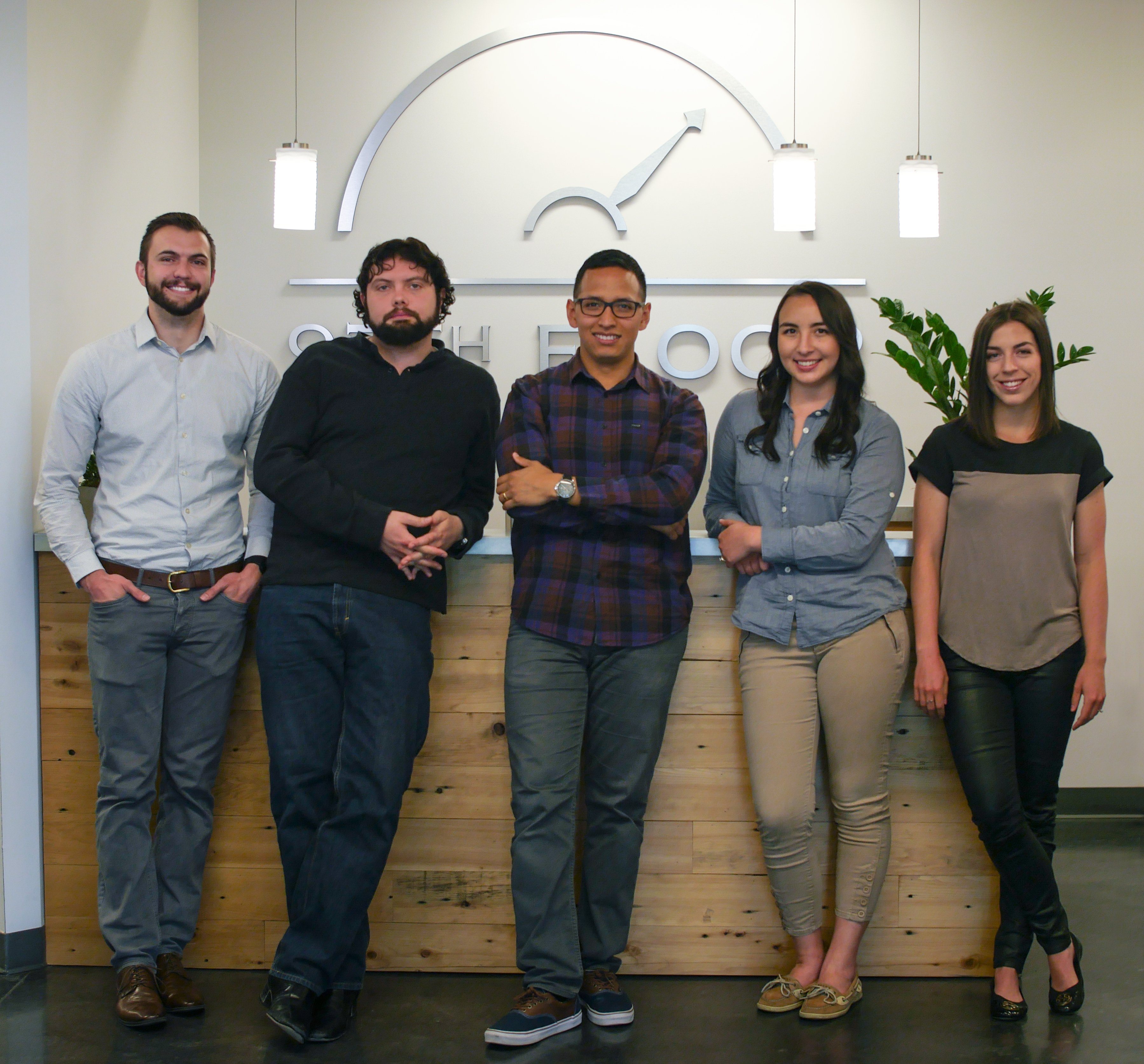 L-R: Josh Moody, Christopher Fosse, Joe Robledo, Samantha Brown, Maggie Call
Lead Enterprise Digital Marketer and Director of Research and Development Josh Moody recently received a "Marketer of the Year" Stevie from The American Business Awards. Additionally, his team won accolades in the category for "Marketing Team of the Year" at the NYC broadcast show. The award-winning team is comprised of marketers Joe Robledo, Kade Call, Samantha Brown, writer Christopher Fosse and designer Maggie Call.
"I really do think they're the best at what they do. One thing that I like is they’re always pushing forward, they’re always pushing to be innovative in every single sphere of work."
Earlier this month 97th Floor was also announced as Inc.’s The 50 Best Places to Work in 2016, where over 500 companies were judged in three categories, including how well companies look after their staff’s financial security (retirement, insurance, benefits, PTO), employee feedback and performance innovation.
Director of Marketing Operations Paxton Gray talks innovation and what it means to be named "Agency of the Year" by the American Business Awards.
"We work really hard to meet our client's goals, but we don't stop once we hit those goals. We keep going and we spend that extra time innovating and finding new ways and new tactics. Really what matters is helping our clients build their businesses."
97th Floor was announced as Inc.'s The 50 Best Places to Work in 2016. Over 500 companies were judged in three categories, including how well companies look after their staff's financial security (retirement, insurance, benefits, PTO), employee feedback and performance innovation.
