



It’s been a good year for us at 97th Floor. Between being named to Inc. magazine “50 Best Placed to Work in 2016,”, a nod to our focus on employee engagement and culture, and today being announced on Inc. magazine’s 35th annual Inc. 5000, the most prestigious ranking of the nation's fastest-growing private companies, we’re feeling fine.
 And why shouldn’t we be? After all, companies such as Microsoft, Dell, Domino’s Pizza, Pandora, Timberland, LinkedIn, Yelp, Zillow, and many other well-known names gained their first national exposure as honorees of the Inc. 5000.
The 2016 Inc. 5000—unveiled online at Inc.com and with the top 500 companies featured in the September issue of Inc. (available on newsstands August 23)—is the most competitive crop in the list’s history. The average company on the list achieved a mind-boggling three-year growth of 433%.
Our’s was 218% and we rank 1706 in the overall lineup of privately-held companies.
The Inc. 5000’s aggregate revenue is $200 billion, and the companies on the list collectively generated 640,000 jobs over the past three years, or about 8% of all jobs created in the entire economy during that period. Companies are ranked according to percentage revenue growth when comparing 2012 to 2015. To qualify, companies must have been founded and generating revenue by March 31, 2012. They had to be US-based, privately held, for profit, and independent—not subsidiaries or divisions of other companies—as of December 31, 2015. The minimum revenue required for 2012 is $100,000; the minimum for 2015 is $2 million. As always, Inc. reserves the right to decline applicants for subjective reasons.
"The Inc. 5000 list stands out where it really counts,” says Inc. President and Editor-In-Chief Eric Schurenberg. “It honors real achievement by a founder or a team of them. No one makes the Inc. 5000 without building something great—usually from scratch. That’s one of the hardest things to do in business, as every company founder knows. But without it, free enterprise fails.”View the complete Inc. 5000 list here.
"I always felt strongly that by building a company that focused on the work—both as it relates to the client and to team work—that the rest would take care of itself. Being recognized as an Inc. “50 Best Places to Work,” while making the Inc. 5,000 fastest growing list in the same year is great proof of that,” said Founder and CEO Chris Bennett.
97th Floor recently met again for our monthly book club meeting. This month, we read and discussed The Happiness Advantage, by Shawn Achor. Achor is the founder of GoodThink, co-founder of The Institute for Applied Positive Research (with his wife Michelle Gielan), and advocate for the field of positive psychology.
After a meal of Greek kebabs and salad, we dove into the discussion. In his book, Achor lays out seven different principles of positive psychology:
While we would have loved to dive deeply into each one of these principles, we knew that time would be a constraint, and so those participating decided on a few specific points to focus in on:
The 20-Second Rule discusses the concept of making the things you want to accomplish easier to access, and making behaviors you want to avoid more difficult. Adding or removing as little as 20-seconds worth of effort has an impact on how likely or unlikely you are to engage in an activity.
The Tetris Effect cites a study in which people who played the popular puzzle game Tetris for prolonged periods of time would begin to see the world through that lens—imagining ways to rotate real-world objects in ways that they would fit together. The principle explores how people are able to train themselves into different mindsets. This includes viewing things in a positive light or a negative one. As you try to recognize positive circumstances, it becomes easier, and eventually, it becomes natural.
The Zorro Circle refers to a training method seen in the film The Mask of Zorro, wherein the student is placed within a series of concentric circles. The first circle is particularly small, but the student is instructed to consider his entire world to be contained within that circle, excluding everything outside of it. As the student masters that inner circle, he then progresses to larger and larger circles. As we master our own spheres of influence, not focusing on the things that we cannot change, then that sphere of influence grows. Rather than despairing of the things we cannot change, or the overwhelming amount of work ahead, we can take each step as it comes, and eventually reach our goals.
Social Investment was the last principle we were able to discuss before separating. Too often, when faced with trouble, people will isolate themselves from others. This principle discusses the detrimental nature of this tactic, as social investment often is what gives us the energy to follow through with our work. Genuine connection with other people fuels our work, while isolation taken to extremes often leads to loneliness and despair, both in our personal and professional lives.
Overall, there was a very positive response to the book, and we definitely recommend it. You can also view the author’s TED Talk.
Due to the holidays, we will be reading our next book over the course of December and January. This time, we will be reading Drive, by Daniel H. Pink. As always, you can follow the #97thbookclub hashtag on Twitter for updates.
Previous Book Club books:
Creativity, Inc., by Ed Catmull
REWORK, by Jason Fried and David Heinemeier Hansson

Last week, marketing executives, e-commerce managers, analysts, and more gathered in Milan, Italy for SMX Milan. SMX is one of the leading international digital marketing conferences, and is organized by Business International and Third Door Media. Sessions focused on SEO, paid search, social media marketing, mobile marketing, analytics, and more.
Paxton Gray, 97th Floor’s Director of Marketing Operations, was a featured speaker at SMX Milan this year. His presentation, The Elements of Viral-Worthy Content: Technical Operation, focuses on what it takes to create a consistent, targeted, and well-optimized content campaign. “How do I get my content to go viral?” is the wrong question to ask, according to his presentation. “If your goal is virality, you’ll probably miss the things that can help you go viral.”
“Viral” content is unpredictable; however, Paxton laid out three characteristics that are necessary for content to be considered viral. First, it reaches a mass audience. Second, it is promoted by its consumers. Finally, it is inexpensive to spread. Paxton then further breaks down the process, especially focusing on keyword research.
.@paxtonmgray #smxmilan: Build #content round #KW research. You’ll go #viral pic.twitter.com/5nia8NA7bx
— Filippo Poletti (@filippo_poletti) November 12, 2015
@paxtonmgray 60% of content market goes unused #smxmilan #11
— Mamadigital (@mamadigital) November 12, 2015
So what's the recipe for compelling #viral content? Wrong question! @paxtonmgray on stage at #smxmilan @smx pic.twitter.com/pkKCkr7MTr — Anna Chiara Sai (@chiarasai) November 12, 2015
In the end, the presentation was very well received. Paxton enjoyed his visit to Milan, and he was able to connect with people in several different industries, both in the US and Italy.
Great job, Paxton!
View the full deck from his presentation below:
At the end of October, we met for our second monthly book club meeting. This time, we read the book REWORK, by Jason Fried and David Heinemeier Hansson, the founders of 37signals, now called Basecamp.
REWORK is broken up into several bite-sized essays, none longer than three pages. Each essay focuses on a specific business principle the authors recommend, and is accompanied by a simple drawing that illustrates the principle being highlighted.
For example, one section, entitled “Draw a Line in the Sand,” emphasizes deciding precisely what your company’s identity is, and figuring out exactly what aspects of that identity you are willing to fight for. “As you get going,” the writers recommend, “keep in mind why you’re doing what you’re doing. Great businesses have a point of view, not just a product or service.” Not only does this help to create a cohesive identity for the employees, it also simplifies all future decision making. “When you don’t know what you believe,” the section continues, “everything becomes an argument. Everything is debatable. But when you stand for something, decisions are obvious.” Some of the other sections we discussed in our meeting include the following:
These are only a few of the topics the discussion touched on. The interesting thing, however, is that among those who attended, there were some strong disagreements on a few of the points made in the book. Each person had their own perspective, and offered different insights. Far from being divisive, though, the discussions led to new ideas on ways we can continue to improve 97th Floor.
This month, we will be reading The Happiness Advantage, by Shawn Achor, a Harvard graduate and founder of The Institute for Applied Positive Research. Follow the #97thbookclub hashtag on Twitter for updates!
Read about last month’s book club meeting, where we discussed Pixar Animation Studios president Ed Catmull’s book Creativity, Inc., here.
Congratulations to Wayne Sleight, 97th Floor’s Chief Operating Officer, who this week was named one of Utah Business’s 20 in Their 20s for 2015!
Meet the #Utah20inTheir20s: @WayneSleight, Chief Operating Officer at @97thfloor https://t.co/zixNcYzhi0 pic.twitter.com/HZCxAEbpQW
— (@UtahBusiness) November 4, 2015
 Wayne Sleight speaking at the Utah Business 20 in Their 20s reception
Utah Business selected 20 individuals who, before the age of 30, have already made a significant mark on the world—whether that means climbing rapidly on the corporate ladder; launching successful business ventures; or impacting business, government, or nonprofit territories. Last night, Utah Business held a reception and awards dinner in Salt Lake City for the honorees, which several of Wayne's friends and colleagues from 97th Floor attended to support him.
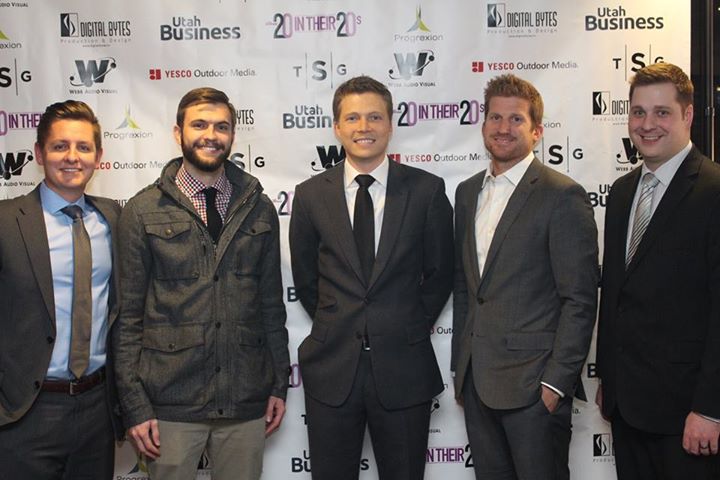 Paxton Gray, Josh Moody, Wayne Sleight, Chris Bennett, and Andrew Yeager at the Utah Business 20 in Their 20s banquet
When asked about his achievement, Wayne responded, “This is a huge honor for me, and I'm grateful to be recognized for the accomplishments I've had the last six years at 97th Floor. That said, I fully recognize that I've surrounded myself with amazingly talented people at 97th Floor, and that is what has allowed me to be a part of really big successes and get this recognition.”
We at 97th Floor couldn’t be prouder of the work Wayne has done and continues to do. He is an integral part of the company and has made an impact on nearly every aspect of the business.
“Wayne is being recognized as someone to watch because he’s young, but the truth is, his accomplishments are significant regardless of age,” says Chris Bennett, CEO and founder of 97th Floor. “The current culture, company growth, and awesome client retention rate that we enjoy at 97th Floor all have Wayne’s influence behind them. The best part is, he’s just getting started.”
Great job, Wayne!


On September 30, 2015, we at 97th Floor had the first meeting of our book club. Every month, we plan to read a different book, then come together over dinner to discuss any ideas that stood out to us and how they could be applied to improving both 97th Floor and ourselves individually.
For our inaugural meeting, we read and discussed Creativity, Inc. by Ed Catmull, the president of both Pixar Animation Studios and Disney Animation Studios. In the book, Catmull presents the history of Pixar, introduces key players in its creation and growth, and discusses several of the underlying philosophies behind the company’s operation and composition. Perhaps more importantly, though, he discusses several of the company’s failures and the lessons they learned from those failures. Several times, he mentions his colleague Andrew Stanton’s mantra of “Fail early and fail fast.”
He also emphasizes fostering an environment that welcomes candor, where people are encouraged to speak up if they feel they have something to add to a discussion or project. 97th Floor’s book club attendees seemed to embrace this idea, as people from all parts and departments of the company put forth their own insights from the book and had a lively discussion of ways we can continue to improve 97th Floor. Several suggestions were made, some of which may be implemented in the future.
So far, the book club seems to be a great success, and several employees who were unable to attend September’s meeting have already expressed interest in coming to our next meeting later this month. At that meeting, we will be discussing REWORK, by Jason Fried and David Heinemeier Hansson, the founders of 37signals and creators of the Basecamp project management software. Follow the #97thbookclub hashtag on Twitter for updates!
Last Thursday, September 10th, 97th Floor’s CEO Chris Bennett spoke at the SearchLove Conference in San Diego. SearchLove SD is an especially great conference for those who are really interested in learning about good tactics. This was the fourth SearchLove conference at which Chris has spoken. In the past, he has also given presentations at SearchLove conferences in Boston, London, and New Orleans.
Chris was a bit hesitant to speak on the topic he presented because the tactics were not earth shattering, but that was the point he wanted to make. His presentation, “How to Never Lose at Content Strategy,” emphasized that you don’t have to chase the newest tactics to succeed in content marketing. In fact, sometimes by just working a little harder and longer during the preparation stages, you can gather insights and data that will dramatically increase your chances for success. Particularly, he recommended not skimping when it comes to keyword research—SEO 101.
In the end, focusing on results is what really matters. Chris gave several examples of different campaigns that reaffirm this, including some that did not end up going viral and garnered very few social media shares, but which still significantly improved organic traffic to the site—which directly translated to revenue. Meanwhile, another campaign seemingly had all the right ingredients for success but only resulted in a brief spike in traffic. This focus on results shows through not only in 97th Floor’s work for its clients, but also in the company’s culture. It trickled down to the company’s employees when 97th Floor became a Results-Only Work Environment, or ROWE.
While each of these concepts seems very intuitive, it proved to be exactly what the audience needed to hear. Overall, the presentation was very well received.
SEO 101: Remember the keywords! Do real keyword research, not 5 minutes, 3 hours. @chrisbennett #searchlove
— Julien Brandt (@Julienbrandt) September 11, 2015
Ohh boy! >> "Add 3 hours to the 5 mins of keyword research you usually do" - @chrisbennett #searchlove
— Megan Cynaumon (@MeganCynaumon) September 11, 2015
The 90s called: they want their keyword research back. @chrisbennett #searchlove
— Marli Mesibov (@marsinthestars) September 11, 2015
Sometimes, the best presentations remind you to just do basics #notshiny #searchlove @chrisbennett
— Wil Reynolds (@wilreynolds) September 11, 2015
Not only that, Chris’s presentation was featured as one of the top decks on SlideShare a few days later.
The final takeaway is that no matter your resources, everyone can work a little harder and focus more on the details. This is exciting, because it means that anyone can can compete when it comes to content.
View the full deck from Chris’s presentation below:
We’re excited and proud to announce that 97th Floor is now officially a ROWE™ Certified Organization!

ROWE stands for Results Only-Work Environment, and is a human resource management strategy that was created by Jody Thompson and Cali Ressler. The idea behind ROWE is to give employees 100% autonomy in exchange for 100% accountability. Employees are judged only on the work that they accomplish, rather than on irrelevant issues such as the hours that they spend in the office. Since creating ROWE, Jody and Cali have founded CultureRx™ to train, assess, and certify organizations in the use of their results-only approach to employee management.
To prepare for our transition into a ROWE workplace, all employees of 97th Floor completed an in-depth series of courses and discussions provided by CultureRx. Each employee was then given a test to ensure that as an organization we’d be successful at implementing this new—and very important—aspect of our culture. We passed with flying colors, and are now operating as a fully certified ROWE company!
If you want to learn more about ROWE, I invite you to read about it in Slate, Inc., or HuffPost. Better yet, check out the CultureRx website, GoROWE.com. However, the basic idea behind ROWE is found in this slogan:
“Work whenever you want, wherever you want, as long as the work gets done.”
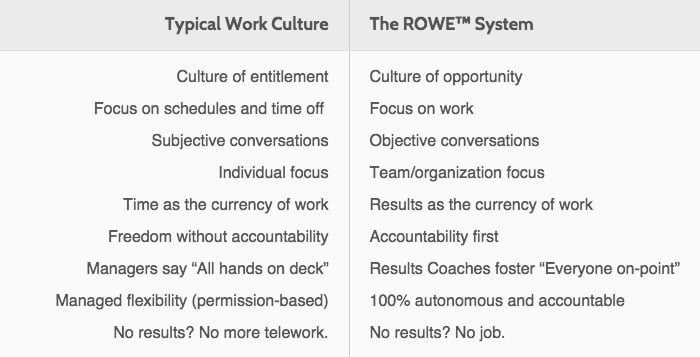
At 97th Floor, we charge our clients based on the results we deliver them, not on the amount of time we work (other than consulting projects). Our clients couldn’t care less if we spent 100 combined hours or 1,000 combined hours during the term of the contract—as long as the agreed upon goals in the contract are met. As such, it seemed inappropriate to judge our own employees based upon the hours that they work, rather than the work that is being accomplished. This was a wake up call for us.
Despite the obvious benefits associated with ROWE, this isn’t a decision that we made lightly. In fact, we’ve been weighing the pros and cons since the beginning of 2014. It all kept coming back to one fear: How can we know that an employee is working, if they aren’t in the office? This is a valid question, but it is one that is rendered moot by a second question: How can we know that an employee is working even when they are in the office?
It’s normal for management to want to exert some form of control over those on the company’s payroll. After all, employees are expected to earn their pay, and when they choose instead to ignore their duties, it can cause serious problems for the business in question. However, the reality is that a bad employee will find ways to avoid responsibility, even while sitting at his or her desk surrounded by coworkers. In fact, by giving employees a standard of measurement based upon something other than accomplishments, leaders enable low-productivity. In essence, they tell workers that they don’t have to work; they just have to show up.
Well, after more than a year of discussion, we decided that we weren’t content with sticking with a flawed strategy. We wanted employees to be adults. We wanted them to be respected. We wanted them to be in control of their work and their lives. We’ve believed for a long time that our agency has the best talent in the industry. Now we are letting our employees decide how to provide the best work possible for our clients—which, in reality, is what we’ve expected of our people all along. Traditional HR tools such as time clocks, office hours, limited vacation/sick days, and mandatory meetings all just get in the way, and distract employee focus from what is really important. ROWE puts everything back into perspective, making it possible for employees to work at the times and in the locations that are best suited to their own talents, and it helps management improve as well, by freeing it from the need to constantly supervise and ‘hand-hold’ those who work below them. When all is said and done, the only viable measure of success is success itself. ROWE allows us to release control over a number of things that we are now realizing that we never wanted to control in the first place.
Being giving the freedom to work on my own terms has been absolutely amazing. Today I went to see Disney Pixar’s Inside Out with my wife and daughter at 3:30pm, and now that my daughter is in bed and my wife is out with a friend, I’m able to get back to work... albeit in my backyard with my dogs while I enjoy this warm summer evening! And I’m not the only one enjoying ROWE. One of our Senior Graphic Designers, Maggie Call, recently travelled through India for a month with her husband (and yeah, she represented 97th Floor at The Taj Mahal). And while she was traveling, she still produced amazing work and met on-going project deadlines. One of our Team Lead’s, Cole Rieben, just had gorgeous twin girls. Complications kept them in the hospital for a few weeks, and Cole was able to be there for his family as a husband and a father, while still providing exceptional work for the company. Think about what type of work Cole would have produced if he had had to neglect his responsibilities at home in favor of arbitrarily putting in eight hours a day at the office resulting in him being stressed out. What kind of quality would Maggie’s work be if she were burned-out from being forced to choose between occupying a desk and following her dreams? How effective would I be in my position if I was depressed from missing this time in my daughter’s life? The sad truth is that when freedom is restricted, results suffer. According to Gallup, over half of U.S. employees were not engaged in their jobs in 2014. I wonder how many employees would be happier and more engaged if they had more autonomy.
Success doesn’t breed happiness; happiness breeds success—that’s the happiness advantage (read Shawn Achor’s book). If we’re tired, stressed, burned out, or just having a crappy day, we don’t need to just sit at the office anymore and fake it. We can do something else and get back to work at a better time. Now our clients are getting work from happy people who are ready to share their own excitement and heart in everything that they produce. Our work in the past has been amazing—just look at our retention rate and the awards that we win. With this improvement to our culture, we can’t wait to see just how much better our work will be!
While one purpose is to attract and retain the best talent, another purpose is to increase productivity. Leaders at 97th Floor no longer have subjective conversations about how hard their team members are working. Now, they only focus on the results. This gives 97th Floor 100% accountability from all employees. To put it simply: No results, no job. That’s how clients treat us, so that’s how we need to treat employees. Does this mean that if an employee has a bad month, we simply fire them? Probably not. Clients usually don’t cancel on us if we have one bad month, or if one campaign fails to perform as expected; they look at the overall track record of our work. 97th Floor will do the same with employees. So while we’re not absolutely cutthroat, we are completely serious about maintaining an A-Player culture. This requires fast firing, regardless of how hard an employee is working. Our clients deserve the best talent working on their accounts, and our employees deserve to be surrounded by the best individuals. ROWE helps us recognize those individuals, and to offer them the best possible environment for them to be able to reach their full potential. In the end, it is the employee who achieves the best results that is recognized and rewarded, regardless of how many hours he or she has spent in the office.
We’re excited about this as a company! If you are a client or a prospective client, you should be excited as well. 97th Floor will be even better than what we’ve been in the past! If you’re a prospective employee, you should be excited as well. Come join us, and see for yourself just how great of results you can achieve!
There is obviously much more to be said about ROWE and what it means to us here at 97th Floor. I’ve talked enough though, so I’ll now let our work and our culture speak for themselves.
never do anything just to make money. only do those things you’re passionate about.
In this episode of 97th Floor Radio, Chris Bennett, CEO and Founder of 97th Floor discusses his start in graphic design and computer technology and all things digital long before design, web development and online technology were part of the mainstream workflow. A fascination with traditional marketing and digital marketing, namely the idea of being able to create something that compels action on the part of consumers, whether it be to purchase a product or sign up for a course or subscribe for more information. His move to online marketing came as he learned more about the competitive marketplace and the great equalizer that is digital, where a solopreneur can compete with big name brands by applying best practices in content and testing.
You will learn:
do more than you read - continue your education but remember to test everything and find out what’s true for you.
Links and Resources Mentioned:
Learn more and connect with Chris Bennett | LinkedIn | Twitter
10 Coolest Entrepreneurs in Utah by Utah Valley BusinessQ.
Agency of the Year - 2014 Gold Stevie Winner
Connect with 97th Floor on YouTube | Facebook | Instagram | Twitter | LinkedIn
What’d you think of today’s show? The conversation continues in the comments below. Be sure to leave your insights.
If you like this episode, subscribe to our YouTube channel and get notifications - we’ll drop a new episode every week.
 |
 |
 |
The most valuable metrics are the ones that impact the bottom line. The right numbers shape the future of your business by showing where to focus, how to improve, and when to adjust.
Choosing which metrics to track isn’t always easy. Marketing performance indicators must be set before meaningful progress can happen.
For a campaign to prove its viability, it needs data specific to its business’s purpose and goals. Clear measurement starts with understanding the language of performance. Metrics, KPIs, and goals may sound similar, but each plays a different role in shaping strategy.
Metric: A metric is essentially any signal that can be tracked. It’s an objective system of measurement, which means that you might have an entire dashboard of metrics that you’ve set up to be tracked. But dashboards only serve as directionless numbers without goals and KPI.
KPI: KPIs (key performance indicators; often called marketing performance indicators) are the metrics that you’ve decided to use in tracking how efficiently your business is meeting its objectives. It’s a little tricky to get down the difference, but just remember that while all KPIs are metrics, not all metrics are KPIs.
Goal: A goal is a metric-driven objective, defined by a clear timetable and tactics, that you are trying to reach. The best goals are SMART goals (specific, measurable, attainable, realistic, time-bound). Goals set a bar for the future of certain KPIs that you then strive to achieve. Goals should move your marketing department and business forward.
Let’s put them together. For example, you may decide that next quarter your business should work to earn more site conversions via organic traffic. Your KPI will be organic traffic. Supporting metrics might include keyword rankings and landing page conversion rates. Finally, your goal could be to reach 100 conversions via organic traffic.
The metrics that you choose for your KPIs will determine what your business will achieve. Keep in mind that there’s no comprehensive list of metrics that you “must be tracking” that will work for every business. The following is a list of metrics we’ve compiled from our own experience at 97th Floor for you to consider as you develop your individualized marketing strategy.
Revenue is something every marketing leader should have in their sight. Of course, tracking this is sometimes easier said than done. A good marketing leader will make every effort to get good data that associates revenue with your various efforts. If done correctly, all other metrics will fall under this single metric.
Conversions are the closest metric to revenue that you can track. What conversions look like varies based on the business. For an e-commerce site, that could be a checkout; for a B2B site, it could be a lead or closed deal. Marketers need to ensure that the conversions they track have monetary attachments. For e-commerce businesses, that can be quite easy; however, B2B companies that work through leads with a sales team will need to be intentional about gathering data and insight from marketing and sales to assign values to things like leads, MQLs, and SQLs.
While knowing the amount of conversions your site brings in is important, knowing the rate at which your site converts traffic to conversions is critical. Paying attention to historical and trending conversion rates will help you know where to focus your attention.
For example, if you see that one month shows a conversion rate that is only 50% of the month prior, you might dig further and see that was the month you launched a new ad campaign. This would tell you that this ad campaign likely wasn’t fruitful.
The close rate is the rate at which leads are closed into actual business and revenue. This metric can be useful in judging both sales and marketing team performance. Lower close rates could mean that the sales team needs additional training, or that the marketing department isn’t providing quality leads. Tracking the close rate will help keep both sales and marketing professionals accountable.
This metric is exclusively for businesses that are running paid ads across the web. Most major advertising platforms (i.e., Google, Facebook, and LinkedIn) have snippets of code called pixels that you can put directly on your site that allow the ad platform and advertisers to track the ad’s performance — including conversions that take place on your site. When ad spend is coupled with conversion data (that has an assigned marketing value) you’ll be able to see the rate of return on your ad spend.
CPL is the total cost to acquire a lead. This is typically used as a long-term benchmark, even though this number may change. For example, a business may find that it costs an average of $42 to acquire a lead over the past year. Assuming budgets have stayed the same, this business can assume that any figure under $42/per lead is a good investment.
As its name implies, CLV is the expected return during the life of an average customer. Marketing leaders at SaaS organizations will benefit the most from this metric. It’s powerful because it can encompass smaller metrics like customer retention rate, customer add-ons, and average length of customer retention. This metric is especially powerful when filtered across a qualifier.
Virtually all businesses utilize some kind of website for their marketing efforts. Knowing how many people visit the site in a given time is essential to knowing the impact of your online marketing efforts. Many metrics could be even more specific than total traffic, such as page visits, sessions, and unique visitors. And, while total traffic might not be incredibly insightful by itself, it’s critical in keeping other traffic-related metrics in context.
There are many traffic sources you can measure, likes ad channels, referrals, social, direct, and organic. Many businesses will benefit from measuring many of these channels. However, organic will make sense for virtually all businesses.
Organic search accounts for over 50% of all web traffic, and unlike other channels, SEO has the potential to attract customers at every stage of the funnel. This could include top funnel conversions like email capture or lead capture, or bottom funnel conversions like demo requests or purchases.
Blogging has proven its worth in the business world, as the most recent numbers say that businesses that blog regularly earn 67% more leads. It has pulled ahead as one of the best ways to participate in both SEO and content marketing. Content will draw users to your site and provide you with unique opportunities to meet their needs. Not to mention the tremendous work that a blog can have on your SEO strategy.
In addition to net blog traffic, consider tracking blog-specific conversions. Conversions on a blog are generally micro conversions, such as newsletter subscriptions, lead magnet downloads, or landing page visits. However, these contacts often move farther along the funnel as they are delighted with your brand and content, and can often turn into leads.
Subscribers are the highest top funnel contacts. They are the ones who know about your business and have opted in to hear more from you. Often, this looks like signing up to be notified of new blog posts or receive a newsletter. These contacts may or may not move farther down the funnel, but that’s okay. Growing your subscribers means growing your audience, which allows you to amplify your content and reach even more new contacts.
Leads are contacts in your database that have indicated some signal that they are willing to learn more than surface-level information about your company, and they’ve given you information to make that happen. Examples of this might come from a PDF lead magnet or a free trial signup.
Are you trying to increase trial sign-ups, improve customer retention, or get more traffic to your website? What are your targeted marketing performance indicators?
MQLs are leads that the marketing team has determined are more qualified than a standard lead based on their action. MQL structure might vary depending on the company, but generally, they are defined as the contacts that have shown enough interest to qualify them as ready to talk to sales. Marketing determines readiness based on either lead scoring or the contacts themselves requesting to talk with sales via a form on the marketing page.
An MQL becomes an SQL after the sales team has determined this lead’s qualifications. Many organizations have their own iterations on this, but SQLs are generally MQLs that are confirmed promising enough to be pursued by the sales team. Sales then takes the reins in nurturing them and aiding them in their journey to becoming a customer.
Email has one of the most positive ROIs of any channel. It’s believed to be as high as $42 for every $1 spent. It’s also one of the most used channels today, despite years of naysayers predicting its demise. This metric measures the effectiveness of subject lines in real-time. However, this metric also tracks much deeper issues, like a company’s reputation. If you have a history of providing good content within your emails, you’ll have a higher open rate.
Email click-through rates (and net clicks) measure the effectiveness of the content inside your email. Having a contact open and read your email is great, but having them follow through on what you asked them to do is even more important. Emails lose much of their usefulness unless contacts take action, so measuring click-through rate is worthwhile.
Social is a set of micro metrics (likes, shares, comments, social traffic, impressions, etc.) from which you can choose what makes sense to track for your company. Some businesses will choose not to intentionally track any of these metrics and put social media on the back burner. For some, social metrics will be a large part of their overall marketing strategy.
The social channels businesses focus on will also largely depend on the company.
Clients and managers may approach agencies and employees with incredibly bad KPIs in mind. KPIs like “increase rankings” or “get more followers” are bound to leave your site barren. Vanity metrics like followers, impressions, or raw traffic can be misleading if they don’t tie back to conversions or revenue.
Healthy KPIs are the ones that connect marketing activity to real business outcomes. Instead of tracking numbers for their own sake, make sure your chosen indicators tie back to revenue, growth, or long-term customer value. When KPIs are aligned with profit, they provide a clear picture of whether your marketing is moving the business forward.
That clarity gets even sharper when you remove the boundary between marketing and sales entirely. Marketer Sterling Snow argues that the highest-performing companies don't have a marketing team at all — they have a revenue team. When marketing owns outcomes alongside sales, both teams stop optimizing for metrics that feel good and start optimizing for the ones that actually drive the business. This short video breaks down why collapsing the line between marketing and sales is one of the most important structural shifts a B2B company can make.
The success of storytelling strategiescan be measured through marketing performance indicators like engagement rates, time spent on page, click-through rates, and conversions.
We’ll close out with a story. In the 1950s, the young biologist Allan Savory was working to set up natural parks in Zambia, Africa. National parks teeming with wildlife are much more appealing than parks devoid of animals; therefore, Savory’s first plan of action was to move the indigenous hunters from the land to boost the wildlife population.
Unfortunately, shortly after Savory removed the hunters, the terrain began to deteriorate and enter a period of desertification. The land was growing barren and becoming increasingly unable to support the growing herds of grazing animals.
As things began to get worse, Savory turned to the data. He discovered that the desertification problem stemmed mainly from the large number of elephants growing unchecked. According to Savory’s findings, the only way out was the extermination of thousands of elephants.

Convincing the Central African politicians to slaughter herds of elephants was no small task. The Zambian government called in a small task force to check and re-check Savory’s numbers. Finally, the team concluded that Savory was correct and his calculations were sound. Shortly thereafter, Savory (aided by the Zambian government) began shooting thousands of elephants, measuring their success based on how many elephants they killed. Fueled by the self-established metric of elephant population, Savory and his team killed over 40,000 elephants in an attempt to save the land. In the end, the land degradation intensified, and Savory had to live with what he still calls the “saddest and the greatest blunder of [his] life.”
The lesson for marketers? Choosing the wrong marketing key performance indicators can have devastating long-term consequences. Just like Savory’s faulty KPI (elephant population), selecting vanity or misaligned KPIs can lead businesses down destructive paths.
We use a combination of analytics tools and marketing performance indic ators (KPIs) to measure the success of your digital marketing campaigns.
Allan Savory’s tragic pursuit of an ineffective KPI has caused him to spend the rest of his life trying to correct his theory. When looking for success in digital marketing, let’s not make the mistake of pursuing unhealthy KPIs only to end up spending much more time cleaning up our mistakes.
With the right marketing performance indicators in place, you’re ready to design a marketing strategy backed by insight, select marketing KPIs that drive results, and make smarter decisions.
At 97th Floor, we help brands focus on the right marketing performance indicators so their strategies lead to real growth. Our team specializes in aligning KPIs with revenue goals, building dashboards that provide clarity, and creating campaigns that move the needle.
Every brand is unique. Success comes from identifying the signals that matter most to your business and using them to guide your marketing forward.
See how an audience-first approach translates to bottom-line results.
