




You’re busy running a business, and you shouldn’t have to spend so much effort figuring out the ins and outs of the marketing industry. When you partner with a marketing agency, they can handle understanding complex buying cycles, nurturing leads, SEO, content marketing, and ultimately delivering measurable results. A B2B marketing agency can specifically help companies that make products for other companies, instead of for the general public.
Whether your goal is to accelerate pipeline growth, expand into new markets, or enhance customer engagement, partnering with the right B2B marketing agency can turn your marketing investment into tangible, revenue-generating outcomes. Read on to learn more about working with a B2B marketing agency and how to find the right one.
A B2B marketing agency is a specialized firm focused on helping businesses market their products and services to other businesses rather than individual consumers. Unlike B2C agencies, which often prioritize mass reach and broad engagement to help you find customers, B2B agencies are designed to reach companies and target top decision-makers in order to draw clients to your company. The agency will work on generating high-quality leads and strengthening your brand in the spaces where your potential clients are.
A B2B marketing agency usually covers a wide spectrum of services, including content marketing, digital campaigns, marketing automation, analytics, and account-based marketing (ABM). At the core of their work is brand positioning—helping companies articulate their value proposition, differentiate from competitors, and establish authority in their markets.
Below are industry-recognized agencies, each with a unique strength to help you compare and choose.
Best for Full-Funnel Strategy & ROI-Driven Growth
97th Floor specializes in full-funnel marketing strategies, combining SEO, paid media, content marketing, and design services. We generate sustainable growth for B2B companies from startups up to the Fortune 500 list—including Salesforce, AT&T, LG, Google, and Celebrity Cruises. Our in-house proprietary tool, Palomar, also helps inform strategy with real-time market intelligence and competitive insights.
Best for SEO + Content Marketing
Siege Media is known for high-quality, keyword-driven content that improves rankings and conversions in SaaS, fintech, and e-commerce sectors. They focus on creating content that drives organic traffic and builds brand authority.
Best for Performance Marketing
Directive Consulting is an expert in paid media, SEO, lifecycle marketing, and demand generation within complex SaaS and enterprise markets. They elevate the focus of B2B marketers from MQLs to qualified pipelines.
Best for Agile Tech Company Marketing
New North excels in multi-channel strategies tailored for tech firms, combining agility with long-term strategic planning. They help B2B technology companies grow with better marketing and offer personalized strategies and dynamic campaigns.
Best for Lead Generation & ABM Strategy
Ironpaper focuses on data-driven demand generation, content sprints, ABM, and conversion optimization for tech clients. They align marketing and sales to drive measurable outcomes.
Best for AI-Enhanced Growth Marketing
Avenue Z combines narrative clarity, AI visibility strategies, and CRM-integrated campaigns for enterprise and professional services. They position brands at the top of their category by turning complex offerings into digestible thought leadership.
Best for Research-Driven Campaign Design
Elevation B2B delivers omnichannel campaigns rooted in strategic insights for brand awareness, lead generation, and growth. They focus on providing full-service, data-driven marketing solutions specifically for B2B companies in tech.
Best for Professional Services Thought Leadership
Hinge Marketing specializes in branding and marketing strategies tailored to professional services firms. Their research-driven approach and emphasis on thought leadership help build authority and pipeline impact.
Best for Holistic Digital Campaigns
Power Digital delivers SEO, PPC, content marketing, and social media with data-driven precision and proven lead-gen results. They offer a comprehensive suite of services to drive growth and optimize marketing ROI.
Best for Visual Brand Storytelling
Column Five are experts in brand strategy, content, data visualization, and multimedia—especially for SaaS and tech brands wanting engaging storytelling assets. They focus on creating compelling narratives that resonate with target audiences.
A B2B marketing agency offers specialized services designed to address the unique challenges of marketing products and services to other businesses. At the heart of effective B2B marketing is creating a marketing strategy that aligns with your business objectives. Agencies collaborate with you to develop comprehensive plans that encompass market research, competitive analysis, and customer insights to create this strategy and help you achieve your goals.
B2B marketing agencies provide a suite of services tailored to the intricate needs of business-to-business marketing, usually including:
B2B marketing agencies can help your company grow thanks to a combination of strategic planning, technology, and data-driven execution. Their focus is attracting great and promising leads and also nurturing those relationships. Below are three ways working with a B2B marketing agency can help your company find the growth you’re looking for.
A core function of B2B marketing agencies is identifying and nurturing high-quality leads. They focus on marketing qualified leads (MQLs)—prospects who have shown interest or engagement with your brand—and work to convert them into sales qualified leads (SQLs), who are ready for direct sales engagement. By aligning marketing and sales efforts, agencies ensure a smoother handoff and higher conversion rates.
B2B marketing agencies often use automation and CRM tools like HubSpot, Marketo, and Salesforce to manage campaigns, track prospect interactions, and deliver personalized messaging at scale. Automation allows agencies to nurture leads while also reducing manual work, so you can see results.
To demonstrate impact and optimize strategies, agencies employ marketing attribution models that track performance across all touchpoints your company needs. These models help your business understand which campaigns, channels, and messaging strategies contribute the most to revenue generation. By analyzing ROI and attribution data, agencies can continuously refine their tactics and help you create a great budget that leads to measurable growth.
Selecting the right B2B marketing agency is the first step to getting the results you want to see. The best partnerships are built on expertise, alignment, and trust, so it’s important to ask the right questions and look for key indicators of reliability. Here are some tips to help you pick out the right fit for you.
Before committing, consider asking potential agencies questions that reveal their capabilities, approach, and fit with your business:
A trustworthy agency demonstrates transparency, flexibility, and proven results. Look for clear reporting practices, adaptable engagement models, and a track record of delivering measurable growth for clients. Ask for case studies and see if this agency’s strategies and efforts would work for your company.
When choosing an agency, avoid making decisions based solely on cost. Sometimes it’s worth paying more for a higher quality B2B agency where you’ll see results. Also consider whether or not the agency will be a cultural fit for your company—just as you would for an employee. Taking the time to vet agencies thoroughly ensures a partnership that drives real results.
For more guidance, read our full Agency Success Playbook for in-depth tips on selecting a high-performing B2B marketing agency.
B2B marketing agencies can help a wide range of industries grow, but certain sectors see especially strong results.
For technology and SaaS companies, marketing agencies focus on subscription models, reducing churn, and increasing customer lifetime value—all of which can help your company grow. They implement targeted campaigns, content strategies, and ABM approaches to engage decision-makers and accelerate adoption.
Learn more about SaaS industry marketing
Learn more about cybersecurity marketing
Manufacturing and industrial businesses often face long sales cycles and niche target audiences. B2B marketing agencies help these companies identify and engage the right buyers, craft tailored messaging, and build campaigns that support complex buying decisions.
Learn more about construction equipment marketing
Learn more about industrial sector marketing
Professional services and healthcare organizations rely heavily on authority and trust. Agencies in these sectors focus on thought leadership, content marketing, and reputation-building strategies that demonstrate expertise and credibility to prospective clients.
Learn more about financial services marketing
Learn more about health and wellness marketing
Want to see how B2B marketing can transform your company? Here are a few case studies to get you started:


See more success stories to get an idea of how a B2B marketing agency can help you.
Measuring success is critical to understanding the impact of your B2B marketing efforts and optimizing for growth. Agencies use a combination of quantitative and qualitative metrics to track performance, inform decisions, and maximize ROI.
97th Floor is a trusted partner for B2B companies looking to drive measurable growth through strategic, data-driven marketing. With proven expertise across digital marketing disciplines—including content, SEO, paid advertising, design, and emerging AI-powered SEO tactics—our team helps businesses generate leads, accelerate pipeline growth, and maximize ROI.
We prioritize transparent communication and consistently deliver results backed by analytics, so that every campaign is aligned with your business objectives. What sets 97th Floor apart is our deep industry experience combined with flexible engagement models. We tailor strategies to your unique needs and scale as your business grows.
See how an audience-first approach translates to bottom-line results.
Curious about how to get your brand noticed on Perplexity Search? You’re not alone. With Apple’s rumored acquisition of Comet making headlines, marketers everywhere are wondering if this AI-powered browser might be the next big thing in search. Whether you’re here to stay ahead of the curve or simply want your site to pop up in more AI-driven answers, you’ve come to the right place. Let’s dive into what makes Perplexity tick—and how you can use it to your advantage.
More than 2-thirds of smartphone users in the United States use an iPhone as their smartphone of choice. About 50% of all internet traffic starts on a mobile device in the United States. Being the default browser and search engine for 68% of half of all internet usage in the United States sounds pretty great right? That might be the reality for Perplexity and their new browser, Comet, as Apple is currently determining if they will go through with the 14 billion dollar acquisition. That is an eye popping amount of money for an acquisition of a company that has never turned a profit (actually lost $65 million in 2024). However it could be a leap forward in AI development for Apple who is severely behind its big tech competitors.It would also mean a real threat to Chrome and less reliance on using Google products on Apple devices. A true threat to Google Search is something that Google has not experienced in decades. The threat is given even more credibility by the fact that Comet is actually quite good and those who have tested it rave about the AI-enhanced browser with built in perplexity search engine. Even if the acquisition from Apple does not go through, it is interesting enough of a search product to look into ranking organically on the Perplexity search and optimizing web content for LLMs in general as the jump in AI-search queries has increased from 250m to 1.1 billion in the last year alone!

In one of our tests, we found that the top ranking page on Google, for non-branded terms, was never the same as the top result in Perplexity. Even more alarming was that each 1:1 query resulted in 85% unique results across Google and Perplexity. While there will be some principles of Search Engine Optimization that remain the same, the results are different enough that a close examination of the top ranking factors for perplexity was necessary. After analyzing SERPs using queries and prompts from multiple industries on Perplexity, we have compiled our top ranking factors for Comet, and the Perplexity search engine here.
The best way to strategize for Perplexity Search is to like traditional SEO, break it out into on site, or on domain optimizations and off page or off domain optimizations. Only off page and on page optimizations don't mean quite the same thing for LLM optimizations as they do for traditional SEO. Below are the most impactful on page and off page optimizations for perplexity search.
From tests we have been running with our clients, we found that the first place that an LLM bot will go to find information about your brand and how it fits into the market, is by analyzing the brand’s own domain. The home page, about us page, any solutions, services or product descriptions, are all very common sources of information for the Perplexitybot and other LLMs. Which is great news for marketers and website managers, that is owned content that is generally very easy to optimize. The LLM will go to your brand’s domain for information about what you do and who you serve, then look to external sources in your industry to back up the claims you made on your own domain. The following are off page optimizations that will boost your presence when your audience is searching on Comet.
Perplexity user experience is much different than OpenAI GPT, Google’s Gemini, or Claude, primarily in its use of source cited and clickable elements in the generative responses. If traffic is still a metric SEOs and website managers are interested in increasing, Perplexity winning the AI race seems to be the best chance website owners have at seeing increases in referral traffic. So how is optimizing for Perplexity Search? Here are a few things to consider:
The team at 97th Floor is doing the work to find every opportunity to increase brand awareness on new and tried and true platforms. Perplexity’s new browser, Comet, has real potential to be a widely used search engine and make a dent into Google's Search market share dominance. When and if that happens, we will be fully prepared to optimize for Comet. Lets connect, our team will do an AI-search competitive analysis for your brand free of charge, to identify opportunities in AI search and if your audience is already adopting Perplexity Search and using the Comet Browser.
Use these free tools to unburden your site of low-value content that prevents an LLM from understanding your brand. Watch your SEO performance skyrocket.
If you have Googled anything in the last few years, you’ve likely come across an AI overview that summarizes some of the ranking pages to answer your query. Or maybe you wondered about the history of the Ottoman Empire or needed instructions to refill your car’s oil and turned to ChatGPT. AI is taking online search by a storm.
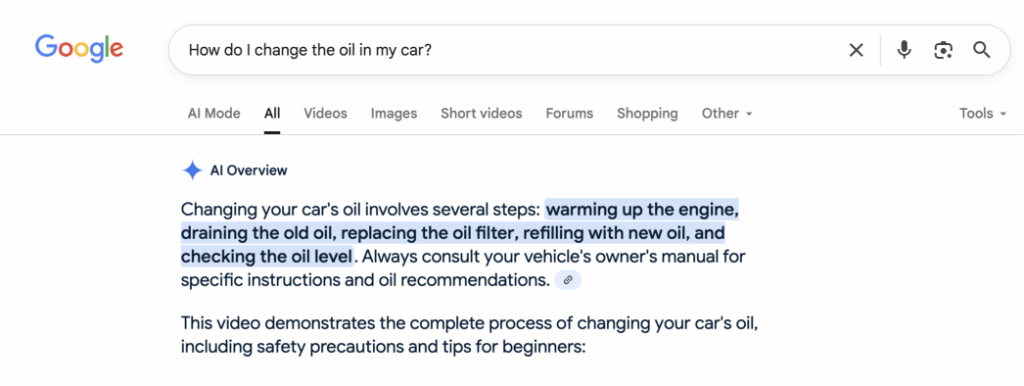
For search engine users, the rise of AI has made getting synthesized summaries of all the top internet easy. For companies and SEO experts, it involves figuring out how to adjust your content strategy to keep your content visible and to reach your customers. That’s why we’ve put together this guide on the future of AI search SEO to help you figure out where and how to tweak your content strategy to be ready for the growth of AI SEO.
Unlike traditional search engines that rely on keyword matching and indexed pages, AI-powered systems use large language models (LLMs) to interpret natural language in an attempt to deliver nuanced, conversational results.
Some of the leading AI search tools you may have used or heard of include:
Search is undergoing a fundamental shift that’s only getting started. In May 2023, Google began rolling out Search Generative Experience (SGE), now rebranded as AI Overviews, which places AI-generated responses above standard results. Microsoft integrated AI mode into Bing in early 2023 using ChatGPT-4, while platforms like You.com and Perplexity launched AI-first search tools that prioritize summarization and citations. Search engines now are prioritizing their own AI summaries at the top of the SERP in what used to be prime real estate for SEOs.
These AI tools are changing the way people interact with SERPs. In fact, a study from the Pew Research Center in May 2025 notes that people are significantly less likely to click on web pages listed in Google search results if there’s an AI summary present. They also only rarely click on the sources listed by the AI summary.
With the shift in how users interact with search engines, SEO is going to shift too.
Traditional SEO is built around optimizing for search engine crawlers and ranking within standard SERPs. This includes tactics you’re likely very familiar with, such as:
GEO—Generative Engine Optimization—targets AI searches. Large Language Models don’t crawl; they try to interpret the context and evaluate:
Because LLMs respond to context and credibility, not just ranking signals, you want to optimize content for semantic relevance, not just visibility. Adding GEO to your content strategy is another way to make your content visible in those AI-generated summaries—though traditional SEO still matters as well.
So if AI is going to change the way people search (and already is starting to do so), you need a content strategy designed to fit in that landscape. These are our four top tips for creating content that your readers will love and that works with AI.
Content these days has to walk a very fine line: being written for humans and for AI accessibility all at the same time. You don’t want to write a brilliant piece of long-form content only for it to be lost in the ether of Google, but you definitely don’t want to end up with AI slop. Some ways you want to cater your content for your readers and for AI include:
The goal here is to write content for your human audience but to make sure it’s fully AI accessible afterward. At the end of the day, good content is still king, so prioritize having well-written content and avoid losing that human touch while optimizing for AI search SEO.
AI works like any other search engine: it will rank your pages higher if they’re correctly set up with appropriate metadata. While AI tools don’t crawl the web like traditional bots, they still rely on structured, well-maintained websites. Technical SEO helps ensure your content is indexed by both search engines and used by AI models that reference top-ranking pages. Prioritize:
Just like with Google Search, AI systems reward content that’s well-structured and technically sound.
Optimizing for search engine results page (SERP) features can improve your visibility in both traditional and AI-generated summaries. Focus on:
Appearing in these SERP features improves your chances of being referenced by AI models—and therefore coming across your readers’ screens.
If you’re looking to build your pages in a way that makes it easy for AI tools to scan your content, focus on these five strategies:
By following these principles, your content becomes easier for AI models to recognize—which then helps you stay visible in the next era of online searches.
Even though it might feel like the search landscape is rapidly evolving, the core principles of technical SEO remain as important as ever. In fact, SEO hasn’t really changed—it’s only expanded to include AI searches. Staying on top of and implementing foundational technical best practices still pays dividends, both in traditional rankings and in AI-generated search results.
Structured data helps both traditional search engines and AI systems better understand the context of your content. Using it can help your content get featured in snippets and AI overview citations. To get the most out of your structured data:
Well-implemented schema makes it easier for AI systems to identify key facts and understand the relationships between ideas—boosting your content’s chances of being referenced in AI search results.
AI-powered search is no longer limited to just text, and your content strategy can capitalize on that. Many search engines and AI assistants now support multimodal inputs and outputs to blend text, images, and video to meet user needs. Make sure your site:
By incorporating diverse formats, you increase your visibility across a variety of SERP features. Your site could end up as the cited image in an AI overview or in an image carousel. That visibility will make your content more accessible and expand your reach.
All the general tips we’ve talked about so far are best practices for any type of AI search tool. While many core principles remain consistent, each model has its unique behaviors and ranking preferences. Some of the most prominent and widely used AI search engines—and the ones offering the most trackable performance insights today—include:

AI systems reward conversational content that mimics how people talk, so here are a few tips to optimize for conversational queries and natural language prompts:
By tailoring your content for the nuances of each platform—and optimizing for how people naturally ask questions—you’ll increase your visibility in both AI-driven and traditional search environments.
Traditional SEO tools may not yet offer complete coverage of AI-driven search experiences—but a new wave of reporting solutions is emerging to bridge the gap.
There are a lot of SEO metrics, but which ones matter for AI search SEO? Key metrics to focus on include:
Since AI search focuses more on credibility and relevance than on traditional rankings, visibility can come in the form of mentions and summaries rather than blue links.
While AI searches are still relatively new, there are tools that are adapting to help you keep track of your most important metrics:
As AI search adoption increases, expect more tracking solutions to emerge. Just like SEO matured with its own analytics stack, AI SEO reporting will become a core part of modern marketing analytics within the very near future. Start experimenting with these tools now to stay ahead of the curve and get a head start above your competitors.
Working with AI to produce AI-optimized content is increasingly essential. Modern AI systems—like ChatGPT, Gemini, and MarketMuse—can help you with identifying content gaps and topic clusters that you can write about, speed up the drafting process, and create content outlines for you.
Don’t think of AI replacing your content creators. Instead, pair AI with human experts to speed up the content creation process without losing what makes human-written content great.
Another way to AI-prep your content strategy is to apply the hub and spoke model. The hub and spoke model is a content architecture that creates a central “hub” page targeting a broad, high-value topic, supported by multiple “spoke” pages that address related subtopics in depth. Each spoke links back to the hub and to one another.
For example, when Maveneer came to 97th Floor in 2023, they wanted content that would rank, so we gave them a hub and spoke strategy with comprehensive overview hubs targeting keywords like “warehouse automation” and “order picking.” After establishing those hubs, we could expand to spokes with drill-down articles like “order picking technology” and “automated sorting systems” linked to and from the hub. This structure improves internal linking, site navigation, and topic authority to search engines and AI systems alike. In fact, for Maveneer, their domain authority R skyrocketed from 3 to 34, and they saw an 886% increase in search impressions YoY.
Search is evolving—and fast. More people are relying on AI to answer their questions and give them potential solutions. With AI browsers popping up, there are only going to be more AI search developments. These platforms don’t just display a list of blue links. Instead, they generate dynamic responses by pulling insights from multiple sources, often without traditional attribution or visible rankings.
For enterprise brands, this shift has major implications.
In this new paradigm, visibility isn’t just about ranking #1—it’s about being referenced, cited, or summarized by AI models at the moment a customer asks a question. Failing to adapt means losing organic visibility at critical touchpoints—especially early in the customer journey when buyers are still gathering information.
Enterprise brands that invest in AI search SEO now can make sure they’re ahead of the curve and stay visible. AI isn’t replacing internet searches—it’s reshaping it. And enterprise brands that evolve their strategies now will be best positioned to lead out in the next era of SEO.
If you're ready to show up in AI-generated results, let's build your strategy.
Is user confidence in online content at an all-time low? AI-generated content dominates many key topics, and users can easily find themselves frustrated when searching, finding articles they could have generated directly from a chatbot themselves. There is also an increasing volume of content that is becoming commonly known as “AI slop.”
And that’s without getting into the other struggle: LLMs are not only competing for eyeballs on regular search engines, but also stealing traffic directly. As a result, sometimes it can feel like the rest of us are left to fight over scraps.
If the current outrage over AI slop proves anything, however, it’s this: users still want good content. And marketers still want to give it to them. So — with the internet noisier and more crowded than ever — how can we complete the matchmaking experience and find each other?
At 97th Floor, we have cracked the code, and we can prove it.
A brief history lesson
The internet has always been noisy, overcrowded, and full of shoddy content churned out by marketers hoping to maximize their reach. While many of us like to think of marketing as a noble profession (we are helping people solve their problems!), there will always be those who act in bad faith, trying to game the system however they can. It’s the whole reason “black hat” marketing exists.
Luckily, Google is fighting the good fight, and every update they have made over the years is done so in an attempt to improve the experience of the user, and get them closer to the type of content they need. This means that those focusing more on gaming the system and less on quality content are the ones who are typically hit the hardest by algorithm updates.
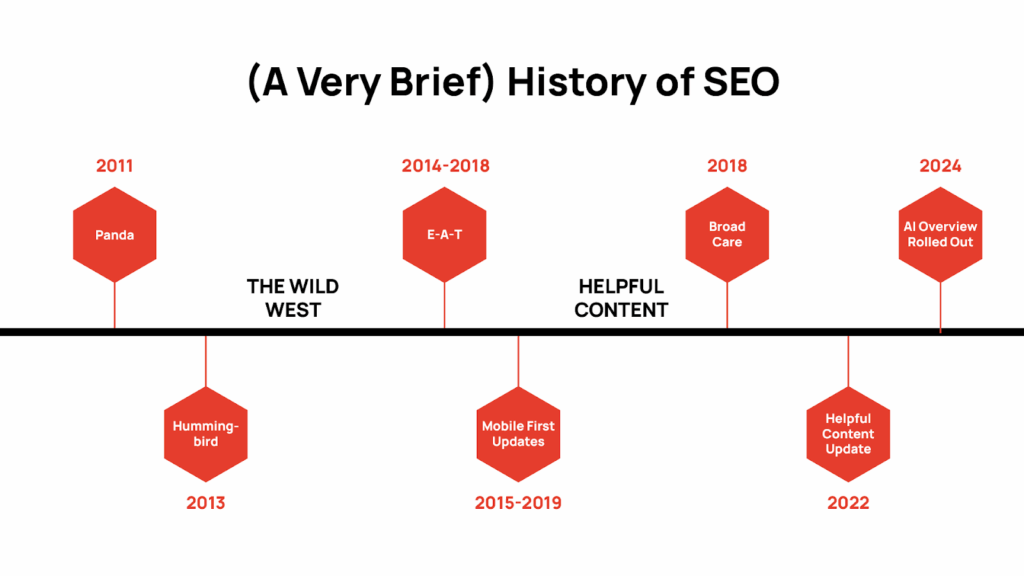
It’s the reason why, if you have been anywhere around content marketing, SEO, or even digital marketing in general for more than a few years, you will no doubt remember getting asked a question a million times, akin to “how do you balance SEO content and quality content.” Real ones know the truth: the best “SEO content” has always been high-quality content. And that kind of content is what has the power to withstand just about any algorithm update.
If that is not reason enough to focus on high-quality content, then let us also add this: The cost of bad content is steep. Analytics company CreativeX recently recently found that the average Fortune 500 company wastes approximately $25 million annually on content that fails to reach its intended audience or is not fully utilized.
It should come as no surprise, then, that the answer to combatting the current cacophony of AI slop is infuriatingly simple: produce high-quality content.
Ok, But…What Actually Is High-Quality Content?
I know, I know, that’s an incredibly unhelpful piece of advice. Because of course, anyone can claim to produce “quality content” but that means different things to different people. So, what do we mean when we say quality content? 97th Floor has a few principles that we have always lived by when it comes to both content and marketing in general.
1. High quality content is audience-focused
One of the main things that people get wrong about content marketing to this day is the how behind making the content itself audience-focused. As marketers, we can get caught up in how great we believe our solutions to be, that we get evangelical about the value that they bring — resulting in us pushing those solutions on our audience, rather than helping them. Quality content starts from a place of “what does my audience want or need?” rather than “what can we as a brand give our audience?”


| ❌ | ✅ |
2. High quality content is relevant to your brand
Ok, so you have figured out what the audience needs, and you have a ton of great content ideas. The next pitfall that marketers commonly fall into is trying to write everything. To illustrate: Take a quick moment to Google “best” anything and look at all of the sites that wrote about it, despite it being completely unrelated to their brand, product, or mission.
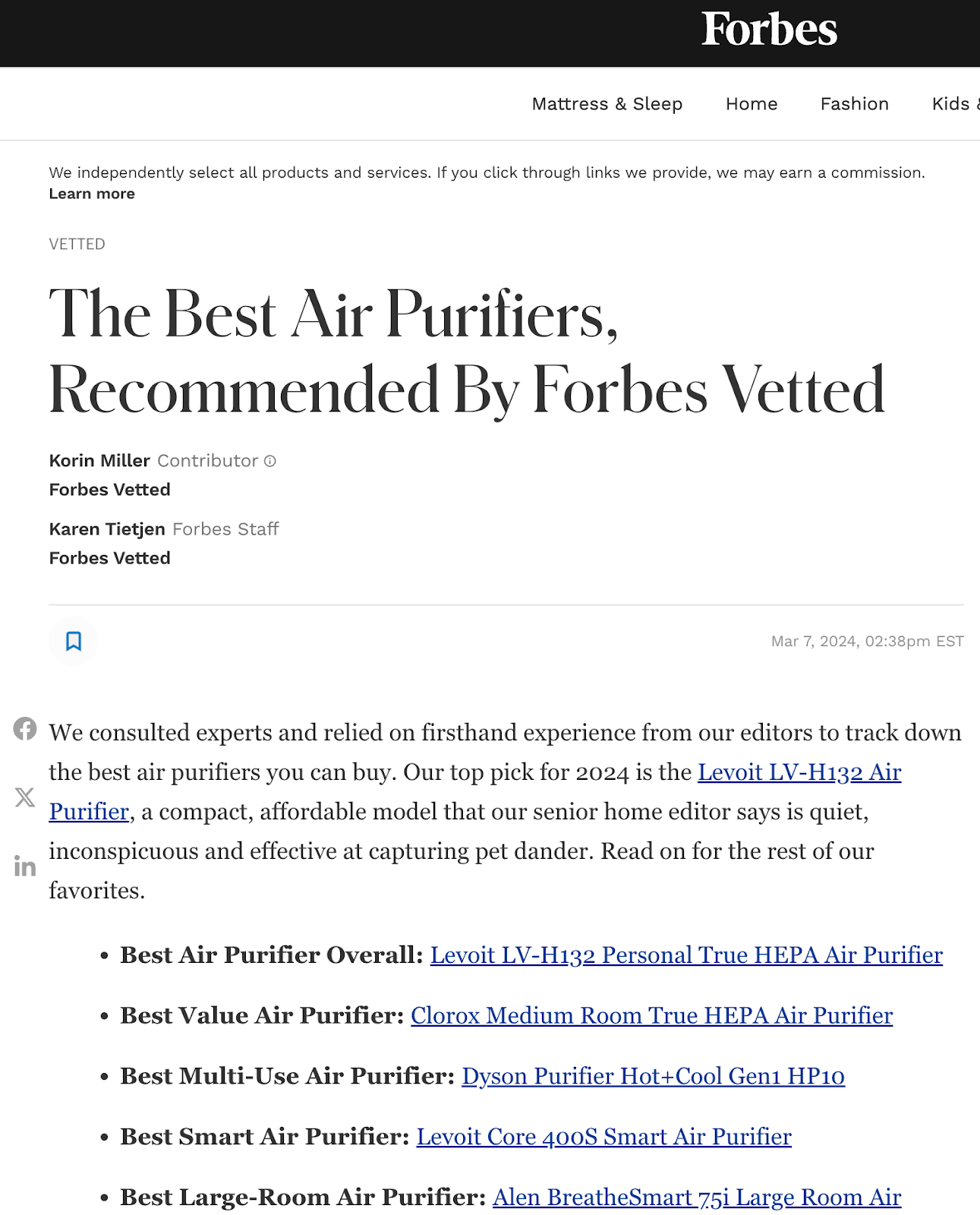
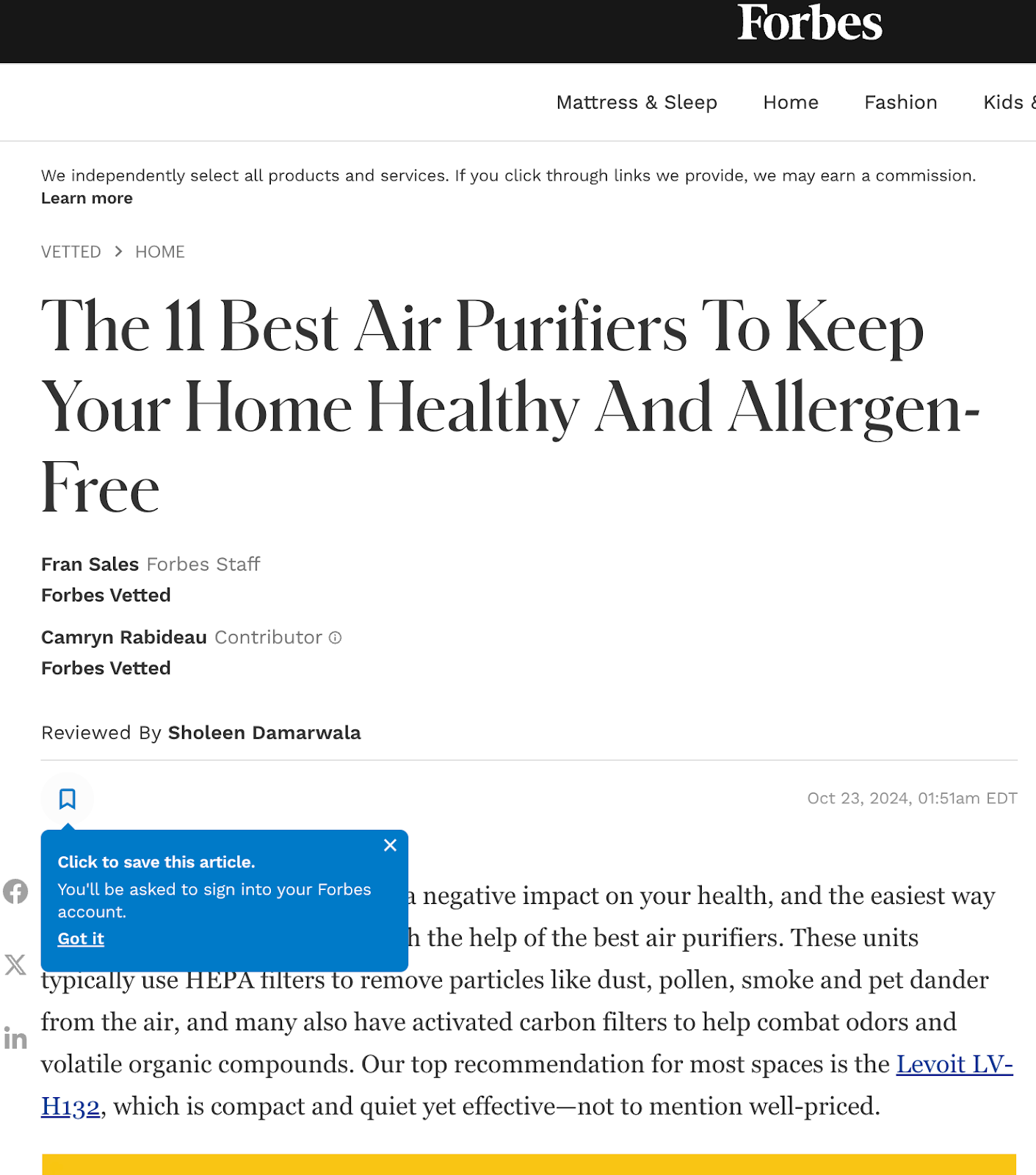
3. You are an expert and/or uniquely qualified to write this content
Authority matters. You might think this is the same as number two, but there’s a slight but significant difference. Something may be relevant to your brand, but you still have to prove yourself uniquely qualified to write it. This might come from expertise, experience, unique insights, or all three. This is also where the human element comes into play — even before AI, but especially now — users want content that they cannot simply generate by asking an LLM themselves. A unique and specialized point of view is more important than ever.
You may have noticed that our three quality content criteria and the use of AI are not mutually exclusive. On the contrary, we are not anti-AI evangelists. In fact, we use AI regularly to aid in efficiency and accuracy in the content creation process. However, it is rare (perhaps impossible) for a piece of content to match all three criteria without first passing by a human expert.
A survey conducted by consulting firm Baringa provides insight into opinions regarding AI-generated content by internet users. A majority of respondents identified at least one reason to value human-generated content above AI-generated content, with 81% citing “authenticity” as the key feature. However, users did not overwhelmingly state that they would avoid AI altogether — especially when it came to the younger demographics.
The fight for quality content is not a fight against AI, rather a delicate dance to make sure that it is used in the most effective way possible.
I Thought You Said You Could Prove It?
Ok, sounds like a nice theory, but does it actually work in practice? And can you prove it? In fact, we can. We have a proven history of this approach to content succeeding time and time again — surviving algorithm updates, changes in user behavior, and more. Here are a few examples.
Blendtec
Earlier, we made the claim that high-quality content will stand the test of time — and withstand algorithm updates. A perfect example of this is an article from way back in 2014 that we produced for Blendtec. A simple listicle of peanut butter smoothies, and accompanying recipes.
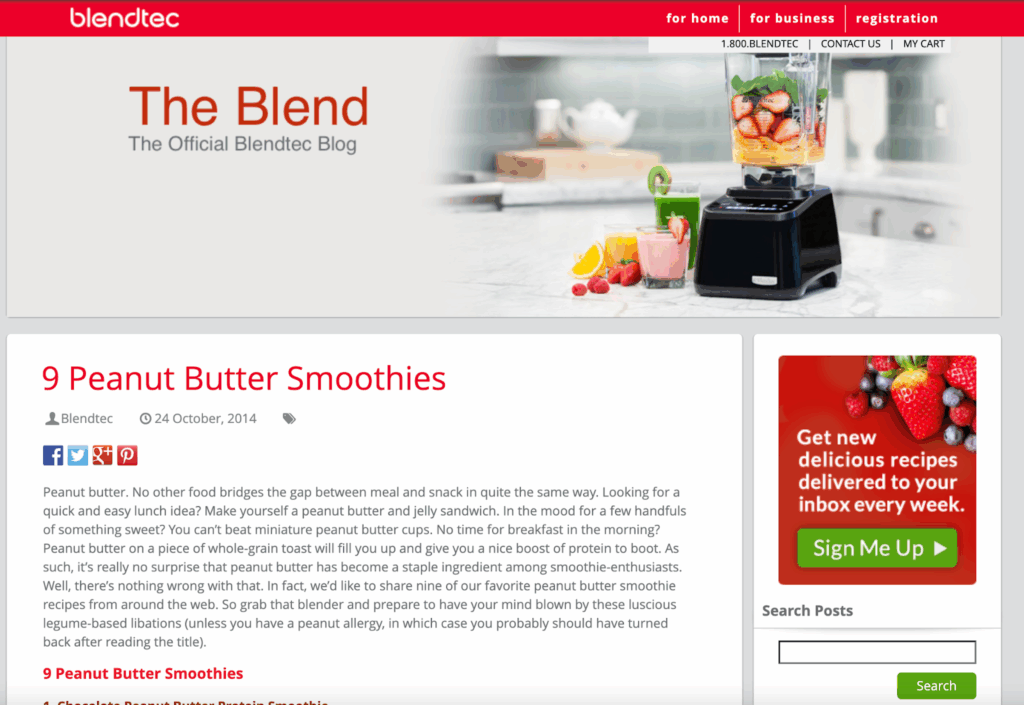
It meets our three criteria to a T and was incredibly successful when published. It continued to rank for several important keywords and survive several algorithm updates over the course of the next 10 years, to remain a top-three traffic driver for the site.
Dr Will Cole
Another example can be found in this guide on increasing progesterone levels for Dr Will Cole that we published and optimized in 2022.

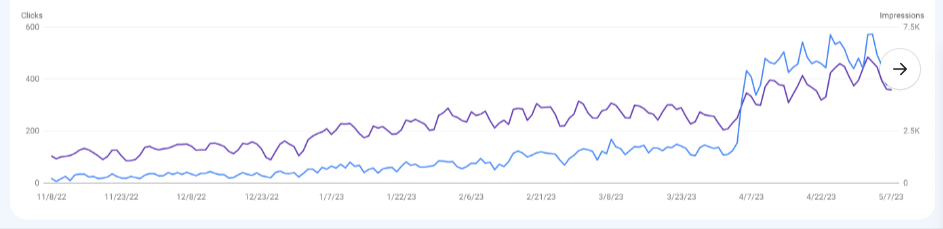
This article saw its biggest jump in traffic after an algorithm update in April 2023.
General Kinematics
But what about now? When AI is everywhere and AI Overview is stealing traffic from many pages. Well, we have countless examples of content that has survived the recent AI-pocalypse through following this simple formula for high-quality content. One such example this simple article for General Kinematics about uses for potash.
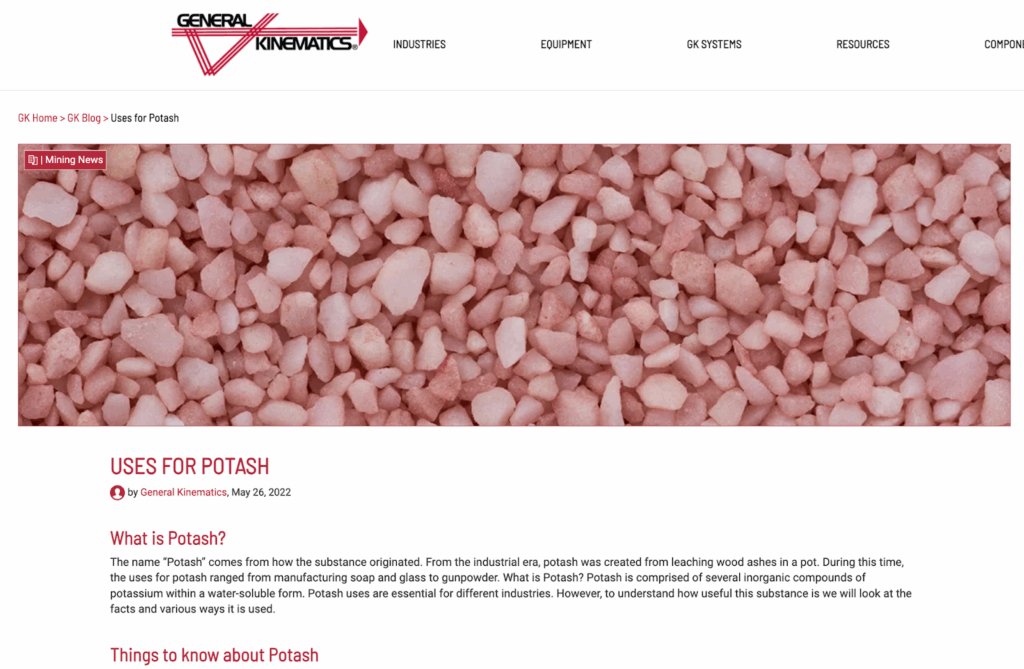
This content is audience-focused, brand-relevant, and something that General Kinematics — a producer of mining equipment — is uniquely qualified to write about. Published in 2022, it was automatically featured in AI Overview upon rollout of the feature in 2024, and has continued to do so since. What’s more: This page actually saw a 60.4% increase in traffic when you compare pre-AIO rollout to post-AIO rollout.
The bottom line: Google agrees with us. Every major and minor Google update in the past decade and change has been to get the search engine closer to prioritizing one of the three facets of quality content as identified by 97th Floor. For example:
1- Helpful content and other updates intended to prioritize user-first content.
2- Updates around brand authority, including recent updates that are deprioritizing irrelevant content for brands (or worse, brands that have spread themselves too thin and made it difficult for Google to assign authority).
3- This one goes beyond Google. Consider this: In a study of hundreds of thousands of citations, the most cited content type was product pages — by some margin. This means that this facet of quality content matters two-fold: Generic blog content is most likely to be directly replaced by LLMs, and product content — i.e. content that you are most uniquely qualified to write — is most likely to be cited. With optimizing both for and against LLMs becoming an increasing priority, this may be the most significant quality content guidepost of all.
I called out just three examples of this, but there are many more where that came from, and so will that continue.
The pattern across every one of those examples points to the same underlying truth. SEO expert Eli Schwartz makes the case that LLM visibility isn't a data or technical problem — it's a brand problem. This short video captures why the brands that consistently show up in AI-generated answers aren't winning on data. They're winning on authority.
Why It Matters Moving Forward
We talked about the ever-increasing noise of the internet. IBM predicts that AI will only continue to expand over the next decade, influencing more than content creation. High-quality content will continue to perform through both search engines and LLMs. The challenge or “noise” as marketers used to be different, but the solution is the same. If you put your audience first and prioritize quality content, the cream will rise to the top every single time.
Further Reading
Of course, that’s only part of the story. Sometimes you have to give even the cream of the crop the best chance to succeed. Next time, we’ll talk about how to get the most out of your content with an audience-first strategy.
If you're ready to show up in AI-generated results, let's build your strategy.
We’ve all felt it. You pour time into high-quality content, only to see your organic clicks drop—despite impressions climbing. What gives?
Welcome to the era of AI-powered search.
Google’s AI Overviews (AIO) and other generative engines are changing how people discover and engage with content. The game isn’t over—it’s evolving. And if you want to keep winning, it’s time to optimize not just for traditional SEO, but for AI-powered results.
At 97th Floor, we’ve spent the last year testing and refining strategies that help our clients show up and stand out in AI results. This guide breaks down what we’ve learned and how you can use it to grow.
Here’s a fast-track checklist that we stand behind:
We’re seeing a clear trend since the advent of Google’s AI Overviews:
This shift in metrics is significant. Your content is still being seen, but it’s not driving as many clicks.
This is largely due to AI Overviews, which are providing answers directly in search results—without users even having to visit your site.
In fact, research from Ahrefs revealed that AI Overviews reduce clicks by 34.5%. They analyzed 300,000 keywords and found that the presence of an AI Overview in the search results correlated with a 34.5% lower average clickthrough rate (CTR) for the top-ranking page, compared to similar informational keywords without an AI Overview.
This doesn’t mean SEO is dead. It means that SEO needs to evolve.
With this change in how users interact with search results, it’s important to note that KPIs are shifting. While clicks may be down, impressions are up—and brand mentions and search visibility are becoming increasingly valuable metrics. It's no longer just about tracking clicks; it’s about how your brand is being mentioned and perceived in the broader conversation.
At 97th Floor, we’re helping brands adapt to this new search landscape. We’re testing what works—and what doesn’t. In this article, we’ll walk you through how to optimize for AI and stay ahead of the curve.
AEO (Answer Engine Optimization) – Structuring content to appear in AI-generated answers and summaries (like Google's AI Overviews).
GEO (Generative Engine Optimization) – A broader strategy to improve how your content appears in LLM-powered results, including chatbots and voice assistants.
Other helpful terms:
Yes. But traditional SEO on its own won’t cut it.
GEO and AEO prioritize intent, clarity, and usefulness over keyword stuffing or link volume. Search engines (and AI tools) want to deliver satisfying answers, not just keyword matches.
Good keyword research still matters—especially when it covers both primary and secondary search intents.
Unlike traditional SERPs that rank blue links, AI search engines pull and generate answers using two main data sources:
They look for:
Here’s the opportunity: content that works well in LLMs often also ranks well in traditional SERPs. Optimizing for both doesn’t require two strategies—it just requires a smarter one.
AI content optimization is the process of structuring, writing, and formatting your content to be more useful and accessible to AI tools, without losing sight of your human audience.
Let’s be clear: the goal is not to “hack” the algorithm. The goal is to help people. To provide persona-driven content that resonates.
Too often, we see content stuffed with keywords or unrelated FAQs just to rank. That’s not helpful. It’s not what AI wants, and it’s not what readers want either.
Before you go all-in on optimizing for models instead of humans, this quick video breaks down why that approach can actually hurt your content’s real-world performance.
Start with your audience. Understand who they are, what they care about, and how they search.
Consider using audience insights to build Custom GPTs that speak in your brand voice and match your customers' tone. (Here’s a screenshot of what it looks like in ChatGPT to configure a custom GPT.)
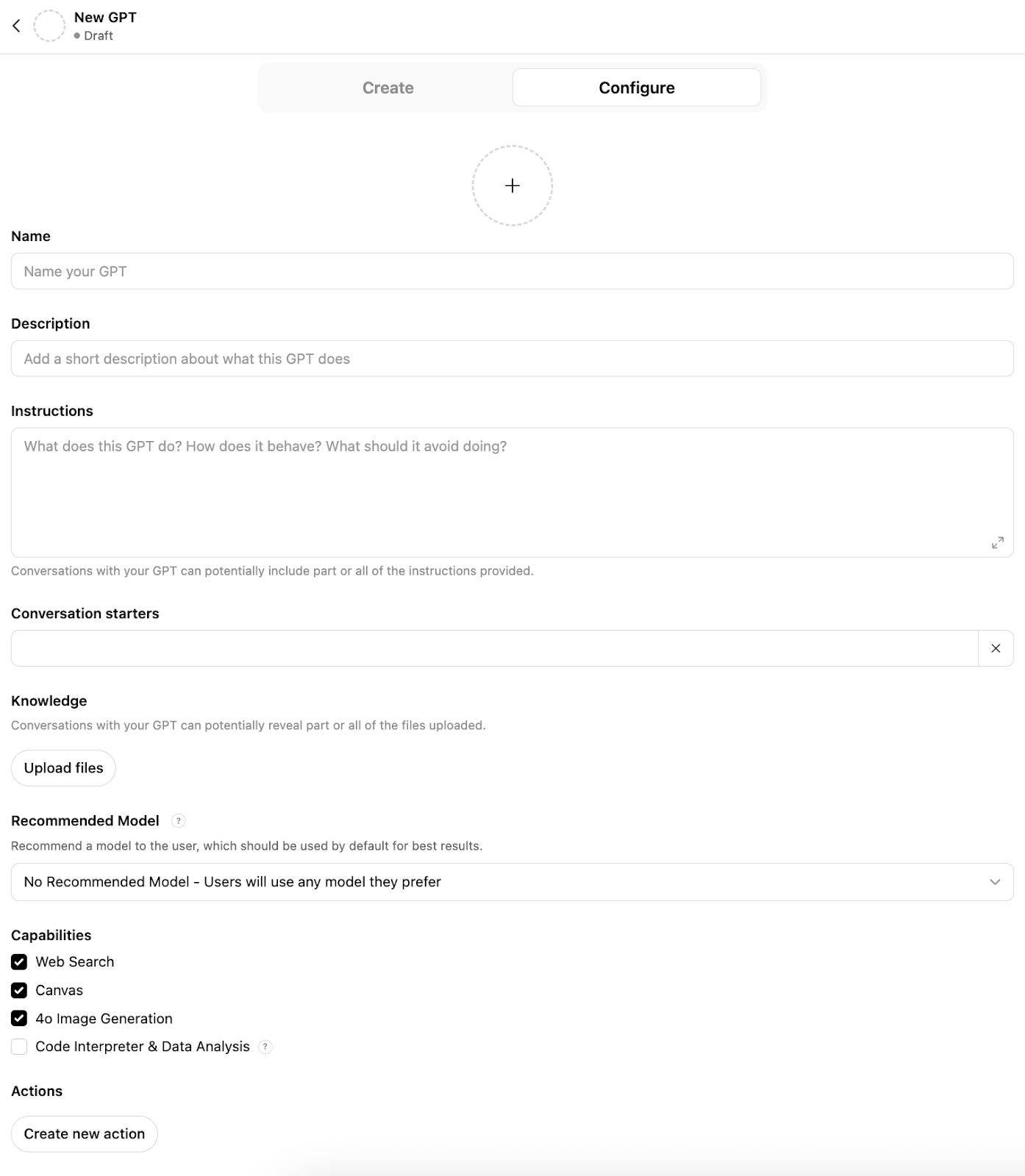
We also recommend:
Start with the answer, then explain it.
Example:
Q: How do I optimize for GEO?
A: Focus on clear, structured answers, semantic HTML, and direct responses to user queries.
Then go deeper.
Also:
AI favors content that’s easy to parse. That means:
97th Floor Test Results:
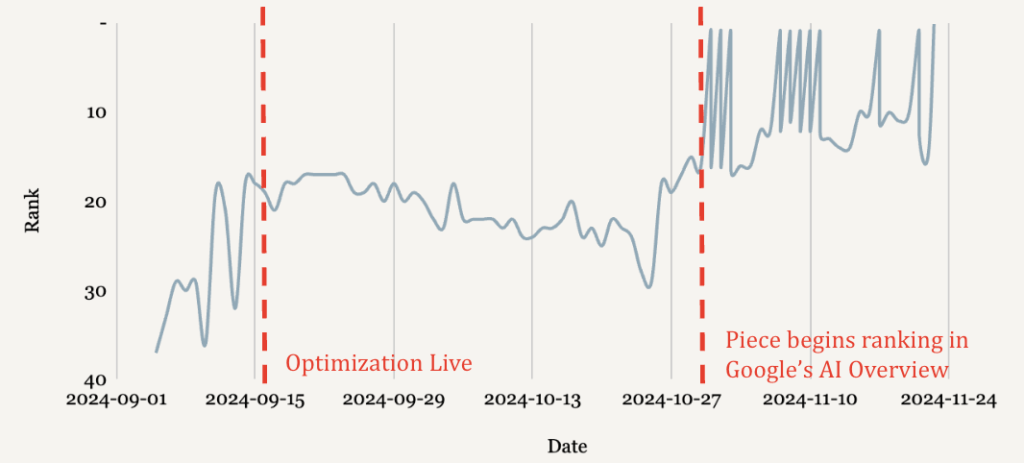
After adding bullet points and clear heading structure to a product page for a 97th Floor client, impressions and AIO rankings for an SEO-optimized article skyrocketed from ranking on the third page of the SERP to the first page (and ranking in Google’s AI Overview) in a short period of time. Here’s the results:
AI wants to serve trustworthy content. Show yours.
Ways to do that:
97th Floor Test Results:
By focusing on tightly-knit topic clusters, we were able to achieve topical authority for Princess Cruises:
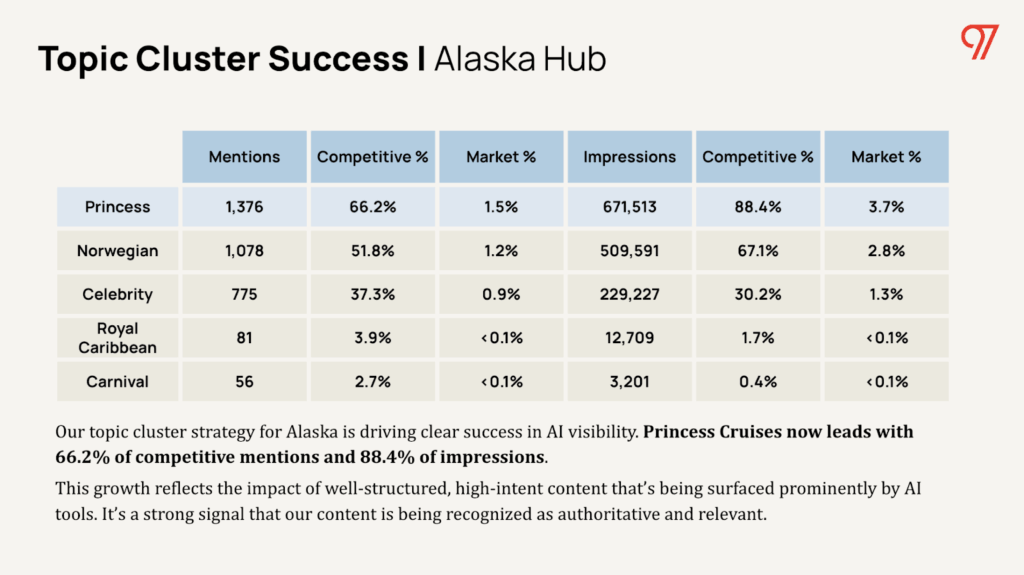
AI search engines increasingly value content from recognized, authoritative sources. This makes brand pages, like your About Us or Homepage, vital for building trust with both AI and human users. Additionally, third-party citations, such as mentions from reputable websites or reviews, are becoming more influential in how your content is perceived. Ensuring your brand is recognized across the web not only boosts authority but also increases your visibility in AI-driven search results.
AI is already reshaping how people find information—and how businesses earn attention.
At 97th Floor, we’ve helped our clients weather the shift from traditional SERPs to AI Overviews and GEO. Our strategies have earned AIO features early and consistently. And we’re continuing to test and refine what works as the landscape changes.
See how an audience-first approach translates to bottom-line results.
On all counts, the Oil and Gas market is more volatile than most. Globally, prices fluctuate, regulations evolve, and supply and demand shift. Regionally, each market has unique dynamics, all dependent on macroeconomic variables like rising material costs and high interest rates, not to mention unique location-specific changes in supply and demand. Being a marketer in this arena demands a solid foundation in industry trends to make the smartest marketing decisions. Maintaining a clear Oil and Gas marketing strategy is the blueprint that guides every touchpoint between your brand and your potential buyers. It outlines who you’re targeting, the channels you’ll use, the messaging that resonates strongest, and the tactics needed to generate meaningful revenue.
However, most brands in Oil and Gas haven’t refreshed their marketing strategies in years. This leaves an opportunity wide open for savvy digital marketers.
We've dug deep into the most recent industry data and our own two decades of experience to provide you with a how-to guide on how to take advantage of this exponentially growing market. We’ll walk through the core components of building that strategy — from segment analysis and target market selection to developing a strong brand position that resonates in this complex landscape. We’ll also break down how to build a comprehensive marketing plan and how to leverage digital channels that drive measurable growth for Oil and Gas companies. With the right foundation, your team can stand out in a market that’s more competitive and more opportunity-rich than ever. Let's get right into it.
The oil and gas market is broken down into segments. If you haven’t yet, a good first step is to analyze each to find where your brand best fits in the flow. This allows for targeted marketing, laser-focused on which part (or parts) of the market you’re planning to win. Whether you and your team choose to focus on:
You’ll need a full understanding of each segment's needs and challenges to build the marketing strategies that place your brand in an optimal position and maximize your ROI. Each market has specific advantages and drawbacks.
Evaluate the potential ROI and align your marketing goals with the most promising markets. Choosing the target can make or break your marketing efforts. Trust us, taking the time to do the research will be the difference between a major win or a budget-crushing fail.
Customer Profiling and Targeting
Always know who you’re selling to. In the oil and gas industry, this could mean large corporations, smaller service providers, or even local governments. Carefully identify these key players and tailor your marketing efforts to meet their specific needs. It’s your job to connect as deeply as possible with your target audience. Potential customers are looking for personal connections with the brands they buy from, currently an uncommon occurrence in this market. This opens a window for you to step in and step up.
That window stays open only as long as your competitors remain comfortable. Marketer Sterling Snow calls this advantage "creating the channel" — and the brands that claim it first rarely give it up. When every player in your category is competing for the same keywords, the same trade media, and the same conference floors, the real leverage is in the channel nobody's thought to build yet. This short video captures why owning an uncrowded distribution channel — before your market wakes up — is one of the most durable advantages in B2B marketing.
Once you've identified your customers, the next step is to understand their behaviors. What drives their purchasing decisions? What are their pain points? What motivates them? What risks are they concerned about? Think about every step they’ll take on the buying journey, how they make decisions, and how you can meet their specific needs.
Once you’ve identified and worked to understand your audience, create a persona to represent your research. A clear, thought-out buyer persona will guide all your subsequent marketing efforts. Keep your persona in mind as you plan strategies and build campaigns. The more personalized and specific you are, the more likely your messaging will resonate with potential buyers. Here's an example Buyer Journey/Persona our team at 97th Floor recently created for General Kinematics.
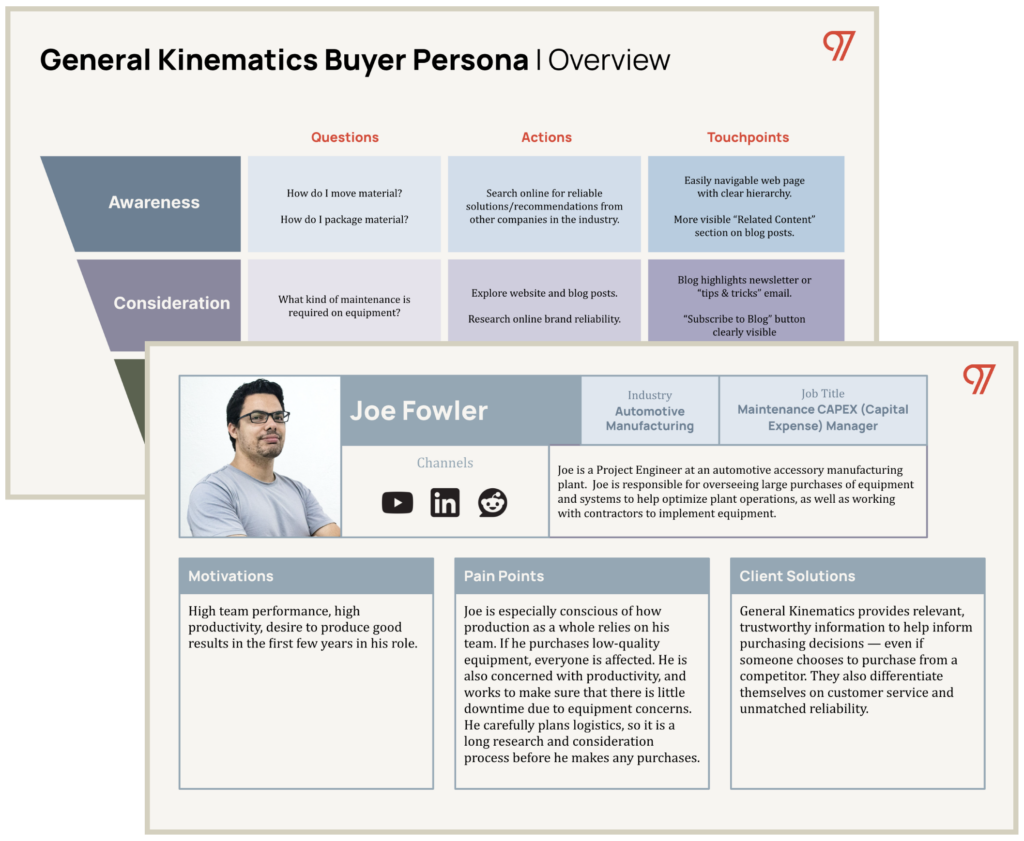
Your brand identity is what sets you apart. Think it through – what makes you different from other businesses in the industry? What are your specialized offering points? Focus on what makes your company unique, whether it's innovative technology, exceptional service, or a strong commitment to sustainability. If you’re looking for a place to start, begin by collecting reviews or interviewing previous customers for their opinions on what you do best.
With your identity in mind, work to position your brand in a way that highlights these strengths to appeal to your target audience. Clear, consistent messaging across all marketing channels is key. To pinpoint what messaging resonates best, you can give A/B testing a shot. Most importantly, always look for new opportunities to demonstrate your value through every medium. Case studies, visual data representations, and customer reviews are common ways to do this.
The battle’s not won yet, sustaining your hard-earned digital clout isn’t an easy process. Building a strong brand reputation takes time and effort. Maintain transparency, deliver on promises, and engage with your audience consistently to keep your brand's reputation positive. This needs to be an integral part of your marketing efforts.
Developing a Comprehensive Marketing Strategy
Supported by your clear brand identity and ideal customer targeting, it’s time to build out a digital marketing strategy. First, define clear, achievable marketing objectives. Whether it's increasing brand awareness, generating leads, or boosting sales, having specific goals helps measure success. Keep track of your goals and efforts to achieve them to celebrate success and identify opportunities for improvement.
A well-developed marketing strategy, especially in Oil and Gas, involves sub-strategies including
Marketers across the field agree, almost every part of digital marketing revolves around a well-optimized website. It's no different in Oil and Gas, your website is your digital storefront – the place all potential customers will navigate to on their path toward a purchase. It needs to be user-friendly, informative, and most of all, optimized for search engines to attract organic traffic. Use tools like Google Analytics, Search Console, and HubSpot CRM to track visitor behavior and optimize performance. Learn more about SEO strategies here.
Social media platforms offer a space to connect with your audience, share industry insights, and showcase your company’s culture. Regular, engaging content helps build a loyal following. Depending on your business, goals, and strategies, social media may or may not be a place to focus your budget and time.
Quality content drives traffic and builds trust. Create valuable content that addresses your audience's pain points and positions your company as an industry thought leader. Publishing content also drives your SEO. Learn more on how to set up a consistent content strategy here.
Regularly analyze your marketing efforts to measure ROI. Use analytics tools to track performance and adjust strategies as needed for continuous improvement. Keep in mind that metrics like impressions and leads can be a great start, but the end-goal of marketing is to generate conversions. Successful marketers make money. If ROI is stagnant, the marketing strategy is too.
By targeting the right segments, fine-tuning your strategies, and focusing on persona-specific messaging, you can position your brand as a leader in this digitally stagnant market. In Oil and Gas, staying ahead requires a laser focus on your goals and your audience's needs. Find ways to set yourself apart and continuously refine your strategies. With a well-crafted Oil and Gas marketing strategy, you’re ready to take advantage of the market and win contracts like never before. Good luck!
Want to kickstart your marketing dreams? We're here to help.
A recent 97th Floor survey of SEOs revealed that "not enough leadership support" is the biggest challenge SEOs face in getting projects moving. The second biggest obstacle, "not enough budget", is often a bi-product of leadership support.

Getting leadership buy-in on the long game of SEO can be hard - especially when other channels are more quickly proven.
That same tension lives in every long-game strategy, and the challenge of getting buy-in goes beyond presenting better data. Bringing a skeptical team along before results are visible is one of the most underrated leadership skills, and most practitioners figure it out the hard way.
Daniel Nisan, startup founder and operator, shares the specific approach he's used to move teams from doubt to conviction — without waiting for results to do the convincing for him. This short video breaks down how to turn your most skeptical stakeholders into your most committed advocates.
Use these three tips to win the hearts of leadership and sell your SEO strategy.
You’ll be a whole person ahead if you have someone in leadership who believes in the massive potential of SEO. Which decision maker seems the most interested in SEO? Who can be a voice for SEO in decision-making meetings?
Identify this stakeholder and then involve them in your SEO work. Consider pitching this executive first, or otherwise involving them in your strategy development. Communicate with them often and be sincere in your efforts to collaborate with them.
This individual’s enthusiasm for SEO, strengthened by their invested time with you in strategy, can make all the difference in prioritizing SEO projects and getting you budget.
To increase the resources coming towards SEO efforts, you need to create urgency by showing the consequences of neglecting SEO—the opportunity cost.
Tom Capper, Senior Search Scientist at Moz, agrees that "when dealing with larger organizations, it's common practice to spell out and estimate the positive ROI of action. What's less common is to spell out the risks of inaction, but often large, established brands, who have a lot more to lose, find it easier to act on this kind of rationale."

Low priority SEO may not sink your company, but how can you show leadership the lost potential (read: revenue) of failing to start?
We have found that competitive comparison as quantified by market share is one of the most effective ways of demonstrating the opportunity cost of neglecting SEO—market analysis is one of the most important jobs of top-level leadership.
Sam Oh, VP of Marketing at Ahrefs, says, "One of the best ways for SEOs to show value to top-level leadership is through competitive analysis. It’s best when you can show it visually in graphs and then add context to educate leadership about what’s happening and why. It may be obvious that a competitor’s organic traffic is exploding, but help leadership see what tactics and strategies would be in play and how long it realistically takes to see results like this."

You may also want to demonstrate the opportunity cost in terms of savings.
Crystal Carter, Head of SEO Communications at Wix, puts it this way, "Leadership cares about revenue, but they also care about savings. Learning your customer’s journey can reveal content that can save the business time and energy. For example, if you learn that customers often contact customer service with the same question, create content that answers that question. This way, your customer service team is addressing real needs instead of sharing basic information.This saves time and energy, while also increasing value for your users."

SEO is a long game. If you want to minimize the irritating, “are we there yet,” conversations, consider handing leadership a map.
Based on your strategy, identify what immediate wins (or signals) leadership can expect, and how long it will take for SEO efforts to reach the bottom line. Set expectations for reporting frequency and metrics.
Perhaps most important, acknowledge to leadership that SEO is impacted by many things that are not in an SEOs control.
Ancestry’s John Crockett explains, “SEO is measured based on what’s going to work and what’s not going to work. We’re only one part of that. We have to worry about how Google’s going to interpret new initiatives. We also have to worry about what our industry competitors are doing. We have to worry about what our search competitors are doing.”

It is imperative that you clarify the difference between branded and non-branded keywords. Distinguishing between the two will help you explain variation in traffic that is unrelated to your SEO work. Branded keywords are heavily dependent on external factors like PR, TV and advertising. Non-branded keywords are in the scope of SEO, so try to delineate and report the traffic, keywords and revenue for non-branded keywords.
By keeping goals specific, timelines clear, and confidently pitching SEO as an important strategy supported by your SEO stakeholder champion, you can win leadership favor and a signed check for your great work.
Inevitably, you’ve discovered technical issues that are hampering your organic growth—and you need development to tackle these optimizations. But getting the ear and time of dev teams can be extremely challenging amongst all the non-SEO initiatives they’re tackling.
Frequently, SEOs will find themselves in these scenarios:
Josh Moody, 97th Floor Executive Director of Palomar, offers five tips for reducing the friction between SEO and development:
Instead of trying to bend development to your SEO-strategy, learn how your development team operates and consider how you can amend your SEO strategy to fit into their existing process.
Get curious about your dev team:
Adjusting your strategy cadence to be more development-friendly decreases frustration for both SEOs and developers.
Before sending over a long list of optimizations, consider how development thinks about implementation. To begin, they’re using a completely different vocabulary than you use. Why in the world are we talking to developers about “optimizations?” Let’s try “bug” instead. Submit tickets, not slide decks.
Ancestry’s Director of SEO John Crockett advises, “Understand a developer’s world enough to talk to them intelligently. I don’t get too much into the solution with them, but I do know enough coding and engineering to be prepared in those meetings with an idea of how we’d accomplish it. Doing the research has taken projects from being labeled as impossible to being done.”
Be respectful of the developer’s expertise. Don’t assume you know what a fix will require from them, but come speaking in their language to show you’re ready to collaborate.
Marketers are always trying to create a story for their target audience. For SEOs, developers are your audience and you should structure your story using the following three components: user description, functionality, and benefit.
Here’s the formula:
As a [description of user] I want [functionality] so that [benefit].
For example,
“As a new or existing website visitor, I want to ensure text remains visible during the page load, so that I can have a better user experience, especially if I’m on mobile devices with a slow network.”
This reads a lot better than “make text visible while the page is loading,” and helps a developer understand why your requests are worth their extremely-limited time.
Writing like a developer is a learnable skill, not a personality trait — Whitney Goldstein makes the case. This short video breaks down what it actually takes for a marketer to close that communication gap.
Get as clear as possible about the problem you are trying to solve and the role development will play in solving the problem.
There’s a huge difference between, “Could you add Google Analytics to the site?” and “Could you add the following JS tracking code to the site via each page’s header?”
A developer’s kryptonite is scope creep—changes made to the project push schedule, budgets, or resource allocation—and every time more clarification is needed, deadlines are at risk. Get clear by helping the developer know exactly what you need from start to finish—you’ll get more accurate estimates and preserve the relationship you’re working so hard to keep with them.
Need a change and want it a certain way?
Phrases like “Add some zing” or “make it more punchy” leave way too much room for interpretation. Whatever those phrases conjure up in your head are drastically different than what it may suggest to a developer. Obviously, you’d never use “zing” or “punchy”, but maybe you’re using other terms with subjective meaning.
Sharing examples side-steps this problem altogether. The best kinds of example you can share are:
Search around Dribbble and other sites to show development what you mean by “zing.”
Bonus Tip: Once a project is completed, share wins with the development team who helped you complete them. CC the boss. CC everyone. Get excited about the ways that SEO is improving customer experience and showcase how each person contributed.
SEOs, remember that your relationship with development is a partnership. Make dev your friends by understanding their world. Developers think literally. They are also extremely busy. Make their job as easy as possible, and your SEO implementations can happen faster and with greater precision.
Organic backlinks are links from other websites that point to your pages because your content earned their attention. These links come from genuine editorial interest, not payment, link schemes, or automated tactics.
This makes them especially valuable: each link signals that your content brings something new, relevant, or useful to the industry. Search engines use these signals to evaluate trust, relevance, and authority across your site.
Organic backlinks play a critical role in long-term SEO growth because they strengthen your entire domain, not just a single page. When reputable sites link to your content, search engines recognize your brand as a trustworthy source, which boosts domain-level authority and lifts keyword rankings across competitive categories. Beyond visibility, these links also enhance your brand’s credibility within the industry and create momentum for future content to perform even better. The more relevant and high-quality backlinks you earn, the more your entire site benefits.
Manual, one-off link building campaigns are essential for going after specific "money" pages and keywords, especially for long-tail keywords with less competition. Guest posting can help in these individual URL scenarios, but this won't boost overall domain authority.
Your best play for a massive website is to run large link-building campaigns. We’re recommending full-funnel brand awareness campaigns that will earn organic links as you pull tons of visibility. But these aren't simple:
There's no formula for making these campaigns happen, but these principles put you in the best place for success.
Be curious. Ask yourself question and go through the mental exercise of finding insights in data. These link building opportunities will not arrive pre-packaged. Be constantly exploring Ahrefs' Content Explorer, Google Analytics, or any other source of valuable data. We recommend scheduling time daily or weekly to do this.
Sam Oh, VP of Marketing at Ahrefs, has great advice for SEOs ready to get started with this practice: "SEOs should be regularly looking at really good data sources and asking themselves, what’s happening here? And why did it happen? You might not always have the right answer. You might not figure anything out for the first week. You just feel like you're looking at numbers and letters, but you are exercising that muscle of exploration and curiosity. Then all of a sudden connections start to make sense. We have everything in front of us and that data is painting a story that can inspire creative link building opportunities."

The heart of any successful marketing campaign is audience.
You need a pure and dedicated understanding of your audience so that you know what they care most about and can create link building campaigns combining this persona knowledge with current events and opportunities. This is where all of 97th Floor's strongest brand and linking campaigns have come from, including this one for sleep-deprived parents.
SITUATION
Our Mattress Industry Client (MIC) is an American mattress and bedding brand. At its launch in 2010, MIC was among the first online, bed-in-a-box companies to disrupt the brick-and-mortar industry.
MIC approached 97th Floor to increase organic reviews and organic market share for the online sleep space. While they do sell 3 main mattresses, they also sell bedding (blankets, pillows, duvets, etc) and other sleep-related products (furniture, noise-canceling machines).
MIC wanted their blog to generate more revenue from the high traffic numbers they were seeing. The sleep space is full of very competitive keywords which made this all the more challenging.
STRATEGY
"Sleep deprivation" is found in headlines everywhere. Large mattress companies pay lip-service to better sleep, but really only focus on getting you to upgrade your mattress.
Our teams decided to focus on possibly the most sleep-deprived group of all: parents.
With MIC, 97th Floor decided to shift the messaging by helping parents prioritize their rest and recovery so they can spend more time focusing on their family.
To accomplish this, we launched a Sleep Ambassador Program — a program where MIC would actually pay a select number of parents to improve their sleep health.
Of 331 applicants, 8 were selected. Aside from products to improve their sleep, each ambassador received a 1:1 sleep consultation with an expert and a personalized Sleep Course.

97th Floor teams then wrote 60+ newly researched, written, and designed blogs, infographics and micrographics to support parents in getting better sleep. Each piece of new content was informed by keyword research and optimized for maximum ranking and traffic potential.
Our teams created copy and design for 17 social media posts for MIC to use, and social media strategy and requirements for the ambassadors and influencers partnering with MIC for the campaign. Three separate email funnels and paid promotion and Linkedin and Meta boosted awareness and nurtured leads.
To increase the reach of this campaign, 97th Floor teams fulfilled outreach to a list of 2,000+ news media, websites, local media and blogs.
RESULTS
By taking an audience-centric approach and leaning into the power of earned media, this campaign won our client 100+ organic backlinks from authoritative and relevant websites.
And that's not all. MIC also benefited from:

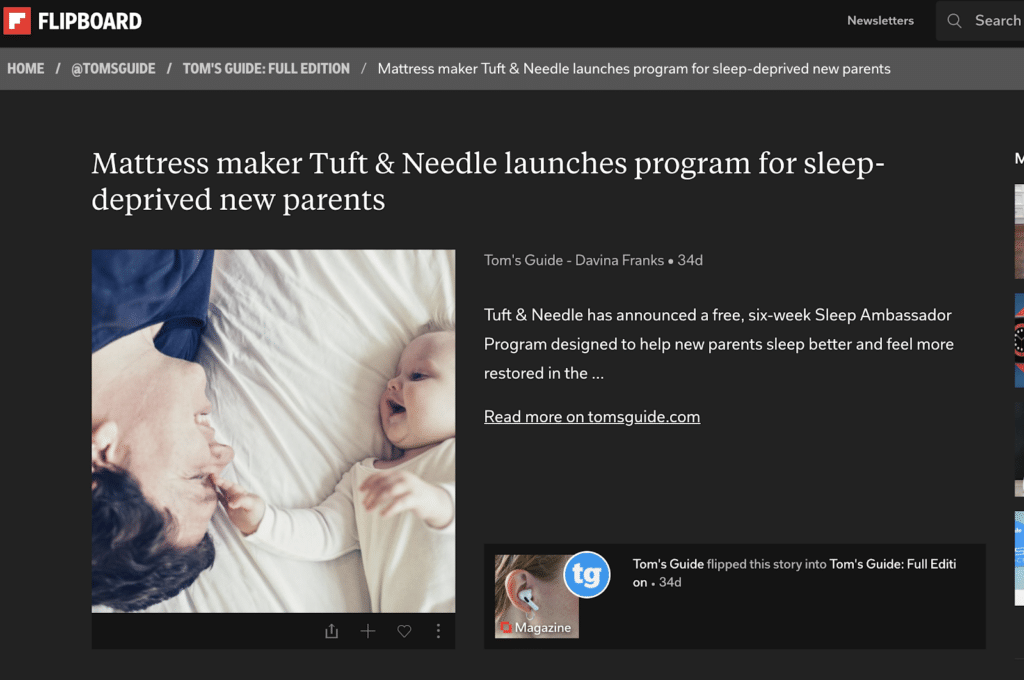


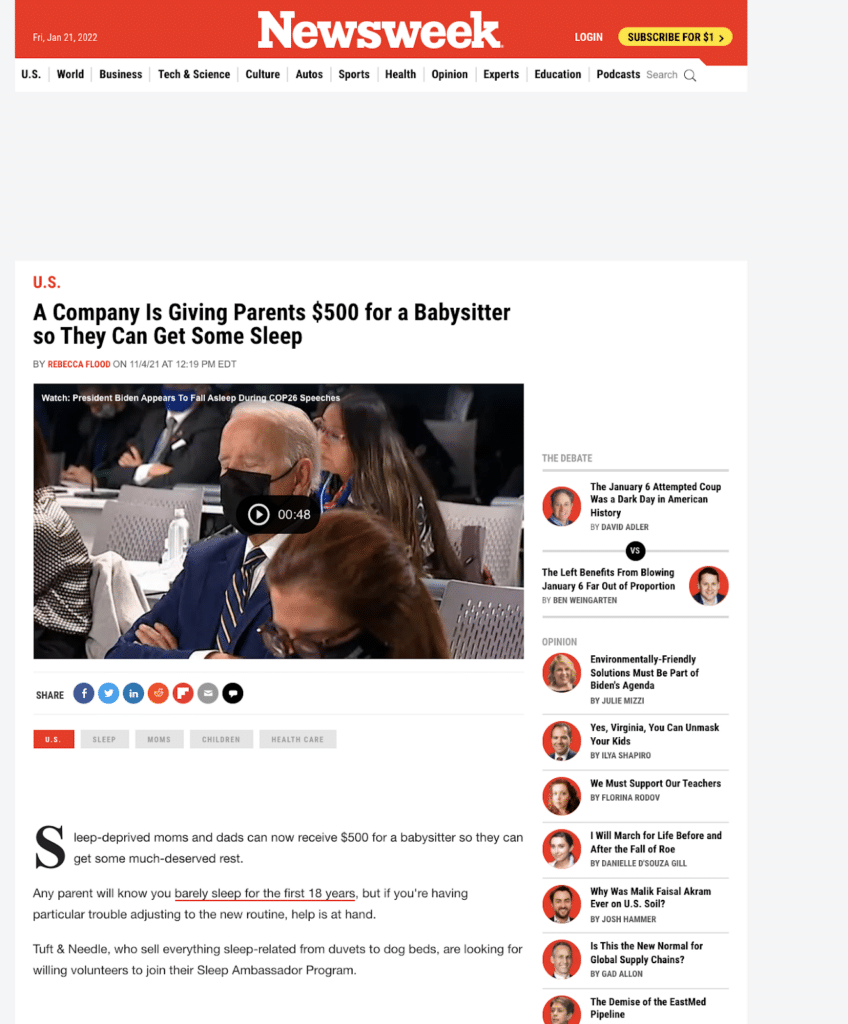
You need a group who understands the value of SEO that you can bounce ideas off of. This may include SEOs, but you can also extend this group to your PPC counterpart, to someone in development, or to a highly-supportive leader.
Get everyone looking at the data and exploring opportunities.
Sam Oh says it's best to "Refine your backlink-generation ideas with a small team of people who understand the value of SEO. This process filters out less impactful ideas, and the buy-in from the individuals involved increases the likelihood that your best ideas will ultimately see execution."

SITUATION
eFileCabinet is a document management SAAS company that takes the pain out of complex filing and digitizing processes. Their software is cutting-edge and intuitive, but the document filing industry is stale.
eFileCabinet hired 97th Floor at a time when their stagnant market share was shrinking daily. Without a single marketing professional to manage the crisis, 97th Floor became the company's chief marketing force.
STRATEGY
After extensive customer research, 97th Floor teams built four target personas. We then synchronized all digital channels to target these personas, including intent-based keyword SEO campaigns; PPC on Facebook, LinkedIn and search; and content audits leading to new ebooks and blog posts. We built strong Hubspot workflows for the leads coming from this omni-channel strategy.
Our omni-channel campaigns were a success, but when eFileCabinet expressed that their trade show presence has been a little lackluster, we took that to challenge.
We dove back into personas to find out what would excite this audience. Our idea was simple: we would set up a room packed with old office equipment and a sledgehammer. Before handing these professionals the hammer, we would collect their information in Hubspot. Attendees were then unleashed to beat the ink out of printers, monitors, fax machines and copiers. In the background, Hubspot nurtured these new leads.

Our final deliverables for the campaign included:
RESULTS
The Rage Cage would go on to be an award winning campaign that would drive the highest influx in MQLs in a single month, which contributed to the following:
Not bad for one tradeshow, right?
97th Floor teams don't think in terms of tactics or services. What eFilecabinet needed was an omni-channel campaign supported by content, ads, creative, and SEO. By integrating all of these capabilities, SEO received a considerable lift as one component of this brand awareness campaign.
Organic search has continued to compound its success since we started with eFilecabinet. In the past year, leads brought in by organic traffic increased by 281%.
Want more? Here are seven link-building tips from our SEO experts.
Advanced Strategies for Scaling Backlink Acquisition
Still curious about backlink acquisition Here are seven advanced link-building tips from our SEO experts. These require a little more technical expertise to execute, but will yield great results.
Scaling your backlink strategy requires going beyond basic link-building techniques. To achieve substantial growth, you need to integrate multiple tactics and maintain a consistent focus on quality and relevance. Here, we’ll explore seven strategies for acquiring organic backlinks at scale, ensuring your website achieves a robust link profile.
By implementing these advanced strategies, you can scale your backlink acquisition efforts, ensuring your website benefits from a strong, diverse, and high-quality link profile. Consistency, creativity, and a focus on value are key to building sustainable organic backlinks that drive long-term SEO success.
Not all backlink tactics push your strategy forward. In fact, some can severely damage your long-term authority. Buying cheap backlink packages, overusing exact-match anchor text, or submitting your site to low-quality directories may seem like shortcuts, but they often trigger spam signals that weaken your domain. Link exchanges, private networks, and irrelevant guest posts can have the same effect, creating a backlink profile that looks manufactured rather than earned. Sustainable organic backlink growth happens when you prioritize consistency, relevance, and editorial value over quick fixes. By steering clear of risky tactics, you protect your authority and set the foundation for a strong, trustworthy link profile that compounds over time.
Building organic backlinks at scale takes creativity, insight, and a coordinated strategy that aligns content, PR, and audience behavior. When every channel works together, your brand earns the kind of editorial links that strengthen authority and drive long-term growth. If you’re ready to take your backlink strategy beyond the basics, 97th Floor brings the experience, data, and creative horsepower to help you make it happen. Let’s build something remarkable.
For seasonal business owners, demand rises and falls with the changing weather. While seasonality is a unique and perhaps daunting challenge, the predictable rhythm of demand means that those businesses who can sync their marketing with the mandates of sun or snow can have success year-round.
97th Floor is no stranger to seasonal marketing; we’ve executed winning strategies for businesses including pool maintenance, sports equipment, cruise lines, pest control, lawn care, solar, and moving services, just to name a few.
In this article, our resident experts in SEO, content, and advertising share five actionable tips for seasonable business marketers.
Search Engine Optimization (SEO) is a long-term game, and waiting until peak season to focus on it can be a costly mistake. It's essential to begin your SEO efforts well in advance, ideally during the off-season.
Head of SEO Mike Witham says, “You need consistent year round efforts to maintain and improve rankings. If your peak season is in March, you should be ensuring you have solid rankings for core pages by no later than December. Do not start working on it the month before your peak season!”
For businesses serving multiple states or a large region of the country, seasonal demand may be different across these various geographies.
Enterprise advertising specialist Spencer Martin uses Google Keyword Planner to anticipate search volume fluctuations in different areas.
He shares, “We launch campaigns early so that we have 2 to 4 weeks to ramp up and capture the full demand. Campaigns need time to scale and learn, so if we wait until the season starts to launch we lose out on potential profits for our clients.”
While digital marketing is crucial, seasonal businesses can see major wins by looking at more traditional advertising. Enterprise Account Executive Nathan Hooper suggests non-digital forms of advertising, such as mailers or community events to target local audiences. Advertising on community calendar pages or local business directories can put your business in front of potential customers who may be researching local services.
Understanding your buyer and their motives for buying is essential for capturing demand at the right time.
Brandon Smithwrick asks what happens to your marketing instincts when you let AI do all the thinking. He breaks down how cognitive offloading quietly erodes the skills great marketers are actually built on.
Senior Director of Campaigns Jon Hammond shares that his clients in the travel industry refer to December through February as “The Wave.” This three-month period is the biggest sales period for travel as people look forward to summer sun during the cold, dark winter months. His clients maximize their ad budget and run major deals and promotions during this time to capture the demand.
Content Marketing Specialist Kaylee Baker emphasizes the importance of targeting specific demographics, such as 18-30 or 25-40-year-old males, who are the main consumers of seasonal services. Consider the platforms they frequent, such as YouTube, to tailor your marketing efforts accordingly.
When reporting to leadership, especially in industries with high historical seasonality, like cruises, it's essential to use Year-over-Year (YoY) data rather than Month-over-Month (MoM) data. This approach provides a more accurate depiction of progress or decline in traffic or sales over the seasons. By analyzing YoY data, you can better understand trends and make informed decisions to optimize your marketing strategies.
In conclusion, marketing a seasonal business requires careful planning, adaptation, and understanding of your target audience. By implementing these five tips, you can maximize your marketing efforts and capitalize on seasonal fluctuations in demand.
Locked away in a vault for nearly 150 years, the Coca-Cola formula is one of the most secretive and highly-guarded pieces of proprietary information in US company history. The only rival worth comparison is the one and only Google Search Algorithm, that great unknown that dictates the lives of SEOs determined to win rankings.
Google rarely shares how it decides what pages to show for which search queries, leaving SEOs to wrestle with the wimpy scraps of information that Google does reveal. However, scrappy SEOs have successfully reverse engineered the algorithm over the last two decades to determine the most impactful ranking factors.
But it seems that the more SEO professionals discover about how the Search Algorithm works, the more Google tries to protect their “secret formula”.
Hardly has a breakthrough graced the front page of Search Engine Journal before Google is issuing carefully worded public statements that confuse the true meaning, all in the name of protecting the algorithm.
What reasons does Google have to hold their ranking algorithm so secretive? Here are a couple to consider:
Well, last week the “vault” malfunctioned. From credible sources, there was a reported internal Google API Docs leak that shed some light for the first time on what Google considers when ranking pages for keywords. Given the history of secrecy and occasional dishonesty from Google around their algorithm, this is a really big deal! Before we jump into our biggest takeaways from this leak it's important to note a couple of things:
There is no information on a scoring system that Google uses to weight these ranking signals that were discovered in this leak. So testing is still very much necessary in determining the impact of these ranking signals.
While it is very exciting to have confirmation of long suspected ranking signals, these ranking signals still very much fall in the middle of these two categories. Without a scoring system, we do not know how important or unimportant they are without testing for a wide range of keywords.
Even though it has long been denied by Google that they use user click and interaction data as a ranking factor, ranking signals found in the leak contradict this claim. The click data metrics measure whether users found what they were looking for when they clicked on the page in the SERP or not.
Why Does it Matter?
This knowledge opens the door to increased emphasis on creating a user experience that matches what the searcher intent is. Obviously this has always been of high importance, but now we can run user experience tests and competitor analysis in the name of ranking higher for intended keywords. One example of what this could look like is testing different pricing strategies to determine if the price of our product does not match expectations, causing the user to bounce after seeing the price, and how that affects our rank on the SERP.
It's important to know that Google is a hoarder-of data. Google saves nearly everything it crawls. According to this leak, the last 20 versions of a page are considered when ranking a page.
Why Does it Matter?
We can now have a better idea of how long Google will take to understand which keywords we want to rank for when a site goes through a rebrand or re-positioning in a market.
The quality and user experience of the homepage of a site is considered every. single. time. a page is ranked by Google. We also suspect that it matters if what is found on the home page is on topic with the content on the page being considered by Google
Why Does it Matter?
The home page can be used as a way to test if Google is considering it as a significant ranking factor for a focus keyword.
The leak showed that Google attempts to find the date of a page in various places: the URL, the title or in semantics of the body text of a page. The date is then considered in rankings in order to determine the freshness of the content.
Why Does it Matter?
If a page has a date in the title or the URL, it is going to indicate to Google whether it is recent information or not. Sometimes this is not a problem, say if you are trying to rank for the keyword “best 2024 baseball bats.” However if you are trying to rank for a more evergreen keyword like “best youth baseball bat brands”, having a date in the URL may harm your ability to rank long term.
One of the pillars of great marketing at 97th Floor is Empathy. All of our marketing efforts are driven by what matters most to the audience we are marketing to. We are connecting real people who have problems that our clients can solve. Nothing about that approach will change given this data leak or any future revelations about the workings of the algorithm.
What this data leak will allow us to do is test and experiment new optimization techniques and tactics to determine what will get our clients the most visibility in front of the intended audience.
Reaching the right audience takes more than targeting — Ardath Albee, B2B content strategist and author, argues that most personalization misses the point entirely. This short video breaks down what buyer-relevant content actually looks like.
97th Floor is expert at getting results from our SEO efforts. We already know our processes drive significant results, but now we have a better understanding on enhancing those processes.
Marketing leadership faces quite a predicament — organic is consistently a website’s highest-converting channel, while also being completely dependent on an ever-fluctuating search engine.
SEOs need a series of checks and protocols — a response plan — not just to weather the algorithm storms, but to proactively leverage them for growth. They need to quickly assess damages, discover opportunities in the shuffle, and lay out next steps whenever updates roll out.
Yes, Google’s search algorithm is constantly changing. By some estimates, minor updates happen up to six times every day — over 2,000 minor algorithm updates every year — to say nothing of the significant core updates Google pushes about five times every year.
In this algorithm emergency response guide, we outline six critical steps to take in the event of a suspected algorithm update:
An SEO’s job isn’t just to grow a website’s organic traffic, but to communicate to leadership the impact that organic is having on the bottom line. This guide will help you know what to do and what to communicate.
Let’s dig in.
With over 2,000 yearly updates to the algorithm, it’s very possible you won’t see a traffic-impacting update coming your way. It may also be difficult to decipher whether fluctuations are coming as a result of your optimization and backlinking efforts or if Google’s been tinkering again.
Luckily, there are brilliant SEOs with massive access to data and key connections within Google who are constantly reporting. As with any news source, there’s also a fair amount of speculation that can be difficult to sift through.
Here are a few trustworthy sources we immediately turn to when suspicion is running high:
Following these entities and/or setting up Google Alerts for them will ensure you’re aware when an update hits.
The key when assessing every algorithm update is to understand what Google appears to be “targeting” with its update: quality of content, page speeds, backlinks, etc.
Beyond looking for the specific targets, it’s also essential to step back and review Google’s high-level goals. Google makes money by providing the best possible information to users searching on its engine. Every update is made with that goal, so every reactive response we make to these updates should be in the pursuit of improving our end users’ experience.
You need to get your arms around this and it’s best to start with the bottom line. Your leaders’ first question will be: are we making money or losing money as a result of this update?
Using your analytics tools, measure the percentage of loss or gain in both traffic and organic-sourced revenue. Keep tracking this every day for at least two weeks as algorithms tend to roll out gradually.
Digging deeper, you need to know which keywords are shifting.
We use STAT for this because it keeps historical, daily data of Google Rank and Google Base Rank for any keywords you’re tracking, providing precise detail around when rankings change.
Historical ranking data in STAT

Examine how rankings have changed over time to pinpoint precisely when specific keywords could have been impacted by an algorithm update.
You’ll notice that if one keyword has shifted, often other keywords within the same topic will also have moved. This is why it’s best to analyze losses and gains on a page-level.
My favorite way to see this is by pulling up Google Analytics and creating a comparison that only shows you traffic coming from the “google/organic” session source/medium. This is done by going to Reports > Add comparison at the top next to All Users > Include Session source/medium > Dimension values: google/organic > Apply. You can deselect the All Users audience to only see the audience just created.
Building comparisons in GA4
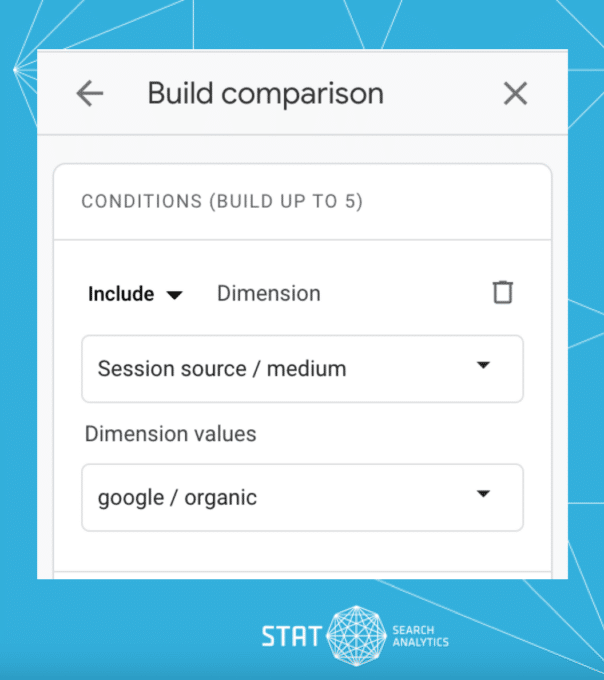
Simply set the conditions for your comparison as shown to isolate your organic traffic in Google Analytics 4.
Once you’ve created your comparison, head over to Reports > Engagement > Landing Page. You’ve now got a list of all your pages that are visited first as a result of an organic search. Start looking at before and after comparisons of the data to see which pages have fluctuated in traffic.
It is at this moment that you must decide whether the algorithm update is so impactful on your rankings, traffic, and revenue that you need to inform top-level leadership. You have the industry reports and you’ve captured the impact on your website — we advise over-communicating with leadership, letting them know that you’re aware of what’s going on and that you’re digging deeper.
Now that you know which of your pages and keywords are seeing fluctuations, it’s time to identify the “winners” and “losers” of the update. The best place to start, regardless of your specific rankings on the SERP, is to analyze the top 10 listings.
STAT’s Archived SERPs feature shows the top 10 listings for any date after which tracking was set up.
The Archived SERPs tab in STAT

Go back in time by selecting a date to see detailed listings of what was on the SERP that day.
First start by asking these questions:
Next, ask:
SEO execution is broadly thrown into three categories: on-page content, off-page authority, and technical — one page at a time, we need to evaluate how our page stacks up to the new standard of the update for each.
On-Page Content
One of the quickest ways to compare your content with the top 10 results is to compare H2s. Does your content address the same subtopics as Google’s favorite results?
You’ll also want to pay attention to characteristics like structure, length, metadata, and multimedia usage such as video and images.
Also consider how other listings are meeting E-E-A-T factors. Does the content have an updated or recent publish date that seems fresh? Is the content author reputable? What sources establish the author’s credibility?
Off-Page Authority
Next up, tune into the off-page authority of competing pages. Look at metrics such as:
Is your page stacking up against competitors well with backlinks or is the discrepancy in volume and/or quality tanking your ranking?
Technical
Finally, investigate the technical page-level components.
Start with the site map. Is this specific page in the site map? Check that the page is not excluded in robots.txt.
Remember to use canonical links to prevent duplicate pages from cannibalizing your page ranking.
Look at your page speed, compare structured page data with other ranking pages, and write alternate text for any images. This consideration for sight-impaired visitors isn’t about ranking, but compliance with ADA requirements improves user experience and may become relevant for ranking down the road.
You may have just discovered a series of important page-level factors that need to be addressed. However, we sometimes run this page-level analysis and find it to be a competitive wash — everyone in the top 10 can look nearly identical from an on-page, off-page, and technical perspective. So, what gives?
Google’s E-A-T guideline identifies Expertise/Experience, Authoritativeness, and Trustworthiness among its most important ranking factors in its algorithm.
This is not only demonstrated on a page level, but on a domain level. It’s the reason why a website could have a page that is arguably “better” than what’s found on the top 10, but not rank. Google needs to see that your domain — and your entire entity — demonstrates these values.
Domain-Level Content
If your domain-level content is suffering, you need to establish topical authority.
“Topical authority is a measure of authority built up through proven expertise and trust in your field. The more high-quality, informative pieces of content there are on your site, the more likely your website is to be perceived as a trusted source of information on a particular topic.” — Zoe Ashbridge, Senior SEO Strategist, Forank (How to earn topical authority in 2022 and beyond)
If your site is hurting here, do keyword research to find the related content keywords, organize your keywords into clusters or pillars, and get to work building and linking new authoritative content.
Domain-Level Authority
Your domain-level authority comes from backlinks. Zoom out and survey your site’s overall domain rating and your overall backlink profile compared to competitors. There are lots of helpful tools that can help you accomplish this — one example (that you can use for free) is Moz Link Explorer.
Domain-Level Technical
Finally, scan your site for glaring technical issues. Check in for these common failures:
With a much clearer picture of what has changed, how it is impacting your business, and what it will take to “win,” you’re ready to execute. More importantly, you also have the ammunition to communicate to key stakeholders.
It’s becoming increasingly rare that an SEO has the skills or access to make all necessary changes to their website. It’s time to communicate with developers, content writers, and top leadership.
Give them a brief that rolls together all of your findings:
And then give them their specific tasks. Do this and you’re on track to mitigate losses, seize opportunities, and prove why you’re an essential asset to the company when so much is dependent on Google.
