



Here are 5 things to create a killer Facebook ad with expert and PPC Specialist Cinthia Packard.
Article and tips here.
When I was just a young pup trying to make his way in the vast and often unforgiving wilderness of content marketing (yes, I’m talking about back in 2013), I often found myself assigned to write about topics that were, shall we say, not within my field of expertise. This was neither uncommon nor unexpected; after all, when your field of expertise consists of an encyclopedic knowledge of 90s-era animated superhero television shows and almost nothing else, then you should expect to work outside your comfort zone.
So, I learned the art of the 20-minute masters course. If I needed to write about tips to getting the most out of the Paleo diet, my first step would be to type “what is paleo diet” into my Google search bar, and my second and last step would be to create an 800 word article about how throwing out 10,000 years of agricultural science might actually be a healthy decision. If I was asked to highlight the benefits of solar energy, I’d learn the science while writing it and come away an hour later convinced that traditional utilities were the tools of the devil.
I learned a lot during those 20-minute, panic-fueled research sessions—taking in, metabolizing, and excreting knowledge back into the internet, like some virtual circle of life, except with trivia and statistics instead of whatever The Lion King was about. By the way, when Simba became leader of the pride, did he kill all of the other male cubs? Because I’ve heard that lions do that.
In any case, the end results were, if I may say so, decently informed content presented in a way that was at least mildly interesting. For example, take an article I wrote about food storage and different types of fictional apocalypses. I mean, when faced with a sea of emergency preparedness articles, it was nice to be able to create something unique, in that it was was both helpful and unflinchingly honest about your family’s chances of surviving a robot uprising. Of course, that’s not to say that I didn’t encounter the occasional snag. Research, particularly the kind that is motivated by imminent deadlines, isn’t always an exact science.
If you’re finding yourself in a similar situation—needing to produce factually-based content quickly—then I think I can help. The internet is a big place, and if you know where to look, whom to ask, and what ‘sponsored content’ is (hint: it’s not news), then there’s no reason why you shouldn’t be able to locate the information you need, and with enough time left over to turn it into something useful.
This may come as a shock to some readers, but just because it’s on the internet doesn’t necessarily mean that it’s trustworthy. Believe me when I say that it doesn’t take much in the way of credibility to get your words up on a website. Do you think that Buzzfeed is asking for credentials and references from the person who just wrote “15 Reasons why Cocoa Butter Is the Best Thing Ever”? Of course not. Why would they? Most internet users aren’t looking for peer-reviewed studies; they’re after some quick entertainment, and the thought of tracing sources or following up on bibliographies is about as far from “quick” or “entertaining” as you can get.
That doesn’t excuse your responsibility as a content creator. To put it bluntly, the internet is already well stocked with sensationalism and biased opinions masquerading as fact; don’t add to it. If you’re going to be presenting information, do everything in your power to ensure that it’s reliable information. Which, of course, means knowing where to find it.
Government and educational sites are generally held to a higher standard than others, although that’s not to say that they are always 100% accurate (or unbiased). Still, those that include data from relevant studies are usually trustworthy, and will not only provide you with relatively reliable information from which to craft your content, but may also give you interesting stats and data to link to to support any arguments you might be making.
News sites are also authoritative resources, but bear in mind that not every news site is created equal, nor is every site that identifies itself as a news site recognized as one. Some are just ideological outlets for particular interest groups (I’m not naming any names, Fox News and Huffington Post). There’s actually a lot of data that goes into which news sites are the most reliable and objective, and I’m not going to bother reproducing it here, but feel free to check it for yourself. Stick to the ones at the top of the list, and you should be OK.
On the bottom of the barrel, we’ve got blogs. Now, I’m not suggesting that blogs are incapable of unbiased reporting or producing accurate data, but I am going to point out that when a post is being written by a single author, for that author’s site, with no editorial or supervision failsafes in place, then there’s really nothing stopping them from making whatever claims they’d like. If, on the other hand, a blog includes links to its resource material, then feel free to track the truth down yourself, and if it looks promising, then link to the original source in your own article.
Finally, I’d like to set a few things straight with regard to Wikipedia. First, no, you should never link to Wikipedia. This is because Wikipedia is a collaborative encyclopedia, and you really don’t have any way of knowing whether the author was relaying reliable information. Perhaps even more importantly Wikipedia has a reputation for being a non-reliable source. A link to Wikipedia can end up doing more harm to the perceived authority of your article than whatever information you’re attempting to cite could hope to offset. Interestingly enough, I was once writing for an Australia-based client who wanted links from Government sites, and I discovered that the Australian .gov pages were not above linking directly to Wikipedia articles. I think I found where I’d like to retire.
This is because, in my personal experience, I’ve found Wikipedia to be one of the most accurate and complete internet resources available. When it comes to general information, I’m more likely to trust Wikipedia than any government or news site, because if there’s one thing that the kind of people who write and edit for wikipedia love, it’s correcting each other. No fallacy or inaccuracy is going to last long when you have thousands (or more) of potential editors looking over everyone’s shoulders, just aching for a chance to show off what they’ve got. It’s like misusing the word “whom” in a room full of English teachers—you’re going to be corrected, and it’s going to be swift.
So, should you use Wikipedia? Of course you should! It’s probably the most complete repository of human knowledge available. Just don’t link to it. Instead, use Wikipedia as a general research tool, and then if you need something to link to, check out the references section. You can evaluate the authoritativeness of specific resources, and if they look good, then you can link to them yourself. You should already be in the habit of tracing information back to its source, so in that respect, Wikipedia really isn’t any different.
Finally, as a general rule, if a site is actively trying to sell you something, then it may not be the best resource. On the other hand, if they support their claims by linking to relevant studies or including a bibliography section, then there’s no reason why you can’t take advantage of their hard work. Don’t worry, if you do a good enough job, you’ll be able to pay to forward to the next internet writer who comes to your site looking for usable information.
Pretty straightforward so far, right? Well, there’s one other thing to consider when researching your article: time. No, I’m not talking about the deadline; I know you haven’t forgotten that part. I’m talking about the date stamped on your source material. You see, usable information is three things—reliable, relevant, and recent. If you find the perfect stats to support your argument, but they’re from a report conducted three decades before the word ‘internet’ even existed, then they’re not the perfect stats. That said, the shelf life on some resources is longer than others.
As an example, let’s take a look at the two links I’ve included in this post. The first one is found all the way back up the page in paragraph #3 (the weird part about how much I dislike Lion King). Clicking that link will take you to a news report on the site Livescience.com. The article is everything you might want in a linkable resource—it’s authoritative, well researched, blah, blah, blah. But take a look at the year it was published. 2013. That means that the data is going on half a decade old. A discerning reader will make note of that, and might wonder why you haven’t been able to find anything newer to back up your arguments.
The second link is the one about which news sites are most widely trusted (about eight paragraphs up from this one). The page I’ve linked to was published less than two months ago, and that means the data is as fresh as a crispy head of lettuce.
But, like I said, the shelf life all depends on what you’re linking. The piece about the lions was published three to four years ago, sure, but how much could lions have changed in that time? On the other hand, the data about the reliability of news sites would likely be outdated much sooner. Can you think of any events, say, maybe far-reaching political events, that might have changed how readers view news-site reputability? In this case, even data that is only a year old might be too antiquated to use. It’s all about what information you’re citing.
Want an easy solution? Well, I’ve got one for you. When you do a Google search for reliable information, just click on the “settings” button underneath the search bar, and scroll down to “advanced search.” This will take you to a new page, where you can more clearly define what kinds of sites you’re looking for. About halfway down the page, you’ll see the “last update” option. Select it, and then select “past year,” before finalizing your search. This will return only pages that have been updated within the last twelve months, so you’ll have fewer outdated results to sift through. Trust me; this one’s a time saver.
It would certainly be nice to be able to contain all of our writing within our own areas of expertise, but it’s just not realistic. In fact, in the four years I’ve been writing at 97th Floor, I think I’ve only had one article published that made any sort of reference to Batman: The Animated Series, and it was subtle enough that the editors at Business.com didn’t notice. The reality is that in order to succeed as an internet content creator, you’ll probably have to take a few steps out of your comfort zone, and that’s actually a good thing.
You can be the expert that readers need, even if that expertise is built on nothing more than 20-minutes of Google search results. After all, content marketing is all about providing readers with content that is educational and informative, and if you can give it to them, then no one will care that you’d be more comfortable writing about cartoons.
Oh, and with that, it looks like I’ve now referenced Batman in two of my articles. I guess my expertise is worth something after all.
You finally took that leap and launched your own healthcare practice. It took grit and guts to get there, and it’ll take grit and guts to keep it going. Now that it’s open, you need to find a continuous flow of patients to fill your practice and keep your business above ground. Or, maybe you've been practicing for a while but are ready to scale and bring your practice to new heights. Regardless of the circumstance, there are some bulletproof healthcare marketing strategies that will get new patients flowing in your doors from a digital audience.
A healthcare marketing strategy defines how healthcare organizations attract patients, build trust, and drive engagement across digital channels while staying compliant.
Unlike general marketing, healthcare marketing prioritizes clarity, accuracy, and confidence at every touchpoint. Patients are not just comparing services. They are evaluating trust, expertise, and ease of access at every step of their customer journey.
A modern digital marketing strategy for healthcare brings together SEO, local visibility, content, and reputation management to support the full patient journey. When executed well, healthcare marketing functions as an extension of your patients’ experience.
Below I've distilled some healthcare marketing ideas and techniques you should be looking into in order to increase the relevance of your healthcare practice online.
Your site is likely the first interaction your potential clients will have with your healthcare brand online. A sloppy, buggy, or thrown-together website can give the impression that your practice is also sloppy, buggy, and thrown-together. In order to nail this first impression, be sure to invest in a well-crafted, visually appealing site that is easy to navigate, provides useful information, and demonstrates your practice’s expertise. A good site is the foundation of an influential online presence.
It should go without saying, but your site needs to look professional and inviting. In today’s digital age there are many avenues to building a website. Though it’s tempting, it’s worth investing in quality over budget when it comes to your site design. In addition to the fact that the average user sees quickly through cheap site design, a good site structure is essential to keep up with your healthcare business as your company scales. It’s important that your site reflects the top notch service and quality you provide.
The good news for you: many of the healthcare sites out there look quite outdated. By updating or creating a well designed site, you can stand out with relative ease.
When people get to your site, it’s for a specific purpose. In your case, people are looking for a healthcare provider that they can trust, with answers to questions only a doctor can answer. They have a specific problem, and they are looking for solutions.
If your website isn’t clear about the value each page brings (or worse, it promises value but doesn’t deliver) that confusion will reflect poorly on your practice. Be clear, be helpful, and put the user-- your potential patient-- first.
Facebook ads can be powerful for your healthcare marketing strategy, but you’ll need to put some thought and strategy into them. The FB ad platform isn’t one that typically brings results by blasting as many users as possible with your ads. The power comes instead from the very specific, granular targeting that can be done. Maybe you focus on sports medicine and want to run a campaign targeted to men and women, aged 20-40, with a particular interest in CrossFit. On Facebook, that’s easy. What if your practice caters to a higher-end clientele? No problem, you can target via income, net worth, home value, location, etc.
Paid social media marketing, such as with Facebook Ads, can be a powerful tool in an online strategy. The key is running tailored campaigns to specific personas. As you refine who you are targeting, you can lower your overall cost of running ads because you aren’t wasting money commercializing to people who will have little interest. To help get you thinking of what campaigns you should run on Facebook, here are some of the targeting options.
If you are embarking on running some social media ads yourself, be sure to read up on all the ins and outs of Facebook’s ad platform and how to use it. There are many options and it is easy to get overwhelmed on your first go. Adspresso has a great guide to get you jump started that can be found here.
Most industries have directories that list professionals within their industry. These directories often put in a lot of time and money in order to rank well for many profitable keywords, which means they are a resource you can use to increase the weight of your own domains. Use these healthcare directories to your benefit while you are getting your site ranked for your chosen keywords.
In most instances, directories will be free (or cheap) and have an easy to fill out form. You will use the form to submit information about your practice to be posted on the public directory.
For example, Healthgrades.com has a comprehensive directory that you should leverage to your advantage. It ranks for many healthcare-focused keywords.
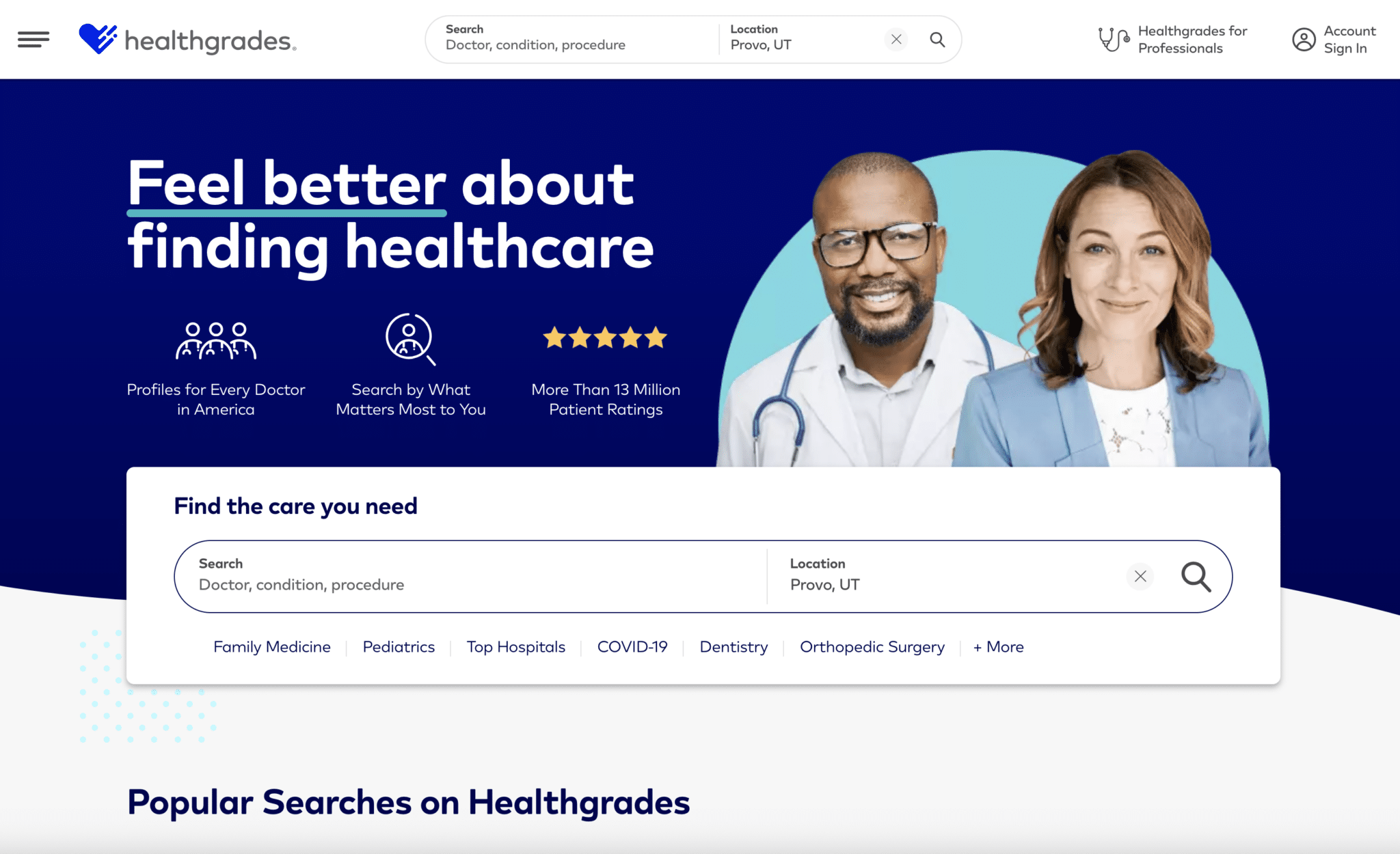
You can create a free Healthgrades.com profile here. It will look something like this:
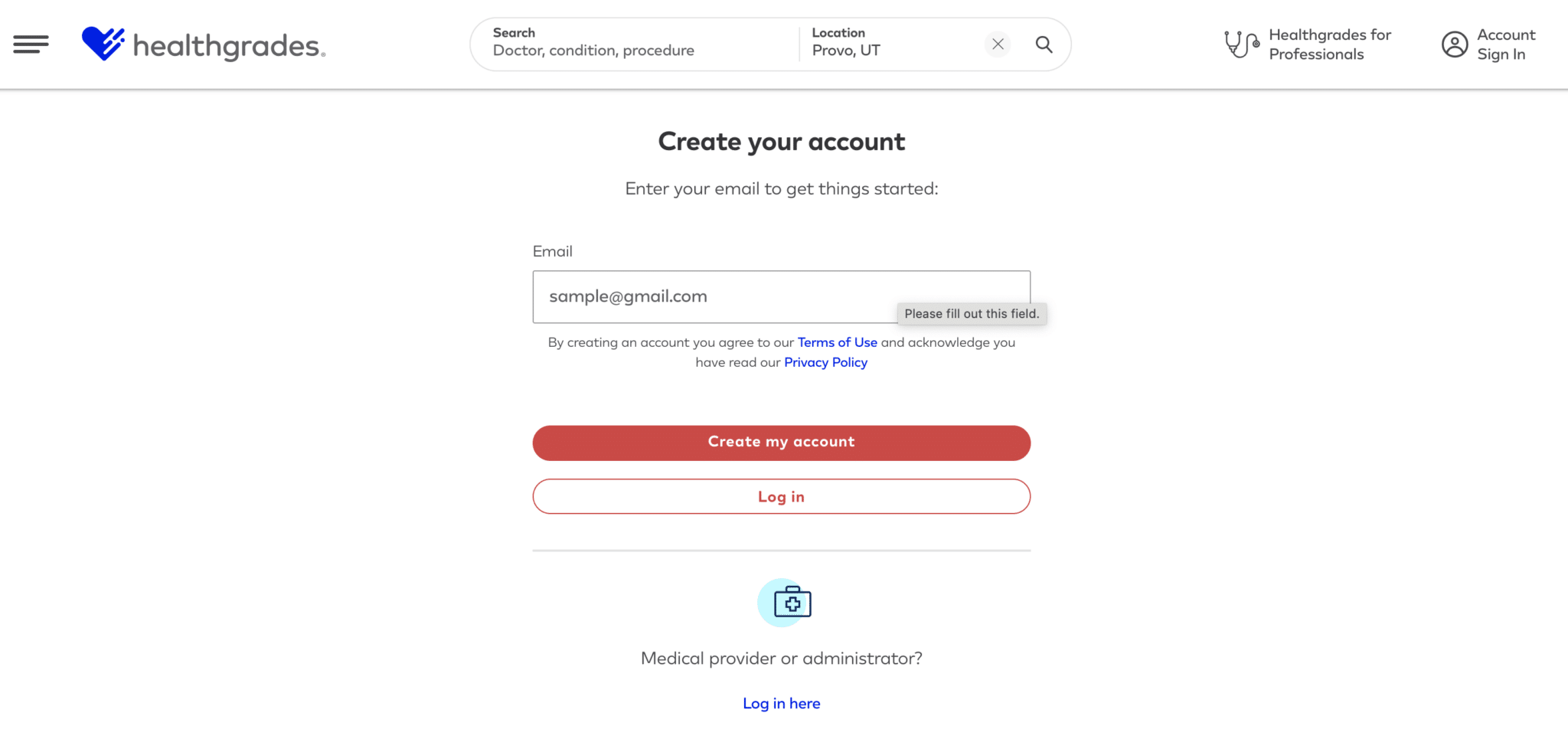
This is a great way to take advantage of all the hard work Healthgrades has put into their site and rankings. And, it’s mutually beneficial. Healthgrades relies on healthcare practices to add themselves to these lists, and you rely on them to aid your ranking positions and lead generation.
Here are a few more healthcare directories that you should be on:
All of the above directories rank for many “healthcare provider in...” type keywords. If this method works for you, don’t stop there! There are many more directories with online clout than the ones listed above. Do a quick search for “healthcare provider in” + “city” to see which directories show up for the city you want to rank for. Be sure to leverage the directories that rank for your target terms first.
Google My Business is incredibly important if you want to show up for local results in Google. I’m sure you’ve seen local results many times, but maybe you didn’t realize it was a part of the Google algorithm that you can leverage. Here’s what a local result looks like when you search “chiropractor SLC”:
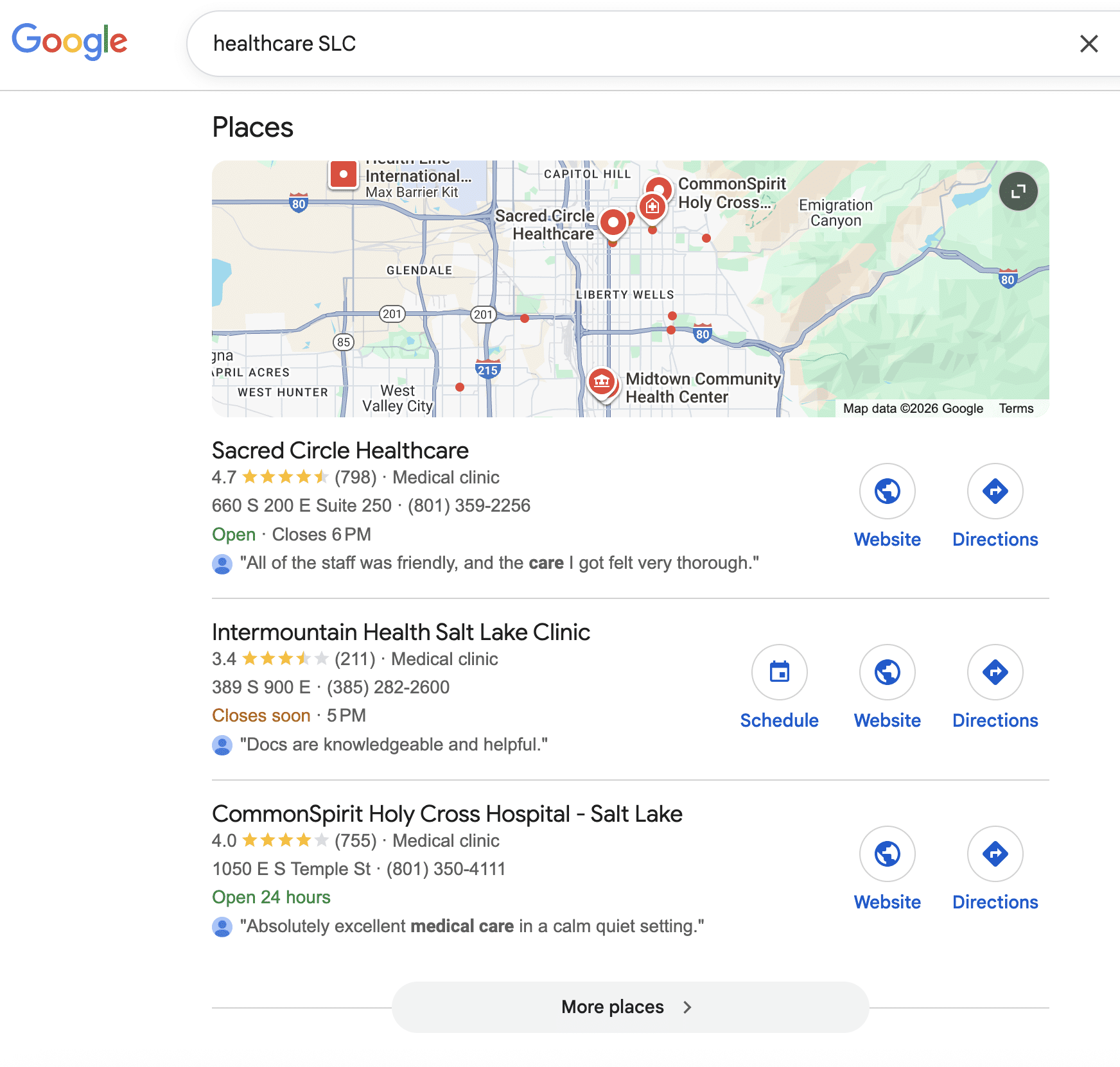
The local box will show different businesses that fit what you are looking for. There are many factors that go into showing up for these, but Google tells us that it comes down to 3 core factors:
So what exactly does Google mean by these?
Relevance is pretty self-explanatory. It refers to how closely your local business listing matches the search someone types in. By doing a thorough job filling out Google My Business and optimizing it to match the queries you want to rank for, you’ll increase in relevance.
Another pretty easy one, distance illustrates how far a person is from your business. In a recent report from Hitwise, it is reported that nearly 60% of searches are now performed through a mobile device. Google will calculate where a user is through their device and use this distance as a factor when providing results.
This is the part where optimization comes in. Prominence tries to gauge how prominent your business is in the offline world and reflect that in local listings.
Many factors are taken into consideration here. Links, local citations, reviews, and your position in traditional SEO results all factor into how “prominent” you are.
You need to verify your business with Google My Business. This is a fairly easy process. After you set up your Google My Business page, Google will send you a postcard with a verification code. You will then enter the code into Google My Business to verify your business listing.
Next, make sure all of your details are up to date and add 3-5 pictures of your business.
After you’ve added some great photos of your business, double check the category that you’ve declared for your business within Google My Business. It is important that you have categorized your business properly.
Thoughtfully fill in your introduction and title of your business in Google My Business so that it represents your business well.
Reviews are very important in local search marketing. Read and thoughtfully respond to reviews about your business. Reviews can make a huge impact on your business for better or for worse. It is beneficial to keep them under control through responding and genuinely taking care of your customers.
Citations are your mentions on various directories on the web. These directories are sites such as Yelp, The Yellow Pages, dexknows.com, chirodirectory.com and more. Building these by hand can take a lot of time, so many companies hire out for citation building.
If you embark on building citations by yourself, make sure you keep all of your information consistent across all of the directories you submit to. Nothing is worse than getting a bunch of citations that have conflicting phone numbers or addresses that you need to go through and clean up.
Traditional SEO for a healthcare practice, sometimes searched online as healthcare SEO, can be immensely powerful. SEO for those who are unfamiliar stands for “search engine optimization.” It is the act of optimizing the elements of your site so that you rank better (closer to the top) within search engines. The idea is that if you are a healthcare provider in Las Vegas, then you want to show up when someone searches “healthcare Las Vegas” within Google or other search engines. And, you want to show up as closely to the top as possible, so more users will click to your site over your competitors’. Performing SEO for your healthcare practice will do more than just generate customers, it will help you build a brand. Here are some of the benefits to investing in SEO.
As a healthcare provider, you are highly skilled in an area where most other people are not. Furthermore, you invested good money in becoming an expert at your craft. Use that expertise to grow your brand through content marketing.
What do I mean by content marketing? You should be consistently publishing content that brings value to your potential patients in a way that only you, as the expert, can. If you’re wondering: “Well, what should I write about?” This is where the keyword research that I mentioned earlier comes in. Keyword research will teach you what people are searching for and how many people are searching for it. In many cases, these search terms represent the questions that your potential patients have for you.
For example, if someone is experiencing upper back pain, they may search “upper back pain” in Google in order to research what the causes could be. Here is a snapshot of what the traffic looks like for some keywords regarding upper back pain.
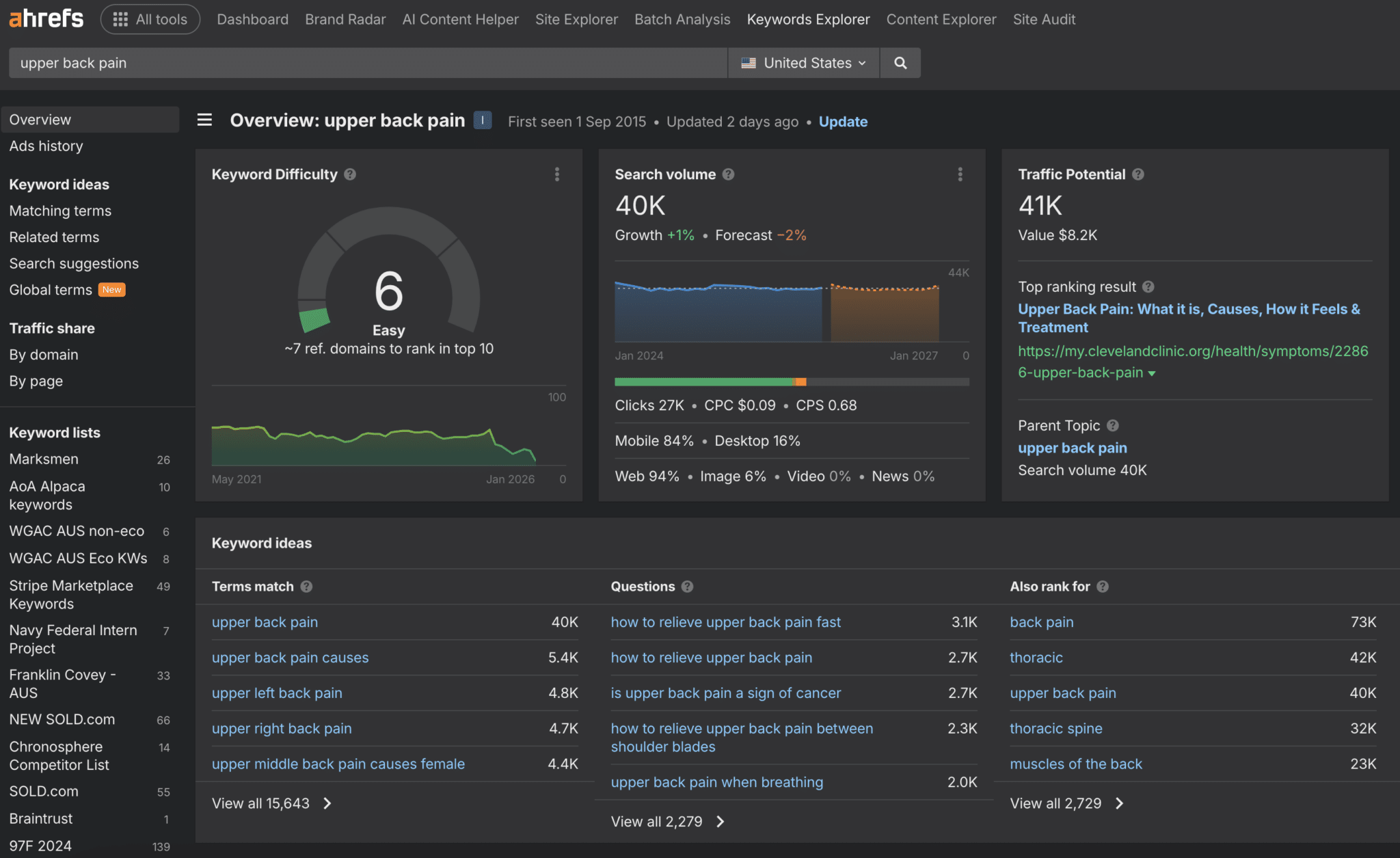
Quick notes -
As you can see in this example, there are many people searching for the keyword “upper back pain” or some variant of it. We also learn that these keywords have relatively low difficulty being in the 20-30 range (out of 100, 100 being the most difficult).
If you, as a healthcare provider, created a piece of content regarding “upper back pain” and optimized it for the above terms, you could begin generating quite a bit of online exposure.
As you begin to show up for searches in Google you will be seen as an authority. The more searches you rank for, the more people will associate you as an authority.
A great example of this is Dr. Josh Axe of Draxe.com. Dr. Axe began by founding the Exodus Health Center in Nashville, helping thousands of families reclaim their lives through improving their health. Furthermore, Josh helped his own mother reclaim her health and beat breast and lung cancer. Realizing that he has a special set of skills, he set out to help more people using the amplification of the internet.
When Dr. Axe started early on, he wrote many pieces of content and published them on his site. Dr. Axe began ranking for many keywords and has since grown to become the “second-most-visited natural health website in the world.”
Here is Dr. Axe’s current site:
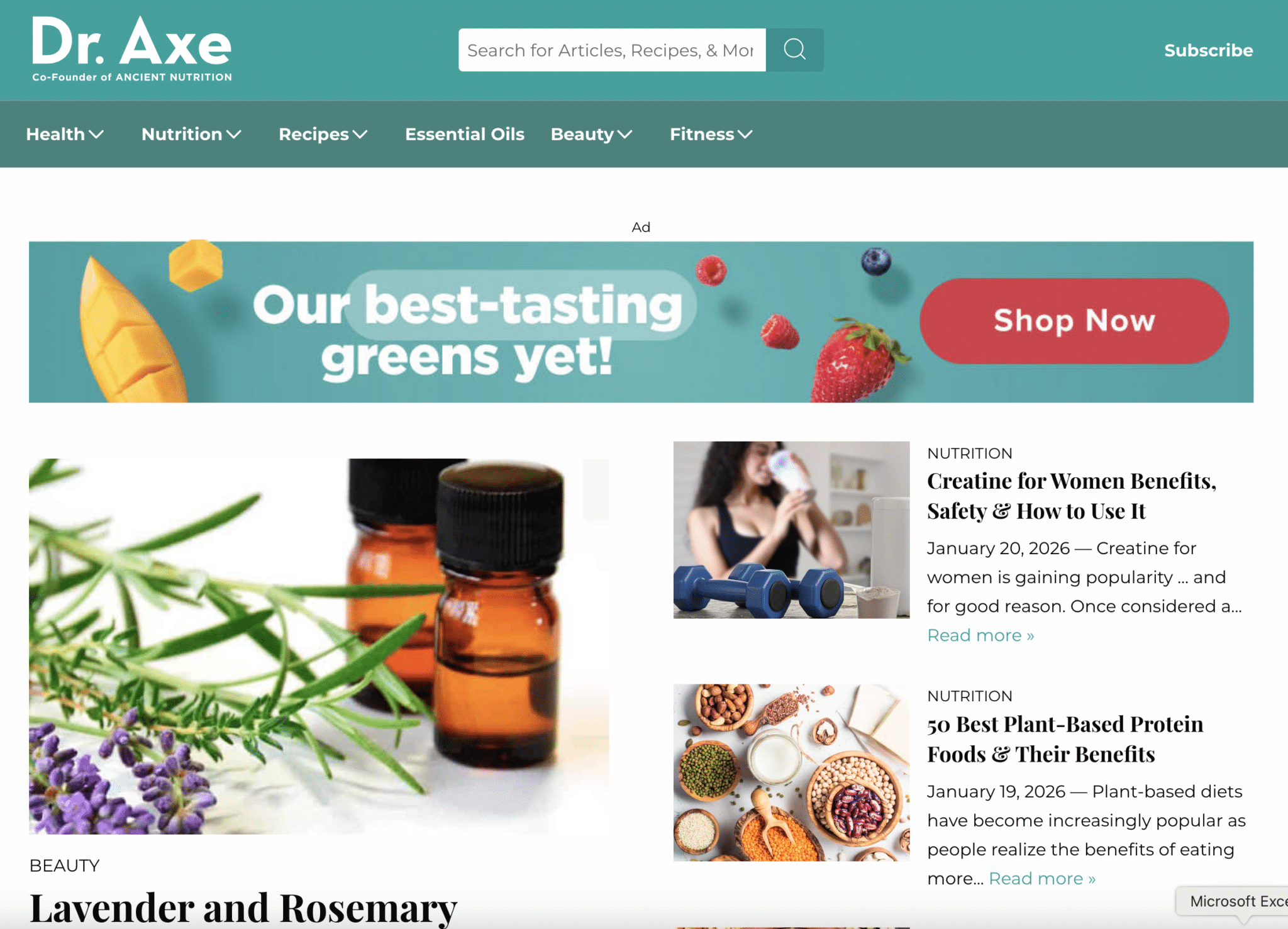
Josh’s site currently ranks for over 1.6 million keywords and generates over 7.5 million monthly visitors (as per Ahrefs).
Dr. Axe is an inspiring case study of what can be done through the leverage of SEO to build a strong brand with immense authority.
Managing your reputation online is at the heart of retaining a good brand image. Google your brand frequently to see what people are saying about you. Better yet, create a Google Alert for your brand name and be notified each time you are mentioned. This way you can jump in and resolve concerns and strengthen your brand.
Patients often research providers across search results, review platforms, and third-party healthcare directories. Monitoring what appears in these spaces helps organizations understand how they are perceived and where gaps in trust may exist. A strong healthcare marketing strategy includes proactive brand monitoring.
Give thoughtful responses to reviews and mentions to show your accountability and reinforce credibility, which is especially valuable when patients are evaluating alternative care options. Over time, this consistency supports a more resilient healthcare marketing strategy by building confidence across digital touchpoints.
For many patients, the first interaction with a healthcare organization happens online. This is often referred to as the digital front door, and it plays a vital role in any healthcare marketing strategy.
A patient-centric digital experience removes friction. Websites should be easy to navigate, quick to load, and clear about services, providers, and next steps. Patients should be able to understand their options, find answers to common questions, and take action without confusion or unnecessary barriers.
A strong digital marketing strategy for healthcare treats the website as more than a brochure. It functions as an access point for care, guiding patients from research to an appointment with confidence. When the digital front door is built around patient needs, marketing efforts convert more effectively, and trust is established before care even begins.
Healthcare is evolving quickly, and patient expectations continue to rise. The organizations that succeed are those that invest in strategy and adapt their healthcare marketing strategy as technology, regulations, and behavior change.
97th Floor helps healthcare teams put their ideas into action and capture the biggest opportunities in the industry. If you’re ready to move beyond tactics and create a strategy designed for today’s healthcare landscape, let’s build it together.
See how an audience-first approach translates to bottom-line results.
Keyword research is at the heart of all the work we do at 97th Floor. In this webinar Director of Marketing Operations Paxton Gray shares advanced keyword research techniques that provide the ground work for solid strategies that garner results, whether for high volume brand awareness or specific product conversions. Whether novice or a pro, you're sure to glean some remarkable and actionable insights.
Get the free downloadable Advanced Keyword Research Template below!
What You'll Find in this Webinar:
[1:28] Who we are
[1:33] Who we work with
[1:41] What we do
[2:10] What is a keyword? 15% of Google search has never been searched, everyday.
[2:45] The Search Demand Curve: Fat Head, Chunky Middle and Long Tail Keywords
[4:15] Google's #1 objective
[4:35] Google Micro-Moments: The consumer journey and you
[5:08] Advanced Keyword Research: What it is, What it's not
[6:07] Think strategy, not specifics.
[6:45] All about expert Paxton Gray
[8:40] Benefits of keyword research
[10:01] Keyword Research: Step 1 "Find Keywords"
[11:20] Keyword Research: Step 2 "Gather Data" and Pillars of Keyword Research Data
[13:23] Tools for pulling data (free and paid)
[15:21] Keyword Research: Step 3 "Analyze Data"
[16:01] Keyword Research: Step 4 "Group by Intent"
[17:00] DEMO and template overview
[36:00] Q&A
[47:00] Next Webinar "How to Get the Most Out of Google Analytics"
[48:24] Questions, comments, concerns? Hit us up at up@97thfloor.com.
Here at 97th Floor, elevating brands we believe in is part of our culture. In light of this, I thought it would be fun to analyze the digital marketing of a brand whose product I like and am very familiar with and really enjoy. That brand is YNAB.
What Is YNAB?
YNAB stands for You Need a Budget and when answering the question, "what is YNAB?", it's important to understand what YNAB does. It is a computer program used for budgeting and tracking expenses. The software takes a different approach from tools like Mint, which focus on pulling all of your bank accounts and credit/debit card transactions into one place where you can categorize and review transactions after they happen. This reactive approach works for many people and was actually my tool of choice before I discovered YNAB.
YNAB takes an opposite, more proactive approach to finances. By educating users on how to properly plan where each dollar will go, while also providing the technology to track spending, YNAB puts people in charge of their finances. A couple of years ago, a colleague mentioned it to me in a conversation and I’ve used it ever since. It is incredible for keeping track of spending and overall being on top of your finances.
But this isn’t an advertisement. If you want to know more about the program, YNAB has an excellent intro to the finer details here. For now, I’d like to take a step back from what YNAB can do, and instead focus on the digital marketing side of things.
For a while, I’ve wanted to dig into YNAB’s online marketing efforts to see what gems I could offer them as a “here’s to YNAB” type toast. As I dug deeper, I realized that YNAB has done an incredible job in building a devout YNAB community online. It is a difficult task to create a cult-like following (which I mean in the most positive sense) around your product. YNAB has created thousands of YNAB ambassadors by leveraging communities on Reddit, Facebook, and other social media sites, and through effective email campaigns.
But while YNAB is doing great things in the community building space, I want to shift the focus to what they could be doing with organic digital marketing to reach even more people and add another channel to fuel their community. For this post, the focus will largely be on SEO-related potential.
To begin, let's take a look at where YNAB is at organically. YNAB ranks for 6,069 keywords in the top 50 results as per Ahrefs. Again, one thing that is immediately apparent is how great of a brand YNAB has built (I’ll probably echo this many times throughout the post). Its brand search for the keyword “YNAB” generates around 130,000 monthly searches alone. Add the rest of its branded keywords and you have a very substantial amount of branded organic traffic.
YNAB also ranks for many non-branded keywords, albeit not nearly as well. There are many opportunities to push up these peripheral keywords so that they bring in significantly more search volume. We’ll get into this in greater detail further down in the analysis.
Part of YNAB’s building such a strong brand is due to leveraging the passionate following that surrounds the online financial niche. Some of the biggest communities on Reddit, like r/financialindependence, are related to finances, such as the following:
Reddit.com/r/personalfinance - 10,235,956 subscribers
Reddit.com/r/frugal - 628,703 subscribers
Reddit.com/r/financialindependence - 183,573 subscribers
The YNAB online community has done an excellent job siphoning traffic from these various subreddits into their own YNAB Reddit community (Reddit.com/r/ynab). The YNAB Reddit community, or subreddit, has over 30k subscribers. Many subreddits are created and die before they ever get enough users to sustain growth—the Reddit.com/r/budgetfirst/ subreddit, which was created by a group of YNAB Reddit users after YNAB switched to a subscription-based model, is one such example.
Despite the challenge of creating a sustainable reddit community, YNAB has managed to create a community that not only wants to be more involved in the YNAB ecosystem, but also help others in their pursuit to financial freedom. Gotta say, 30k hungry brand ambassadors is never a bad thing to have.
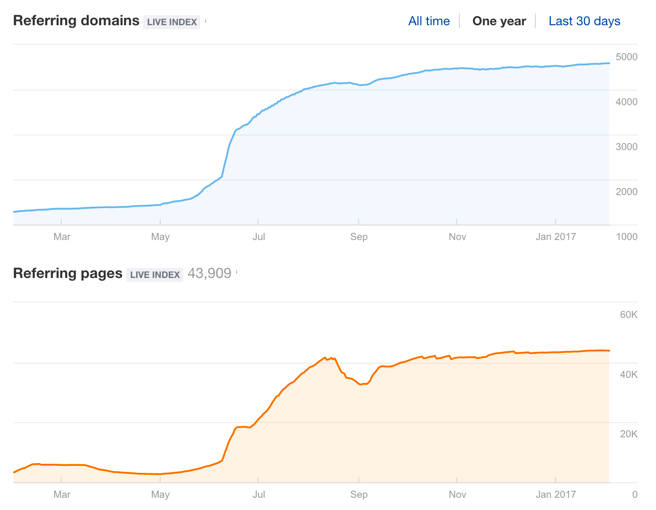
Ahrefs indicates that YNAB is increasing in referring domains quite healthily. The data below raises the question: where is YNAB getting their links from?
One thing I found right away, is that YNAB has some great links on what I like to call “feeder sites.” “Feeder sites” are sites that have content that is syndicated by many other large publications. Finding valuable feeder sites can be immensely powerful for SEO due to the amount and the quality of links that can be obtained.
Below is an example of what this feeder process looks like that YNAB has benefitted from.
An article was placed on the Reader’s Digest’s site, RD.com, entitled “34 Little Life Skills Everyone Needs to Be a Grown-Up.” RD.com is a feeder site to MSN.com as well as a handful of smaller sites. You can see that MSN.com syndicated the same article here. This means that for the effort of creating one very high-quality post, you can net a handful of links, sometimes from some large publications. This can be immensely powerful, and can lead to great jumps in increased rankings,
In the last few months, YNAB has received links like these:
And this is honestly only naming a few of the total links built recently.
YNAB is in a great position. It has the benefit of being able to target money-management communities with its methodology while at the same time targeting sites that focus on cell phone apps. This widens the targetable audience for the amount of websites YNAB can get links from. More links equal more authority, and when properly used, convert into better rankings and more traffic.
YNAB gets numerous mentions on both large and small publications. It is in the great position of garnering many mentions through its thousands of devoted fans. Typically, sites struggle with gaining more authority, therefore, they need a lot of high quality and well-targeted link building.
One note, however, is that many of the specific blog posts on YNAB’s site don’t get as much link love as the core YNAB pages (homepage, feature page, etc.). YNAB would benefit from additional links to their established blog posts, as well as to new posts as they are published. With the right content paired with YNAB’s community, this kind of link building should be cake.
YNAB has opportunities to generate much more organic traffic through their currently ranking pages. In order to diagnose how many opportunities there are, I pulled all ranking keywords (positions 1–50) from Ahrefs. Second, we needed to segment the data in order to see rankings in specific ranking buckets. I segmented rankings by keywords in the top 3 positions, positions 4–5, positions 6–10, page 2, position 21–50, and page 3+ rankings. I did this for every URL on the site in order to gain an understanding of each page and its rankings. The results looked something like this:

From a glance at the spreadsheet above, you can see a particular URL and what keyword positions that it ranks for. This makes it easy to determine which URLs simply need a bump in optimization and authority in order to generate traffic increases. This also allows you to forecast how big the traffic increases will be.
Let’s go through an example of how this data can enable us to take traffic-increasing action.
We see in the above screenshot that the blog post “How to Pay off $26k of Debt in 18 Months on a $35k per Year Income” ranks for 4 keywords in the top 1–3 ranking positions and 9 keywords in positions 4–5. The keywords in positions 4–5 represent around 520 monthly searches. This is what we see on the keyword level.

Looking at the average difficulty of these keywords, as well as taking into account that this post ranks as it does with not many links, YNAB could bump these 9 keywords up into the top 3 with only a handful of inbound links. This would increase the traffic of this page to somewhere between 100–150% with minimal effort. Sure, this is merely a couple hundred visits extra, but considering the minimal effort it would take, it would be worth it. Furthermore, you can see how this strategy can scale across the entire site. YNAB could increase overall traffic to the site by a large margin simply by taking advantage of this strategy applied too many of their blog posts.
The Google Featured Snippets box can be incredibly powerful to leverage. I want to show you how YNAB could leverage it to rank in a position essentially above position #1 (sometimes referred to as position #0). For context, the Google Featured Snippets box was debuted in Sept 2014, and was created as a vehicle for putting relevant answers in user’s hands much more quickly. For example, if you search “how to budget and save money” in Google, you will see something like this (highlights in red are mine):

You can see in the above screenshot that bettermoneyhabits.bankofamerica.com occupies the #0 position in Google’s featured snippet. This gives bankofamerica.com a strong advantage over americasaves.org in positions #1 and #2. Not only does bankofamerica.com have an augmented snippet, it also rank above position #1. This position can generate much more traffic than position #1.
Another value in ranking in the Google Featured Snippets box is that you can circumvent the climb to the top and be picked for a top page ranking, even if your site technically occupies a different rank land somewhere else on page 1. A detailed post on the specifics of how to do this can be found here.
YNAB already ranks on the first page for a handful of keywords that have the Featured Snippets box, but someone else shows up for the Featured Snippet. Because YNAB already ranks on the first page, it could implement some on-page changes and increase its chances of stealing the coveted Featured Snippets position. This would drastically increase the traffic YNAB receives from currently ranking keywords. For example, YNAB ranks in the 10th position for “how to pay off debt." This keyword generates around 5,400 searches per month. At the 10th position, YNAB doesn’t pull in that many of the 5,400 searches. However, if YNAB ranked in position #0, it would pull in a large percentage of that traffic.
Here are some of the keywords that have Featured Snippets YNAB could steal:

The process of optimize live posts is fairly simple, although it takes diligence. Cole Rieben, one of our Campaign Managers here at 97th, has a great post on what changes can be made in order to boost a site into the Featured Snippet spot (found here).
Without a doubt, creating new, high-quality, keyword-targeted content is one of the most rewarding actions YNAB could take. Content should be created for the user first, but in order for it to be valuable, it must also be findable. SEO done well is the perfect marriage between solid content and the ability to have that content found when users are asking questions. Keyword research can further help you understand exactly what kind of content people are looking for. It is an insight into their needs. Think about it, these people are asking questions already, we just need to meet their question with the best answer.
YNAB has created a lot of content. Most of it is fairly short and doesn’t rank for a ton of keywords. In addition, there are so many budgeting-related questions being asked daily. If YNAB can answer these questions with their grade-A philosophy and budgeting tool, it would be a huge win-win. Users get the answers they need, and YNAB grows.
To analyze what the market looks like in terms of budget/finance related keywords, I pulled a lot of data—like, over 111,000 unique keywords worth of data.
After researching the keyword level data, we needed to organize it to make it useful. The goal in leveraging all of this data is to understand a few things.
The first is keyword groupings of well-ranking URLs in the finance space. These URLs are from many other finance related sites. The data allow us to understand what keyword groups Google ranks these pages for. Secondly, I want to understand what it took for these sites to rank well
