



I spend a lot of time thinking about what separates a good agency from a great one.
Most agencies can deliver what they promise. They hit deadlines, ship the content calendar, show up to every call, and send a tidy report at the end of the month... Those things are important, and clients should absolutely expect them.
But the real value of an agency comes from what happens beyond those deliverables.
Are we paying attention to what's actually moving the business forward? Are we bringing ideas and recommendations that our clients haven't considered? When something isn't working, are we taking responsibility for figuring out why and what to do next?
As VP of Client Services at 97th Floor, I oversee the teams responsible for delivering results for our clients. And one of the things I care most about is building a team of marketers who take real ownership of those results.
That means having opinions, challenging assumptions, collaborating, and being willing to try something different when the current approach isn't working.
It's also what I believe makes an agency genuinely valuable to the businesses it serves. Here's what that looks like in practice at 97th Floor.
At a recent company meeting, our CEO walked the whole team through a framework from The 7 Habits of Highly Effective People: the circles of concern, influence, and control.
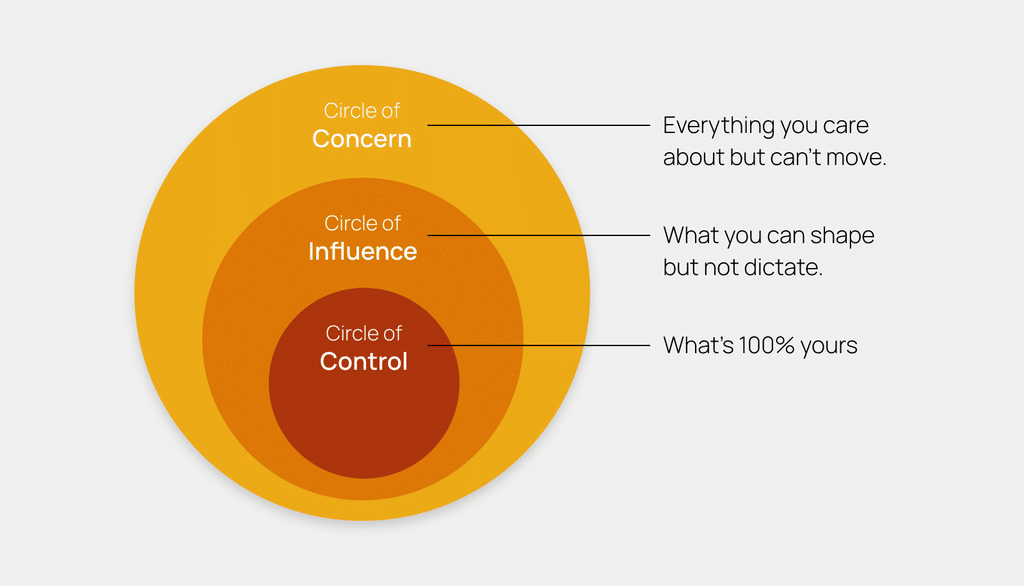
Then he asked the room a question: where do client results sit?
My perspective is that we have a tremendous amount of influence over client outcomes, and that influence starts with how we define success in the first place.
This is something I consistently advocate for with my team. Our responsibility isn't to blindly accept a goal and hope we can achieve it. It's to use our expertise to determine what's realistic, where the biggest opportunities exist, and what it will actually take to get there.
Think about how much time and money a business can waste pursuing a goal that was never realistic to begin with. Or investing in something simply because it was part of the original plan, when there are much better opportunities sitting right in front of them.
That's where I expect our team to step up. If we don't believe a goal is achievable, or we see a better use of the client's resources, we have a responsibility to say so. Bring the data, make the case, and recommend where we believe their investment will make the biggest difference. Even when that means challenging what the client originally asked us to do.
We can't guarantee every outcome, but we can take ownership of the goals we help establish, the strategies we recommend, and the decisions we make along the way. And when things aren't working, we have a responsibility to recognize it, understand why, and recommend what needs to change.
That's the value of hiring experts. You should be able to trust that they're helping you make the best decisions for your business, even when those decisions look different from what you originally had in mind.
97th Floor runs as a Results Only Work Environment (ROWE). Our team has the freedom to decide how they work. That freedom comes with a non-negotiable: you own the outcome.
A scope of work defines what we're responsible for delivering. It's an important guideline. But it is not the result. Our expertise decides how we approach the work and what we recommend to actually move traffic, conversions, and revenue.
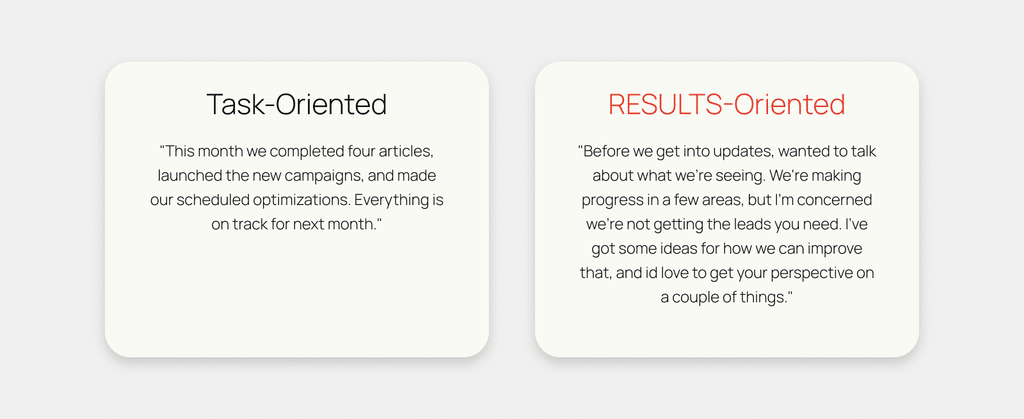
Ownership changes the questions we ask, the decisions we make, and ultimately, the value we bring to our clients. Here's what that looks like in practice:
| Task-oriented | Results-oriented |
| "Conversions are down, but we did everything we said we would. We're not sure what else to try." | "Conversions are down. I've dug in. Here's what I want to change, why I think it'll work, and how long until we know." |
| What's due this week? | What actually needs to happen? |
| What did the client ask for? | What does the client actually need from us? |
| Did I complete my work? | Where did my work make a difference, and where didn't it? |
| What should I tell the client today? | What does the client need to understand? |
The “Results-oriented” column is the expectation for every person on our team, from associate to senior. If your content isn't getting published or your optimizations stall in review, we don't shrug and point to the SOW. We ask why, and we fix the disconnect, whether that's education, prioritization, or showing more clearly what the work will return.
Taking ownership of results means being just as invested in figuring out what's not working as we are in celebrating what's going well. And some of the most valuable work we do for our clients happens when we have to rethink our approach, make adjustments, and find a better path forward.
A recent client experience is a great example of this.
One of our SaaS clients recently made a significant investment in paid media after being consulted on a growth opportunity that came with promising projections. Based on that guidance, they secured additional budget to pursue the strategy.
After ramping up the campaigns, results fell short of expectations. While the original recommendation hadn't come from our team, the investment had been made, and we weren't about to let that opportunity go to waste. We took ownership of understanding what wasn't working and finding a better path forward.
Our Senior Ads Manager kept everyone informed, proactively sharing what we were seeing, what we were testing, and what we recommended changing. Working alongside our creative team, we cut spend on underperforming campaigns, launched new comparison and demo video ads, built industry-specific targeting for sectors like hospitality, manufacturing, and energy, and moved budget to the ads driving the most sign-ups.
The following month, acquisition cost fell 23%, from $856 to $659 per new paying user, while volume held steady at 773 new paying users. Compared with July, the last month before the ramp-up, that’s 37% more new customers each month at an acquisition cost only about 6% higher.
Despite the initial setbacks, we earned even greater trust in our partnership. They had confidence in the decisions we were making, understood what we were learning, and were excited enough about the direction to pursue further investment and experimentation.
We won't get every recommendation right, and results won't always go according to plan. But our clients should never have to question whether we're paying attention, taking ownership, and doing everything we can to make their investment worthwhile.
Our goal is to understand our clients' businesses so well that we're identifying opportunities they haven't considered and bringing recommendations that can make a meaningful difference.
For one of our healthcare software clients, our team recognized an opportunity to strengthen their visibility in AI search. Without being asked, we developed a full answer engine optimization (AEO) prompt strategy, identifying target personas, where they sit in the funnel, and the specific prompts worth tracking at each stage.
When we shared the strategy, they were thrilled. As it turned out, they'd already been investing in monthly AEO reporting through another partner but weren't seeing the value they'd hoped for. We had no idea. We'd simply recognized an opportunity that mattered to their business and took the initiative to do something about it.
That same mindset is driving how we're experimenting with new approaches to content. For years, search data has been one of the biggest drivers of content strategy, telling us what people are searching for and what we need to create to rank.
That data still matters, but as the way people discover information evolves, creating genuinely helpful, unique content for real people is more important than ever. We're looking beyond the usual blog-post playbook, using what we know about our clients' audiences to develop creative ideas, test new formats, and find better ways to deliver results.
We're also running controlled tests on what earns AI citations, like comparing identical articles with and without subject matter expert input. When we learn something, every client benefits.
The marketing industry has changed dramatically since 97th Floor started in 2005, and AI is accelerating that change. Work that once required significant time and specialized resources can now be accomplished faster and more efficiently.
That's an enormous opportunity for businesses, but it should also raise their expectations of what an agency can deliver.
If execution is becoming faster and more accessible, what additional value should you expect from the experts you're investing in?
I'd encourage businesses to pay close attention to how their agency thinks.
These are the things that will increasingly separate great agencies from the rest.
At 97th Floor, we're using AI to prototype interactive tools, explore new content formats, and streamline processes that previously consumed valuable time. That efficiency gives our team more opportunities to invest in strategy, understand audiences, and test ideas that might not have been feasible before.
But having access to better tools doesn't automatically make someone a better marketer. It still takes expertise and judgment to recognize which problems are worth solving, identify the right opportunities, and develop a strategy that will make a meaningful difference.
And that's ultimately what I'd encourage any business to look for in an agency: people who understand your business, have opinions about how to make it better, and take the initiative to turn those opinions into action.
Everything I've shared comes back to a few expectations I hold our team accountable for, and that you should be able to count on from your agency:
One client said it simply when he renewed for another year:
That's what happens when people care about your results and know how to act on it.
If you're looking for a team that will treat your growth like its own, let's talk.
I expected technical SEO and fresh content to be what got HR tech brands named in AI answers. After scoring 115 brands on how often LLMs like ChatGPT and Google’s AI Overviews mention them, neither made much of a difference in our data. The strongest signal was how often other sites talk about the brand.
The short version:
B2B buyers are already building vendor shortlists in AI tools. In a G2 survey of 1,076 B2B software buyers, 51% said they start research in an AI chatbot more often than in Google, and 69% picked a different vendor than planned because a chatbot recommended it.
And in HR tech, those AI shortlists are short. On average, the most visible brand in each category showed up in 55% of that category’s AI answers. More than half the brands we studied (52%) showed up in fewer than 5%.
I wanted a straight answer to two questions: what actually moves AI visibility in HR, and what sounds important but turns out to be noise? The result is the AI Search Report: 2026 HR Tech Edition, a Fortune 500-style leaderboard that shows who's #1, who's last, and where every brand stands against competitors of the same size and category.
We scored 115 HR tech brands across 15 categories, from Core HR and payroll to background screening and L&D. Over 31 hours of research, we analyzed 1,000+ website pages, tracked brand mentions across YouTube and Reddit, pulled apart G2 profiles and checked whether LLMs could actually read each site, scoring every brand on 30 metrics in all.
Every brand received an AI Search Score from 0 to 100:
| Component | Weight | What it measures |
| AI Search Performance | 60% | Share of voice, mentions, impressions and citations in Google AI Overviews, AI Mode and ChatGPT, ranked within category |
| AI Readiness: Off-Page | 22% (55% of Readiness) | Link authority plus presence on "best of" lists, G2, Reddit, YouTube and Wikipedia |
| AI Readiness: Content | 14% (35% of Readiness) | Content quality across an 8-page sample, plus publishing pace |
| AI Readiness: Technical | 4% (10% of Readiness) | AI crawler access, raw-HTML text, Organization schema, mobile PageSpeed, server response |
Then we compared Readiness inputs against Performance to see which ones actually travel together. Data is US-only, pulled in late September 2026. Throughout this article, “AI Search Performance” is a 0 to 100 percentile within each category. A brand at 70 is more visible in AI answers than roughly 70% of its direct competitors; a brand at 13 is ahead of almost none of them.
In our data, technical factors did little to separate the brands AI names most from the ones it skips. I went in expecting schema and JavaScript rendering to show up as major factors. In this study, they didn’t show a measurable effect.
Here’s how we checked. We audited each brand’s homepage for common technical issues, then compared the AI visibility of brands with each issue against peers of the same company size. The table shows how many brands had each issue and whether it lined up with lower visibility.
| Technical issue | Brands | Effect on AI visibility |
| Blocks live-answer AI bots in robots.txt | 2 | Yes: about 18 to 20 points below their size tier |
| Blocks training bots only | 6 | None visible |
| Mostly-JavaScript homepage | 23 | None measurable |
| No Organization schema | 34 | No difference |
| Mobile PageSpeed under 40 | 49 | None. ADP ranks #1 overall with a mobile score of 32 |
That doesn’t make technical SEO optional. A crawlable, sound site is the price of entry. But in the results we saw, once a site cleared that bar, extra technical polish didn’t translate into more AI visibility.
The one rule you can't break: don't block the bots that fetch live answers. If ChatGPT or Perplexity can't read your site when a buyer asks a question, you're out of the conversation. Open your robots.txt today and check.
Three page traits moved citations: length, a summary near the top, and answering the question right away. We audited 860 pages across the 115 brands, 8 per brand: three top-traffic pages, three random pages and the two most recent posts.
| Page trait | Cited share (has it) | Cited share (doesn't) | Verdict |
| 2,000+ words vs. under 1,000 | 27.3% | 8.3% | About 3x |
| Summary in the first 30% | 25.8% | 12.6% | About 2x |
| Answers the question first | 16.1% | 11.6% | +4.5 pts |
| Links to outside sources | 15.5% | 13.2% | Too small to call |
| Updated in the last 12 months | 13.9% | 14.3% | No difference |
| Original data | 12.8% | 14.4% | No difference |
| Credentialed author | 11.6% | 15.5% | No difference |
Freshness was my biggest surprise. I was sure it would be a top factor. It made no difference at all.
The median cited page runs about 1,700 words; the median uncited page, about 1,100. And the most-cited editorial pages in the study are comparison and explainer content: HiBob's guide to types of HRIS systems (101 AI citations), Workday's HCM software explainer (97) and Workable's types of HR software (56).
Publishing more, on its own, barely moved AI visibility. We split brands two ways: whether they publish faster or slower than peers their size, and whether their content quality scored above or below the median. Then we compared median AI Search Performance for each group.
For mid-size companies (201 to 1,000 employees), the gap was even bigger. Among brands publishing at a faster pace, those with weaker content had a median of 21. Those with stronger content had a median of 70, more than 3x higher. If you’re deciding where next quarter’s content budget goes, our data points to making fewer pages better before making more of them.
Off-page presence separated winners from everyone else more than any other pillar. The more places the internet talks about you, the more often AI names you.
Start with “best of” lists. For each brand, we checked the top-ranking “best [category] software” articles and counted how many included the brand. It was the strongest single signal we measured, and it held after adjusting for company size.
The more interesting part is how steady the drop-off is. Each step down in list coverage cost brands roughly 20 points of AI Search Performance:
You don’t need to be on every list to compete, but every gap shows up. And 16% of the brands we studied weren’t on a single list we checked. In AI answers, those brands were ahead of almost none of their competitors.
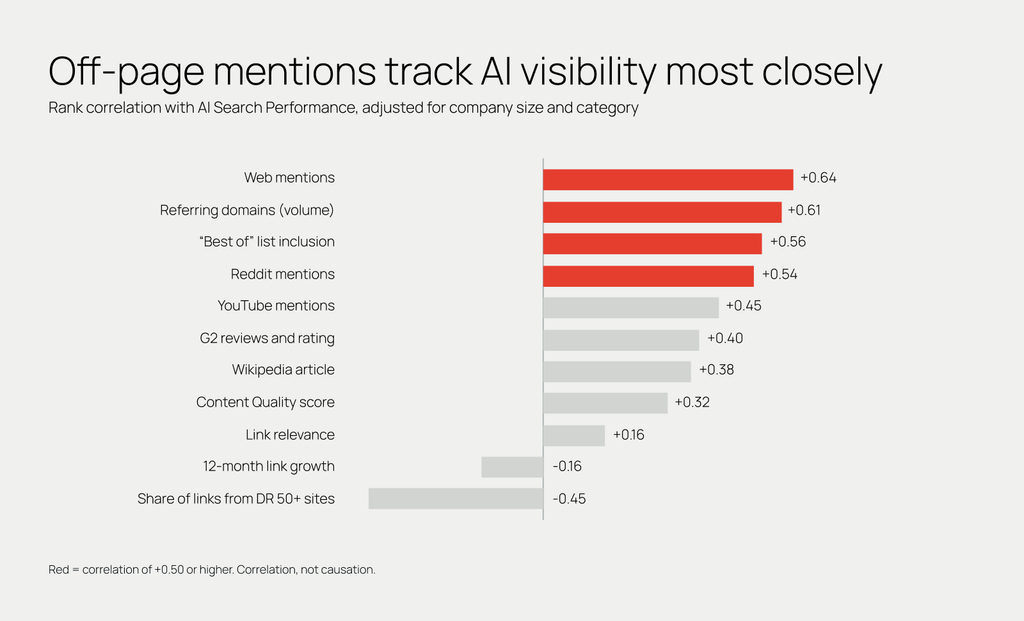
The link data surprised me. Volume of referring domains mattered almost as much as raw web mentions. But the share of links from high-authority (DR 50+) sites correlated negatively. AI tools seem to reward being everywhere over being on a few prestigious domains.
In plain terms: if you're not on the listicles and in the threads where your category gets discussed, you're not in the AI answer.
Here’s where I’d start, in order of how strongly each factor tied to AI visibility in our study:
The full AI Search Report: 2026 HR Tech Edition has the complete 115-brand leaderboard, category breakdowns and brand-level scorecards.
Want to know which buyer questions name your competitors instead of you? Book an AI search audit and we'll map your gaps and build a prioritized 90-day plan.
Measurement continued to be a topic at Ahrefs Evolve after BrightonSEO. Everyone has heard of and is talking about the decreasing line in search console. Organic is down. People have said it’s disappearance has been tucked away in direct. The attribution is messier than ever, but that doesn’t mean outcomes are.
At Ahrefs Evolve, we interviewed 12 in-house marketers about how they're handling AI search. When we got to measurement, a surprising number of them told a version of the same story. Their traffic is down, but the business is fine. In several cases it's better.
The pattern makes sense. AI tools answer a lot of top-of-funnel questions on the spot. The people who still click through have usually already done their research. There are fewer of them, and they're closer to buying.
The problem is proving it. As Dave Kimball, marketing director at Invite Networks, put it: "Attribution is the billion-dollar whale. Everyone's trying to figure that out."
The people we talked to named a couple reasons AI search is so hard to attribute, outside of the typical conversation of traffic hiding in direct.
Sales cycles outlast the data. Dave's IT business has sales cycles of one to three years. Tying a first touch in ChatGPT to a deal that closes two years later is close to impossible with today's tools.
The systems don't talk to each other. Eden used the shift in search to push NRG's CMS from on-premises to the cloud, so she could finally connect analytics, journey data and AI visibility in one place. Until that's done, "I can see clicks went down, clicks are now up. I don't know why."
We asked every marketer what their leadership looks at when they report on AI search. Seven of the 12 gave some version of the same answer: revenue, pipeline, leads or customers.
Irina Jordin, VP of Marketing at Checkmate, carries a pipeline number herself, so she didn't hesitate: "It is all about SQLs." Leadership asks where deals come from, "but they really don't care how or what. They just want to see the dollar signs at the end." Jonathan Rundle, head of marketing at ChemPoint, said his leadership cares about "revenue, margin impact, leads." Eden's leadership at NRG asks one question: does it add customers or help keep them?
Visibility metrics still have a place, but mostly as supporting evidence. Stefanie Maio at Evans Hotels reports mentions, citations and share of voice, framed explicitly as trends rather than precise numbers. James's leadership watches prompt visibility as a brand-health signal, "but ultimately it's where are the leads coming from and what's the conversion rate."
No one we talked to has solved attribution. But the most confident teams are combining several imperfect signals into one story:
Pipeline as the north star. Alexandre's team stopped arguing about which channel gets credit and made "pipeline generated and influenced by marketing" the main goal. They also track new signals, like time spent on money pages and conversion rates on those pages.
AI referral traffic, judged by conversion. James calls this "the metric I can really hang my hat on." The sessions are small. The conversion rate isn't. Jonathan's team is seeing ChatGPT referrals convert too, enough that they're now testing ChatGPT ads.
Self-reported attribution. Irina reads her form fields closely. Leads now name AI search as a source alongside direct and organic. James sees more people saying, "I found you through ChatGPT or Claude or a Google AI Overview."
Context with every number. This might be the biggest takeaway when reporting your success in IA Search to leadership who might understand the full picture. Eden's tip for reporting up: never show an AI metric on its own. When she compared NRG to its top five competitors, she pointed out that AI only recommended a provider in about 100 of 40,000 answers, and a specific mention of NRG was only a handful of times. "Every time you say a number, there's like four lines of context you have to give around it."
One trusted source of truth. Will Heany, SEO manager at Snowflake, has seen two managers send leadership AI numbers that say completely different things. His team is now building prompt tracking inside Snowflake's own data warehouse, which they find "a lot more trustworthy" than outside tools.
Rand Fishkin, who spoke at Ahrefs Evolve on zero-click marketing, recently pointed people to Eduard Blacquière's AI KPI model as "possibly the only thing I've seen comprehensive enough" to show how you're actually doing in AI visibility. It's worth a look if you're building a framework from scratch.
If your traffic is down and your leads aren't, here's how we'd help you prove it:
For more on the measurement gap, read Measurement is AI search's biggest unanswered question, and listen to Rand Fishkin and Paxton Gray on Attribution Is Dead. Now What?
A falling traffic chart used to mean something was broken. Today it often means AI is answering the easy questions, and the people who still show up are the ones ready to buy.
That's not a problem to explain away. It's a story to tell, with the numbers to back it up.
Need help proving what AI search is doing for your pipeline? See our GEO/AEO services or let's talk.
At BrightonSEO San Diego, our team asked some of the sharpest people in AI Search a simple question: what's YOUR biggest unanswered question about AI search right now?
We expected a spread of answers: agents, Google's next move, the future of the website. What we got was a pattern that was so stark it even felt repetitive by the day's end. Five of the eight leaders who answered said some version of the same thing: we still can't measure this well.
Some framed it as a prompt tracking problem. Nobody knows what people actually type into ChatGPT, Gemini or AI Mode, so nobody fully trusts the visibility scores built on top of those prompts. Others framed it as an attribution problem. Even when you show up in an AI answer, connecting that to pipeline and revenue is murky.
That matters, because measurement is what earns a budget and internal support. If you can't show what AI search is doing for the business, you'll struggle to keep investing in it. Here's what we heard, who said it, and what we think you should measure instead.
Benchmark how AI sees your brand, build a strategy to strengthen it, and measure the impact.
I specifically interviewed the folks that I felt have been leading the AI Search conversation online, as well as the companies that have been diving in and experimenting the most. We do this often with our guests on our podcast, The Campaign. Kevin Indig came on with us and expressed a lot of the same concerns we heard at Brighton. Here was the lay of the land of folks responses to what is still unanswered for them in AI Search:
| Expert | Role | Their Unanswered Question |
| Brooke Weller | AI Search Expert, LinkedIn | Can anyone accurately track prompts? |
| Chris Long | Co-Founder, Nectiv | What are people actually typing into AI search? |
| Ken Marshall | Co-Founder, Meet Sona | How do prompt-tracking tools build their data? |
| Lucy Hoyle | First Content Engineer, Carta | How do we tie AI visibility to revenue? |
| Nick Lafferty | Founding Marketing Engineer, Profound | How do we attribute AI-driven demand, and how does the organic listing interplay with ChatGPT ads? |
| Martha van Berkel | CEO & Co-Founder, Schema App | What happens to the role of the website in the future? |
| Skyler Rudolfsky | GTM, Semrush | How will AI platforms monetize in the future? |
| Thomas Peham | CEO & Co-Founder, OtterlyAI | Why do citation sources suddenly shift? |
Chris Donnelly, CEO and Co-Founder of Searchable, mentioned the Prompt Universe, Searchable’s new product offering, as a way to answer the questions of, “What prompts am I tracking? Are they the right prompts? Am I tracking enough prompts?” While Searchable, Profound, and Scrunch are growing tools, trust across the board of their validity doesn’t seem to be strong in the SEO community.
Problem 1: People aren’t trusting prompt tracking just yet, so stick to knowing your audience
In traditional search, Google Search Console tells you which queries you showed up for. AI Search has no equivalent. That gap is what most of our experts are stuck on.
Chris Long, co-founder of Nectiv, put it plainly (watch Chris's clip):
"No one knows the prompts people are putting into AI search systems."
He isn't optimistic it gets solved soon. Every tool has its own method for building prompt sets, and none of the major AI platforms share real query data. Unless a data provider opens it up, he doubts there will ever be a great answer.
Brooke Weller, who leads AI search at LinkedIn, sees the same thing from inside a major brand (watch Brooke's clip):
"I don't think anyone can accurately track prompts."
Even at LinkedIn, she reports an AI search visibility score she isn't sure is accurate. She also points out that AI conversations are personal and long-running. She has threads that go on for months, so no single "first prompt" captures how people actually reach a brand.
Ken Marshall, co-founder of Meet Sona, wants more transparency from the tools themselves (watch Ken's clip). Many visibility platforms don't publish how they choose prompts or model personas.
This is a human element of search that still has to be in place from human marketers in order for a brand to achieve visibility and recognition. Alyssa Felix, one of our senior search marketers, put it plainly, “The best prompt research tool is still talking to your customers, reading their questions, and paying attention to what they actually say.”
The second half of the problem starts after a brand shows up in an AI answer. What did that appearance actually do for the business?
Lucy Hoyle, founding content engineer at Carta, named the pressure many marketers feel (watch Lucy and Nick's clip):
"Attribution is still really difficult. Visibility is one piece and it's very top of funnel, but how does that then track to engagement, revenue?"
Marketing teams are being asked to generate pipeline and prove ROI, and AI visibility on its own doesn't do that.
Nick Lafferty, founding marketing engineer at Profound, shared one low-tech fix that works. Profound's contact form forces every lead to write, in an open text field, how they heard about the company before being able to navigate further. Self-reported attribution catches the AI answers and conversations that tracking can’t uncover. Nick pointed out that this kind of first-party signal "will become really foundational" for brands if they do want to have somewhat of an answer for attribution as it gets messier and messier.
This matched what our own Alyssa Felix heard at the BrightonSEO AEO/GEO roundtable. For in-house teams, she said, "the big question right now is reporting and attribution": proving organic still works, and proving the team behind it still matters. The buzz phase of AI Search is over. Executives know it’s important, but HOW important is starting to be questioned and the level of investment will be determined by how much attribution can be shown.
Rosy Callejas, who works on enterprise SEO and AI search at Microsoft, offered the practical takeaway in approaching executives about AI Search now. (watch Rosy's clip). To win trust from leadership, bring "ANY data to show them," because "we're all data driven at this point." Something is better than nothing!
The three experts who didn't name measurement still raised questions worth tracking:
Even these answers come back to measurement. If citation sources can swing overnight, you need reporting that catches the swing and shows what it cost.
Perfect prompt data may never arrive. That's no reason to fly blind. Here's the approach we use with clients at 97th Floor:
AI search isn't missing strategies. It's missing a scoreboard. The experts we talked to at BrightonSEO know how to earn visibility in ChatGPT, Gemini and AI Mode. What they can't do yet is say, with confidence, which prompts drove it and what it was worth.
Until the platforms open up their data, the teams that win will be the ones that combine imperfect signals: first-party platform data, citation tracking, self-reported attribution and pipeline. Then they bring those numbers to leadership before anyone asks.
For more from the conference, read Mike Witham's 45/40/15: What BrightonSEO San Diego taught me about where SEO is headed.
Ready to prove what AI search is doing for your business? Let's talk.
A month ago, Google changed how Target CPA and Target ROAS bidding strategies behave when campaigns are constrained by budget.
At the time, I wrote about why I thought the change could ultimately be a good thing for advertisers. The short version: Google would start treating your target more like an actual target, rather than potentially outperforming it simply because a limited budget allowed the algorithm to be selective about which auctions it entered.
My advice then was simple: be intentional with your targets.
TL;DR
Now we have some actual data.
We analyzed 28 campaigns across multiple advertisers, comparing performance before the August 17 update (July 14–August 16) with performance after it (August 18–September 20).
For Target CPA campaigns, we evaluated CPA and conversion volume. For Target ROAS campaigns, we evaluated ROAS and conversion value. We also looked at budget limitations, Search Impression Share lost to budget, target changes, and subsequent bidding-strategy tests.
This isn't a controlled experiment. Seasonality, auction conditions, account optimizations, and other variables are always changing. But after a month of data, some patterns are emerging.
Across the 28 campaigns, the median campaign saw:
| ↑ +3% Spend Stayed roughly flat | ↓ -18% Volume Meaningfully declined | ↓ -7% Efficiency Slightly worse |
| Median change across 28 campaigns |
The efficiency decline isn't the most interesting part.
It's that campaigns spent roughly the same amount of money while generating meaningfully less volume.
And that pattern became even stronger when we isolated campaigns where we intentionally kept the target unchanged.
There were 16 campaigns where we were comfortable with the existing efficiency target and didn't adjust it after August 17.
For those campaigns:
| ↑ +0.2% Spend Essentially flat | ↓ -31% Volume Significant decline | ↓ -17% Efficiency Meaningfully worse |
| Median change across 16 campaigns where the target was intentionally unchanged |
Same target. Essentially the same spend. Very different outcome.
That's a strong reason to revisit targets that worked before August 17 rather than assuming they'll continue producing the same balance of spend, volume, and efficiency.
The effect also wasn't evenly distributed across bidding strategies.
Among the 16 Target CPA campaigns:
| ↓ -9% Lower spend | ↓ -32% Fewer conversions | ↑ +10% Higher CPA |
Among the 12 Target ROAS campaigns:
| ↑ +4% Steady spend | ↑ +2% Steady conversion value | ↓ -4% Slightly lower ROAS |
Our sample isn't large enough to conclude Target CPA is universally more affected. But within our data, tCPA campaigns showed a much more pronounced decline in volume.
Historically, a budget-limited campaign could substantially outperform its target.
Imagine your tCPA was $100, but your daily budget only allowed Google to participate in a fraction of the available auctions. Google had to be selective. It might spend the full budget while averaging a $70 CPA simply because it prioritized the opportunities it liked most.
After the update, Google is more likely to treat the target you set as the number to aim for—even when budget constraints previously would have pushed it to outperform that target.
Among the budget-limited campaigns we analyzed, median Search Impression Share lost to budget increased from approximately 29% to 42%, while efficiency worsened 11%.
That doesn't mean every budget-limited campaign needs more money. Start by asking whether it's hitting its target.
We saw the opposite problem too.
Some campaigns experienced significant declines in spend and conversion volume. In those cases, making the target more aggressive would only make the problem worse.
So we tested removing the target entirely.
We reviewed nine campaigns with usable before-and-after data after moving away from Target CPA to Maximize Conversions.
| Campaign | Spend | Conversions | CPA |
| Campaign A | -20% | +7% | -26% |
| Campaign B | +25% | +208% | -60% |
| Campaign C | -28% | +27% | -43% |
| Campaign D | +27% | +121% | -43% |
| Campaign E | +11% | +86% | -40% |
| Campaign F | -4% | +13% | -15% |
| Campaign G | +6% | +4% | +1% |
| Campaign H | +6% | +71% | -38% |
| Campaign I | +7% | -7% | +15% |
Seven of the nine campaigns improved CPA. In most of them, conversions grew much faster than spend:
Removing the target often resulted in more productive spend, not just more spend.
This doesn't mean tCPA is broken, or that everyone should switch to Maximize Conversions. It gives you another option when a target seems to be choking delivery.
Start by figuring out which situation your campaign is in:
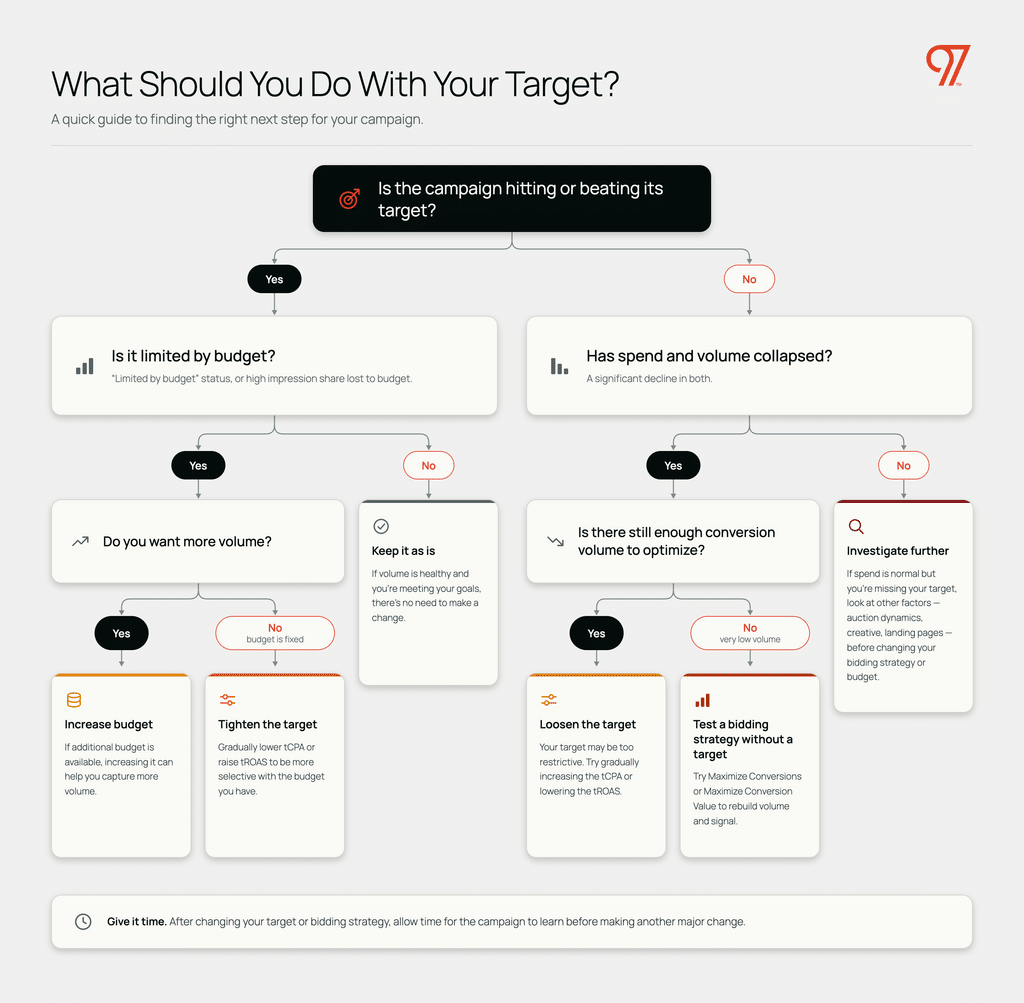
My advice then was to be intentional with your targets. A month of data shows why that matters more than we expected.
Target CPA and Target ROAS still work. What changed is how your target, budget, and volume relate to each other, and that's enough to justify revisiting every target set before August 17.
Your target is something you adjust over time. Sometimes that means tightening it, sometimes loosening it, sometimes removing it, and sometimes leaving it alone. The key is knowing which problem you're solving before you change it.
Not sure whether your targets are working against you? Talk to our advertising team about a bidding strategy audit.
The first thing you notice inside OpenAI's Ads Manager is how much it looks like something you've already used. Campaign, ad group, ad. Objective, location, daily budget. If you've spent any time in Google Ads, your hands know where to go before your brain catches up.
That familiarity is the most misleading thing about it.
We built our first ChatGPT Ads campaign this summer for a B2B SaaS client in the SMS marketing space. It was an awareness push across ten industry segments, running to the US and Canada. The build itself went quickly, because the keyword research was already sitting there waiting to be used. It's everything after the build that turned out to be the hard part.
You can construct a ChatGPT Ads campaign using almost everything you know about paid search. You just can't optimize one that way yet.
Here's where that plays out.
Campaigns hold ad groups. Ad groups hold ads. So far, so Google.
The difference lives at the ad group level. Instead of keywords, you write context hints: plain-language descriptions of the conversations where your product would genuinely be useful. OpenAI's documentation is refreshingly blunt about what they are and aren't. Hints describe the conversations, topics, or keywords where their products or services may be relevant, and they are not exact-match keywords and do not guarantee delivery in specific conversations.
Read that second half again. There's no match type. There's no negative list. You are describing a situation and asking a model to decide when your ad is helpful.
We started from keyword research. One segment alone carried nine near-identical variations of mass texting for nonprofits. In ChatGPT Ads, all nine of them collapsed into a single hint that read something like this:
Organizations comparing nonprofit text messaging platforms and SMS marketing tools. Users looking for affordable, easy-to-use software to improve donor engagement, increase event attendance, boost fundraising efforts, automate communications, and measure campaign performance.
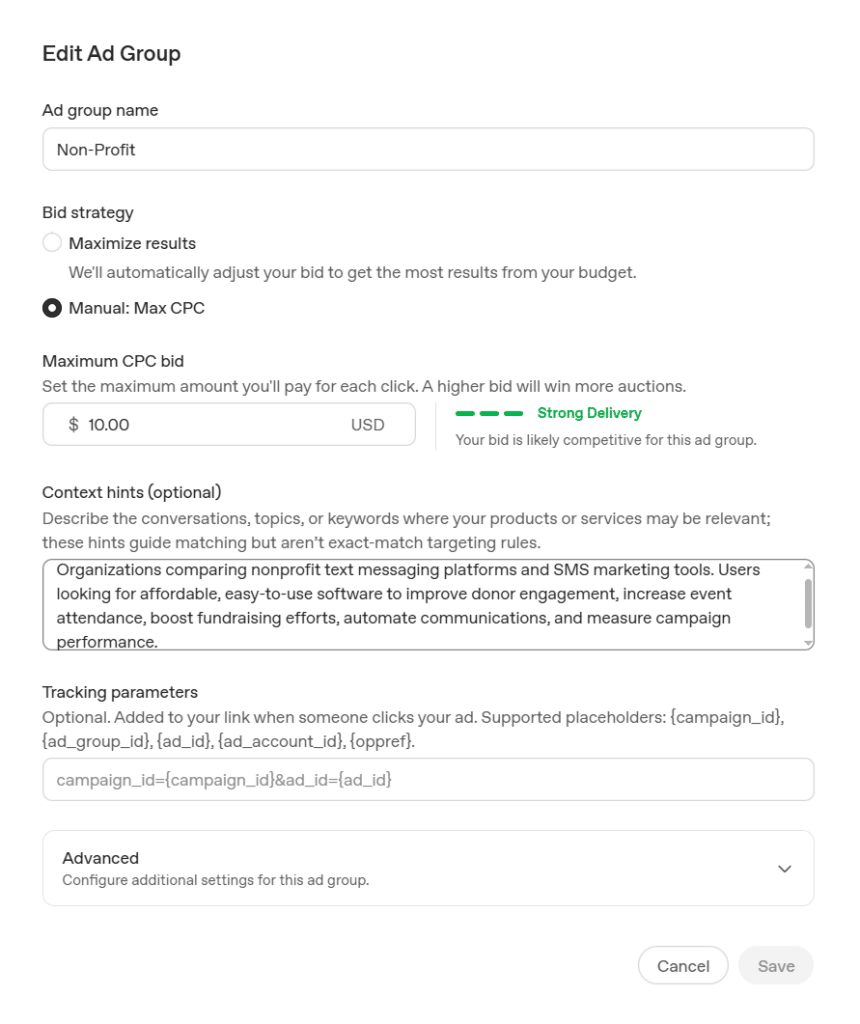
Same research, completely different output. The keywords stopped being used for direct targeting and became source material. That's the reframe, and it's most of the job: your keyword list still tells you what people want, it just no longer tells the platform anything.
The mental shift that actually helped: stop asking what words do I want to match and start asking what is someone working on right before my product becomes relevant? A nonprofit director doesn't type "mass texting for nonprofits" into ChatGPT. She says her donor emails aren't getting opened and asks what to do about it.
Benchmark how AI sees your brand, build a strategy to strengthen it, and measure the impact.
Ads in ChatGPT aren't shown to Plus, Pro, or Business subscribers, or to accounts the system identifies as under 18. Your reach is the free and Go tiers.
For consumer brands, that's a large and perfectly good audience. For B2B, it deserves a second look. A meaningful chunk of the buying committee you're trying to reach is sitting on a company-provisioned Business seat, which means they are structurally unable to see your ad. That doesn't make ChatGPT Ads a bad B2B channel. Plenty of decision-makers are on personal free accounts, and plenty of research happens before procurement gets involved. It does mean the total addressable audience is not "everyone who uses ChatGPT," and pretending otherwise will make your forecasts wrong.
Fifty characters for the headline. One hundred for the description. A square image, minimum 256 x 256. That's the whole ad.
It's tighter than it sounds, because ads can truncate well before those caps depending on placement. In practice, we wrote to about half the limit and treated anything past that as a bonus. The ads that felt best were the ones that stated a specific tension in plain words, like School Emails? Only 1 in 5 Parents Opens Them, rather than the ones that tried to describe a product.
A few things we'd repeat:
This is the real gap, and it's worth being direct about.
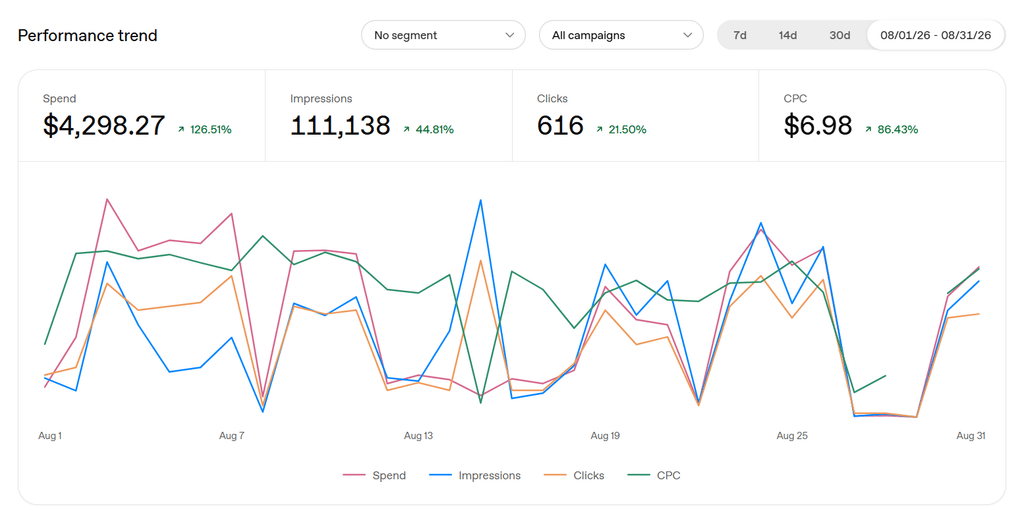
You can segment reporting by device and country. You cannot see performance by context hint.
Think about what that removes. In Google Ads, the search terms report is how you close the loop. You learn what actually triggered your ad, you prune, you expand, you get smarter every week. In ChatGPT Ads, you write eight descriptions of eight conversations, the campaign spends, and the platform tells you how many clicks you got in aggregate. Which description earned them is, right now, your guess.
The metrics themselves are reasonable for a beta: impressions, clicks, spend, CTR, average CPC, average CPM, and conversions, available at campaign, ad group, and ad level. Pixel and Conversions API measurement both exist. But there's lag to plan around. Attributed conversions can take 24 to 48 hours to appear, and the view-through window is fixed at one day.
There's also no published guidance on the questions you most want answered. OpenAI hasn't documented a maximum number of context hints, a character ceiling for them, or whether narrower hints outperform broader ones. There's plenty of advice circulating. Three to eight hints per ad group, one to three sentences each, is the rule of thumb we've been working from. But that's practitioner consensus, not official guidance, and I'd rather label it honestly than dress it up as documented best practice.
Since the platform can't tell us which hint worked, we built the campaign so our own analytics could.
One intent per ad group, strictly. Not one industry. One need. If "appointment reminders" and "flash promotions" both live in a healthcare ad group, no result from that ad group means anything.
Every ad group gets its own landing page and its own UTM. The part that matters is pushing the ad group's theme into utm_content, so every click lands already labeled with the intent it came from. That one parameter does more heavy lifting than anything the platform reports back. Your site analytics becomes the segmentation layer, because the platform isn't there yet.
Hints are hypotheses, and you write them down as such. Before launch, we noted what we expected each hint to reach. When behavior on the landing page didn't match, that was a signal. Not clean attribution, but directionally useful, which is what a beta gives you.
Budget it like a test, not a channel. This is money spent to learn how a new surface behaves. We'd rather find out now, at a small scale, than in a year when the auction is crowded and everyone's figured it out.
We've been running these for weeks, not quarters. I'm not going to tell you what ChatGPT Ads CPCs "should" be, or hand you a conversion rate benchmark, because I don't have enough of my own data to add a better number to the pile. We’ll have that answer in a few months.
What I'm reasonably confident about is the shape of the platform. The creative constraints are real. The audience exclusions are real. The reporting gap is real, and it's the one that will decide whether this becomes a channel you can scale or a line item you defend every quarter.
What I'm not confident about is any of it staying true. Conversion bidding, geo exclusions, and bulk tools have all landed since the self-serve beta opened in May. The list of things we can't see is shorter than it was four months ago, and it'll be shorter again by the time you read this.
So: build it with a paid search mindset. Measure it like an analytics pro. And write everything down, because the version of this platform you're learning today isn't the one you'll be running next year.
That's not a reason to sit it out. It's just the price of being early.
One of my favorite Chrome extensions is the Ahrefs SEO Toolbar. Click it on any page and you get a quick read on how that page is doing in search — domain rating, backlinks, keywords, traffic, the works. It's been a staple for a long time.
But here's where it starts to fall short: we're now optimizing pages for the prompts people are actually typing into AI tools, and a lot of those prompts simply aren't in Ahrefs' keyword database yet. That's especially true for pages we've just published or just re-optimized. So the tool that used to be the fastest gut-check on "how's this page doing" gets a lot less reliable right when we need it most — on our newest, most AI-focused work.
So Claude and I built something to fill that gap.
GSC Metrics Sidebar is a Chrome extension that shows you real Google Search Console data for whatever page you're on, right in your browser — no tabs to Search Console, no exporting, no digging through property lists. If it's a domain you have GSC access to, you get the numbers instantly.
View it in the Chrome Web Store →
Open the sidebar on any page and it pulls up:
Because this is pulled straight from Search Console, it doesn't matter whether the page went live yesterday or five years ago, or whether the queries it's ranking for are obscure, brand-new, or prompt-style phrasing Ahrefs hasn't indexed yet. If Google has data on it, you'll see it.
That's it. No extra setup, no config.
Watch my full walkthrough of the install and a live demo of the sidebar in action!
Grab it, install it, and start clicking around on client pages you're already working on. If anything looks off or you think of a feature that would make this more useful, send it my way — happy to keep improving it.
One more thing: this is exactly the kind of gap tools like Ahrefs can't close on their own right now — real performance data on the AI-driven queries our AI Search Services are built around. If you're needing a clearer read on how your content is actually showing up in AI search, reach out.
There's a version of the AI search conversation that treats all of this as a future problem. Someday buyers will research in ChatGPT. Someday AI answers will shape deals. Someday you'll need a strategy for it.
G2's research on B2B software buying says the someday already happened.
Per G2's report, The Answer Economy: How AI Search is Rewiring B2B Software Buying, 51% of B2B software buyers now start their research with an AI chatbot. Not "have tried one." Not "consult one at some point." Start there. The first touchpoint of the modern software deal — the moment a buyer goes from feeling a problem to naming it — is now, for the majority of buyers, a conversation with an AI.
We put this data in front of our entire company at our monthly meeting, because it reframes everything about how we think content earns pipeline. Here's why it stopped us in our tracks — and what we think it demands of every B2B marketing team.
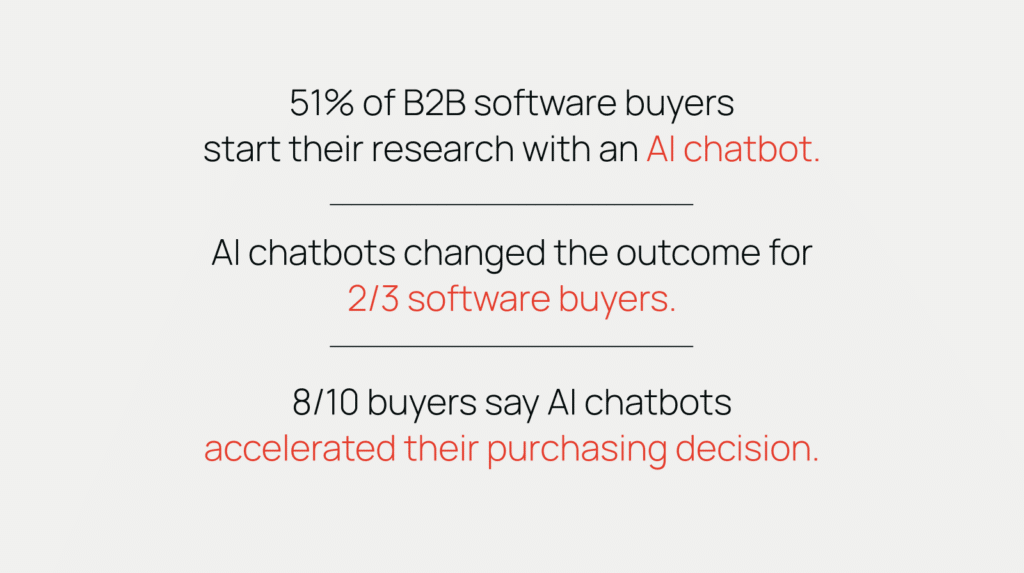
The adoption number gets the headlines, but it's actually the least interesting of G2's findings. Buyers moving to a new research channel is a distribution story — marketers have navigated those before. The next two stats are a different kind of story.
AI chatbots changed the outcome for two-thirds of software buyers.
Read that again. Not "informed their thinking." Changed the outcome. Two out of three buyers who used AI in their research ended up somewhere different than where they were headed — a different vendor, a different category of solution, a different shortlist entirely.
This is the part that should reorganize your marketing priorities. A traditional search engine handed your buyer ten links and let them assemble their own conclusion. An AI assistant hands them the conclusion — a synthesized recommendation, a comparison table, a "for a team your size, I'd look at these three." The AI isn't a new place buyers gather information. It's a new participant in the decision. It has opinions, and buyers are taking them.
Benchmark how AI sees your brand, build a strategy to strengthen it, and measure the impact.
And 8 out of 10 buyers say AI chatbots accelerated their purchasing decision.
Faster deals sound like good news, and for the vendors in the answer, they are. But think about what acceleration means mechanically: the research phase compresses. The weeks a buyer used to spend reading blog posts, downloading comparison guides, and sitting in your retargeting audience — the entire window where marketing traditionally worked on them — shrinks to a handful of AI conversations. Buyers are arriving at shortlists before most vendors' funnels even register that a deal exists.
Put the three numbers together and the picture is stark: the majority of buyers start in an AI, most of them are redirected by what it says, and nearly all of them move faster because of it. The buyer's journey didn't add a new step. It got a new gatekeeper.
Here's the mechanism underneath the "changed the outcome" stat, and it's worth understanding because it's genuinely different from how search shaped decisions.
In traditional search, the buyer did the synthesis. They'd search "best project management software," open six tabs, weigh the review sites against the vendor pages, and form a consideration set themselves. Your job was to be present at enough of those touchpoints that you made the list. Imperfect, but the buyer was the editor.
In AI-era research, the model is the editor. When a buyer asks, "We're a 40-person agency with clients in healthcare — what project management tools handle HIPAA compliance well?", the AI composes an answer from everything it knows and everything it retrieves — and the vendors named in that answer are the consideration set. There's no page two. There are no ten blue links to scroll past the answer. For a growing share of buyers, if you're not in the response, you were never in the deal.
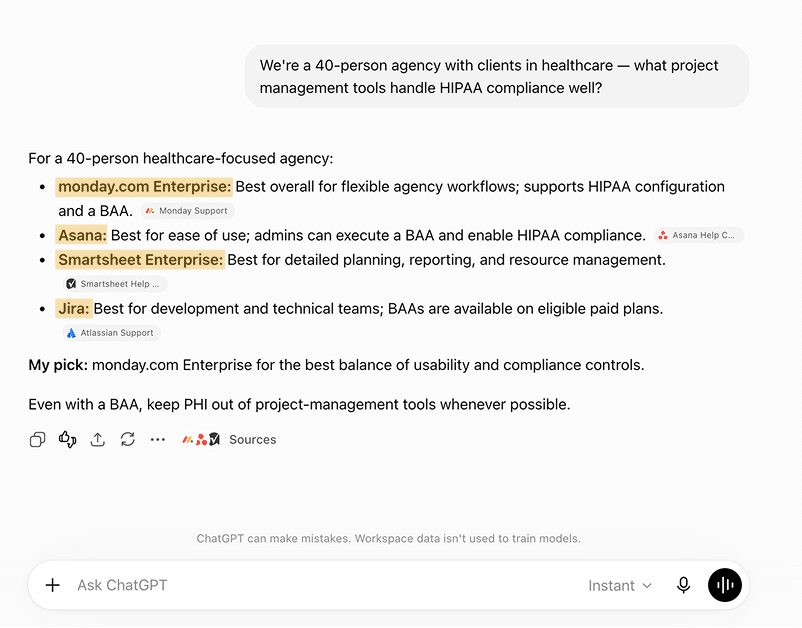
That's why buying outcomes are changing. The AI doesn't just reorder the same shortlist buyers would have built anyway — it builds a different one, weighted toward whichever brands are most legible to it: clearly explained, widely referenced, credibly reviewed, easy to cite. Brands that dominated the old game of rankings can be invisible in this one, and challengers with clearer, more citable material are showing up in answers next to incumbents ten times their size.
If your analytics look fine, that's not evidence this isn't happening to you. It's the nature of the shift.
Those AI research sessions happen off your properties, generate no impressions you can count, and mostly resolve without a click. The buyer who asked an AI four questions about your category, got steered toward a competitor, and never visited your site doesn't show up anywhere in your reporting. Neither does the one who was steered toward you — they arrive later as "direct" traffic, unusually educated, unusually far down the funnel, and your attribution model shrugs.
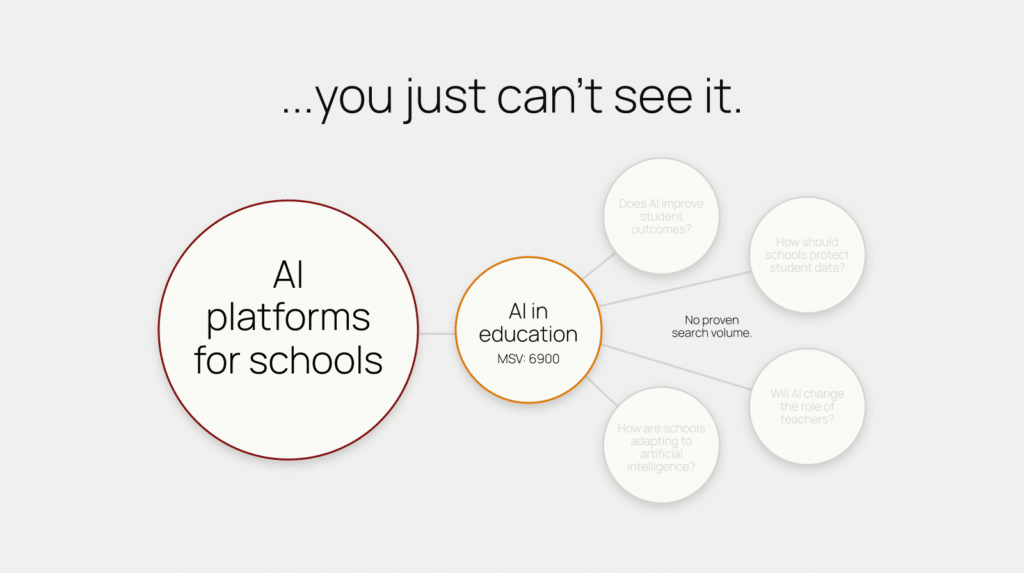
This is the same visibility problem we've written about across this series: the most important buyer activity in your category no longer produces trackable data. When we ran a keyword-free content exercise across our whole company, roughly 40% of the ideas our teams generated — the real questions real buyers ask — weren't covered anywhere on existing content calendars, because nothing in the keyword data ever pointed to them. The G2 numbers are the demand-side confirmation of the same story: the buyer conversation moved somewhere your dashboards can't follow.
Just because you can't see it doesn't mean it isn't happening.
The question every CMO should be asking isn't "should we respond to this?" The buyer already moved; that decision was made for you. The question is whether your brand is in the answers — and there's a concrete way to work on that.
Start by auditing your presence where buyers actually start. Ask the major AI assistants the questions your buyers ask — not your keywords, their questions. "What should a company like X consider when solving Y?" "Compare the top options for Z." Note who gets named, who gets recommended, what's said about you, and what sources the answers cite. This is the new SERP audit, and most teams have never run it. (If you want a head start, we run a free AI audit that measures exactly this.)
Then build for the questions, not the keywords. The prompts steering these deals — "I have $50,000 and a mandate; where's the highest-impact place to put it?" — have no trackable search volume and never will. They come from understanding your buyer: their fears, frustrations, objections, comparisons, and buying concerns at each stage of the journey. That's why we've stopped treating keyword research as step one and started from the audience instead, with keyword data brought back in later for validation and forecasting. Search volume is evidence of demand, not the boundary of demand.
Make your material easy to cite. AI assistants recommend what they can confidently parse and attribute: clear claims, specific comparisons, transparent pricing and capability information, third-party validation, structure a machine can lift an answer from. This is where E-E-A-T implementation for AI search stops being an abstract quality guideline and becomes a revenue lever. Vague thought leadership doesn't get cited. Direct answers to real questions do.
And measure the new funnel honestly. Sessions and rankings won't tell you whether you're winning in AI answers. Citation share, brand mentions across AI platforms, and the volume and behavior of branded and direct traffic will. This work compounds: one of our clients grew AI search results 261% with a topic cluster strategy built for exactly this environment. The teams that build this richer view of organic now are the ones who'll be able to show the work paying off — and keep investing in it — while everyone else argues with their attribution model.
Every stat in the G2 report will keep climbing. The 51% becomes 60%, then 70%; the buyers who haven't moved yet are the trailing edge, not the resistant core. Which means right now is the strange, brief period where the buyer behavior has already shifted but most vendors' strategies haven't.
That's not a threat. For any brand willing to move, it's the most asymmetric opportunity in B2B marketing: your competitors are still optimizing for a journey buyers are abandoning, while the new gatekeeper is still deciding whom to trust.
Half of your buyers are starting their next purchase in a chatbot. The only question left is what it says when they ask about you.
Want to know how your brand shows up in AI answers today? Get a free AI audit, or explore our GEO & AI Search services.
Platform properties are now available to everyone. Google announced this month that the feature has rolled out globally in Search Console, along with a new performance guide for social and video content. If you missed the original announcement, we covered it in full when the feature first launched — read that article here for a breakdown of what platform properties are and how to set them up. This article is about what to do next: how to actually use this data to your advantage.
First, a quick refresher on why this data is different. The data you get from Google Analytics is valuable primarily because it's your data. You own the domain, the tracking code fires on every user interaction, and you get to see how customers move through your content, which channels drive traffic, and where the journey breaks down. But your website is only one of many places your customers find your brand through search. Your YouTube channel appears in search results. So does your Pinterest profile, your TikTok account, even your Instagram posts. The difference: you don't own those platforms, so you've never had visibility into how people find your brand there.
Google Search Console has always been the exception, it shows data owned by Google, not dependent on a tag firing on your site, showing you exactly how your domain gets found organically. Platform properties extend that same visibility to the profiles you maintain on platforms you don't own. That's a genuinely new window into your brand's search footprint. Here's how we recommend using it to build effective content strategies.
Benchmark how AI sees your brand, build a strategy to strengthen it, and measure the impact.
When you connect a platform property and open the Performance report, you're looking at the actual search queries that led people to your Instagram posts, TikTok videos, X threads, or YouTube content. These are a direct read on what your audience is typing into Google when they're in the market for the kind of content you create. And because this data lives outside your website, it often captures demand that never shows up in your standard GSC property or GA4 at all.
Start by filtering the Performance report by query rather than by post. Look for terms generating consistent impressions across pieces of content across multiple platforms— that's your clearest signal of which topics Google associates with your brand. This is actionable whether Google has it right or wrong. If the association is right, you've confirmed your positioning. If it's wrong, you've found a disconnect between the content you're producing and the brand you're trying to build.
Pay close attention to the gap between impressions and clicks. A post sitting at thousands of impressions with a low click-through rate usually means one of two things: either the content isn't compelling in how it appears in search results, or the query intent is better served by something other than a social post. Say one of your TikToks is pulling 12,000 impressions on a "how to" query but converting under 1% of them to clicks, don’t mistake that for a failing video, that's a searcher who wants a step-by-step guide, not a 30-second clip. Cross-reference these queries against your domain's GSC property, and you have a prioritized list of content your site is missing for topics Google already associates with your brand.
The introduction of AI Overviews (AIO), along with Google making every SEO's life harder by making positions 1–100 nearly impossible to track, has injected a lot of unknowns into content planning. Keyword research is less accurate than it used to be, and the keyword datasets from SEO tools are no longer as reliable or actionable. Content strategy has started to feel like guesswork.
Platform property data gives you a faster, more grounded way to pressure-test topics before you commit significant resources to them. Here's the logic: if your social or video content on a topic is already generating impressions and clicks through Google Search, that isn't projected demand from a keyword tool. That's actual people looking for that content right now. It's the kind of validation that moves a topic from "we think this might work" to "we have evidence this works" in one report.
The practice is simple. Before greenlighting a major content investment such as a pillar page, a video series, a guide, first filter your platform property queries by the topic and look at the impression trend over the last 28 days. Growing impressions across multiple posts? Green light. Flat or nonexistent? Either the demand isn't there or Google doesn't yet see you as relevant to it, both of which are worth knowing before you spend the budget. This works in reverse, too: topics your team is convinced are winners but that show zero organic pickup across any platform deserve a hard look before the next quarter's calendar gets built.
Topic clusters have been a staple of SEO strategy for years: a pillar page supported by related content, interlinked to signal depth on a subject. Platform properties let you extend your topic clusters beyond your domain.
Think about how Google now sees your brand. It isn't just crawling your website, it's also crawling and indexing your YouTube explainers, your Instagram carousels, your TikTok tutorials, and your X threads, and platform properties show you which of those are earning search visibility. When your blog post, your video, and your social content all rank for queries within the same topic neighborhood, you're demonstrating authority on that subject across the entire search results page, not just in the ten blue links.
Use your platform property data to find the clusters that are already forming. Pull the top queries from each connected platform and group them by theme. Where you see the same topic surfacing across two or more platforms plus your domain, you have an emerging cluster, ready to be reinforced. Fill the format gaps: if the topic has a strong video and a strong blog post but nothing on social, that's your next carousel. Where a topic performs on social platforms but has no corresponding pillar on your site, that's your next long-form piece, and your existing social content becomes the distribution engine for it the day it publishes.
It is also essential to convey the same messaging and be consistent on unique value propositions, products and offerings, and overall voice of your brand across all platforms. You are trying to build an entity on the web that clearly tells Google who your brand is, what you do, and who you serve. That messaging needs to be consistent across all platforms that talk about your brand.
The goal is to stop treating your website content and your social content as separate strategies with separate teams and separate calendars. Google is evaluating your brand's expertise holistically. Your planning should work the same way.
The teams that get the most out of platform properties won't be the ones who check the report once out of curiosity. They'll be the ones who build it into their operating rhythm.
Add a platform property review to your monthly or quarterly content planning sessions, right alongside your standard GSC and GA4 reporting. Three questions worth asking every time:
This is also a report worth putting in front of stakeholders who don't live in Search Console. Social teams have historically had to justify their work with platform-native metrics such as likes, follows, engagement rate. These never quite connect to the pipeline. Platform properties give them something new: proof that social content is capturing organic search demand, in the same report and the same language the SEO team already uses. For agencies and in-house teams alike, that's a bridge between two functions that have been measured separately for too long.
Platform properties won't replace your keyword research or your analytics stack, but they close a visibility gap that's existed as long as brands have had social profiles. The brands that win with this feature will be the ones who treat it as a strategy input, not a vanity report. Connect your platform properties this week, and if you want help turning what you find into a content strategy, we can support. Let’s talk.
