



4 Lessons from The Internet's Giants
SEO’s never been a very simple game—there’s a reason most small-to-medium sized companies outsource the bulk of it. But what about the largest sites in the world? The ones with millions of pages and hundreds of developers. Simply put, these sites only get more complex with their size.
We’ve interviewed the SEO experts managing these behemoths to uncover the strategies specific to them. This is not your tips-n-tricks, “how to growth-hack your site” kind of article—let’s dive in.
Questions we’re answering:
"There are more people and constant change at a large organization, so we’re always educating and building our credibility. Just as you find things running well with one team, they’ll reorganize. Figuring out how to best work with other teams will always be part of the business."
- John Crockett, Director of SEO at Ancestry
Credibility with other departments will be the foundation for all future efforts—when working on large-scale websites, an SEO leader will often act more as a salesperson pitching SEO strategies internally, than a roll-up-your-sleeves practitioner. It’s no surprise that a large organization has frequent turnover, but don’t let that constant change deter you from building and rebuilding relationships with other teams.
As you have these conversations, consider the following:
Pro Tip: Always be on the lookout for contacts in other departments that champion your work. These are your evangelizers and will help immensely when you’re trying to get your projects prioritized.
Questions we’re answering:

A deep understanding of top leadership’s goals is critical. For many leaders, SEO by nature is not on their agenda, so it is your responsibility to connect how SEO supports the goals they already do have. Crockett says, “At the end of the day, we need to translate those metrics into what’s of greatest concern to those teams.”
Pro Tip: Take the goals of the executive team and articulate how you’ve aligned your SEO KPIs with those in language that’s meaningful to THEM. Educate them so SEO can become a common priority.
Kaleb Gilliland is the Director of Development at Pro Athlete. Pro Athlete manages 4 sporting goods websites that together have over 6.5 million pages to manage. Gilliland shares, “Sometimes SEO isn’t deemed valuable from a business standpoint because you can’t see tangible results immediately.” John Crockett adds that “SEO is measured bets on what’s going to work and what’s not going to work. We’re only one part of that. We have to worry about how Google’s going to interpret new initiatives. We also have to worry about what our industry competitors are doing. We have to worry about what our search competitors are doing. So sometimes it makes it harder to make the case that SEO should be prioritized from a resource standpoint.”
How can you prove the payoff? Crockett shares “Sometimes, you have to iterate your way into things. Don’t jump right into the huge thing that’s going to cost millions of dollars and take half our development resources for the year. You know that’s not going to be feasible. So it's finding ways to step into this until it proves itself, then you can open the floodgates because you’ve proven the value in smaller ways.”
Start with low-risk opportunities and work your way into bigger projects. Document successes and failures along the way. Use whatever analytics you’ve got because, with a website of massive scale, just a 5% increase in organic traffic can easily translate to massive revenue increases. These numbers will show that the ROI for SEO is worth the patience it takes to get to those results.
Pro Tip: Crockett shares, “Anybody can understand the value of getting free traffic, (free meaning there’s not a per-impression expense) and that this traffic has longevity. Show how traffic is leading to revenue.”
A tool like Ahrefs allows you to pull the traffic value for your website. That essentially takes what you are organically ranking for and compares it to how much you would have to spend via ads to show up in those same SERPs. Airbnb saved an estimated $4.8 million this last month. People.com saved an estimated $12.2 million this last month. These numbers are a powerful illustration of how SEO can translate into saving money and making money.
Questions we’re answering:
“SEO should create a partnership with development…It’s not just a business handoff of requirements. It’s not two separate teams. It’s one team doing different things to accomplish the same goal.”
-John Crockett, Director of SEO at Ancestry
If your SEO-development relationship feels strained, you’re not alone. Frequently SEOs will find themselves in these scenarios:
From the perspective of the development team, they may have had new SEO leaders every few years, each with a laundry list of “urgent” changes they need to be fixed. Alternatively, they could have the same SEO leaders consistently for years but due to algorithm/industry changes, the strategy changes frequently. It can be exhausting for them.
Building a partnership with development will require education. Developers may not know why duplicate content is a problem or how impactful mobile speed can be on a site’s ability to rank. Trent Howard, Head of SEO at 97th Floor, suggests, “Consider making a list of all the different areas development touches SEO, then educate your dev team on why they are important. This will help alleviate the pain point of development feeling like SEO comes to them with a new priority every week. This doesn’t replace the importance of ongoing education, but it does demonstrate how vast SEO’s responsibilities are.”

But SEOs need to get educated, too. Crockett advises, “Understand a developer’s world enough to talk to them intelligently.” Research possibilities and find examples to share. Crockett continues, “I don’t get too much into the solution with them, but I do know enough coding and engineering to be prepared in those meetings with an idea of how we’d accomplish it. Doing the research has taken projects from being labeled as impossible to being done.” Be respectful of the developer’s expertise. Don’t over solve it, but come speaking their language to collaborate about new ways to approach the problem.

Pro Athlete Inc has found major success in getting SEO projects prioritized because of its unique team structure. Kristina Kuska, Head of Organic Search at Pro Athlete, shares, “One of our major successes at Pro Athlete is having development on the marketing team. Having developers who understand SEO changes, agree with them, and implement quickly has been invaluable.” Pro Athlete’s structure is heavily influenced by one of their founders who was a big advocate for SEO. Now SEO is baked into everything they do. Gilliard shares, “Development prioritizes projects that are going to keep SEO at the forefront of what we do. If people can’t find us, we’re going to have a hard time no matter what we’re selling or doing.”
Pro Tip: Find creative ways to link the development team closely with the SEO team. Maybe you can’t restructure your org, but try for a monthly collaboration meeting with all the decision-makers present. Set goals that encourage partnership and that lead to mutual benefits.
Whether development is on your team or not, a true partnership can be made if you can learn to speak their language and invest time educating on the benefits of prioritizing SEO.
Questions we’re answering:

39% of people will stop engaging with a website if images won’t load or take too long to load (Hubspot), so don’t underestimate the power of chipping away at the mountain of SEO fixes you may find yourself with. Develop a system to be consistent with your SEO optimizations. John Crockett shares that he stays on top of SEO by considering three things:
Make sure SEO is considered for all future content creation. If SEO can be considered during creation, less of your time is eaten up going back and making fixes. Gilliland shares a counter point, “Don’t ignore the technical aspects of SEO with the sole focus on content. You can produce the greatest content in the world, but if someone can’t load it, what good is it?”
Pro Tip: For many large sites, pages are scaled programmatically, so in that process of automatically building pages, can SEO optimization be built in? Kuska shares that with their webpage generation “everything is structured to best SEO practices, but then we can also go in and optimize pages individually.” Pro Athlete was able to set up this structure to help them remove the chaos of needing bulk changes done to web pages.
When you have millions of pages on your website, it’s going to be impossible to rank for every page. Gilliland says, “You don’t have to have every page on your site ranking and Google crawling it all the time. You’ve got to define the things you want to rank for and make it clear what you want Google to choose for those keywords.” Rely on data to direct your decisions for what to prioritize. Then when you get the question of, “why aren’t we ranking for…[insert keyword]” you can confidently explain the strategy of targeting what’s most important.
Pro Tip: Remember that SEO is an ever-changing industry. Crockett shares, “What was best-practice in SEO 15, 10, even five years ago needs to be revamped, cleaned up, fixed, removed or redirected.” Don’t be afraid to go back and redo things, and to have the conversations explaining to other departments why it has to be fixed again.
You know what’s at stake—the potential for massive revenue, massive brand exposure, improved user experience…the list goes on. But it’s highly unlikely that your organization understands, and unfortunately, we see many enterprise-level SEOs bounce from company to company seeking that perfect landing spot. Take these lessons and proactively build a culture of SEO priority within your org—align your goals to theirs, build up your interpersonal relationships, explore the full impact of SEO on their workload, and ease into a cycle of organic success.
Sell 60,000 tickets and you fill a stadium for an afternoon. Create 60,000 memories and you'll fill a stadium forever.
Experiences become memories, memories become traditions and experiential marketing is the way to create an emotional bond with customers that pulls them back to your brand over the competition again and again.
Pro sports teams live and die not by their teams’ records, but by their ability to create experiences that begin long before kickoff and continue way after the stadium has emptied. They create fans, not customers.
We’re here to say that experiential marketing is for every industry. While your marketing will be specific to your brand, we’ve pulled three principles from pro sports marketing to help you convert customers into loyal brand fans.
In this guide, we’ll break down experiential marketing in sports examples drawn from real teams and brands, then show how those same strategies can be applied across industries.
At its core, experiential marketing works because it creates emotion, not just awareness. And no industry understands that better than pro sports.
Sports teams don’t market products; they market moments. Every touchpoint in sports marketing is designed to make fans feel something and feel it together. The shared emotion is what turns a single experience into a lasting memory, and a memory into long-term loyalty.
The strongest experiential marketing examples in sports are immersive and interactive. They invite fans to get up out of their seats and participate. They reward attention, amplify momentum, and extend the experience far beyond the physical event through digital channels and social conversation.
This is why experiential marketing in sports examples translate so well to other industries. When brands focus on how people feel before, during, and after an interaction, they learn more about their audience to improve their experience the next time they interact. This is the advantage sports marketers have been playing for years.
What translates isn't the tactic — it's the principle underneath it. The medium you choose — the event, the touchpoint, the format — communicates something before your audience reads a single word. Udi Ledergor, former CMO at Gong, invokes Marshall McLuhan's idea with a sharp marketing application: most brands are obsessing over what to say while ignoring the signal their channel selection is already sending. This short video breaks down why the medium isn't a delivery vehicle — it's the message itself.
Here are seven experiential marketing examples in sports that show how experiences turn audiences into lifelong fans.
Before changing a single seat or concession stand, the Utah Jazz spent a year listening to what fans actually wanted. By grounding the experience in real fan insight, the team transformed the arena into a space designed for making lasting, brand-loyal memories.
After the Utah Jazz’s $125M arena renovation, Bart Sharp, CMO at the Utah Jazz, shared that his team spent an entire year researching what Jazz fans wanted beyond the court before making any renovation plans. Their research showed a strong desire among their fans for more premium options, ice cream (yes, Utahns love their ice cream), and Instagrammable photo opps. With these findings, the Jazz transformed their arena to provide fans unforgettable experiences.

Built Bar shows that experiential marketing can happen far beyond the venue. By placing customer service directly under marketing, the brand turns real-time feedback into responsive experiences that make customers feel heard and valued.
BuiltBar has a unique way of ensuring their customers are heard and that feedback gets injected directly into their marketing campaigns. “We’ve actually put the customer service team under marketing leadership. That way we can pivot and change quickly without going through multiple channels,” said Colleen Ferrier, VP of Marketing at Built Bar. “So we’re hearing as leaders directly what the customers love, what they don’t love, what they’re liking, what they’re not liking. And we as a team can shift and change quickly for them.”

By directly listening, learning, and responding to customers, Built Bar’s marketing team has the ammunition they need to generate more value for their customers.
As marketers, we must prioritize listening before campaign creation. We should never assume we know why someone came to our websites or their purposes for joining in the experience. Every time we make assumptions, we limit ourselves and miss opportunities for our customers, putting time and energy in the wrong places.
Do This: Customer feedback/research surveys always endear customers to you—show you care and learn from your most important audience. Also, consider moving Customer Service under Marketing to close the customer feedback loop.
When momentum strikes, great experiential marketing captures it instantly. The Suns turned a split-second, game-winning play into a physical product almost overnight, allowing fans to own a piece of the moment while the emotion was still fresh.
With only .9 on the clock, Deandre Ayton scored a game-winning alley-oop against the Clippers during the Suns’ 2020-2021 season. Being hyper-engaged on social media, the Suns’ social media team quickly recognized an opportunity to capitalize on the excitement surrounding the play. New “Valley-Oop” shirts were announced on their social channels that night and available for purchase the very next day. No one could have predicted the alley-oop, let alone prepare t-shirt designs. But the Suns were ready—they took an awesome on-court experience and memorialized it for the fans.

Marketing teams have to find ways to monitor momentum. Bart Sharp shares how this is a key principle they follow within their marketing strategy. “I’ve learned in this industry you’ve got to be very nimble because things can change very fast. In an instant, we have to shift our focus and find ways to capture that momentum.” Sometimes the team is playing really well and there’s a story there. Sometimes there’s not. In pro sports (and really in just about any industry) you can’t predict how the seasons will go. You can have an idea based on data you’ve gathered (players on the team, how we compare to competition, injury reports, etc.) and that informs direction. But if things get going and you notice momentum is building somewhere else, you’ve got to make that pivot.

Marketers may be the best planners in the world, but following the momentum inherently means that marketers must be ready to abandon their plans—which is frankly really hard to do! What if the Suns chose to just stick to their content calendar? They would’ve missed out on a huge opportunity for the brand to bond with fans.
Not all experiential marketing examples happen inside a stadium. Oreo’s now-famous “dunk in the dark” response during the Super Bowl blackout shows how brands can insert themselves into shared cultural experiences by acting quickly and understanding the moment.

We all remember the classic example of Oreo capitalizing on the power outage in the 2013 Superbowl with a tweet about “dunking in the dark.” The brand acted quickly around a current event, which was only possible because they were aware of what their audience was doing and how to appeal to them in that moment.
It doesn’t take a huge team or expensive software to interact with your audience. Plan all you want, but be ready to strike when the opportunities arrive.
Do This: Marketers can’t capitalize on momentum if they aren’t looking for it, if they don’t have a supportive infrastructure, or if they don’t have the green light from leadership.
Experiential marketing doesn’t always require large-scale activations. Real Salt Lake demonstrates how thoughtful, personal interactions on social media can become powerful micro-experiences that deepen fan loyalty.
Tyler Gibbons, VP of Marketing at Real Salt Lake (RSL), shares how seriously they take online interactions with their fans. “When someone shares wearing a team jersey and you respond back to them on social, you probably made that person's day. You're going to have a fan for life.” In their case, RSL is extremely careful about who on their team has the permission to dialogue with fans—they don’t underestimate the power of these micro-experiences.

Creating an experience doesn’t mean that you need a full event or production. Experiences can be small and individualized for your specific audience. Hubspot emphasizes that even when you give your audience a tangible experience, there must still be an online dialogue happening. Dialogue is especially crucial to industries where the experiences are largely digital. It’s those conversations that become a major part of audience-brand bonding.
Not every fan can sit courtside. Geography, cost, and capacity make that impossible. The Warriors decided to redesign that reality.
By experimenting with virtual reality, the Warriors created a way for fans to experience games from a courtside perspective without ever stepping foot in the arena. Using VR technology, fans could feel closer to the action, immersed in the sights and sounds of game day, even if they were watching from hundreds or thousands of miles away.
This is a strong example of experiential marketing because it expands access instead of limiting it. The experience isn’t just about watching basketball, but about giving fans a story to tell. Now, fans can feel like they were courtside, even if they technically weren’t.
The takeaway here isn’t that every brand needs VR. It’s that the best experiential marketing examples use technology to remove barriers and deepen emotional connection.
AT&T Stadium is massive. Iconic. And, it’s intentionally designed to be experienced even when no game is being played.
The Cowboys have turned their stadium into a year-round experiential marketing engine through immersive tours that give fans behind-the-scenes access. Visitors can walk the field, explore locker rooms, learn the architectural story of the venue, and see how one of the most recognizable franchises in sports operates from the inside.
This is a masterclass of storytelling at scale. The Dallas Cowboys’ stadium has become a physical brand expression, reinforcing the Cowboys’ identity as larger-than-life, premium, and deeply rooted in sports culture.
What makes this one of the strongest experiential marketing examples is its longevity. The experience doesn’t rely on a single event or even a game; it creates value every day, for fans who may not even attend a game, but still leave feeling closer to the brand.

Look at the interactions happening with your target audience. Is there a way to build an online element into a tangible experience? Are you keeping a dialogue going on and offline?
A major sign of marketing maturity in an organization is the level of experience they place in customer-facing roles (such as social media managers, customer experience, etc.). Unfortunately, many brands put their “greenest” people in these roles—preventing organizations from fully capturing their audience’s feedback and preventing audiences from an elevated experience.
There’s a reason why pro sports teams pull in top talent for game-day coverage. Inside the NBA, for example, features the beloved Charles Barkley and Shaq. College GameDay utilizes former athletes, coaches, and other experts to talk about the football games. Both shows have subject matter experts in charge of the dialogue, giving this dialogue the best people to engage audiences.

So don’t put your least experienced employees in charge of all the digital dialogue for your brand. Make sure that whoever is helping to create that dialogue knows and understands your company’s offering, your values, and how to interact with your audience in a way that is meaningful to them.
Do This: Don’t hire entry-level for audience-facing positions.
Pro sports marketers have an obvious edge in creating customer experiences—their product is literally an experience—but their playbook is written for every brand in every industry. A stronger focus on experiential marketing truly can turn your brand observers into lifetime, loyal fans.
If you’re ready to take inspiration from these experiential marketing in sports examples and apply them to your own brand, we’re here to help.
At 97th Floor, we partner with teams who want to create experiences people remember. If you’re ready to build experiential marketing that connects, converts, and lasts, let’s build together.
Want more expert marketing content sent right to your inbox?
Join our newsletter and never miss a beat.
Revolutionary branding can change how customers perceive an entire industry, but few companies are willing to take that step in the dark. Uncharted territory comes with a lack of data and research to back your efforts—it takes guts.
Moz said it best. “Playing it too safe is...a great way to remain somewhere in the middle. Almost everyone likes the middle. Nobody loses their job in the middle. Customers come and go at a steady rate in the middle. Nobody boycotts the middle.”
This article explores creative marketing tactics that can help you move beyond the middle. From purpose-driven messaging to playful brand voices, these tactics show how bold ideas inspire attention, spark loyalty, and fuel growth. Whether you’re a small challenger or a large enterprise, you’ll find practical tips you can apply to give your brand the refresh it needs.
Creative marketing tactics are unconventional strategies that brands use to capture attention, spark emotion, and differentiate themselves in crowded markets. Unlike traditional campaigns that rely on predictable playbooks, these approaches focus on being memorable and connecting with audiences on a deeper level.
Think of them as creative marketing ideas that shift perception. They can be bold visuals, unexpected partnerships, purpose-driven messages, or even playful responses to criticism. At their core, creative marketing tactics prove that playing it safe is rarely the way to stand out.
We’ve curated five tips to show you how to put these ideas into practice, along with real-world examples. #1 Be Unapologetically Interesting
“If you always just try to sell, then you’re predictable. You’re every other brand and company out there.” —Michael Lee, Oatly Creative Director. Oatly stands out—we all saw the controversial SuperBowl commercial. The alternative dairy brand embraces unapologetic fun while still communicating its core values.
Part of what makes Oatly so appealing is its contrast with other milk brands. Picture any other dairy brand—the homepage likely has a perfectly composed stock photo complete with a heartwarming description of the product. Swap the milk out with any other household item, like Windex or Clorox, and you don’t have to change a thing.

Oatly stands way, way out with a cartoony, playful, almost handmade aesthetic website. When photos are included, they’re messy and candid — almost like a friend took them. The copy has an unpolished, almost rambling feeling that is nothing like its competitors' carefully crafted, “clean” taglines.

Oatly doesn’t use industry competitors as models for what they should become. While other brands fill their website with recipes to sell more product, Oatly's recipes are only a fraction of the available content. The bulk of Oatly’s content is dedicated to being interesting. The brand even has a section dedicated entirely to "Things we do" that has unique content to make audiences smile.
Lee revealed the core of Oatly’s branding strategy: “Don’t try to sell anything — just be interesting. If you’re interesting, people will pay attention to you and they’ll be interested in what you do next.”
How do they do it though? Oatly takes an unstructured approach. The creative team chats about content that would be fun to create and then they make it a reality. Lee explains, “We produce our own work, and we prove our own work. There’s no filter, no checkpoint meetings with the sales guys, no half way meetings with marketing managers.” This method allows content to land with it’s full creative potential preventing leadership from watering it down. Creating without gatekeepers is a terrifying prospect for many companies, but Oatly doesn’t let this hold them back.
Do This: Trust in creative teams and whatever you do, don’t be content in the middle ground.
Is the strategy of simply being interesting paying off? Oatly is claimed to be the world’s largest oat milk company and 2020 saw a 106.5% increase in reported revenue. Oatly is Starbucks’ oat milk of choice, and there was even a time when people were selling their supply of Oatly for over $200 on Amazon.
Yep, being unapologetically interesting works.
SaaS companies are infamous for ambiguous copy and visuals that all look the same. When every solution looks the same, customers quickly lose interest and have a difficult time keeping track of the unique value each solution offers. Gong, a revenue intelligence software is...different.
The pressure to stand out just got more urgent. Former Slack CMO Bill Macaitis breaks down why lean AI-native startups are now achieving the same ARR with a fraction of the headcount — and what traditional SaaS companies need to do to stay competitive. This short video captures why the window to adapt is closing fast.
Let’s take a look at the websites of some other sales platforms. This industry is ruled by clean designs, cool colors, futuristic gradients, and flat illustrations.

Then there’s Gong with fun stock photos, bright colors, and a playful pooch as its chatbot representative. The smooth UX and attention to quality (albeit stock photo quality) allow the brand to take risks in an otherwise streamlined market.

While some may not enjoy the cheesy nature of its aesthetic, Gong doesn’t really care. CMO Udi Ledergor acknowledged, “If you’re pleasing everybody, you’re not exciting anybody.”

Ledger defines Gong’s brand as “whimsical and authoritative” — two adjectives you wouldn’t normally think go together. They’ve combined seemingly unrelated, opposing elements to craft a brand voice that fits perfectly.
Do this: Carve out your own identity and carry your voice throughout every piece of content.
Ledger continues “When you read our content, when you hear one of our amazing speakers at a conference, when you look at our website, when you go to our LinkedIn content, you see that whimsy coming through everything we do."
This commitment to a consistent voice allows Gong’s audience to instantly recognize every piece of content they create. More importantly, audiences can differentiate Gong from the sea of other software companies who are pushing the same message.

As of June 2021, Gong raised $250 million in funding and ranked top-50 in outstanding growth within SaaS companies—not bad for high-fives and fist pumps.
Billie was the first to push the boundaries in the women's razors market by using body hair in images and fighting against the pink tax. In an interview, Billie Cofounder Georgina Gooley shared the inspiration behind the brand’s identity. “We knew we couldn’t just sell a better product at a better price — we wanted to reinvent the category’s relationship with women.”

For decades, razor brands have depicted the ideal version of a woman. Women were told that their body hair was something to be ashamed of, something needing to be removed. “We've always wanted to put our audience ahead of our product, so emphasizing the importance of choice has always been core to what we believe.”

Billie’s competitors have quickly followed suit. As Gooley points out,“The fact that a new, challenger brand like Billie could change the way women are represented in a century-old category shows that even the newest players have the power to create change.”
Although Billie’s competitors have slightly adapted their imagery, their core branding has stuck closely to the refined, spa feeling we’re used to seeing from razor companies. Billie takes a bold approach to branding with bright colors, body-inclusive models, and 90s throwback styling.

Beyond bold visuals, sticking closely to strong values is what sets Billie apart from other brands.
While overthrowing the pink tax by charging less and offering rebates means smaller margins for Billie, audiences see the dedication to a cause and become lifelong fans. While other companies say they’re committed to women, Billie actually backs up their statements.
Do this: Permeate purpose-driven values at every level of the organization. Put your brand’s purpose before your product to attract customers and open up doors to other creative marketing tactics.
You’ve never met a more hardcore water brand than Liquid Death. The company’s energy-drink-inspired branding is a complete 180 from the peaceful, flowing springs used to market other water brands. The tagline “MURDER YOUR THIRST” seems a little contradictory when selling the most essential-to-life product on earth, but that contradiction is exactly what makes it unforgettable.

CEO and founder Mike Cessario explained that the core idea for the brand was inspired by the hilarious, random marketing in the junk food market. “Liquid Death was a way of taking the healthiest food you can drink and brand it and market it in a way where you can compete with all the crazy marketing of junk food.” Liquid Death is unique because it’s not really competing with other water brands.
And Liquid Death thrives on this bold persona. When social media trolls flood their comments with hate, the brand doesn’t hide or delete. Instead, they double down by turning those insults into music albums (punk tracks with screamed lyrics pulled straight from negative online comments).
Founder Mike Cessario summed it up best: “Hard work is a waste of time if your idea sucks. Figure out how you have a great idea first before you then start putting all the blood, sweat and tears into it.” Liquid Death has that great idea, and they’re not afraid to make it louder by amplifying even their harshest critics.

Do This: Don’t run from criticism. Use it. Turning negativity into content not only disarms haters but also strengthens loyalty among your core fans.
Of course, the irreverence goes beyond the jokes. Liquid Death pairs its over-the-top branding with real values, pledging “death to plastic” by offering a sustainable alternative to bottled water. That combination of humor and purpose has built them a cult following and fueled 126% growth last year.
Liquid Death proves that the boldest creative marketing tactic isn’t just to be different, it’s to take what others fear and flip it into your loudest megaphone.
3M isn’t just trying to stand out in its industry, it’s trying to stand out from itself. A quick look back at the 3M website reveals that its messaging has transformed from a focus on innovative technology to applied science and connecting with the people who use 3M products. Over the years, technology imagery has given way to people-centric visuals.

3M has countless products in various industries, but you probably know them best for their tape. Despite consumer business being the least profitable sector at 3M, this is an area that the brand focuses a lot of marketing effort on.

By focusing on individual consumers, 3M is able to focus on messaging that resonates with people. Because at the end of the day, B2B and B2G customers are just people.
Do this: See your audience as humans—market to them as humans.
Making science fun and accessible to all is at the heart of 3M’s marketing strategy. CMO Remi Kent explained, “We really wanted to show that creativity of how you might use our products in a nontraditional way, but in a way that could provide your family with an outlet for fun.”
Bold marketing doesn’t always require a complete rebrand or a viral stunt. These creative marketing tactics can be tested quickly and scaled when they work.
Pairing up with a brand outside your category can stop audiences in their tracks. Think Taco Bell and Doritos, or Lego and IKEA. Unexpected pairings spark curiosity and open the door to new markets. The key is to choose a partner that shares your values, even if your products are worlds apart.
Guerrilla marketing is all about disrupting the ordinary. It could be sidewalk chalk art, a flash performance, or a surprising outdoor installation. When executed well, these activations feel more like cultural moments than ads. They generate buzz precisely because they break away from traditional formats.
Your audience often creates content that feels more authentic than polished brand campaigns. Starbucks’ #RedCupContest and Calvin Klein’s #MyCalvins are great examples of customers becoming co-creators. UGC lowers production costs and builds trust because real people represent the brand.
Nostalgia taps into emotions that go deeper than product features. Brands like Pokémon and Nintendo have built entire second lives by reimagining their classics for a new generation. A 90s throwback or retro design element instantly sparks connection because it reminds people of when they first loved your category.
Events, whether virtual or in-person, allow customers to experience your brand in a new way. Red Bull’s Flugtag competitions and Adobe’s creative conferences show how experiences can become brand-defining. Even smaller brands can use pop-ups, live streams, or interactive workshops to create memorable touchpoints.
When brands participate in cultural conversations, they show audiences they’re paying attention. Oreo’s “You Can Still Dunk in the Dark” tweet during the Super Bowl blackout is one of the most famous examples. These tie-ins succeed when they feel natural and timely, so monitor trends and move quickly when opportunities arise.
Supporting a meaningful cause is more than philanthropy; it’s strategy. Patagonia’s environmental stance and Billie’s fight against the pink tax show how brands can build lasting loyalty by aligning with movements their customers care about. The important step is following through with real action, not empty statements.
Sometimes creativity comes from changing how a product is packaged or presented. Heinz’s upside-down ketchup bottle and Reese’s seasonal shapes prove that even small tweaks can make a big impact when they surprise customers. These changes keep products fresh in categories that rarely evolve.
Digital marketing can go far beyond static ads. Interactive quizzes, AR filters, or gamified experiences turn audiences into participants. Spotify Wrapped is a perfect example: it celebrates users while transforming them into promoters who share their results with the world.
Many brands stand out because of how they speak. Wendy’s Twitter roasting competitors on Instagram or Duolingo’s cheeky TikTok presence are proof that tone can capture attention as much as visuals or products. An unexpected voice gives audiences a reason to pay attention in an endless feed of sameness.
Creative marketing ideas are exciting, but they only matter if you put them into motion. Start by defining clear goals for your campaign (ex., awareness, engagement, or loyalty). Choose one or two tactics that align with your brand values, and launch them on a small scale to see how your audience responds. Measure the results, refine your approach, and expand the campaigns that prove effective. The path to standing out begins with a bold step.
When you’re ready to push beyond safe strategies, 97th Floor brings the expertise and creativity to make it happen. Our team has helped brands break free from the middle ground by designing campaigns that capture attention, spark emotion, and deliver results. We’ll partner with you to find the tactics that set your brand apart.
See how an audience-first approach translates to bottom-line results.
Keyword research is a necessary step that you do to understand your market, and plan your SEO strategy. But what if you could use it to learn about user intent, restructure a whole site, and increase conversions as well as traffic? That’s exactly what we did with this client.
CBD American Shaman is a health company that sells CBD oils. While it’s a competitive market, their products have an edge on the competition because they’re water soluble. Despite this, they were struggling to capitalize on their great product with the kind of SEO traffic that it warrants.
Yet the potential was there: An audit revealed that the more specific SERPs previously targeted for the product had a pretty small search demand — but the right strategy could capture a large amount of traffic. Think “CBD oil” with 1 million searches versus “water soluble CBD oil” with only 1,300.
97th Floor was brought in with a clear business question to address: How do we capitalize on this great demand and become a breakout CBD shop?
Like much of SEO, the solution starts on the site-level. The CBD American Shaman site was hosted on a custom CMS (rather than WordPress, Shopify, or Hubspot, etc.), which always complicates technical SEO solutions. Their CMS was completely done by hand. The site organization was also done by hand, and more subject to human error.
They had a wide list of products, but their site wasn’t utilizing this wide variety to capture organic search. Their site’s architecture was flat, lacking the intuitive hierarchy that both Google and the user need to easily navigate and understand a site. In the beginning, there were only three categories on the CBD Shaman site: wellness, pets, and beauty. This organization made sense at the conception of the site, when the company offered few products. However, as their business scaled and expanded, that category structure no longer made sense, and in fact, felt difficult to navigate and drastically out of date.
It soon became clear that a total overhaul of the site’s organization was necessary. Any SEO tactics would yield mitigated returns unless the site was a complete, SEO-driven overhaul.
Just as a doctor treats a whole patient rather than a symptom, we chose to stop looking at each individual problem, and instead gather it all into one place and focus on the most essential and basic purpose of the site. In this process, keyword research and mapping were essential in understanding how to treat the site as a whole — curing all of its symptoms, rather than just hitting one at a time.
Keyword research is important, but like any data, it means nothing on its own. It’s what you do with the insights gleaned from research that matters. So — while sometimes all you need from your keyword research is a handful of new keywords to tackle — for CBD American Shaman, keyword research would go on to guide the entire reconstruction of their site.
We used our keyword mapping to guide the new site’s entire structure. By using keyword research as the foundation of the site, we captured more authority, and redistributed that authority back to the site’s most relevant and converting pages.
For example, the category page for /cbd-oils now houses all of the CBD oil products, allowing for more weight to target that high-volume keyword as well as an ease for the user in browsing the different oils available. In the previous version of the site, the following page was trying to rank for “CBD oil,” /vg-cloud-terpene-rich-cbd-oil-tincture. See the problem? Yes, it was a CBD oil product, but its strength was wasted in attempting to rank for “cbd oil” and it was poorly optimized for a user from coming form a Google SERP.
With the knowledge that these new category pages were much more likely to rank in Google SERPs, we followed our keyword research further. We used it to map and reorganize the entire site, categorically moving pages to align with relevant category pages rather than stand on their own. By connecting these further pages to those authoritative category pages, it allows us to pick up additional traffic from newly targeted keywords.
Evaluating the keyword landscape — which keywords ranked for which landing pages, and which keywords should be combined moving forward — was a BIG project. Pulling all of our ranking keywords, separating them by landing page, and creating new keyword groups took us a full month.
We had to determine what keywords should rank for a single landing page versus separate landing pages, which allowed us to find instances of keyword cannibalization. We also had to cross-reference each keyword within the designated SERP to identify whether a category page or an individual product page was needed to best fit the ranking criteria for that SERP. It was a lot of work, and a lot of detail, but it paid off.
Under the “shop” menu on the homepage, we added sixteen new categories, all based on newly selected high-potential keywords. It turned out that not only did search engine bots like this kind of layout, but users did too. Within weeks, CBD American Shaman saw a 13% increase in organic traffic, not only that, we saw an unexpected radical bump in conversion rates. Which makes sense when you consider how this also drastically improved navigation and the user experience.
CBD Shaman has an extensive product offering that is always being added to. With all of these choices, the shopping experience was previously overwhelming to users. Products were difficult to locate, and customers had no clear understanding of where to find certain products, or even what products were offered. Instead, the site was set up in such a way that they'd have to endlessly scroll through lists of product after product, without the ability to filter based on product type or use. It was hurting their sales, and alienating their customer base. So we knew it had to change.
They are constantly evolving their product catalog. With their previous strategy, a single product page may have built up a lot of authority over time, only to be taken down, and that authority would then be redirected to an unoptimized page or lost completely. With our new category-centric strategy, the business’s evolution is supported. No matter which products are added or taken away, the authority will remain in the category pages. These pages stay consistent in a constantly changing website, allowing users to always find their way.
The result is an SEO framework that not only worked on the onset, but it’s proven effective even a year later. This keyword mapping system has paved the way to double organic traffic for CBD American Shaman.
2020 is an unusual year. Nothing can be assumed, and shopping trends are no exception. We at 97th Floor commissioned a study that dove into all of the newest trends in Black Friday and holiday shopping. Our objective: to help marketers prepare for this unusual season. In this post we’ll look more closely at some of the most interesting data points specifically around email, and how they might affect your marketing strategy.
This year, shoppers are getting a head start on their holiday lists. 54% of shoppers say they want to do their holiday shopping by early November to avoid crowds, and 68% of shoppers say they’ll be moving online. As marketers, we need to meet our customers where they are. This year, that means online and early.
Because shoppers want to get their shopping done earlier, you should consider emailing them earlier too. Don’t be afraid to email more consistently during the holiday season; shoppers expect to see more emails this time of year, so it’s a great time to take advantage of that as an opportunity to push your brand’s value and story.

Ultimately, the end goal of any email track is to lead your contacts on a journey. You can use email to tell your story, and to explain your value. Use your email marketing this holiday season to build a story for your products. Like J. Peterman’s famous catalog illustrates (pun intended), the way that you present your products must be more than an explanation: it needs to be a story. Best case scenario, even your presentation will be a kind of art. Don’t underestimate the importance of this. Email is a great way to control the way your product is positioned and presented.

Email marketing is the way you’ll be able to take people with casual interest in your products and turn them into true fans. This holiday season, treat all your email contacts like they are at least mild fans of the product (a safe assumption as they did give you their email) and turn them into mega-fans of your brand.
Our stats say that 81% of shoppers aren’t sure they’d head to brick and mortar locations even if the retailers offered great in-store experiences for the holidays. In fact, 88% of parents even say they won’t let their kids sit on Santa’s lap this year. Yet we know that experience is everything. So this holiday season marketers need to turn their attention to the digital sphere.

Be sure that all of the content you put out this season, including your email, provides an enjoyable experience for the user. This includes your website and landing pages. Take a look at the ease of use on your site — can users easily navigate your site to find what they need?
Get inventive with the way you use email as a part of an experience. Create amazing digital experiences and use email to share the opportunities with your audiences. For example, share social media campaigns your audiences can interact with, like zoom calls with Santa, an interactive about how your business works, or whatever the digital experience is that fits best with your business goals. Consider building out a multi-part, text-based experience for your email marketing, something that your audience will look forward to engaging with on day 1, but also day 3, 5, and 9. A story (see below) is one option, but any content that can be broken up in a linear fashion can be turned into an email experience.
Email is an effective way to spread the word about--and create--the experiences you have going on this holiday season; be sure you make the most of it.
Consider which metrics are most important for you, and then track them diligently. For brands just starting on their email marketing, your open rate might be your top priority. More mature email marketers will probably want to make their top priority either CTR (click through rate) or CToR (click to open rate).
The important thing is that you don’t just launch your emails out into the world like fledgling birds where they will either fly or die. Pay attention to performance, experiment, and continually tweak things to see how it affects outcomes. As an agency, we spend a lot of time measuring performance -- it’s our lifeblood. If we aren’t producing results, we lose your trust and your business. For you, in your business, you can afford nothing less.
The age of impersonal email is long behind us. There are many simple, easy ways to make your email copy individualized for your audiences, and they are common enough that they have become expected best practices, not only from savvy marketers, but the everyday consumer. When getting ready for a large-volume push with many different email tracks, it can be easy to want to cut corners, talk generally, and forget what your audiences really want to see.
Use your list’s first names in the email greetings, and choose the email track you put your contacts in based on their specific interests and issues. This will be a busy season, so everyone is about to get busy inboxes. If you want your emails to stand out, get personal. Put in the extra effort, use the research and data you have on your contacts and put it to good use.
It’s easy to fall into the trap of personalization-for-personalization’s-sake. We don’t personalize just because we can, but because it works. However this comes with a risk, too. If you’re not careful, personalization can come across as smarmy, too familiar without cause. This can turn off customers and lose business. The solution is simple: use personalization as a way to show respect for your customers, to demonstrate that you are thinking of them not as a patsy or a mark, but as a valued individual. Use personalization not to manipulate your audience, but to humanize them. Do it because you truly do value and respect them. It’ll show -- and it will help your bottom line.
If you’re not doing email marketing today, now is a great time to get started. Don’t wait until you have every single piece nailed down, even a moderate effort can be valuable. If you are doing email marketing already, now’s the time to ramp up your efforts and improve your process. Get personal, pay attention to your metrics, make it an experience, and build a story. Yes, it’s hard work, but it’s worth it (and we can help!).
May your holidays be bright with email marketing success.
Many retailers use the holidays to end their fiscal year with a bang. This year, many marketers, especially retailers, are putting their hopes in the 2020 holiday season to capture revenue at the tail-end of what has been a hard year. 97th Floor’s latest study dove into all of the newest trends in Black Friday and holiday shopping to help marketers prepare, and in this post we’ll dive deeper into how these insights might affect your ad strategy this season.
COVID-19 has shifted every business’s strategy and planning in 2020. As cases continue to rise, holiday shopping trends are no exception. This season, 68% of shoppers say they plan to do most of their shopping online due to COVID, and 52% of shoppers say they expect they’ll never shop in person for the holidays ever again.

Things are changing, and marketers need to keep up. Especially this holiday season, it will be imperative that marketers make the most of the newest consumer trends. The changing market will likely mean many advertisers will be prioritizing ads for their holiday campaigns, so marketers need to look at what that will mean as far as higher costs in the ad platforms, etc. and need to be ready to traverse the new waters with skill.
Here are a few tips to make the most of your ads this 2020 season based on our recent data.
For two months in a row, Facebook’s CPMs have risen by 10% — reaching a record high for 2020. Higher costs might mean that your strategy needs to pivot. Be sure to place pixels from other platforms on your site so that you can hold onto your followers in case you decide to pivot to other ad platforms that may be less expensive.
With virtually every retailer trying to make up for lost ground earlier in the year, you can bet you’ll see more competitive bids, decreasing your ROAS. Facebook will likely become an incredibly competitive market, with costs continuing to rise. This season, be prepared to switch platforms and pivot to make the most of your budget.
This holiday season, your ad copy and creative needs to stand out, but you already knew that. What you might not know is that only 20% of shoppers say they're definitely in “a shopping mood” this holiday season. Advertisers need exceptional copy and creative to earn clicks and conversions from their audience this year.
Even stores that are used to pushing in-person sales will be moving online, and users will be inundated with ads. Advertisers need to be leaning into their established personas to create copy and creative that speaks to your audience. Even if you have high performing ads, they will likely need a refresh with a holiday angle to ensure they are speaking to your persona during the holiday season.

Savvy advertisers will have already built a deep retargeting pool months ago that they can lean into heavily during the holiday season. So while it might be too late to build a retargeting pool for this season’s retargeting efforts, the holidays could be a perfect time to build that pool for future efforts.
If you can gain a solid retargeting pool, it will give you the leg up in your future endeavors (like starting 2021 off with lower CPCs). Retargeted audiences are some of the most likely to convert, and that’s what ultimately matters over any kind of wide reach or visibility. Figure out ways to get qualified traffic to your site en mass, even if it’s not on a product page, and then use pixels to add them to your remarketing pool. And who knows, focusing on building that pool might just bring you conversions this season too.

This holiday season will be different than anything we’ve experienced before. Advertisers should prep their leadership with accurate numbers, as 73% of shoppers plan to spend either as much or less than they did last season.
Monitor your channels closely and be ready to pivot as needed. Don’t lose track of your CPM or CPC prices, and be strategic with your budget as costs rise. Stay hyper aware, or you’ll find yourself paying a lot more per ad. And look to the future (yes, there’s hope beyond the holiday season)! Build your remarketing pool, and prepare for an audience base that has the potential to stay largely online, even once the COVID crisis ends.
COVID-19 cancelled a lot of plans in 2020. Teachers. Doctors. CEOs. Politicians. Parents. Children. Travelers. They’ve all had to adapt to The New Normal. With Black Friday approaching, we’ll add retailers to that list.
Most retailers rely on Black Friday doorbusters to make their year profitable, and this year Black Friday is even more important to many retailers as they’ve suffered with shutdowns, lockdowns, and letdowns.
97th Floor has helped hundreds of brands find success during their holiday marketing push, but we’ve never done it in a year as unique as 2020. We wanted to know how shoppers would react to these changing times, so we commissioned an independent research study of 1,000 US shoppers to understand their hopes, fears, and behaviors when it comes to crowded malls, bustling stores, and online shopping this holiday season.
We’ve put together some of the most interesting insights in this article, but all the data can be seen in the PDF download attached to this article.


It’s true that this has been a difficult year for business. However, there are steps that you can take to safeguard your own sales as the holiday season approaches. Our advice? Focus your efforts online. 97th Floor will be releasing a small series of in-depth articles covering these topics deeper.
Sign up for our monthly newsletter to make sure you don’t miss one.
Some SEO tactics take months to see results, but the holiday shopping season is already upon us. So, this year we’d recommend finding that sweet spot between SEO that works for ecommerce sites and the SEO practices that yield results quickly. A few “quick wins” you should look at to increase the readability and user-friendliness of your site are product schema markup, proper rel=canonical for duplicate product pages (for holiday special prices for example), appropriate redirects, claim unlinked brand mentions, strategic internal links, and title tag adjustments.
Many brands can expect an influx of traffic during the next two months, so this could be a good time to roll out some testing in order to capture revenue from as much of that traffic as possible. Small changes can make a big difference on your site — one of our clients saw a 29% increase in revenue in just 18 days, without any increase in traffic at all. Imagine the possibilities as traffic does increase this holiday season. Our advice? Get started testing as quickly as you can. That way, when traffic really starts to peak, you know you’re getting that traffic to the most optimized versions of your pages.
It’s difficult to predict what will happen with ad auctions and CPCs during the holidays, but it’s certain prices will go up. Perhaps more this year than any other year since so many brands are hoping to make up for poor performance in previous quarters. Work to get more traffic right now, so that you can form remarketing campaigns later, which will be cheaper and more effective than cold ads. This might mean getting ads out the door earlier than you may have planned. Additionally, get all of the pixels you can active on your site. Even if you are only running Facebook Ads right now, still include pixels for Pinterest, LinkedIn, and Google if appropriate. Doing this will allow you to quickly pilot to new platforms if rising prices caused by holiday influxes on your platform of choice push you out. This will help you keep a steady ROAS.
Keep in mind that people are more likely to try a new product or business during the holidays, so if gaining new customers is a focus for your business, this is your time to shine. Monitor all of your channels closely, as well as CPM and CPC. Become hyper-aware so that you don’t end up paying more than you’d like per ad. Also, build your remarketing pool earlier and be ready to pivot.
Email is a channel that deserves more attention this holiday season. Work on more specific segmentation, increase your email frequency. A greater volume of emails is much more acceptable by most users this time of year, so it’s a great time to show them all the value you can), and be sure to keep it personal. There are little things you can do to add personalization to your emails, such as personalization in both copy and context, that make a big difference to those on the receiving end. Email your contacts based on their interactions with you, as well as the information you already know about them. When the situation is more specific, your emails are more likely to be effective.
There is no doubt that this holiday season will look different than any that has preceded it. Yet, even in 2020, there is still room for success when you plan strategically. Strive to work with the times rather than against them. The data collected in this study can be used to help tell a more accurate story this holiday season. And, taking to heart these suggestions, you can be armed to take this challenge head on — and hopefully see incredible results in the process. We’re going to be dropping more specific articles on our blog throughout this season, so be sure to follow us on social media and subscribe to our newsletter so you don’t miss a thing!
Many ecommerce businesses begin with a D2C model, selling quality products on their own site while dreaming of the days they’ll hit it big by getting serious traction in a major brick and mortar.
It’s a big step and an exciting achievement, but it also carries risk. As you push your product through bigger stores, you give up control over your brand and your ability to connect directly with your customers. It’s often a matter of trading control for (hopefully) greater volume.
This was Zhou — a nutrition brand thrilled to fulfill their longtime goal of seeing their product in 433 Target stores across the US, but worried about the new lack of control. They wanted to retain a hand in their own success, and see that their entrance to Target was a success in terms of actual foot traffic and revenue.

Zhou presented 97th Floor with a fixed budget for advertising in 433 specific locales. The task was one Zhou had never attempted before — drive foot traffic and sales with Facebook Ads to physical Target locations through geo-targeting, in addition to Target’s online landing page. Driving and tracking success via Facebook Ads to your own landing page is easy to track and control, but driving foot traffic to a secondary store is another story.
Ultimately, the strategy and results were so positive that after two weeks, Zhou found extra budget to push towards these ads.
It’s quite a triumph when longtime D2Cs enter big-time stores like Target. But success isn’t guaranteed. The D2C still has to do the work of getting their brand recognized in stores, and pushing foot traffic into those stores to actually buy the product.
In order to start off with a bang and keep the momentum going long term, Zhou allocated some budget to getting products moving in the locales they were entering. Pushing that traffic, especially in those first few weeks, would prove critical in making their transition into Target stores a success.

Zhou came to us with a moderate budget, but when split over 433 different markets even a sizable budget goes pretty fast. We began with a total budget of $30,000, which meant each store got only $4.62 in daily ad spend. This meant we had to be pretty picky and intentional about where we put our money. The tactics we used had to be effective and incredibly targeted. We also ran this project for just two weeks, so time was of the essence. After those first two weeks and initial $30,000, Zhou was so impressed with the results that they decided to push an extra $10,000 toward another five days of campaigning.
We decided that higher click through rates and lower cost per clicks would be the best markers for our success in this particular campaign. In addition to revenue information gathered from Target. This was because we weren’t trying to drive sales directly, but rather foot traffic to brick and mortar Target locations as well as their online landing pages.
The two products that Zhou placed in Targets were Collagen Peptides and Hairfluence supplements. The primary target for these products were women, so we catered our copy and ad images towards that demographic.

We built out a strategy with ads for 160 different geo-targeted markets, including up to 27 stores within each market. The Target logo was prominent in the ad visuals, highlighting that the product was now available at Target. That math adds up to thousands of different geo-targeted ads, each directed at their specific markets. And, to complicate things even further, we wanted all of them to go up within Zhou’s first few weeks inside Target.
With that great volume of ads to set up in such a short period of time, we knew we had to be careful how we approached their launch. If we put them all up at once there was a high likelihood that the Zhou account would be disabled. Which would throw a real wrench into the already time-sensitive campaign. So, we played it safe and uploaded them in batches, day by day.

This turned out to be a strategic advantage, because after the first week, we located the underperformers and pulled them, reallocating their budget to the highest performing ads and locales. This helped us make the very most of the budget, and see quicker and more substantial results from our efforts. It’s always a good feeling to put your money where the data is.
We also created a live dashboard with Google Data Studio so we could see the performance of our ad variants across all locations in real-time. We shared this with the executives at Zhou and their parent company (Nutraceutical) who then shared it with Target. Target was able to provide us with in-store conversion data, allowing us to truly see the impact of our efforts on the bottom line. At this point, Zhou, thrilled about the increasing conversion rates, sent that extra $10,0000 to continue the campaign.

Together, Zhou and 97th Floor truly revolutionized the process of entering brick and mortar stores as a D2C. Zhou kept control of their brand, and pushed customers toward their new Target locations. No longer do D2Cs just have to sit back and hope that greater volume will mean greater results. Instead, they can still have a hand in their own success.
And, it wasn’t just Zhou that profited. This strategy was a win-win for both Zhou and Target — Target gets customers in their doors, and Zhou gets revenue and product recognition. This ad strategy and real-time dashboard were so successful together that Zhou now uses this framework as a playbook when guiding new product lines to enter big retailers like Walmart, Sam’s Club, Costco, and more.
Ultimately, Zhou saw a 27.46% increase in in-store purchases in just one week of this campaign. Proving to themselves, and other curious D2Cs, that profitable partnerships with big-names like Target are not only possible, but probable, with the right ad strategies.

Often digital and brick and mortar marketing are seen as opposites rather than partners, but Zhou proved that it doesn’t have to be that way. Online shopping might be the new frontier, but there will always be a place for the convenience and experience of local brick and mortars. Zhou and 97th Floor’s partnership led to great results, revolutionary processes, and a successful start to Zhou’s product pushing in Target.
Zhou kept control, but was able to take advantage of Target’s wide reach. Now, Zhou is looking for even more products that they can push through this process and get inside of brick and mortar stores.
Visual storytelling is a universal mode of communication that has been in use since the beginning of time. And, through the ages of cave art to silent movies, it has shown itself to be one of the most effective ways of catching not only human attention.
It’s no different in this day and age. From the humble blog article to the Times Square billboard, visual elements tell the story as importantly as copy. No marketing campaign is complete without striking visual elements, and more than likely, that’s what your potential customers will remember.
We’ve compiled 7 storytelling strategies to help elevate your brand:
It takes the average person just 50 milliseconds to form an opinion about a webpage, and 2.6 seconds for their eyes to settle on the most impactful spot. That’s not a lot of time for your brand to make a good impression.
You need to capture people’s attention quickly and slow their scroll down. Even the most avid readers skim webpages. And as people scroll, words get blurred together, losing their impact. If there is no imagery in your storytelling, it’s likely your readers will bounce from your page quickly.
Picture this: a web page advocating a new weight loss method that only includes text, OR a similar ad that includes a striking before-and-after image. Which one are you more likely to stop and look at?

When time is money, getting users to take time out of their day to stop and look at what you have to offer is essential to driving revenue.
Most people remember what they see far better than what they hear. According to some studies, there can be up to a 65% increase in retention if the information is obtained visually. And the best part: images require zero work for the user. Sifting through text is hard, but taking in imagery? That’s fun.
We cling to images in storytelling because they allow us to interpret the information for ourselves, rather than being told how to interpret it. Good images don’t require an explanation. Instead, they tell personal and applicable stories without using words.
Nike’s home page is a great example of this storytelling strategy. Their first fold is an eye-catching video, and their second fold looks like this:

They tell the story of each sport with both text and images, but, as you can see, the text is a very small portion of the story. The majority of the page is taken up by action imagery showing users what playing each sport looks like. And, it looks cool. Can’t you see yourself gearing up for football or playing soccer with the best of them? Most importantly, you could find exactly what you needed from this page without any text at all. And that’s how it should be.
You’ve probably put together an IKEA dresser without reading any of the written instructions. If the visual queues are clear and walk you through the process with baby steps, image-only instructions can be just as effective and a lot less stressful.
Think of the signs that we use in driving. A few have text, but the majority use color, shape, and image to portray their instructions. Similarly, it’s not uncommon to see images in the business world that give customers instructions using no text at all.

How much more enticing is this video on making cheesy potatoes rather than reading a blog post on how to do it? It’s approachable, entertaining, and makes it look easy. Visual instruction is on the rise.
While I wouldn’t recommend doing away with text entirely, I would encourage you to think about how using visuals more strategically could positively change your marketing efforts. Images have the power to instruct your users, which means you have the power to influence what actions they take next.
Take a look at this example from Upright Pose:

This image tells a story, and gives an obvious next step: you’ve been slouching a lot lately, you’re worried about your health, and the solution is to buy Upright Pose. Textual calls to action are important, but they’re also pretty obvious. Imagine the ability to influence a user’s next step without them even realizing they are responding to a call — well-planned and properly placed images have that potential.
Pretend you’re watching a video ad. The camera follows a man getting ready for the day in an average-looking home. Suddenly, he notices a brown paper lunch bag on the kitchen counter. He snatches it up and rushes outside to hand it to a little boy waving goodbye on his way to the bus stop.

Did you need a narrator to tell you that the man is in his own home? That the little is boy his son? Of course not. You followed the context of the story just fine. In fact, having that information spoken would seem silly because it’s so unnecessary.
Take advantage of the human ability to read context in a story. Don’t waste time spelling out information you could give your audience through your images. They’ll pick up the information faster and with more ease, leaving them with a better idea of what you have to offer them, and more energy to move closer towards conversion.
Take a look at this ad from Nikon:

They didn’t need words to let you know that, surrounded by mountains and wilderness, you might find a use for binoculars. Wouldn’t you still feel drawn to the binoculars and the adventure they promise without any words? That’s how the best images use context. They tell an entire story simply through what you see.
Humans are the center of our universe. When we see images, we want to be able to place ourselves within them. We want to know how what you are offering will help us do better or feel better.
So, it’s smart to focus on people when you plan your visual storytelling strategy. Whether that means you show people in your marketing, or whether the implication is implied, the focus needs to be on the humans in the story, not the product.
Look at this visual from Outdoor Voices:

Yes, Outdoor Voices’ products are showcased, but the focus is not on the people. They tell the story of how the product is used and how it makes human lives better. It is the people in the image that make the product notable, not the other way around.
Like we’ve talked about already, the best images tell stories, and the basis of any good story is conflict. So don’t shy away from it! When you can use an image to show potential customers the conflict that your product or service will solve — and not just the conflict, but the solution itself — that is a golden storytelling technique..
Take a look at this advertisement from Home Depot:

In the image, we see a common pain point that Home Depot’s business solves. The messy porch, the leaves on the cement, and the bucket that shares the solution: Home Depot can help you clean up this mess.
People understand conflict, and they crave solutions. Your images can bring out an emotional response from your potential customers that it would take pages of text to convey. Images can speak volumes in a story, so let your images share your conflicts and solutions.
You probably have different colors and styles that you like or don’t like, ones that make you feel good and others that drive you crazy. But designing images for your brand’s story goes beyond preference. Good design can make or break your website, your advertisements, and eventually hurt your revenue numbers.
It’s time to start thinking less like an artist and more like a designer. Artists make things that are beautiful, while designers have a purpose behind their products. Every color or pattern is there for a specific reason. Visually pleasing arrangements (put in place for a specific purpose) are more likely to put your potential customers at ease, tell them your story, assure them of your professionalism, and sell.
Take a look at these two cartons of chocolate milk:

One is a generic brand, the other is a Fairlife product. Fairlife understands that even if they want customers to believe their product is top-notch, their product’s design had better tell that story. The generic brand doesn’t look the part of an elegant, high-end chocolate milk. But it’s not trying to be something it’s not — it’s a generic brand for a reason. So while it may not look “pretty,” its design is telling its own story: run-of-the-mill chocolate milk is 20-40% cheaper and tastes just fine.
Here is another example, this time with websites:

These are both homepages of interior design companies. While both do great work in reality, Amber Interior’s website design intentionally shows users the quality of work they are able to do.
As you can see, the visual storytelling strategies and design of a website or brand truly have the potential to make or break your opinion of them.
It only takes a minute to look at your brand’s visuals with these tips in mind. Evaluate where your brand is succeeding, and where there might be room to improve. Then put a plan in place to optimize your visuals and bring your brand’s game to the next level — increasing your revenue and sales. Remember: a picture is worth a thousand words, so make sure your pictures are saying the right words.
Strong storytelling strategies make your brand stand out and stay memorable. By blending visuals, context, and emotion, you can create stories that connect deeply with your audience and drive measurable results. If you’re ready to elevate your brand through effective storytelling strategies, the team at 97th Floor is here to help.
See how an audience-first approach translates to bottom-line results.
It’s no secret that conversion rate optimization (CRO), is an essential part of business strategy in this digital age. No matter your business model, your online presence is imperative to your success.
Marketers have known this for decades. But optimizing a site for the customer’s journey can’t just be intuited out of thin air. Every action a potential customer makes on the website is a part of their personal journey, and small changes can make a big difference when looking at the site holistically. The ease of a customer’s journey is essential in turning potential customers into active, happy customers.
CRO is the process of removing barriers to conversion, enticing action, and creating an overall positive page experience for your customers.
It’s easy to think there’s some kind of “magic bullet” when it comes to CRO-- a tried and true formula that produces immediate results for every industry and website. Unfortunately, there’s not. Instead, the true secret to CRO is knowing what to test and how to test it. You need intuition to know what to test, but sometimes the results of those tests will surprise you.
CRO testing is a quantifiable way to discover what is truly working on your site and what is not. It will save you money in the long term, with the potential to increase your revenue in the short term. Plus, you’ll learn things about your customers that you never imagined.
KOIO sells handcrafted Italian leather shoes. Their boots had hit a wall: they had consistent traffic viewing their product pages, however these users rarely added products to their cart. They were unsure what they could do to turn more visitors into customers, so they came to 97th Floor with the goal of capturing more users who were bouncing from their pages.

97th Floor knew KOIO’s situation and recommended a CRO campaign to provide actionable insight as to what site changes would produce the most dramatic results. They are a B2C business whose primary customer is a luxury audience willing to purchase products at a high price point. As a result of the average product price, revenue increases were closely tied to higher conversion rates. This made CRO an incredibly effective strategy in achieving their goals.
Audit: First, 97th Floor analyzed KOIO’s site and noted points of the customer’s journey with the highest potential for improvement. We worked to understand what bumps in the customer journey might cause potential customers to leave the purchase pages prematurely (and why). We did this by actively seeing things through the customer’s eyes. With the customer’s journey in mind, we identified areas where we could improve or modify KOIO’s current value propositions and CTAs.
Another site variation we were especially interested in was understanding the behaviors of their mobile and desktop users. Nearly 70% of users on KOIO’s site are on mobile devices, so we wanted to know: how effective was KOIO’s site for mobile users?
Using the findings from the audit, we made tactical hypotheses about what changes would best improve conversion rates. Then we designed a campaign to test which elements were the most potent forces for conversion.
Based on the specific situation and KOIO’s unique goals, we recommended multivariate testing-- a type of CRO in which several different variations are tested simultaneously and data is collected about each variation’s effectiveness.
Hypothesis: In order to optimize the testing process, we gave each of our hypotheses a score based on which ones we expected to perform the best. We thought about user experience, and the messaging they were exposed to on the product level. Then we scored them as to how likely the change was to increase the likelihood of sales. After our ranking evaluation, we placed each hypothesis on a priority road map to be sure that the majority of our resources focused on testing the highest potential variations.

Tests: After we’d formed our strategy, it was time to start testing. In order to be most efficient with our client’s budget, we set an appropriate timeframe for running tests, and determined to only continue running the tests that showed significant improvements. More traffic means faster results, and because our previous SEO strategy was already bringing in the traffic we needed, the results came quickly. For this test, getting significant results took about two weeks.
In addition, we ran two separate tests: one on the desktop site, and the other on mobile. For both tests, we kept the content nearly identical, but altered the placement of different elements as outlined above-- more on the importance of this strategy later.
As these tests were running, we monitored the results to evaluate trends and pivot as needed. For example, one of the tested variants (making “free shipping and returns” float) quickly showed that the results wouldn’t be helpful, so that variant was stopped.
Once the tests were in place, the results began rolling in.
If you remember, we started with five hypotheses and dropped one (that was clearly showing negative results). The four test variants that continued all resulted in positive lift percentages on the desktop test. The highest of these increases was a jaw-dropping 28.5%. Now, let’s emphasize that having several high performing variants is an unusual occurrence in CRO. Usually one variant pulls ahead as the clear leader. We were delighted to see that in this case, every variant was a positive one. This is a good reason to run multiple tests, so you get a clear picture of what is possible, rather than running the risk of missing something in testing a single hypothesis.
The highest individual increase was a 52% revenue increase for the variant in which we removed the financing option. This particular variant also brought us new information about KOIO’s customers-- their luxury audience did not respond as well to the product when asked if they’d like to choose a financing option. This is a valuable insight into how their customers want to be addressed and treated. However, if we had not run these tests it would have been easy to overlook a small detail like this, without which we would have lost both the 52% increase, and the valuable insight into our customer’s desires.

KOIO also gained valuable insight into their customers’ mobile experience as a result of CRO testing. A common misstep in any sort of multivariate testing is to run a desktop test, and blanket apply the findings to both the desktop and mobile versions of the site. Fortunately, 97th Floor knew better. We tested the mobile and desktop experiences separately, allowing us to see distinctions in desktop and mobile behavior. Our client was then able to take this information and create a plan for a separate mobile-optimized site.
With this information, we organized the product pages to better serve the customers, and the rest is history.
The total result for all of the variants combined was a 29% increase in revenue in 18 days. Those kinds of growth numbers are worth stopping for: CRO is no joke. Because of these higher conversion rates, our client experienced more than a quarter jump in sales and the bounce rate dropped significantly. Most importantly, KOIO now has a clear game plan based on solid data that they will use to maximize their revenue into the future.
KOIO is now bringing in more revenue than ever, because of the simple steps they took with us to optimize their site for their customers.
CRO has the potential to provide businesses with actionable insights that make a real impact — but it must be done right. Testing backs up intuition, and the two make an unstoppable CRO pair.
One of the not-so-secret secrets to successful marketing is knowing your audience. Arguably, the best way to do this is to use persona based marketing. When we onboard new clients at 97th Floor, we always ask for their existing personas, and they often shrug their shoulders and rifle aimlessly through some papers. “I think we had some made about a year or two ago,” they say. But in this age of smart digital marketing, that just won’t fly. The world needs more personas—and better personas. We at 97th Floor have the expertise, and we’re here to make the internet a better place. So we put this guide together to help you build personas for your business that will bring in consumer insights that will elevate all of your marketing efforts and increase your revenue.
A buyer persona is a fictional depiction of an ideal, individual customer. Creating and applying a buyer persona helps marketers craft campaigns that feel more true and have more impact. A good buyer persona can turbocharge the understanding of your customers, leading to more traffic, higher conversions, and eventually, bigger revenue figures.
This is Tony Zambito in 2001. He invented the concept of buyer personas, according to
himself and the internet. “Buyer personas are research-based archetypal (modeled) representations of who buyers are, what they are trying to accomplish, what goals drive their behavior, how they think, how they buy, and why they make buying decisions.”
Sound familiar? Maybe you're thinking of a time when you fit in a very small chair at a very small desk and were instructed that 5 W's and an H - Who, What, When, Where, Why, and How - belong in every story. Hmm. And we didn't think they taught marketing that young. But the truth is that you need these components for your company's storytelling and you must have them for your consumers' sake.
While we're here, let's consider what a persona is not.
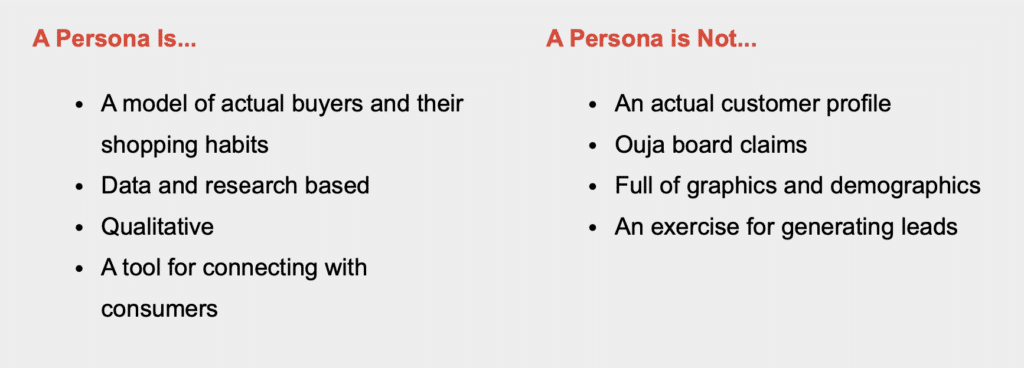
Consider this quote from Scratch: “Consumers aren't as interested in your story until it helps them tell their own. Personas are a powerful and concise way for you to use data to understand your consumers—and help your whole company understand your consumers - so that they are ultimately interested in your brand story”. Sounds rather important, right?
Persona based marketing is the practice of building your entire marketing strategy around detailed, data-driven buyer personas. Instead of creating broad, one-size-fits-all campaigns, you develop messaging, offers, and experiences tailored to the specific needs, motivations, and challenges of your ideal customers. This approach ensures every ad, blog post, email, and social media update speaks directly to the people most likely to engage with your brand. When executed well, persona based marketing increases clicks and conversions, builds trust, fosters loyalty, and keeps your brand top of mind for the audiences that matter most.
In the past few years, our client teams at 97th Floor have launched wildly successful campaigns driven by insights discovered through building personas.
In-depth personas are invaluable to our teams and our clients.
Rachel Bascom, head of content at 97th Floor, shares these benefits from using personas:
And if your personas are doing that, they're ultimately bringing you this:
We're confident that data-driven personas enable every department to work better for clients and the company.
How should you create a buyer persona? The ingredients are simple, and the process is not rocket science. Like baking bread, you already own most ingredients—flour, water, yeast, salt—and the things you don’t already have in your cupboard are easily accessible.
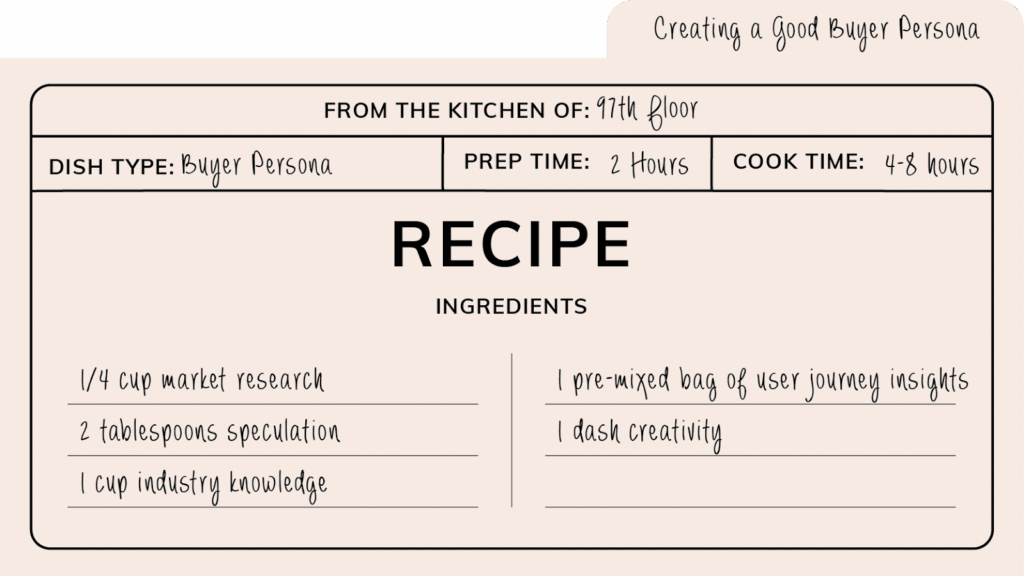
Begin with a little market research. What data do you already have about your customers? What are their current job titles, responsibilities, and interests? If you can, use a tool like SparkToro to find out more about what your customers care about. Ask: Why would they benefit from your brand? What are their pain points, and how does your offer solve them? The more research you can do, the better.
Then add a little speculation. If your persona loves running, you can assume they’ll care about running form or proper running shoes. If they’re a busy mom, you can assume they’re looking for ways to relax and save time. Some assumptions are okay, and even needed, but be sure you don’t get off track.
Once you flesh out your customer with a few assumptions, mix your research and speculation together with a knowledge of the user journey for your product or service. For instance, how do they come in contact with your brand? Will they be eager to buy, or will they need a little persuasion? What appeals to them on your site?
Finally, sprinkle a little creativity on top. This is the fun part: make it a story. Be as specific as you possibly can. What is their name? What do they look like? How does an average day in their life flow? Don’t be shy, write it out. Use your imagination. The end result should be fun, spunky, realistic, and easy to remember.
In baking bread, you simply put the dough in an oven. For personas, however, you need something much more rare: objectivity. A good persona requires you to set aside what you think you know about your customers and to see what the data tells you. This is very, very difficult for most businesses, which is why it makes sense to ask someone else to do it for you. When it comes to paying someone to create a customer persona for you, the greater the objectivity, the more you will pay. Spend less, and you will have a few assumptions mixed in with your objective assessments.
However, assumptions, especially when used in the less-critical and less-controversial parts of the buyer persona, are likely a good trade-off for many businesses. Not everyone needs to spend $50,000 to get something truly useful.
The personas that we build for our clients at 97th Floor are a mix of strategic assumptions and objective research. We are intentional in our approach, choosing where we can assume and where to use data. It might not be the right approach for every business, but it’s appropriate for most businesses most of the time.
Let’s break it down.
There are three major parts to buyer personas
As you might presume, demographic information tells us the external details about the persona. This describes the age, gender, racial identity, socio-economic details, family status, occupation, and such. We glean it from a number of sources: existing customer profiles, analytics data, competitive analyses, etc. We use whatever we can get our hands on.
When we build our personas, we use a balance of assumption and evidence. Our stance is that in this area, the information that we infer is good enough for the purpose, and the potential mistakes are low-impact ones. But don’t get me wrong, you shouldn’t go wild with assumptions here.
There isn’t much value in knowing that your average age customer is 37 rather than 39 or 40. But there is a significant difference in the average age of 30 instead of 45. Be careful that you have enough evidence for the correct ballpark. But don’t waste resources digging into teeny specifics if they aren’t likely to be impactful.
Remember that a buyer persona is different from a target audience. This is not a broad composite, but a fictionalized specific individual. There is value in having a target audience in mind--in knowing a range that describes the whole of your customers--but the value of a buyer persona is to clearly envision one perfect client.
The demographic information describes the external details of the individual, while the psychographic information describes her internal life. We want to know what she likes and dislikes, what makes her excited or nervous, what she reads and who she follows. This is the information that a savvy marketer will prize.
We obtain this through research into tens of thousands of individuals’ web habits. With this information, we can better predict the specific behaviors and biases of a likely customer, but also general principles that describe a lot of people. There are tools out there that will help you to accomplish this task with some confidence--just don’t forget the critical role of objectivity here. We’ve seen clients with personas that only really describe the client themselves. It’s an awkward conversation: “Since you’re just launching Bob’s Widgets, is it realistic that your persona is already a member of the Bob’s Widgets Fan Club?”
When you get the psychographic profile right, it’s almost magic. For example, our research might uncover that people who like your brand are also fans of the Chicago Bulls or the Los Angeles Dodgers. It is probably too specific to know which particular team they root for, but it is useful to know that your audience is sports fans (as opposed to, say, fans of quilting or politics or tattoos).
Many clients we onboard don’t have personas (or have only target audience information). Others have spent tens of thousands of dollars on specialists to get personas built. These expensive ones are often very slick, visually stunning, but a little impractical. While there is a lot of good stuff in these large personas, the mental strain to use them—and to tell what is most important—is too much. So we developed a convenient method that uses our inherent human neurological strengths to make it memorable.
We tell a story.
Maybe our stories aren’t on par with Shakespeare, but we are not doing this to scratch a creative itch. We are doing this because, as humans, we remember stories. We also remember songs, but that seemed like a little too much. So we’ve chosen to always tell a story about our persona.
There is no new information in the story. All the data we use for the story is already covered in the demographic and psychographic sections. But when we craft it into a couple of clear, easy-to-read paragraphs to describe the character succinctly, suddenly she is easier to understand and easier to remember. Because of that memorable image, it is easier to keep clearly in mind, and thus easier to create campaigns just for her.
Critically, when we tell a story, we have more of the facts in easily accessible memory. Without personas, marketers will create campaigns crafted for one or two of the most obvious customer characteristics, and they generally fall pretty flat. They’re not much better than target audience descriptions. But a good story to anchor our memory allows us to retain a fuller picture of the individual. In turn, our campaigns therefore have more depth, fullness, and richness. They are, simply, more effective campaigns.

She tried to diet and exercise, but her goal seemed so distant. Plus, was it even realistic for her to lose 50 pounds when she barely had time to pee alone before one of her hungry kids found her? She wanted more direction, maybe from a personal trainer or dietician, about what her goal weight should be. But they were so expensive.
She’d tried doing her own research about her BMI and ideal weight. But those gave her wide ranges or goal weights that seemed impossible.
Do you see how this little clip from Sharon’s life makes her a tangible woman? We feel her discomfort at the party. We understand why she is the perfect customer for this fitness company. We even get excited to find marketing strategies that will help Sharon find our client’s company and feel empowered on her next birthday.
Personas that hang around in a company’s back pocket unused aren’t doing anyone any good. A successful buyer persona is one that gets frequently referenced and utilized. The team has read it, talked about it, and knows it. They know that fictionalized individual as well as they know each other. She feels real to them.
Not only should these personas feel real to your team. You should lean on them during planning and writing content. This is the essence of persona based marketing. For instance, as you're sitting down to plan out Q2’s content, turn to your personas. Mention, “Taylor (your persona) has young children. During Q2 those children will start summer break. How might that affect the kind of content she wants to access during that time? How might it affect how much time she has to engage?” Use the persona’s name. There’s power in shared vocabulary. Of course “Taylor” won't mean much to those outside this team, but your marketing team should be using your persona’s names. Use the personas to tap into the daily life of your content consumers, and they will feel a more realistic connection to your company.
All of this work might seem like the buyer persona is creating extra work: compressing data into a single point, and then it has to be expanded again when doing the actual marketing. The magic of the buyer persona is that it enables, and even encourages, the marketer to work at an individual level but to have that function at a broad scope. The compress-decompress that the buyer persona facilitates will hone the edge of the campaign. In practice, if it’s done right, it can feel like a superpower.
We create personas for clients as a service, or we upgrade existing ones, but personas are only the launching pad into the deep pool of consumer-facing work. Here are a few examples of great client work powered by a marketing team that understands its audience using the processes we describe above.
Wikipedia's Jimmy Wales built the world's biggest knowledge base by knowing exactly who he was building it for. He shares the one insight that turns audience research into a real negotiating edge.
eFileCabinet came to us with a goal of increasing its brand visibility. In a fairly stagnant industry, their cutting-edge technology had a hard time gaining the excitement it deserved. Our team came together to define who eFileCabinet’s customers were. Like most businesses, they required multiple personas, but one particularly useful buyer persona portrayed an accountant who was frustrated with endless paper filing and tedious office chores.
Sure, this persona is an accountant, but he was far from boring.
We looked closely at what human emotions and pain points he faced, as well as ways he might enjoy letting off steam. The answer: taking a hammer to the often-frustrating office equipment he sits in front of every day. Enter: the Rage Cage.
So they could live the Office Space dream, our team crafted an experience for an accounting conference that would give them what they really wanted—the chance to smash old office equipment. Then we connected with these individuals to introduce them to the benefits of eFileCabinet’s problem-solving, headache-reducing software. This became an award-winning campaign that brought eFileCabinet the highest influx of MQLs in a single month and 100+ closed deals. None of this would have been possible without concrete, memorable, human buyer personas.
One 97th Floor client, a data service company called Qubole, was facing a long sales cycle that they were eager to tighten. We knew that buyer personas would undoubtedly help Qubole target the most promising potential customers. So we took a closer look at Qubole’s ideal buyers and got to work.
We created a persona who was a data scientist at a growing tech business that needed to scale quickly. We got to know his pain points with bringing on a data company, including security and IT complications. Knowing this information, we created a hyper-focused content strategy that was built with him in mind.
With the help of this persona sitting in the driver’s seat of our newly targeted content strategy, Qubole’s traffic and conversions skyrocketed. In fact, 97th Floor's strategy led to a 600% increase in organic traffic and a 300% increase in qualified organic leads. In addition to chopping their buyer’s cycle from 240 days to only 90 days.
As with most NBA teams, the Utah Jazz found themselves struggling to sell their summer season ticket. They came to us with a desire to increase their summer ticket sales and maybe, just maybe, they’d be able to do something never done before: sell out the entire lower bowl for the summer season. As always, we began with the audience and personas.
Because we are from Utah, we knew what a typical Utah Jazz fan looks like, and so we had a good understanding of the audience to begin with. The final version of our persona consisted partially of what we knew from the standard Jazz fan and was merged with the data we had collected about folks who buy low-cost items (like summer season tickets) via Facebook Ads. Once we had our more specific persona, building the campaigns in Facebook Ads came very naturally.
First, we fanned out our ads’ reach to a wide audience of Jazz fans on Facebook. Then, we conducted tests to see which ads were the most effective at increasing sales (this information even informed our personas to make them better for the next round). We found that segmentation, even to a non-Utah Jazz audience, and sales-focused ad copy brought in a positive ROAS, a great achievement for the low budget of their summer season marketing. Our knowledge of the buyer personas of these summer customers gave the Utah Jazz an increase in ticket sales by over 300% MoM.
Our beauty and skincare client uses playful design, sustainable ingredients, and
delicious flavors to deliver products that feel like a treat for their consumers. But the company wasn’t leveraging its audience to maximize conversions. They needed real customer personas, complete with a goal and journey for each.
Using analytics, we built—you guessed it—5 consumer personas.

Each persona included personality traits, concerns, risks, influences, an analysis of the buyer’s current status with the company, and solutions for improvement.
This in-depth analysis led to a full-funnel strategy, including launching on new platforms.
Our research helped us craft persona-focused messaging. Our discovery that certain personas were interested in astrology inspired our design team to create these stunning ads for a zodiac sign campaign, targeting shoppers based
on their birthday.
And the results? Highest-ever engagement, volume of purchases, and ROAS of all client ads.
Using only
4.1%
of total ad budget
Accounted for
42.5%
client's total purchases
While achieving
Historic ROAS
of all purchases
As these examples show, personas are not reserved for folks in content marketing roles. Entire teams from SEOs to paid media specialists to, well, everyone, should be well-versed in your buyer personas because a good persona will have insights that influence every decision from every member of a marketing team.
We've all stumbled through a cluttered Walmart. The seasonal decor, random furniture, and crates full of $5 movies and cereal boxes stall your progress to the single thing you came here for. Pretty annoying, huh?
In 2009 Walmart addressed the mess with Project Impact. The project's purpose was to improve customer experience by reducing clutter and improving the aesthetics to compete with Target. This idea came from a survey that asked customers, "Would you like Walmart to be less cluttered?" The answer was an overwhelming, Yes. But who wouldn't say yes?
Walmart halted the project when the first 600 locations that they tidied saw year-over-year sales plummet. Walmart lost an estimated $1.85 billion in sales. It appeared that all the extra clutter led to people buying more.
Fueled by turkey and pumpkin pie and armed with a Christmas wishlist, nearly 155 million Americans make Black Friday weekend the biggest shopping event of the year. Seattle-based outdoor retailer REI would rather not participate.

Instead of wow-ing shoppers with massive markdowns, REI closes its stores, activity centers, distribution centers, call centers, and headquarters for its annual #OptOutside campaign.
In 2015, REI saw 10 times more traffic than any other retailer on social media as thousands posted with the hashtag.
In 2021, REI expanded the campaign to challenge its members and community to get outside and build an inclusive outdoor space.
And yearly earnings? Up and up.
Alright, alright. So we can't really say for certain that Walmart wasn't using personas and that REI was. But what we can say for certain is that REI understood its mission and its consumers' habits and lifestyle far better than Walmart did.
Persona based marketing is an ongoing process that shapes every part of your overall strategy. The more you refine your personas with real data and insights, the more precise your targeting, messaging, and campaigns will become. If you’re ready to turn buyer personas into a powerful growth tool, let’s talk about how 97th Floor can help you build and use them to drive measurable results for your brand.
See how an audience-first approach translates to bottom-line results.
[leadership] comes down to who you are and your ability to influence people to do great things.
Welcome to the the 97th Floor Mastermind Interview Series where each week we sit down with one of the makers, thought leaders, and visionaries behind the biggest and/or up-and-coming brands around. We talk about everything from business and marketplace insights to personal journeys and successes, to failures and legacy.
In this episode we’re talking to Kurt Workman, CEO and Co-Founder of Owlet Baby Care, about his own journey to business success. Through personal experiences and insights, Kurt shares how he learned how to turn potential hurdles into valuable educational opportunities.
0:10 About Owlet
2:52 Priorities
5:12 Technology behind Owlet
8:45 Failure
12:10 The startup phase
17:15 Building the company
19:03 Success
23:55 Hiring and firing
28:43 What keeps you up at night
31:15 Pain points with growth
35:55 Kurt’s legacy
Learn more about Owlett
Connect with 97th Floor on YouTube | Facebook | Instagram | Twitter | LinkedIn
Be sure to subscribe to our YouTube channel and get notifications - we’ll drop a new episode every week.
 |
 |
 |


