



Keyword research is a necessary step that you do to understand your market, and plan your SEO strategy. But what if you could use it to learn about user intent, restructure a whole site, and increase conversions as well as traffic? That’s exactly what we did with this client.
CBD American Shaman is a health company that sells CBD oils. While it’s a competitive market, their products have an edge on the competition because they’re water soluble. Despite this, they were struggling to capitalize on their great product with the kind of SEO traffic that it warrants.
Yet the potential was there: An audit revealed that the more specific SERPs previously targeted for the product had a pretty small search demand — but the right strategy could capture a large amount of traffic. Think “CBD oil” with 1 million searches versus “water soluble CBD oil” with only 1,300.
97th Floor was brought in with a clear business question to address: How do we capitalize on this great demand and become a breakout CBD shop?
Like much of SEO, the solution starts on the site-level. The CBD American Shaman site was hosted on a custom CMS (rather than WordPress, Shopify, or Hubspot, etc.), which always complicates technical SEO solutions. Their CMS was completely done by hand. The site organization was also done by hand, and more subject to human error.
They had a wide list of products, but their site wasn’t utilizing this wide variety to capture organic search. Their site’s architecture was flat, lacking the intuitive hierarchy that both Google and the user need to easily navigate and understand a site. In the beginning, there were only three categories on the CBD Shaman site: wellness, pets, and beauty. This organization made sense at the conception of the site, when the company offered few products. However, as their business scaled and expanded, that category structure no longer made sense, and in fact, felt difficult to navigate and drastically out of date.
It soon became clear that a total overhaul of the site’s organization was necessary. Any SEO tactics would yield mitigated returns unless the site was a complete, SEO-driven overhaul.
Just as a doctor treats a whole patient rather than a symptom, we chose to stop looking at each individual problem, and instead gather it all into one place and focus on the most essential and basic purpose of the site. In this process, keyword research and mapping were essential in understanding how to treat the site as a whole — curing all of its symptoms, rather than just hitting one at a time.
Keyword research is important, but like any data, it means nothing on its own. It’s what you do with the insights gleaned from research that matters. So — while sometimes all you need from your keyword research is a handful of new keywords to tackle — for CBD American Shaman, keyword research would go on to guide the entire reconstruction of their site.
We used our keyword mapping to guide the new site’s entire structure. By using keyword research as the foundation of the site, we captured more authority, and redistributed that authority back to the site’s most relevant and converting pages.
For example, the category page for /cbd-oils now houses all of the CBD oil products, allowing for more weight to target that high-volume keyword as well as an ease for the user in browsing the different oils available. In the previous version of the site, the following page was trying to rank for “CBD oil,” /vg-cloud-terpene-rich-cbd-oil-tincture. See the problem? Yes, it was a CBD oil product, but its strength was wasted in attempting to rank for “cbd oil” and it was poorly optimized for a user from coming form a Google SERP.
With the knowledge that these new category pages were much more likely to rank in Google SERPs, we followed our keyword research further. We used it to map and reorganize the entire site, categorically moving pages to align with relevant category pages rather than stand on their own. By connecting these further pages to those authoritative category pages, it allows us to pick up additional traffic from newly targeted keywords.
Evaluating the keyword landscape — which keywords ranked for which landing pages, and which keywords should be combined moving forward — was a BIG project. Pulling all of our ranking keywords, separating them by landing page, and creating new keyword groups took us a full month.
We had to determine what keywords should rank for a single landing page versus separate landing pages, which allowed us to find instances of keyword cannibalization. We also had to cross-reference each keyword within the designated SERP to identify whether a category page or an individual product page was needed to best fit the ranking criteria for that SERP. It was a lot of work, and a lot of detail, but it paid off.
Under the “shop” menu on the homepage, we added sixteen new categories, all based on newly selected high-potential keywords. It turned out that not only did search engine bots like this kind of layout, but users did too. Within weeks, CBD American Shaman saw a 13% increase in organic traffic, not only that, we saw an unexpected radical bump in conversion rates. Which makes sense when you consider how this also drastically improved navigation and the user experience.
CBD Shaman has an extensive product offering that is always being added to. With all of these choices, the shopping experience was previously overwhelming to users. Products were difficult to locate, and customers had no clear understanding of where to find certain products, or even what products were offered. Instead, the site was set up in such a way that they'd have to endlessly scroll through lists of product after product, without the ability to filter based on product type or use. It was hurting their sales, and alienating their customer base. So we knew it had to change.
They are constantly evolving their product catalog. With their previous strategy, a single product page may have built up a lot of authority over time, only to be taken down, and that authority would then be redirected to an unoptimized page or lost completely. With our new category-centric strategy, the business’s evolution is supported. No matter which products are added or taken away, the authority will remain in the category pages. These pages stay consistent in a constantly changing website, allowing users to always find their way.
The result is an SEO framework that not only worked on the onset, but it’s proven effective even a year later. This keyword mapping system has paved the way to double organic traffic for CBD American Shaman.
Visual storytelling is a universal mode of communication that has been in use since the beginning of time. And, through the ages of cave art to silent movies, it has shown itself to be one of the most effective ways of catching not only human attention.
It’s no different in this day and age. From the humble blog article to the Times Square billboard, visual elements tell the story as importantly as copy. No marketing campaign is complete without striking visual elements, and more than likely, that’s what your potential customers will remember.
We’ve compiled 7 storytelling strategies to help elevate your brand:
It takes the average person just 50 milliseconds to form an opinion about a webpage, and 2.6 seconds for their eyes to settle on the most impactful spot. That’s not a lot of time for your brand to make a good impression.
You need to capture people’s attention quickly and slow their scroll down. Even the most avid readers skim webpages. And as people scroll, words get blurred together, losing their impact. If there is no imagery in your storytelling, it’s likely your readers will bounce from your page quickly.
Picture this: a web page advocating a new weight loss method that only includes text, OR a similar ad that includes a striking before-and-after image. Which one are you more likely to stop and look at?

When time is money, getting users to take time out of their day to stop and look at what you have to offer is essential to driving revenue.
Most people remember what they see far better than what they hear. According to some studies, there can be up to a 65% increase in retention if the information is obtained visually. And the best part: images require zero work for the user. Sifting through text is hard, but taking in imagery? That’s fun.
We cling to images in storytelling because they allow us to interpret the information for ourselves, rather than being told how to interpret it. Good images don’t require an explanation. Instead, they tell personal and applicable stories without using words.
Nike’s home page is a great example of this storytelling strategy. Their first fold is an eye-catching video, and their second fold looks like this:

They tell the story of each sport with both text and images, but, as you can see, the text is a very small portion of the story. The majority of the page is taken up by action imagery showing users what playing each sport looks like. And, it looks cool. Can’t you see yourself gearing up for football or playing soccer with the best of them? Most importantly, you could find exactly what you needed from this page without any text at all. And that’s how it should be.
You’ve probably put together an IKEA dresser without reading any of the written instructions. If the visual queues are clear and walk you through the process with baby steps, image-only instructions can be just as effective and a lot less stressful.
Think of the signs that we use in driving. A few have text, but the majority use color, shape, and image to portray their instructions. Similarly, it’s not uncommon to see images in the business world that give customers instructions using no text at all.

How much more enticing is this video on making cheesy potatoes rather than reading a blog post on how to do it? It’s approachable, entertaining, and makes it look easy. Visual instruction is on the rise.
While I wouldn’t recommend doing away with text entirely, I would encourage you to think about how using visuals more strategically could positively change your marketing efforts. Images have the power to instruct your users, which means you have the power to influence what actions they take next.
Take a look at this example from Upright Pose:

This image tells a story, and gives an obvious next step: you’ve been slouching a lot lately, you’re worried about your health, and the solution is to buy Upright Pose. Textual calls to action are important, but they’re also pretty obvious. Imagine the ability to influence a user’s next step without them even realizing they are responding to a call — well-planned and properly placed images have that potential.
Pretend you’re watching a video ad. The camera follows a man getting ready for the day in an average-looking home. Suddenly, he notices a brown paper lunch bag on the kitchen counter. He snatches it up and rushes outside to hand it to a little boy waving goodbye on his way to the bus stop.

Did you need a narrator to tell you that the man is in his own home? That the little is boy his son? Of course not. You followed the context of the story just fine. In fact, having that information spoken would seem silly because it’s so unnecessary.
Take advantage of the human ability to read context in a story. Don’t waste time spelling out information you could give your audience through your images. They’ll pick up the information faster and with more ease, leaving them with a better idea of what you have to offer them, and more energy to move closer towards conversion.
Take a look at this ad from Nikon:

They didn’t need words to let you know that, surrounded by mountains and wilderness, you might find a use for binoculars. Wouldn’t you still feel drawn to the binoculars and the adventure they promise without any words? That’s how the best images use context. They tell an entire story simply through what you see.
Humans are the center of our universe. When we see images, we want to be able to place ourselves within them. We want to know how what you are offering will help us do better or feel better.
So, it’s smart to focus on people when you plan your visual storytelling strategy. Whether that means you show people in your marketing, or whether the implication is implied, the focus needs to be on the humans in the story, not the product.
Look at this visual from Outdoor Voices:

Yes, Outdoor Voices’ products are showcased, but the focus is not on the people. They tell the story of how the product is used and how it makes human lives better. It is the people in the image that make the product notable, not the other way around.
Like we’ve talked about already, the best images tell stories, and the basis of any good story is conflict. So don’t shy away from it! When you can use an image to show potential customers the conflict that your product or service will solve — and not just the conflict, but the solution itself — that is a golden storytelling technique..
Take a look at this advertisement from Home Depot:

In the image, we see a common pain point that Home Depot’s business solves. The messy porch, the leaves on the cement, and the bucket that shares the solution: Home Depot can help you clean up this mess.
People understand conflict, and they crave solutions. Your images can bring out an emotional response from your potential customers that it would take pages of text to convey. Images can speak volumes in a story, so let your images share your conflicts and solutions.
You probably have different colors and styles that you like or don’t like, ones that make you feel good and others that drive you crazy. But designing images for your brand’s story goes beyond preference. Good design can make or break your website, your advertisements, and eventually hurt your revenue numbers.
It’s time to start thinking less like an artist and more like a designer. Artists make things that are beautiful, while designers have a purpose behind their products. Every color or pattern is there for a specific reason. Visually pleasing arrangements (put in place for a specific purpose) are more likely to put your potential customers at ease, tell them your story, assure them of your professionalism, and sell.
Take a look at these two cartons of chocolate milk:

One is a generic brand, the other is a Fairlife product. Fairlife understands that even if they want customers to believe their product is top-notch, their product’s design had better tell that story. The generic brand doesn’t look the part of an elegant, high-end chocolate milk. But it’s not trying to be something it’s not — it’s a generic brand for a reason. So while it may not look “pretty,” its design is telling its own story: run-of-the-mill chocolate milk is 20-40% cheaper and tastes just fine.
Here is another example, this time with websites:

These are both homepages of interior design companies. While both do great work in reality, Amber Interior’s website design intentionally shows users the quality of work they are able to do.
As you can see, the visual storytelling strategies and design of a website or brand truly have the potential to make or break your opinion of them.
It only takes a minute to look at your brand’s visuals with these tips in mind. Evaluate where your brand is succeeding, and where there might be room to improve. Then put a plan in place to optimize your visuals and bring your brand’s game to the next level — increasing your revenue and sales. Remember: a picture is worth a thousand words, so make sure your pictures are saying the right words.
Strong storytelling strategies make your brand stand out and stay memorable. By blending visuals, context, and emotion, you can create stories that connect deeply with your audience and drive measurable results. If you’re ready to elevate your brand through effective storytelling strategies, the team at 97th Floor is here to help.
See how an audience-first approach translates to bottom-line results.
Key takeaways
Holistic SEO is a unified approach to search optimization that treats a website as a connected system rather than a collection of isolated tactics. Instead of focusing on single levers like keywords or links, holistic SEO aligns user experience, content quality, authority signals, and technical performance to support long-term growth. At 97th Floor, holistic SEO is operationalized through the XACT framework, ensuring every optimization supports both search engines and real users.
Traditional SEO is often executed in isolation. Holistic SEO is designed to work as a connected system that compounds over time.
When people ask what is holistic SEO, the simplest answer is this: it’s SEO designed to survive algorithm changes by improving the entire system, not just one part of it.
At 97th Floor, holistic SEO is executed through the XACT framework, which organizes strategy into four core pillars: UX, Authority, Content, and Technical. Together, these components support semantic SEO, topical authority, and sustained organic growth.
Good UX keeps users engaged, which reinforces relevance and performance signals across search.
Authority helps search engines determine who deserves to rank when content quality is similar.
Strong content frameworks allow sites to own topics rather than compete page by page.
Without a strong technical foundation, even great content and authority underperform.
Together, these four pillars create a system where improvements compound over time—the defining characteristic of effective holistic SEO.
Holistic SEO only works when each of these pillars is treated as part of a larger system. Focusing too heavily on one area (content, links, or technical fixes) can create short-term gains. That looks good in reports, but it rarely produces sustainable growth on its own.
That’s because SEO isn’t a monolith. It can’t be painted with a broad brush. A truly comprehensive strategy will act like a flywheel where progress in one area supports others, and over time, results compound.
Or, to put it another way, more SEO doesn’t necessarily lead to proportionally more results. What matters is where those efforts are applied, and how well they work together.
This is the origin of the 6 Disciplines of SEO framework. Designed by 97th Floor, this framework exists to help move teams from doing more SEO, to doing holistic SEO.
As Google’s algorithm has matured, there have been ground breaking updates which have improved overall user experience.
Much of how the industry views SEO today is because of these wide reaching (and sometimes earth-shattering) updates. For over a decade the theme has been Google making changes, and SEOs trying to intuit the signals with moderate success.
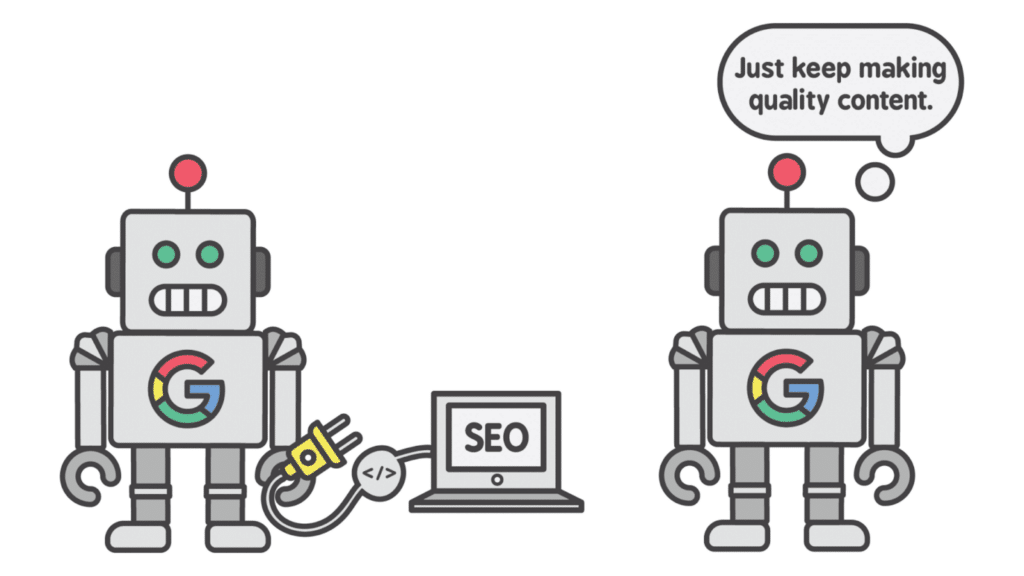
Today, we see that Google is releasing frequent broad core updates aimed at improving the algorithm from a holistic perspective. Google has clarified that for each of these updates the advice they give comes down to making great content that is high quality, expertly written, trustworthy, unique, and valuable to the user.
We suggest focusing on ensuring you’re offering the best content you can. That’s what our algorithms seek to reward.
While this advice is good, it isn’t enough. Optimizing for users over bots makes Google an ally rather than an enigma, as you both work towards the same goal: a better experience for the people behind the searches.
Enter the holistic strategy any SEO can adapt: The 6 Disciplines of SEO.
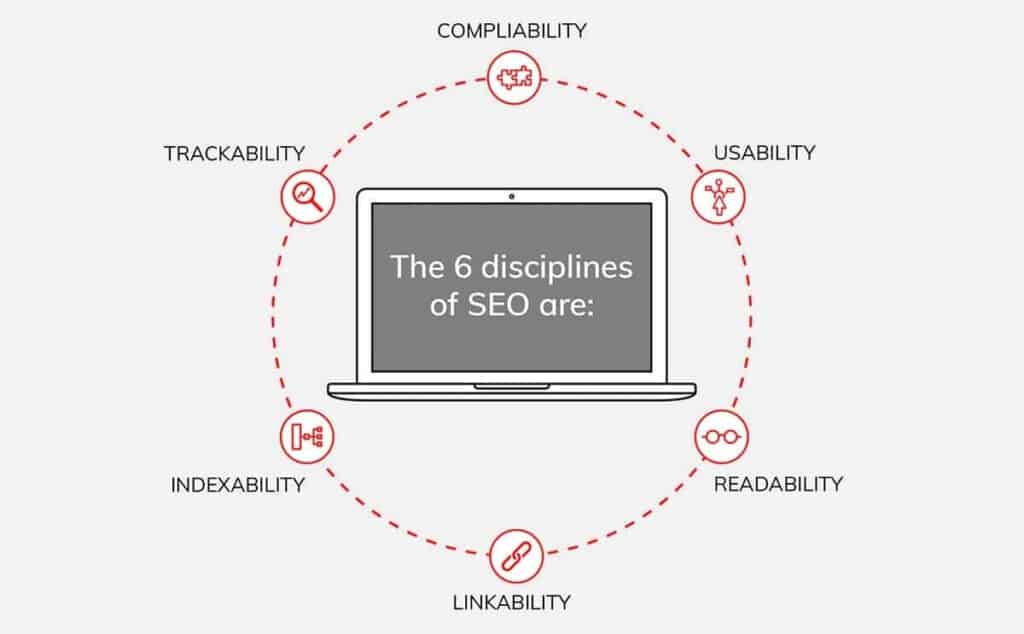
A note on our naming convention: we get that a lot of these words sound made up, but we chose to name the disciplines with a focus on the the ability derived from each. Yes, they are weird. That’s by design; weird things are easier to remember.
Here are some examples of what execution can look like within each of these disciplines.
The SEO industry has a wide and comprehensive list of recommended best practices. And, luckily, Google has provided fairly explicit guidance on what websites can do to be compliant with their guidelines. In addition, we’ve executed internal strategies which have yielded results which challenge previous assumptions and best practices.
Armed with all of this knowledge, you can make sure your site is properly aligned and thereby maximize your SEO efforts.
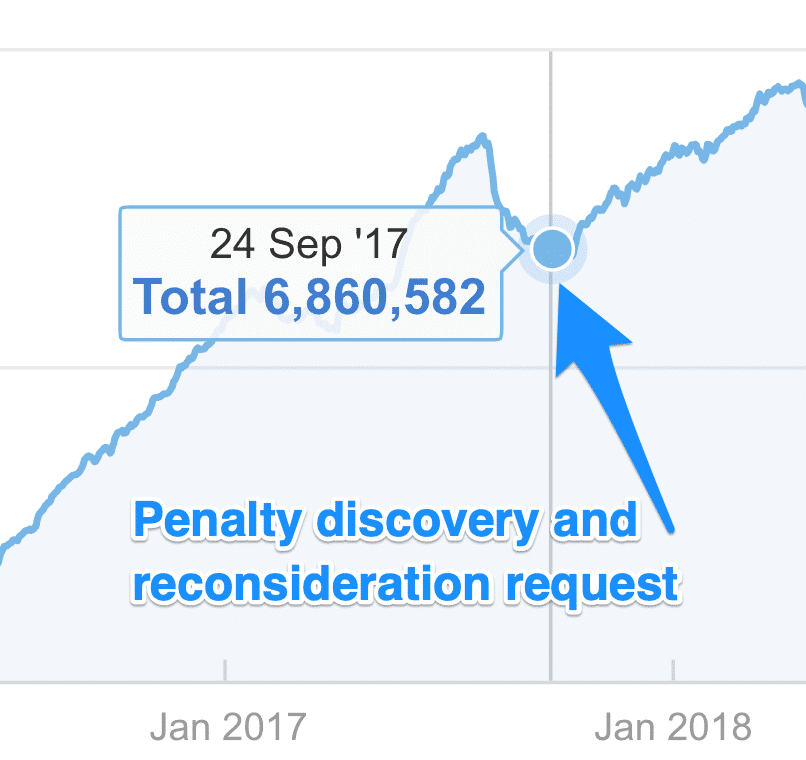
One client came to 97th Floor with stalled SEO efforts, despite their best efforts. Some digging during our onboarding site audit uncovered that they were unaware a manual action penalty had been placed on their site. Google Search Console revealed that structured data was being misapplied to a specific segment of the site's blog pages.
In the past, this site’s posts had included a comments section. But over time the comments became too much to moderate and they ultimately decided to disable comments for the site. In doing this, however, they forgot to disable the structured data on the backend that called out the recently disabled blog comments.
Once this was discovered, it was imperative that all of the residual structured data was removed from those pages. Doing that reassured Google that the client’s site wasn’t claiming to have something on-page that they didn’t actually have. It was a relatively easy fix, but not an obvious find for the untrained eye.
Fixes were applied. The next step was to put together a reconsideration request and submit it to Google. Once the reconsideration request was filed, the penalty was lifted within a week and the site saw significant increases in organic traffic from that point on.
Google isn’t outright about much of their algorithm. This is why the latest user-experience based algorithm update Page Experience, is getting so much attention. This update and the trends in recent updates pay particular attention to the Usability discipline, which ensures the overall SEO strategy is UX based.
Improved user experience is important to have baked into any SEO strategy from the beginning, because it has the potential to aid both your SEO-focused goals and your bottom line business goals like conversions.
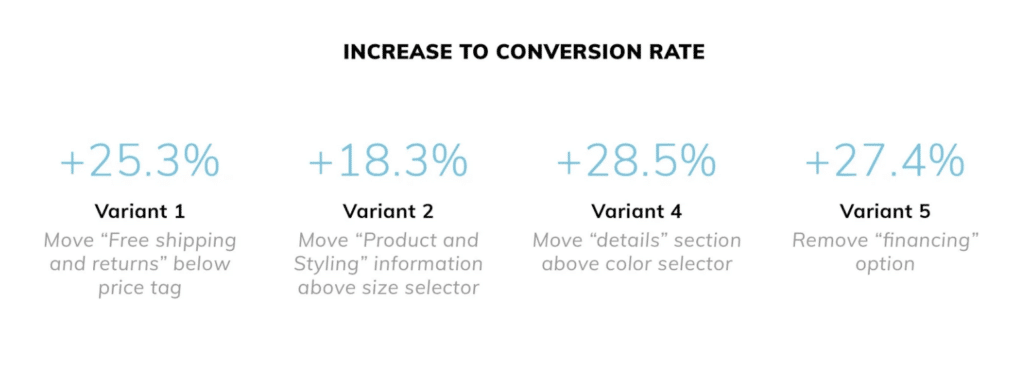
An ecommerce business came to 97th Floor with a dilemma: users were reaching their product pages, but not converting. Hypotheses were formed and ranked as to what site changes might have the greatest impact on UX, but even the most intuitive hypotheses aren’t a place to end.
Multi-variant testing showed which variations brought in the most conversions and new revenue. This was a luxury ecommerce business, even small upticks in conversion rates can show significant increases in revenue, which means they stood to gain quite a bit. In this case, almost every variant showed a positive increase in both conversions and revenue. Overall, implementing these changes led to a 29% increase in revenue over just a few weeks.
In prioritizing the usability, our client gained tangible and actionable information about what their customers like to see on their site, which in this case was removing the financing option from their checkout.
Readability in this sense refers to the ease of reading your site for bots, not humans. Readability in this sense should not be confused with user-focused readability scores that measure the sophistication and ease of reading of your copy.
Cleaning up your site’s readability can play a significant role in its ability to rank, because metadata are an important way bots analyze the content on your pages.
Improving the metadata that adorn a site’s pages is an essential way to signal to Google the relevance of the on-page content to the target focus keyword.
The most critical ways to improve readability include:
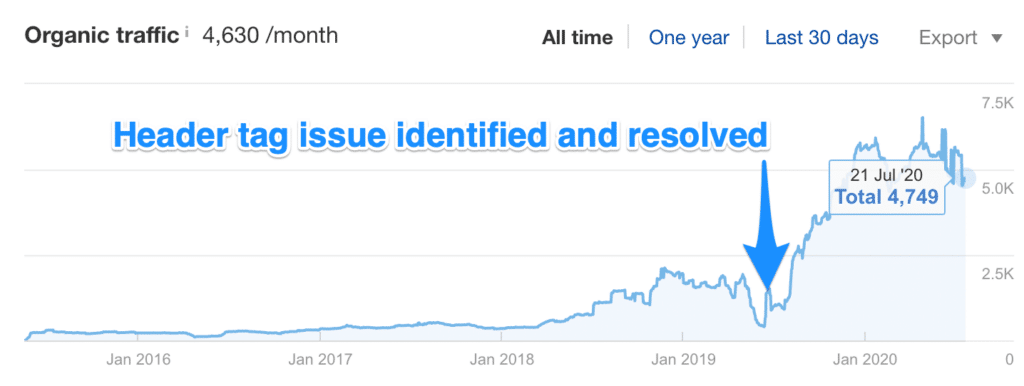
A new client approached us with hopes to increase their blog’s organic traffic. They had been blogging for years, but they weren’t seeing the traffic increases they were hoping for. An audit revealed that they were misusing H1 and H2 tags throughout their blog, at the fault of the customer template they were using. They’d chosen to use more H1 tags as H2 tags, effectively using multiple H1 tags per page. But that looked most attractive on their template, so they unknowingly were shooting their blog’s readability in the foot.
They had no idea they were defying Google’s guidelines. And while their use of H1 tags might have been easier on the eyes, it wasn’t helping them win Google’s favor. Once the H tag errors were resolved, our client saw an immediate jump in traffic. These simple readability changes brought in a golden age of SEO for their site that is still going strong.
A healthy backlink profile has always been a major part of a site’s rankability. A healthy backlink profile requires various tactics to not only increase backlinks; including branded links, anchor text distribution, link velocity, and more. Not only external links, but internal linking structure is a critical (and often overlooked) part of the linkability of a site.
Here are a couple ways you can do this:
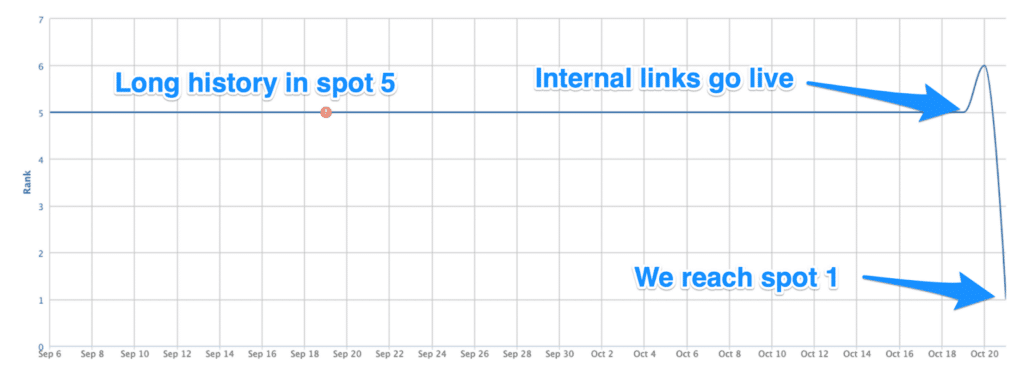
Our client was stalled ranking in position 5 on their chosen SERP, and needed to move up to gain the visibility they desired. An analysis of their site revealed they had several pages that all concerned the same topic, which can create confusion for Google. In addition, most of their pages were four links from the homepage, while few were just one or two links away.
By creating a map for Google’s bots using internal linking (using just 7 new links), the site jumped in ranking from position 5 to position 1.
This keyword had an average month search volume of 15,000 searches, which means moving from spot 5 to spot 1 generated an average of 3,300 additional clicks to the client’s webpage per month for just this keyword alone.
Indexability is how well Google is able to crawl and index a site. Google indexes sites similar to how books are indexed in a library, collecting relevant information about your site and making it easier for users to find. So, it’s in your best interest to be sure Google can easily index your site, and that it’s getting the relevant information from your site that it needs.
While readability deals exclusively with metadata, indexability is a bigger umbrella that deals with the indexability of your entire site.
If Google can’t access and process your website’s content effectively, it won’t rank your site’s URLs very well. If part of your site is unindexed or poorly indexed, Google won’t know what your website is all about. This leads to missing pages, poor rankings, and overall less traffic. Once you discover symptoms of crawlability or indexability issues on your site, you’ll need to investigate further to uncover the source.
These areas of investigation often include:
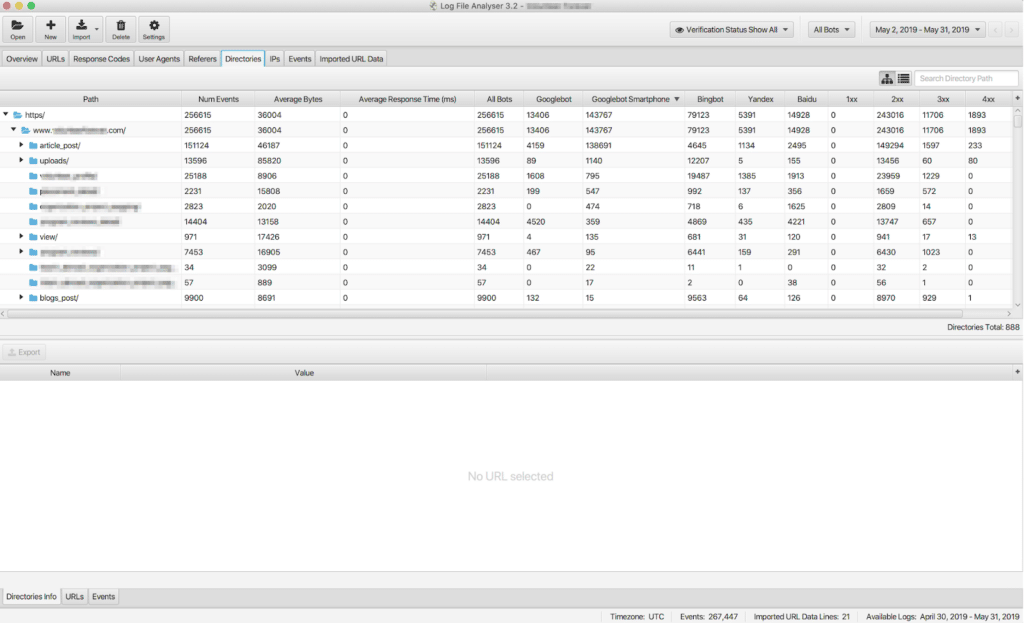
In a technical site audit for a client, we discovered some irregularities in their indexation. Further digging uncovered pages missing from the overall coverage of the site, which is a common symptom of an indexability error.
The execution of a log file analysis directed our efforts in improving indexability. The analysis revealed several actions that could be taken to fix the indexing issues the site was experiencing, including: clearing a number of redundant subfiles that Google was crawling, broken pages that needed to be redirected, and other folders Google was crawling that didn’t play a role in the overall SEO strategy.
A strategic clean up of the site’s indexability issues resulted in not only immediately more traffic, but an increase in organic revenue for our client. In the 30 days immediately following the rollout of these changes, Google organic transactions increased by 25.86%.
At 97th Floor we have about a dozen platforms to track our campaign’s performance but most commonly we use Ahrefs, Google Analytics, and Stat. You can decide what platforms and strategies are most effective for your company, however, no matter what platforms you decide to use, it’s important that you’re accurately tracking the progress of your campaigns.
The most crucial part of this data mix is making sure that the deployment and configuration of Google Analytics is not only correct but that it’s tracking the right conversions as they relate to our SEO strategy and client business goals.
Below are some ways that we do this:
You can’t make informed decisions if you aren’t tracking relevant data. Our teams consistently identify goals and values for clients in order to better track the impact of the ongoing SEO strategy in place for them.
As we continue to iterate on what is driving the most conversions to the site, we’re able to focus the strategy efforts into the parts of the site that are making the most difference for the client’s bottom line.
Holistic SEO requires visibility across the entire system. That means using tools that help teams understand how content, UX, technical performance, authority, and indexing work together.
There is no single “holistic SEO tool.” Instead, effective teams assemble a stack based on their maturity, goals, and internal capabilities.
Below are common tool categories that support holistic SEO execution:
As teams mature, the goal is not to add more tools, but to ensure the data they provide is actionable and aligned with business outcomes. Tool selection should always be driven by what decisions need to be made, not by feature checklists.
Holistic SEO is best understood in practice. The following examples show how aligning multiple disciplines leads to sustainable ranking improvements, traffic growth, and measurable business impact.
National Funding is a leading financial services company providing tailored financing solutions for small and medium-sized businesses.
The challenge
After a Google algorithm update, National Funding lost rankings for high-value keywords such as “bad credit business loans.” These rankings were critical to lead generation, and isolated fixes were not producing results.
The strategy
97th Floor implemented a holistic SEO strategy focused on restoring trust, relevance, and structural clarity across the site. This included:
The results
This systemwide approach restored and strengthened keyword visibility, leading to:
Rather than overcorrecting in one area, the holistic strategy allowed improvements to reinforce each other.
Gigamon is a network analytics vendor providing hybrid cloud infrastructure, security, and observability solutions for enterprise organizations.
The challenge
Gigamon was investing heavily in SEO but could not break into the top rankings for the highly competitive keyword “network security.” Despite doing many things right, progress had stalled.
The strategy
97th Floor took a counterintuitive, holistic approach. Instead of forcing incremental gains on the primary keyword, we:
The results
The strategy produced rapid and compounding gains:
Today, this page remains the top driver of organic traffic for Gigamon, a clear example of how holistic SEO can unlock competitive keywords by strengthening the system as a whole.
Each of these six disciplines is aimed at taking into account the various aspects of an SEO strategy. When built and executed properly, these six disciplines will positively impact the bottom line and delight your visitors.
Knowing when to reexamine each of these 6 areas of SEO will come down to knowing the symptoms of issues relating to each discipline. This goes beyond just seeing a decline in ranking or traffic. In fact, it’s knowing the specific symptoms and how to treat them that can make your SEO strategy powerful.
As you grow to understand each of these 6 realms you’ll be able to build effective. Just remember: you will get more out of strategies that are flexible and produce the greatest yields long-term.
As more time is spent mastering each of the six disciplines, your SEO strategy evolves from a collection of tactics into a cohesive system—one that compounds over time, driving lasting growth and resilience in the face of every algorithm update.
It’s no secret that conversion rate optimization (CRO), is an essential part of business strategy in this digital age. No matter your business model, your online presence is imperative to your success.
Marketers have known this for decades. But optimizing a site for the customer’s journey can’t just be intuited out of thin air. Every action a potential customer makes on the website is a part of their personal journey, and small changes can make a big difference when looking at the site holistically. The ease of a customer’s journey is essential in turning potential customers into active, happy customers.
CRO is the process of removing barriers to conversion, enticing action, and creating an overall positive page experience for your customers.
It’s easy to think there’s some kind of “magic bullet” when it comes to CRO-- a tried and true formula that produces immediate results for every industry and website. Unfortunately, there’s not. Instead, the true secret to CRO is knowing what to test and how to test it. You need intuition to know what to test, but sometimes the results of those tests will surprise you.
CRO testing is a quantifiable way to discover what is truly working on your site and what is not. It will save you money in the long term, with the potential to increase your revenue in the short term. Plus, you’ll learn things about your customers that you never imagined.
KOIO sells handcrafted Italian leather shoes. Their boots had hit a wall: they had consistent traffic viewing their product pages, however these users rarely added products to their cart. They were unsure what they could do to turn more visitors into customers, so they came to 97th Floor with the goal of capturing more users who were bouncing from their pages.

97th Floor knew KOIO’s situation and recommended a CRO campaign to provide actionable insight as to what site changes would produce the most dramatic results. They are a B2C business whose primary customer is a luxury audience willing to purchase products at a high price point. As a result of the average product price, revenue increases were closely tied to higher conversion rates. This made CRO an incredibly effective strategy in achieving their goals.
Audit: First, 97th Floor analyzed KOIO’s site and noted points of the customer’s journey with the highest potential for improvement. We worked to understand what bumps in the customer journey might cause potential customers to leave the purchase pages prematurely (and why). We did this by actively seeing things through the customer’s eyes. With the customer’s journey in mind, we identified areas where we could improve or modify KOIO’s current value propositions and CTAs.
Another site variation we were especially interested in was understanding the behaviors of their mobile and desktop users. Nearly 70% of users on KOIO’s site are on mobile devices, so we wanted to know: how effective was KOIO’s site for mobile users?
Using the findings from the audit, we made tactical hypotheses about what changes would best improve conversion rates. Then we designed a campaign to test which elements were the most potent forces for conversion.
Based on the specific situation and KOIO’s unique goals, we recommended multivariate testing-- a type of CRO in which several different variations are tested simultaneously and data is collected about each variation’s effectiveness.
Hypothesis: In order to optimize the testing process, we gave each of our hypotheses a score based on which ones we expected to perform the best. We thought about user experience, and the messaging they were exposed to on the product level. Then we scored them as to how likely the change was to increase the likelihood of sales. After our ranking evaluation, we placed each hypothesis on a priority road map to be sure that the majority of our resources focused on testing the highest potential variations.

Tests: After we’d formed our strategy, it was time to start testing. In order to be most efficient with our client’s budget, we set an appropriate timeframe for running tests, and determined to only continue running the tests that showed significant improvements. More traffic means faster results, and because our previous SEO strategy was already bringing in the traffic we needed, the results came quickly. For this test, getting significant results took about two weeks.
In addition, we ran two separate tests: one on the desktop site, and the other on mobile. For both tests, we kept the content nearly identical, but altered the placement of different elements as outlined above-- more on the importance of this strategy later.
As these tests were running, we monitored the results to evaluate trends and pivot as needed. For example, one of the tested variants (making “free shipping and returns” float) quickly showed that the results wouldn’t be helpful, so that variant was stopped.
Once the tests were in place, the results began rolling in.
If you remember, we started with five hypotheses and dropped one (that was clearly showing negative results). The four test variants that continued all resulted in positive lift percentages on the desktop test. The highest of these increases was a jaw-dropping 28.5%. Now, let’s emphasize that having several high performing variants is an unusual occurrence in CRO. Usually one variant pulls ahead as the clear leader. We were delighted to see that in this case, every variant was a positive one. This is a good reason to run multiple tests, so you get a clear picture of what is possible, rather than running the risk of missing something in testing a single hypothesis.
The highest individual increase was a 52% revenue increase for the variant in which we removed the financing option. This particular variant also brought us new information about KOIO’s customers-- their luxury audience did not respond as well to the product when asked if they’d like to choose a financing option. This is a valuable insight into how their customers want to be addressed and treated. However, if we had not run these tests it would have been easy to overlook a small detail like this, without which we would have lost both the 52% increase, and the valuable insight into our customer’s desires.

KOIO also gained valuable insight into their customers’ mobile experience as a result of CRO testing. A common misstep in any sort of multivariate testing is to run a desktop test, and blanket apply the findings to both the desktop and mobile versions of the site. Fortunately, 97th Floor knew better. We tested the mobile and desktop experiences separately, allowing us to see distinctions in desktop and mobile behavior. Our client was then able to take this information and create a plan for a separate mobile-optimized site.
With this information, we organized the product pages to better serve the customers, and the rest is history.
The total result for all of the variants combined was a 29% increase in revenue in 18 days. Those kinds of growth numbers are worth stopping for: CRO is no joke. Because of these higher conversion rates, our client experienced more than a quarter jump in sales and the bounce rate dropped significantly. Most importantly, KOIO now has a clear game plan based on solid data that they will use to maximize their revenue into the future.
KOIO is now bringing in more revenue than ever, because of the simple steps they took with us to optimize their site for their customers.
CRO has the potential to provide businesses with actionable insights that make a real impact — but it must be done right. Testing backs up intuition, and the two make an unstoppable CRO pair.
Last week, Google announced a new set of metrics that will play an integral part in the future of Google’s algorithm called, Core Web Vitals. Google is giving a whopping 6+ months head’s up for SEOs and webmasters, and it looks like we’re going to need it.
This update will not take effect until 2021.
From Google, “The ranking changes described… will not happen before next year, and we will provide at least six months notice before they’re rolled out.”
I’ll go into it in detail later on the Core Web Vitals, but they are essentially an organized set of loadability metrics Google believes contribute to positive user experience. These contribute to the encompassing term from Google, page experience, which is core to this upcoming update.

At a glance, page experience is a set of signals that measure how users interact with a web page beyond its strictly informative elements. It includes Core Web Vitals, which is a set of metrics that measure real-world user experience for loading performance, interactivity, and visual stability of the page. Once this update rolls out, Google will be combining the Core Web Vitals ranking signals with the existing Search signals of mobile-friendliness, safe-browsing, HTTPS, and intrusive interstitial guidelines in order to create a more complete and measurable picture of the user’s on-page experience.
The focus on page experience seems to be a signal from Google that holistic SEO matters more now than ever. It’s clear that content or links alone don’t determine the ranking of a given webpage, although Google has made it clear that content still plays a vital role in the future of the core algorithm.
A good page experience doesn’t override having great, relevant content. However, in cases where there are multiple pages that have similar content, page experience becomes much more important for visibility in Search.
Content still tops the list when optimizing a page or site, but it seems page experience can solve tie-breaker situations.
Core Web Vitals are encompassed within Google’s definition of page experience. At this time, it appears that three vitals will be measured when this core update launches:
Google has made it clear that this list is not set in stone, and there could be new metrics added to this group down the line. 97th Floor will continue to give updates on Core Web Vitals as more information is made known, and we have more time to test.
SEOs have long been able to use tools provided by Google like Page Speed Insights, Google Search Console, and Chrome User Experience Report. As of last week, they have each been updated with new elements pertaining to the Core Web Vitals.

Marketing leaders need to ensure that their SEOs and development team members are properly integrated to ensure the testing, and execution of these improvements take place.
The world has at least 7 months before this rolls out, but that’s no reason to sit until that time comes. Because much of what will go into page experience will require web developers to optimize, it’s critical that SEOs begin having those conversations now to ensure they have the bandwidth for technical fixes in the months to come.
Curious SEOs have already started digging into the tools provided by Google to see how their site’s fare:

Effective immediately 97th Floor is including LCP, FID, and CLS into our site audits for all clients. Of course, Google has mentioned that the effects of these fixes will not directly help sites until the update officially rolls out in 2021, but some sites could see longer runways to rollout than others, and henceforth will require ample time to execute fixes. We recommend SEOs begin utilizing their Google testing tool of choice.
For the next six months double down on content that cuts to the heart of the user’s questions. I suggest SEOs review high traffic pages and ensure that new content conveys clear messaging and gives users a reason to stay on the page.
For example, if your web page has a chart that lists out the qualifying times for the Boston Marathon, turn that into a calculator, provide graphics that illustrate training regimens, and link to your existing articles about the Boston Marathon.
One way that you can identify the pages that could use the most attention would be to hop into Google Analytics and filter down to Google / organic pages that have a session duration that is below the average session duration for your site. This list could then be sorted by the ones that have been getting the most conversions in order to ensure you’re prioritizing the pages that will drive the most return for your site going forward.
I’d also add one last plug for SEOs to continue optimizing sites for the areas Google has called out in previous updates like mobile-friendliness, safe browsing, HTTPS security, and intrusive interstitials so that once the update goes live, you’ll be ahead of the curve on those areas as well.
As a whole, SEOs should take time with each initiative they undertake to ask themselves, “is this creating a better user experience?” Gone are the days when SEO was only concerned with acquiring links, and creating good title tags. SEOs need to appeal to the human algorithm more and more, which means they need to understand their unique audience and create an experience tailored to their needs.
As if the world needed more change at the moment, Google announced a new core algorithm update on May 4th and began rolling it out last week — completely disrupting many SERPs and websites in the process.
SEOs can expect 2-4 core updates like this one each year, but this update reaches wider and cuts more severely than most. Core Google algorithm updates can take as long as two weeks to roll out completely, but so far we’ve seen this wave begin in earnest on May 4th and hit hard again on May 8th.
The May 2020 Core Update is now rolling out live. As is typical with these updates, it will typically take about one to two weeks to fully roll out.
— Google SearchLiaison (@searchliaison) May 4, 2020
The effects of this update have been fierce, with some SEOs around the web reporting that it feels more like a penalty than an algorithm update. For some, the negative effects have felt even more insulting given the timing, but of course, where there are losers, there are also a few winners.
The impact seems generally industry agnostic, with all industries seeing fairly similar volatility rates (for better or for worse). However, while SEOs around the globe are reporting fluctuations across virtually all industries, there seems to be a concentration in the chatter around real estate, health, and travel.
There’s no shortage of findings here, but one example worth discussing is news-medical.net (and other health/medical sites), who are seeing a dramatic return to a higher status. News-medical.net is one of many sites who was hit with harsh ranking and traffic drops after Google’s Medic Update in August of 2018.

It’s also fascinating to see lexico.com, oxforddictionary.com, and encyclopedia.com as winners in this turnout given their potential for exposure based on the sheer volume of these sites. In theory all three of these sites are meeting very similar needs in SERPs, yet all three has seen drastic increases.
Perhaps not quite as surprising is seeing sites like beachbodyondemand.com and yogainternational.com leading the pack given that they have risen in popularity organically during these times of isolation.
As for the traffic losers, the theme is more obvious. Streaming, be it video (twitch.tv) or music (allmusic.com, iheart.com, and spotify.com), are all taking notable hits. This is especially strange because one can assume that (like the fitness websites above) these sites should be receiving more visits than ever during times of isolation.
While this list is far from comprehensive, it does shed light on the notable sites who have seen the largest decreases in organic reach with Google. Websites seeing negative outcomes from this update should identify competitor sites or related industry sites who have fared better, and work to determine the difference between their site’s keywords, structure, backlink profile, content quality, and overall EAT (expertise, authority, and trust) and those of the competition. This should lead to a number of actionable SEO recommendations.
SEOs familiar with Google updates know that not much official advice comes from Google when a core algorithm update rolls out.
We know those with sites that experience drops will be looking for a fix, and we want to ensure they don’t try to fix the wrong things. Moreover, there might not be anything to fix at all.
Google adds, “There’s nothing wrong with pages that may perform less well in a core update.”
With vague (and some could say, disheartening) advice like this, it’s natural to want to throw in the towel after devastating losses. But it’s important to remember that these core updates happen multiple times a year, giving SEOs plenty of opportunity to reevaluate their site’s structure, keyword targeting, backlink profile, and quality of content in preparation for the next update.
Smart SEOs are taking this time to reevaluate the on- and off-page metrics and models of their competitors who have won out their SERPs so that they can get a fresh view on what options might be most effective in regaining lost ground. As Google’s core algorithm updates mature, the fixes and actions for SEOs will become more nuanced and specific to the site and SERP, and simple advice like clean up your backlink profile, or have better EAT won’t produce the same value it did in the past.
97th Floor is searching through our client’s analytics and rankings to identify any sites that have seen a negative impact in order to uncover a discernible reasoning behind those whose rankings sunk versus those who were lifted higher. However, we haven’t found any websites with starkly negative results. In fact, most have increased during this shakeup.
This could be indicative of our holistic approach to SEO strategies over a one size fits all tactic. In addition to the above recommendations from the industry, we add that a holistic SEO strategy will beat out a fad fix in the long run every time.
A holistic SEO strategy focuses on the core disciplines of SEO:
Because our clients have fared comparatively well over this set of core updates, we believe that SEOs should be focusing on a comprehensive strategy in addition to fixing the obvious errors on their sites. This is the SEO strategy that will allow sites to weather any algorithm storm and come out strong on the other side.
If you have any questions about this update or want to chat about what we can do to help you be better prepared for the next core update, we’re here for you.
Comments or questions? Hit me up on Twitter.
At 97th Floor we love to talk shop. We also love to talk about pop culture, and you better believe that television tropes are frequent points of discussion. You may have heard of the classic trope known as, A.I. is a crapshoot. It’s the scenario where a supposed perfectly created artificial intelligence rises up, and ultimately leads to humanity's demise — or at the very least ruins someone’s day.
This isn’t a new concept. In fact, it features (in varying degrees) in some of the worlds most well known movies and television franchises: Terminator, The Matrix, Avengers: Age of Ultron, 2001: A Space Odyssey, TRON, Logan’s Run, Battlestar Galactica, Dr. Who, and the list continues on until you get to the genteel Pixar classic, WALL-E (I am of course referring to the evil co-pilot robot, not the cute one that saves the world).
If pop culture is any indication, it’s pretty clear that we, as a collective whole, have trust issues when it comes to cold, soulless data. But if that’s the case, then why are marketers so keen on putting the numbers in charge?
Now, don’t get me wrong; I love data. But I have to love data. A digital marketer literally cannot function without data. So when I see “data-driven” on a resume or across an agency’s site, it’s almost like they’re saying nothing at all.
It’s like seeing a pizzeria advertising that they use dough on all of their pizzas. I mean, sure, it’s better than the alternative (although dough-less pizza would be a big hit with the keto crowd). It’s probably just not something that needs to be advertised. It’s a pizzeria; even without being told, we’re already pretty sure that dough is part of the equation.Data and modern marketing are inseparable. So stop bragging about it.
Additionally, I believe there’s a growing flaw in the data-driven mindset, namely that data becomes a dictator in the strategy. But handing over the reigns to analytics programs is exactly how LA got cremated inTerminator, and doing the same thing with marketing strategies is only slightly less careless.
If you’ve ever read a terribly unhelpful blog post, you could probably trace it back to some SEO who saw a valuable long-tail keyword, and then threw together some heavily optimized (but ultimately worthless) dumpster fire of content designed to capture it. Or, if you’ve ever been accosted over email relentlessly asking for a purchase with varying price discounts, it’s probably because the data said that users make purchase after 14.2 emails, which led a marketing automation specialist to believe that hitting you up on a daily basis would make you convert faster.
And yes, obviously analytical insights are invaluable. And strategies built exclusively on data can even work sometimes. But the returns will seldom stack up to what you can get with a flesh-and-blood marketer calling the shots. The point is that data doesn’t run marketing strategy for humans. Humans make campaigns for humans, and we need to keep it that way.
In other words, you never put the robot in charge of the nukes, and you don’t let a spreadsheet do your marketing for you.
The same logic applies to every marketing convention that gets codified as "best practice." Once something earns that label, it belongs to everyone — which means it belongs to no one's advantage. Udi Ledergor, former CMO at Gong and B2B marketing strategist, makes the case that the marketers who win aren't following the consensus — they're the ones who acted before it formed. This short video captures why arriving at a best practice on time is usually arriving too late.
But PJ, you’re in digital marketing. Are you saying you ‘don’t use data?’
No. I’m not saying that I don’t use data. Quite the contrary, we need data. We rely on it — always have, and always will. In fact, let me tell you a story:
In the first version of competitive research I ran at 97th Floor, we collected 43 metrics for each result on the first page of Google, plus the page we were trying to rank.
Don’t worry, I’ll do the math for you: That’s 473 different cells being manually populated. And when I say manually, I really do mean manually. We used 10 different tools to get everything we needed. Metrics ranged from word count, to load time, to followed backlinks, to Google+ shares (do you feel old yet?). A single SERP would take someone 1.5 – 3 hours. Let’s just say I got through a lot of podcasts during this method of competitive research.
And while time consuming, this method of data mining was therapeutic, restful, even invigorating. The process of gathering data by hand was lengthy, but every hour in the trenches saved weeks of bad strategy.
A lot has changed since then at 97th Floor, we’ve scaled that research process into our suite of proprietary software. Now of course we have our competitive research tool (more on that to come later), which lifts all the metrics we need through the glorious use of APIs and some custom formulas. But the core truth, that our data helped us do a better job, remains.
So yeah, we like data. We respect data. We use it and abuse it. But data, all by itself, does not move the needle — like at all. It’s the action you take based on the data that makes all the difference.
I’d be lying if I said that we’re not proud of our new set of proprietary tools that have essentially taken our drawn out processes, and condensed them into something simple, effective, and efficient. But the reason we love these tools so much is because of the time they save us on the front end of a campaign. If we can condense the first week’s worth of data gathering into an afternoon of well coordinated data pulls and analysis, we’re that much further ahead. But we’re certainly not done.
Not all robots are bad. Heck, R2D2 certainly picked up more than his share of the slack. And sure, most of the time data does the heavy lifting.
I remember a relatively recent situation where a newly onboarded client approached us with a keyword they had been struggling with for years. They had a well optimized page for it, the page had many links going to it. On paper they should have been doing better for this keyword.
Once upon a time, that page had been in an above-the-fold position for its SERP. Then it had begun to drop. The client added more copy to the page to counter the dropping ranking. But more copy caused it to drop even further, which suggested to the client that they had to add even more copy. This game of cat and mouse went on until they were off the first page entirely. And that’s where they were when 97th Floor was brought in.
After assessing the situation, we threw the page into our proprietary competitive research tool. Once the data was finished crunching, the answer was obvious. They had vastly over-optimized the page!
When looking at the top 10 results on the front page of Google, the SERP was seeing an average word count of 1,983. But the page our client has built had… any guesses?
17,744 words.
Not characters, words. Oh and the page was using the exact-match keyword more than twice the amount of the average on the SERP.

The data called out a problem. It helped save the day. But the data didn’t come up with the solution.
We got to work crafting a strategy involving everything from keyword usage, to semantic analysis, strategic internal links to alleviate cross page cannibalization, and strategically cutting and reworking sections of the page. Essentially, we deoptimized the page. After the above plan was executed with the client, we saw fruit — jumping from page 2, to spot 2 in less than a week.
I love this story because:
1) The tool saved us a bunch of time upfront on research and on the backend by ensuring we weren’t wasting time reoptimizing what was already too optimized.
2) The SERP data lead us deeper down a very productive rabbit hole; cannibalization, which upon more research, yielded some very actionable tactics.
3) Possibly my favorite, we didn’t have to waste any time and energy on backlinks.
The above story and hundreds before it have happened at 97th Floor. While we can’t function without data, we certainly can’t function with numbers alone. That’s why it’s called digital marketing, not digital analyzing.
That’s why I love this industry. We’re a fun breed of humans that crave and cultivate good data, and then create something bold and beautiful — with or without the data’s support.
I cringe a little when I hear people say, “well, this is what the data says we should do.” I’m sorry did I hear you just imply that this spreadsheet told you to increase your bid strategy? Of course not. What you meant to say was, “I believe we should increase our bid strategy.”
Own that strategy, don’t let data own you.
Don’t be handcuffed by data; have the courage to look beyond surface-level data inferences, and use your own intelligent, problem solving, human brain to figure out the rest. Because, when all is said and done, your clients aren’t interested in hiring a spreadsheet (or even R2D2).
One of the not-so-secret secrets to successful marketing is knowing your audience. Arguably, the best way to do this is to use persona based marketing. When we onboard new clients at 97th Floor, we always ask for their existing personas, and they often shrug their shoulders and rifle aimlessly through some papers. “I think we had some made about a year or two ago,” they say. But in this age of smart digital marketing, that just won’t fly. The world needs more personas—and better personas. We at 97th Floor have the expertise, and we’re here to make the internet a better place. So we put this guide together to help you build personas for your business that will bring in consumer insights that will elevate all of your marketing efforts and increase your revenue.
A buyer persona is a fictional depiction of an ideal, individual customer. Creating and applying a buyer persona helps marketers craft campaigns that feel more true and have more impact. A good buyer persona can turbocharge the understanding of your customers, leading to more traffic, higher conversions, and eventually, bigger revenue figures.
This is Tony Zambito in 2001. He invented the concept of buyer personas, according to
himself and the internet. “Buyer personas are research-based archetypal (modeled) representations of who buyers are, what they are trying to accomplish, what goals drive their behavior, how they think, how they buy, and why they make buying decisions.”
Sound familiar? Maybe you're thinking of a time when you fit in a very small chair at a very small desk and were instructed that 5 W's and an H - Who, What, When, Where, Why, and How - belong in every story. Hmm. And we didn't think they taught marketing that young. But the truth is that you need these components for your company's storytelling and you must have them for your consumers' sake.
While we're here, let's consider what a persona is not.
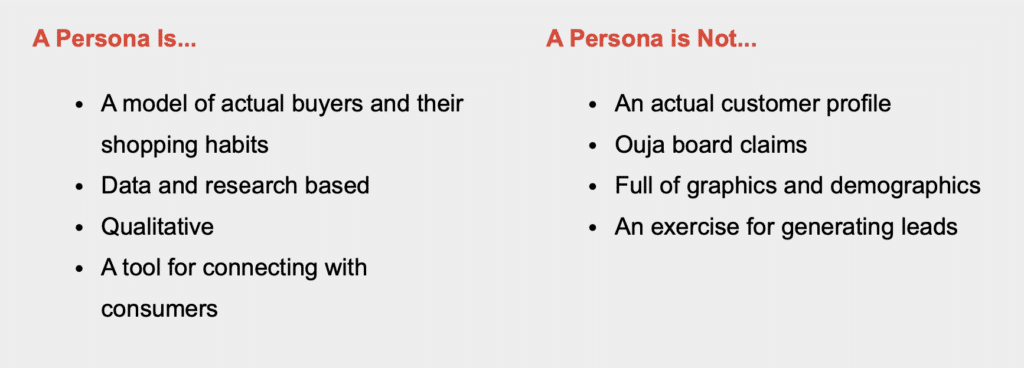
Consider this quote from Scratch: “Consumers aren't as interested in your story until it helps them tell their own. Personas are a powerful and concise way for you to use data to understand your consumers—and help your whole company understand your consumers - so that they are ultimately interested in your brand story”. Sounds rather important, right?
Persona based marketing is the practice of building your entire marketing strategy around detailed, data-driven buyer personas. Instead of creating broad, one-size-fits-all campaigns, you develop messaging, offers, and experiences tailored to the specific needs, motivations, and challenges of your ideal customers. This approach ensures every ad, blog post, email, and social media update speaks directly to the people most likely to engage with your brand. When executed well, persona based marketing increases clicks and conversions, builds trust, fosters loyalty, and keeps your brand top of mind for the audiences that matter most.
In the past few years, our client teams at 97th Floor have launched wildly successful campaigns driven by insights discovered through building personas.
In-depth personas are invaluable to our teams and our clients.
Rachel Bascom, head of content at 97th Floor, shares these benefits from using personas:
And if your personas are doing that, they're ultimately bringing you this:
We're confident that data-driven personas enable every department to work better for clients and the company.
How should you create a buyer persona? The ingredients are simple, and the process is not rocket science. Like baking bread, you already own most ingredients—flour, water, yeast, salt—and the things you don’t already have in your cupboard are easily accessible.
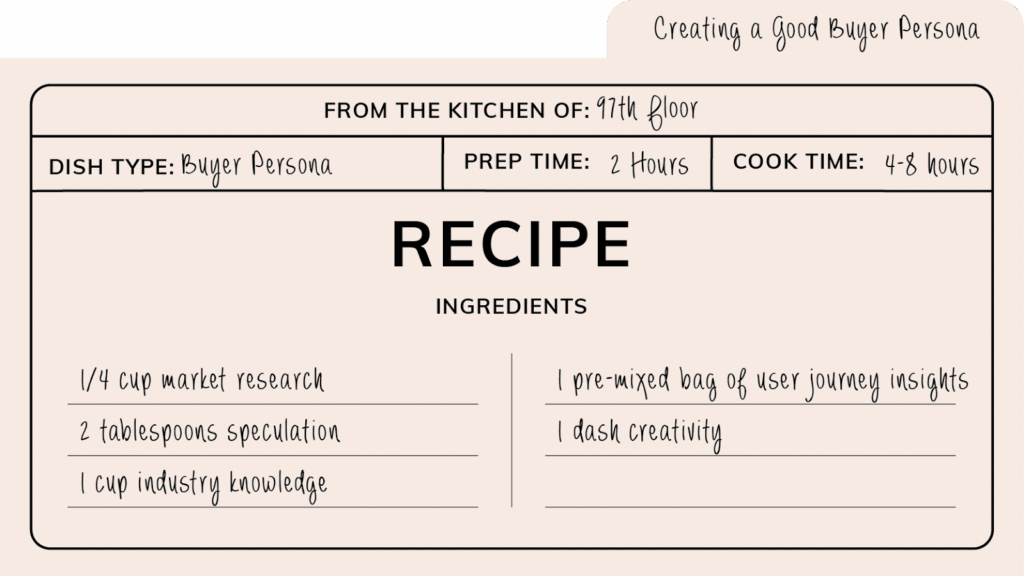
Begin with a little market research. What data do you already have about your customers? What are their current job titles, responsibilities, and interests? If you can, use a tool like SparkToro to find out more about what your customers care about. Ask: Why would they benefit from your brand? What are their pain points, and how does your offer solve them? The more research you can do, the better.
Then add a little speculation. If your persona loves running, you can assume they’ll care about running form or proper running shoes. If they’re a busy mom, you can assume they’re looking for ways to relax and save time. Some assumptions are okay, and even needed, but be sure you don’t get off track.
Once you flesh out your customer with a few assumptions, mix your research and speculation together with a knowledge of the user journey for your product or service. For instance, how do they come in contact with your brand? Will they be eager to buy, or will they need a little persuasion? What appeals to them on your site?
Finally, sprinkle a little creativity on top. This is the fun part: make it a story. Be as specific as you possibly can. What is their name? What do they look like? How does an average day in their life flow? Don’t be shy, write it out. Use your imagination. The end result should be fun, spunky, realistic, and easy to remember.
In baking bread, you simply put the dough in an oven. For personas, however, you need something much more rare: objectivity. A good persona requires you to set aside what you think you know about your customers and to see what the data tells you. This is very, very difficult for most businesses, which is why it makes sense to ask someone else to do it for you. When it comes to paying someone to create a customer persona for you, the greater the objectivity, the more you will pay. Spend less, and you will have a few assumptions mixed in with your objective assessments.
However, assumptions, especially when used in the less-critical and less-controversial parts of the buyer persona, are likely a good trade-off for many businesses. Not everyone needs to spend $50,000 to get something truly useful.
The personas that we build for our clients at 97th Floor are a mix of strategic assumptions and objective research. We are intentional in our approach, choosing where we can assume and where to use data. It might not be the right approach for every business, but it’s appropriate for most businesses most of the time.
Let’s break it down.
There are three major parts to buyer personas
As you might presume, demographic information tells us the external details about the persona. This describes the age, gender, racial identity, socio-economic details, family status, occupation, and such. We glean it from a number of sources: existing customer profiles, analytics data, competitive analyses, etc. We use whatever we can get our hands on.
When we build our personas, we use a balance of assumption and evidence. Our stance is that in this area, the information that we infer is good enough for the purpose, and the potential mistakes are low-impact ones. But don’t get me wrong, you shouldn’t go wild with assumptions here.
There isn’t much value in knowing that your average age customer is 37 rather than 39 or 40. But there is a significant difference in the average age of 30 instead of 45. Be careful that you have enough evidence for the correct ballpark. But don’t waste resources digging into teeny specifics if they aren’t likely to be impactful.
Remember that a buyer persona is different from a target audience. This is not a broad composite, but a fictionalized specific individual. There is value in having a target audience in mind--in knowing a range that describes the whole of your customers--but the value of a buyer persona is to clearly envision one perfect client.
The demographic information describes the external details of the individual, while the psychographic information describes her internal life. We want to know what she likes and dislikes, what makes her excited or nervous, what she reads and who she follows. This is the information that a savvy marketer will prize.
We obtain this through research into tens of thousands of individuals’ web habits. With this information, we can better predict the specific behaviors and biases of a likely customer, but also general principles that describe a lot of people. There are tools out there that will help you to accomplish this task with some confidence--just don’t forget the critical role of objectivity here. We’ve seen clients with personas that only really describe the client themselves. It’s an awkward conversation: “Since you’re just launching Bob’s Widgets, is it realistic that your persona is already a member of the Bob’s Widgets Fan Club?”
When you get the psychographic profile right, it’s almost magic. For example, our research might uncover that people who like your brand are also fans of the Chicago Bulls or the Los Angeles Dodgers. It is probably too specific to know which particular team they root for, but it is useful to know that your audience is sports fans (as opposed to, say, fans of quilting or politics or tattoos).
Many clients we onboard don’t have personas (or have only target audience information). Others have spent tens of thousands of dollars on specialists to get personas built. These expensive ones are often very slick, visually stunning, but a little impractical. While there is a lot of good stuff in these large personas, the mental strain to use them—and to tell what is most important—is too much. So we developed a convenient method that uses our inherent human neurological strengths to make it memorable.
We tell a story.
Maybe our stories aren’t on par with Shakespeare, but we are not doing this to scratch a creative itch. We are doing this because, as humans, we remember stories. We also remember songs, but that seemed like a little too much. So we’ve chosen to always tell a story about our persona.
There is no new information in the story. All the data we use for the story is already covered in the demographic and psychographic sections. But when we craft it into a couple of clear, easy-to-read paragraphs to describe the character succinctly, suddenly she is easier to understand and easier to remember. Because of that memorable image, it is easier to keep clearly in mind, and thus easier to create campaigns just for her.
Critically, when we tell a story, we have more of the facts in easily accessible memory. Without personas, marketers will create campaigns crafted for one or two of the most obvious customer characteristics, and they generally fall pretty flat. They’re not much better than target audience descriptions. But a good story to anchor our memory allows us to retain a fuller picture of the individual. In turn, our campaigns therefore have more depth, fullness, and richness. They are, simply, more effective campaigns.

She tried to diet and exercise, but her goal seemed so distant. Plus, was it even realistic for her to lose 50 pounds when she barely had time to pee alone before one of her hungry kids found her? She wanted more direction, maybe from a personal trainer or dietician, about what her goal weight should be. But they were so expensive.
She’d tried doing her own research about her BMI and ideal weight. But those gave her wide ranges or goal weights that seemed impossible.
Do you see how this little clip from Sharon’s life makes her a tangible woman? We feel her discomfort at the party. We understand why she is the perfect customer for this fitness company. We even get excited to find marketing strategies that will help Sharon find our client’s company and feel empowered on her next birthday.
Personas that hang around in a company’s back pocket unused aren’t doing anyone any good. A successful buyer persona is one that gets frequently referenced and utilized. The team has read it, talked about it, and knows it. They know that fictionalized individual as well as they know each other. She feels real to them.
Not only should these personas feel real to your team. You should lean on them during planning and writing content. This is the essence of persona based marketing. For instance, as you're sitting down to plan out Q2’s content, turn to your personas. Mention, “Taylor (your persona) has young children. During Q2 those children will start summer break. How might that affect the kind of content she wants to access during that time? How might it affect how much time she has to engage?” Use the persona’s name. There’s power in shared vocabulary. Of course “Taylor” won't mean much to those outside this team, but your marketing team should be using your persona’s names. Use the personas to tap into the daily life of your content consumers, and they will feel a more realistic connection to your company.
All of this work might seem like the buyer persona is creating extra work: compressing data into a single point, and then it has to be expanded again when doing the actual marketing. The magic of the buyer persona is that it enables, and even encourages, the marketer to work at an individual level but to have that function at a broad scope. The compress-decompress that the buyer persona facilitates will hone the edge of the campaign. In practice, if it’s done right, it can feel like a superpower.
We create personas for clients as a service, or we upgrade existing ones, but personas are only the launching pad into the deep pool of consumer-facing work. Here are a few examples of great client work powered by a marketing team that understands its audience using the processes we describe above.
Wikipedia's Jimmy Wales built the world's biggest knowledge base by knowing exactly who he was building it for. He shares the one insight that turns audience research into a real negotiating edge.
eFileCabinet came to us with a goal of increasing its brand visibility. In a fairly stagnant industry, their cutting-edge technology had a hard time gaining the excitement it deserved. Our team came together to define who eFileCabinet’s customers were. Like most businesses, they required multiple personas, but one particularly useful buyer persona portrayed an accountant who was frustrated with endless paper filing and tedious office chores.
Sure, this persona is an accountant, but he was far from boring.
We looked closely at what human emotions and pain points he faced, as well as ways he might enjoy letting off steam. The answer: taking a hammer to the often-frustrating office equipment he sits in front of every day. Enter: the Rage Cage.
So they could live the Office Space dream, our team crafted an experience for an accounting conference that would give them what they really wanted—the chance to smash old office equipment. Then we connected with these individuals to introduce them to the benefits of eFileCabinet’s problem-solving, headache-reducing software. This became an award-winning campaign that brought eFileCabinet the highest influx of MQLs in a single month and 100+ closed deals. None of this would have been possible without concrete, memorable, human buyer personas.
One 97th Floor client, a data service company called Qubole, was facing a long sales cycle that they were eager to tighten. We knew that buyer personas would undoubtedly help Qubole target the most promising potential customers. So we took a closer look at Qubole’s ideal buyers and got to work.
We created a persona who was a data scientist at a growing tech business that needed to scale quickly. We got to know his pain points with bringing on a data company, including security and IT complications. Knowing this information, we created a hyper-focused content strategy that was built with him in mind.
With the help of this persona sitting in the driver’s seat of our newly targeted content strategy, Qubole’s traffic and conversions skyrocketed. In fact, 97th Floor's strategy led to a 600% increase in organic traffic and a 300% increase in qualified organic leads. In addition to chopping their buyer’s cycle from 240 days to only 90 days.
As with most NBA teams, the Utah Jazz found themselves struggling to sell their summer season ticket. They came to us with a desire to increase their summer ticket sales and maybe, just maybe, they’d be able to do something never done before: sell out the entire lower bowl for the summer season. As always, we began with the audience and personas.
Because we are from Utah, we knew what a typical Utah Jazz fan looks like, and so we had a good understanding of the audience to begin with. The final version of our persona consisted partially of what we knew from the standard Jazz fan and was merged with the data we had collected about folks who buy low-cost items (like summer season tickets) via Facebook Ads. Once we had our more specific persona, building the campaigns in Facebook Ads came very naturally.
First, we fanned out our ads’ reach to a wide audience of Jazz fans on Facebook. Then, we conducted tests to see which ads were the most effective at increasing sales (this information even informed our personas to make them better for the next round). We found that segmentation, even to a non-Utah Jazz audience, and sales-focused ad copy brought in a positive ROAS, a great achievement for the low budget of their summer season marketing. Our knowledge of the buyer personas of these summer customers gave the Utah Jazz an increase in ticket sales by over 300% MoM.
Our beauty and skincare client uses playful design, sustainable ingredients, and
delicious flavors to deliver products that feel like a treat for their consumers. But the company wasn’t leveraging its audience to maximize conversions. They needed real customer personas, complete with a goal and journey for each.
Using analytics, we built—you guessed it—5 consumer personas.

Each persona included personality traits, concerns, risks, influences, an analysis of the buyer’s current status with the company, and solutions for improvement.
This in-depth analysis led to a full-funnel strategy, including launching on new platforms.
Our research helped us craft persona-focused messaging. Our discovery that certain personas were interested in astrology inspired our design team to create these stunning ads for a zodiac sign campaign, targeting shoppers based
on their birthday.
And the results? Highest-ever engagement, volume of purchases, and ROAS of all client ads.
Using only
4.1%
of total ad budget
Accounted for
42.5%
client's total purchases
While achieving
Historic ROAS
of all purchases
As these examples show, personas are not reserved for folks in content marketing roles. Entire teams from SEOs to paid media specialists to, well, everyone, should be well-versed in your buyer personas because a good persona will have insights that influence every decision from every member of a marketing team.
We've all stumbled through a cluttered Walmart. The seasonal decor, random furniture, and crates full of $5 movies and cereal boxes stall your progress to the single thing you came here for. Pretty annoying, huh?
In 2009 Walmart addressed the mess with Project Impact. The project's purpose was to improve customer experience by reducing clutter and improving the aesthetics to compete with Target. This idea came from a survey that asked customers, "Would you like Walmart to be less cluttered?" The answer was an overwhelming, Yes. But who wouldn't say yes?
Walmart halted the project when the first 600 locations that they tidied saw year-over-year sales plummet. Walmart lost an estimated $1.85 billion in sales. It appeared that all the extra clutter led to people buying more.
Fueled by turkey and pumpkin pie and armed with a Christmas wishlist, nearly 155 million Americans make Black Friday weekend the biggest shopping event of the year. Seattle-based outdoor retailer REI would rather not participate.

Instead of wow-ing shoppers with massive markdowns, REI closes its stores, activity centers, distribution centers, call centers, and headquarters for its annual #OptOutside campaign.
In 2015, REI saw 10 times more traffic than any other retailer on social media as thousands posted with the hashtag.
In 2021, REI expanded the campaign to challenge its members and community to get outside and build an inclusive outdoor space.
And yearly earnings? Up and up.
Alright, alright. So we can't really say for certain that Walmart wasn't using personas and that REI was. But what we can say for certain is that REI understood its mission and its consumers' habits and lifestyle far better than Walmart did.
Persona based marketing is an ongoing process that shapes every part of your overall strategy. The more you refine your personas with real data and insights, the more precise your targeting, messaging, and campaigns will become. If you’re ready to turn buyer personas into a powerful growth tool, let’s talk about how 97th Floor can help you build and use them to drive measurable results for your brand.
See how an audience-first approach translates to bottom-line results.
Talking about design, and giving feedback can be difficult. Sometimes it feels as though there’s a whole language you don’t know how to speak. And when you can’t find the words, it’s a challenge to get anything done the way you envisioned it in the first place. Here are a few pointers to help you communicate better with your designer so you can both end up in a place you’re proud of.
There’s nothing more frustrating for graphic designers than finishing a project and being notified of an issue that could have been addressed (and fixed) in the early stages. If you have concerns or feedback about something, voice them early and as they arise. Waiting until the end of a project to address the issue only makes things worse. Most often, it creates a domino effect of other changes that now must be made.
Don’t be afraid to give a free and honest critique. Graphic designers expect opinions, and yours are valid. Everything should be up for discussion. Remember, you know your brand/company/product the best. Your designer needs your voice on that front. While some feedback may seem obvious to you, it may not be obvious to your designer. Be sure to share your concerns. If you don’t tell your designer you think something needs to be revised, they won’t know there’s an issue. And when words are hard to find, gather examples. Show your designer what you like and/or what you don’t like. This will help carve a more guided path for the designer to take.

When it comes to graphic design, there are 5 main principles your feedback should live under.
When you give feedback, be specific to one of those principles. Instead of saying, “Make it pop.” Say, “I’d like to see brighter colors.” The field of interpretation to “make it pop” opens up a sea of possible solutions. But by being specific, the graphic designer can then ask more clarifying questions. Do you like the current color combination? Do you want brighter hues of what we have, or new colors? This will help pinpoint the root of the issue.
Poor: “Make it pop.”
Good: “I’d like to see brighter colors.”
Best: “I’d like to see brighter colors because it’ll show up more prominently. It also relates to our youthful audience.”
Telling your “why” helps the designer see from your perspective beyond your feelings or emotions (“I think” and “I feel” statements). Giving specific feedback is helpful, but explaining the “why” can really visualize your thought process. Opinions (“I think” and “I feel” statements) hold weight, but “why” statements can reveal more substantial underlying points worth talking about.
Design is subjective. While you may feel strongly one way about a design, your designer may feel the opposite way. State your case. This means you’re giving specific feedback and following your feedback with the “why” behind it. After you state your case, be sure to ask and listen for your designer’s reasoning. Design is full of decisions that you may not be aware of. Find out what the designer insists is necessary to the project, then compromise on what can be changed.
Keeping your website in optimal condition gives your business an edge against the competition. Regular website audits help identify and resolve issues that may hurt performance, user experience, or search engine visibility. With consistent, comprehensive audits, you can keep your website functioning at top-level, reaching your audience, and supporting your business objectives. Here, I’ll give the SparkNotes version of how to perform a successful audit and maximize your website’s potential.
Whether you’re a novice or an expert in the field, when performing a website audit, you need to start with the basics to identify any glaring issues that require immediate attention. In this article, I’m not going to dive into keyword research. While keyword research is an important step in evaluating the SEO of your website, it requires a longer explanation if you want your research to be perfect. If you want to dive into keyword research, one of our SEO experts, Joe Robledo, covers the steps of a low hanging fruit keyword audit here.
For the steps of an SEO website audit that I’ll be covering, you’ll need to use a few tools and platforms. Here are my recommended platforms to use for this audit.
In the sections below, I’ll break down what to look for, the tools necessary for each section, and also uncover potential issues. Welcome to your SEO audit crash course.
To fully understand the success of your website efforts, you must have accurate data. There are many issues that come from incorrect data or lack of data. I’ll be speaking specifically about Google Analytics in this section. The first step is to review the goals that are set up within your view. Ask yourself, are these goals valuable? Do they represent my team’s KPIs? Does this information help us track revenue and ROI?
After you’ve ensured your goals are tracking the exact data you’re after, check on your filters tab within your reporting view and review your filters. If it’s not currently added, take your company’s IP address and add it as a filter to your view. You don’t want all the times employees viewed your website pages to skew your data.
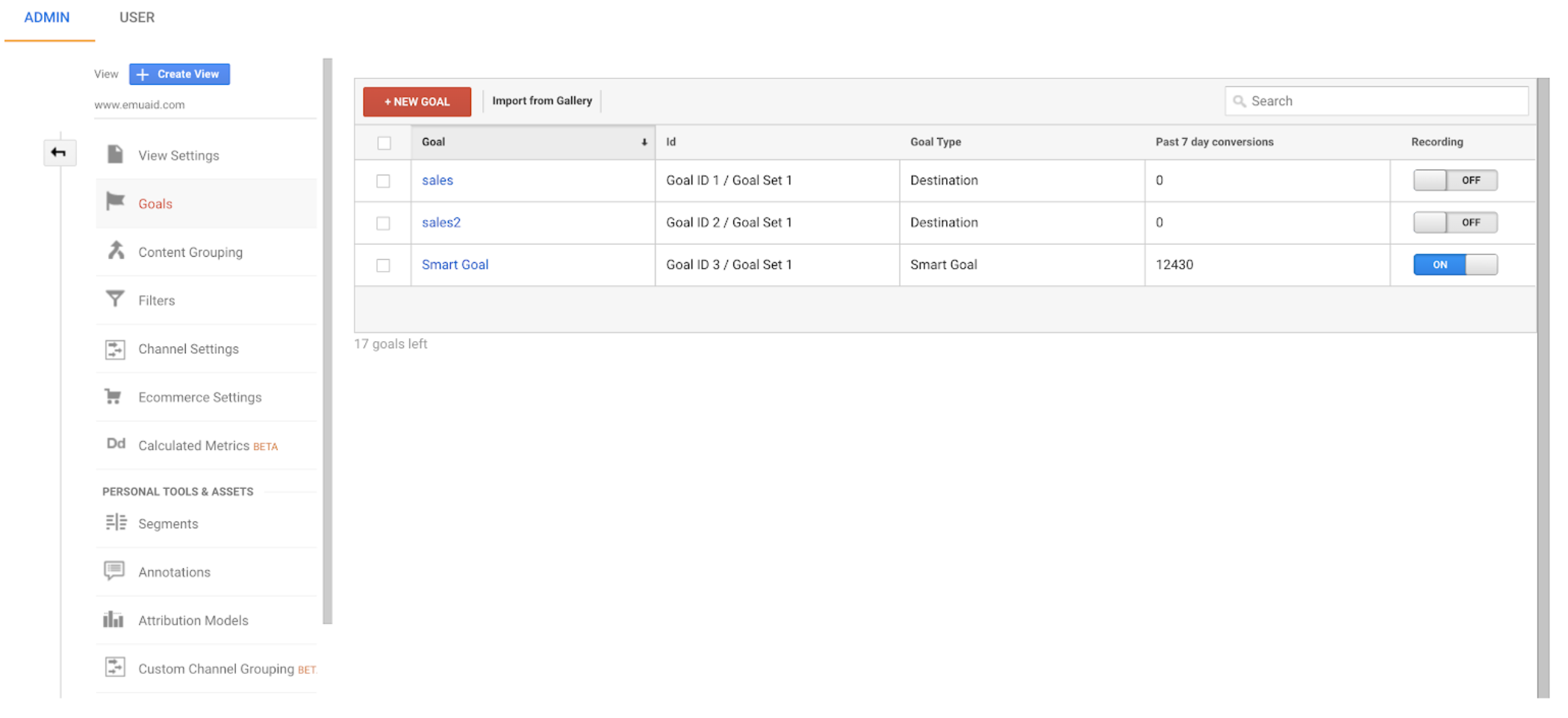
Once you’ve properly filtered your IP, go back to your home tab and view your traffic channels located under the ‘All Traffic’ dropdown in your ‘Acquisition’ tab. What is the traffic distribution of your channels? If your direct, other, or not set channels have a traffic percentage larger than 5% then there is a possibility of a tracking error across your website. A possible issue is that you have a login page on your website and haven’t included current users as an excluded filter.
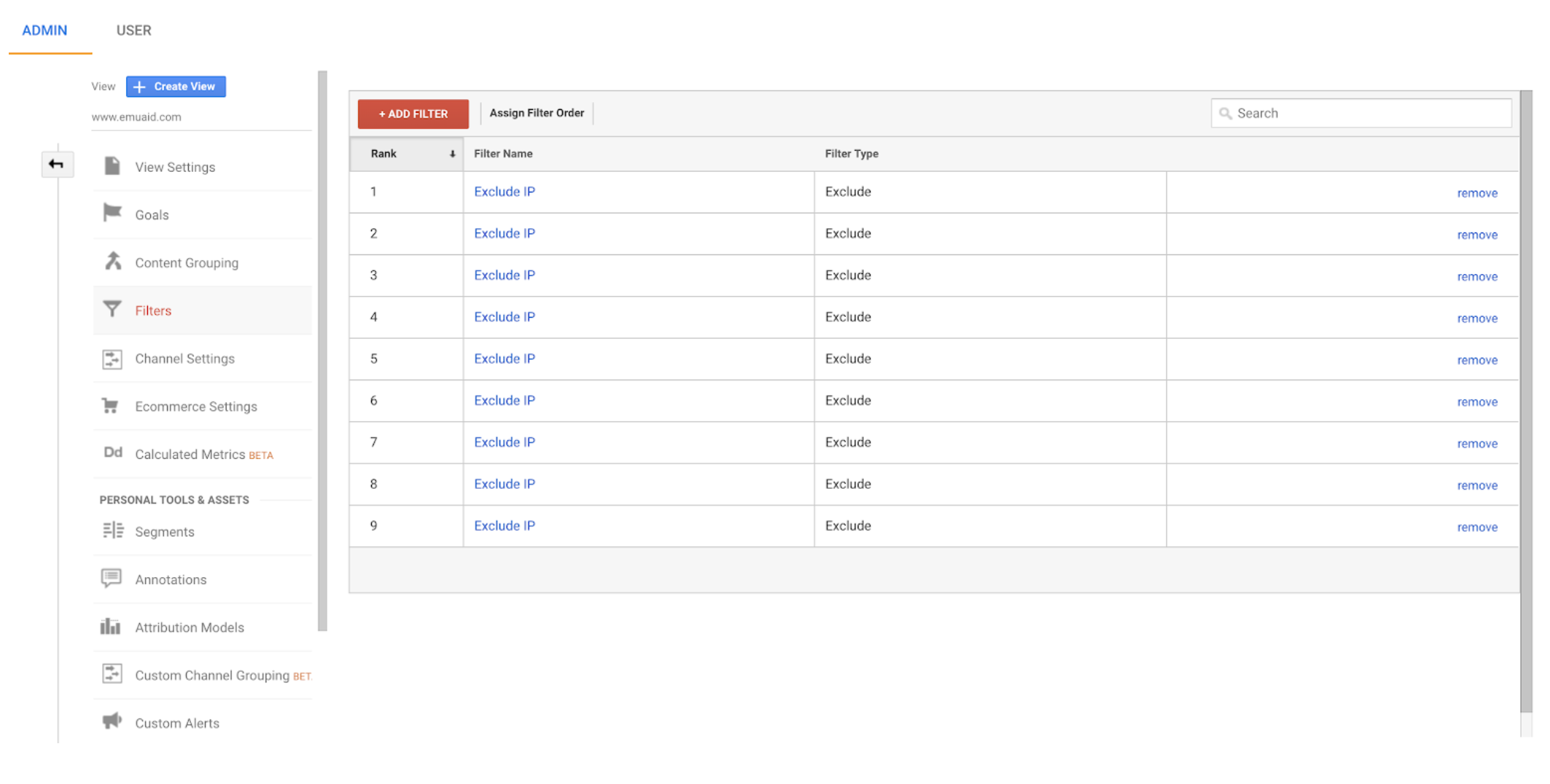
Next, check your organic traffic over the past few years. Are there any major dips in traffic? If there is anything substantial, your website may have experienced a penalty in the past. Gather as much information as you can from past penalties and determine how they were resolved.
The last step to verify all traffic is being recorded properly is to use GAchecker.com. This tool allows you to see if any pages across your website don’t have your UA tracking code. Ensure all the website pages that you want tracked are included in the list of pages with the tracking code.
Indexation
Once you’ve verified that Google Analytics is set up correctly, you’ll need to verify that your website is being indexed in Google. The first items to check are your robots.txt file and sitemap. The robots.txt file can usually be found by typing yourdomain.com/robots.txt. Your robots.txt file should look something like this:
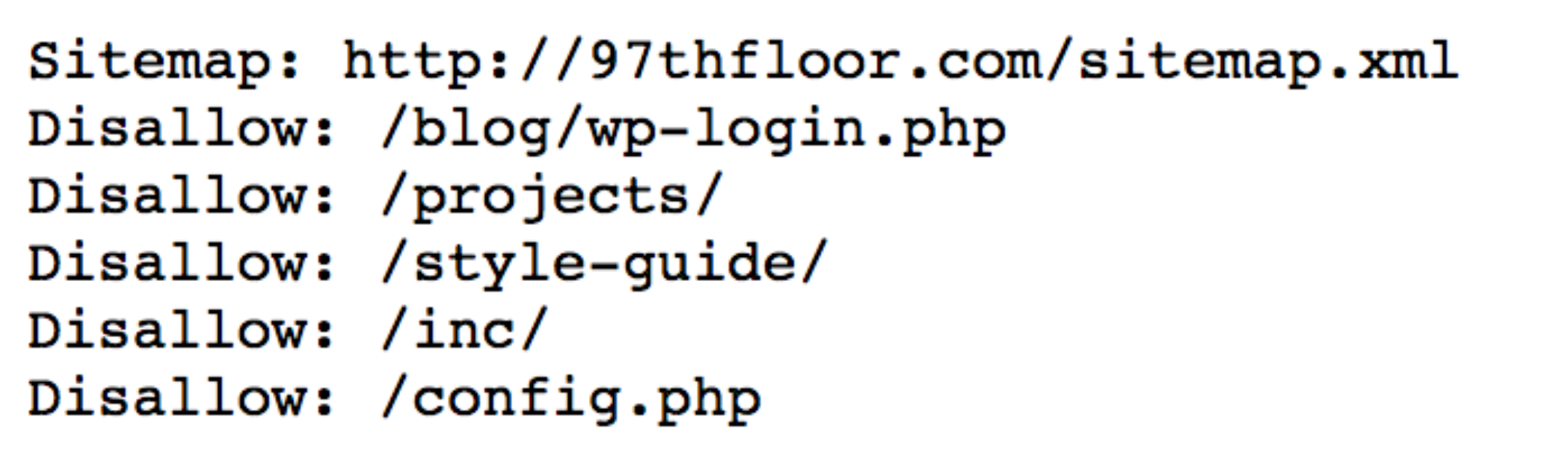
Your robots.txt file tells Google bots what they should and shouldn’t index on your website. Any pages that you don’t want showing up in the SERPs should be added as a Disallow. Such pages include: login pages, internal assets, or any page not needing indexation by Google’s search engine. In the robots.txt file, you also want your sitemap listed for Google bots to easily locate and crawl.
What is a sitemap? A sitemap is your website’s repository of pages, neatly compiled for Google’s bots to crawl. In short, a sitemap is the file that can help Google bots navigate your website and find pages that you want indexed. Even without this file, Google can still crawl and index your website’s pages, but with a sitemap, you can make your pages easier to crawl and improve your chances of sending Google to the right pages.
Another indexation problem that I have seen across a majority of sites is duplicate content. Duplicate content can happen in multiple ways and may cause Google to drop your keyword rankings because it’s not sure which page should rank for certain keywords. The first duplication issues to check are the URLs. Are there variations of the same page that are pulling up a 200 status code instead of redirecting to one page? Examples of potential duplicate URLs are below.
Each of these pages is the same, yet they show up as different URLs. This could be happening across your website and there are two ways to fix this issue. The first solution is to set up site-wide redirects to send any variation of a URL to one specific designation. If your website is ‘HTTPS’ without ‘www’ and contains a trailing slash, then set up all variations to redirect to https://yourdomain.com/.
If you’re unable to set up 301 redirects due to the platform you’re using, or if you need to keep those pages, then set up a rel=canonical tag. The rel=canonical tag signals to Google that a given page is a duplicate page, but to reference the rel=canonical URL as the first and main page when indexing.
Another problem that lowers your chance of showing up in Google SERPs is JavaScript. Google has a hard time reading JavaScript, so if you have on-page elements in JavaScript, it’s possible they may not show up for Google bots. Hubspot’s Matthew Barby explained this issue in describing a robust content category page that his team built that wasn’t showing up in Google’s SERPs. In troubleshooting the issue, they used a JavaScript Switcher extension to see what the page showed to Google and saw nothing. After recognizing this error, with a few tweaks to the page, they were able to rank for their focus keywords.
One of the last steps in reviewing the indexation of your website is checking your mobile-friendliness. Use Google’s Mobile-Friendly Test to see how Google values your mobile pages. With Google’s mobile-first index, the content on the mobile version of your website is going to affect how Google ranks your pages. If you’re not serving a mobile-friendly page, then you could be hurting your rankings.
After reviewing your analytics and the indexation of your website pages, it’s time to dig into the content on your website. When Google is crawling your website pages, you want to ensure everything is in working order and optimized to match the search intent behind searchers’ queries. When reviewing your on-page content, using Screaming Frog will help you uncover issues involving meta information. Run your domain through Screaming Frog’s spider tool and review the items below:
The last step in your SEO website audit is to review additional technical aspects of your website that might improve your website’s rankings. Identifying and fixing major technical issues on your website can be the difference between ranking at the top of page two, or reaching the top of page one in Google’s SERPs.
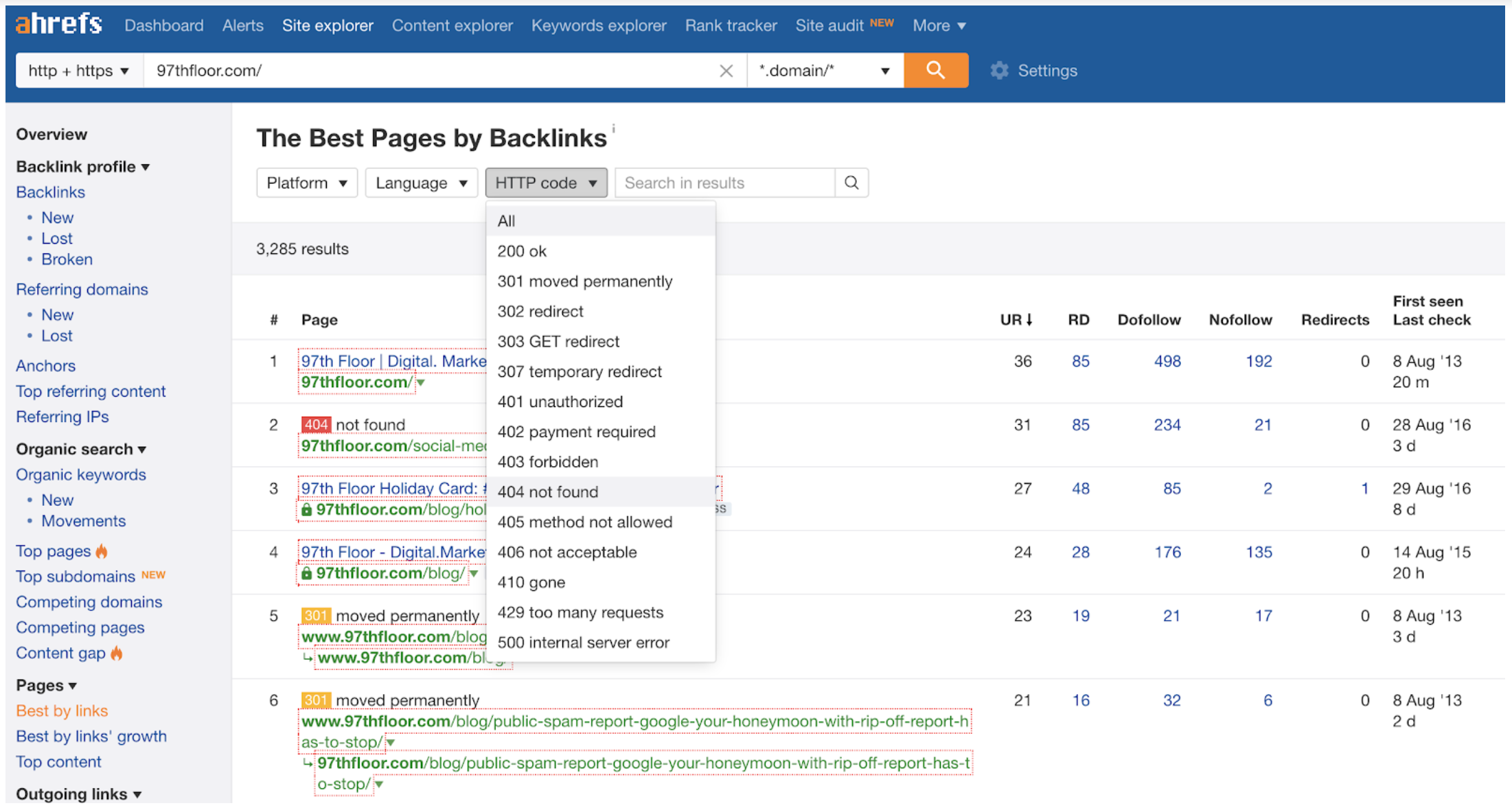
There are a few common mistakes made when conducting website audits. Look out for the following:
Keep an eye out for these pitfalls as you conduct your own website audit. They’re easily avoidable when you know what to look for.
Before you begin diving into new content and off-page optimizations, review this audit list to ensure the site’s health is in top shape. Once your site’s technical issues are in order, then you’ll be ready to crank out new content.
You’ve seen it happen: a brand posts a clever hashtag or starts a striking thread, and suddenly it’s everywhere. But is trending on Twitter just a matter of luck? How do you create a campaign that actually sparks conversation and drives sales?
Twitter campaigns (or X campaigns, these days) are a way to bring intentionality to your social media growth. Tweets feel like a simple click when you post on Twitter, but there are all kinds of coordinated efforts behind the scenes that capture your audience and build a community.
Don’t let your efforts peter out as your brand gets lost in the scroll; let’s break down a realistic strategy for your tweets.
Twitter campaigns are a coordinated marketing effort to build awareness, conversations, or conversions. Instead of relying on a single tweet to catch fire, campaigns bring strategy and structure to how your brand shows up on the platform.
What makes them powerful is the way they combine creativity with direction. A strong campaign ties together:
Put those pieces together, and you have a campaign that can grab attention and keep it, strengthening brand recall and putting your business on the digital map.
Most Twitter campaigns fall into two buckets:
Both have value. When brands blend both approaches, that’s when campaigns really shine — organic posts build authenticity, and ads make sure the right people actually see them.
Campaigns on Twitter can serve very different purposes: some build awareness, others gather support, and some drive direct sales.
A hashtag can turn into a rallying point when it’s easy to remember and share. Simple, memorable, personal. Take Coca-Cola and its #ShareACoke campaign. Throwing names on bottles gave people a reason to personalize their posts and be playful, which made the hashtag succeed beyond the standard ad.
If you want your audience to care about what you post, you have to post about what they care about. It sounds obvious, but it’s an easily missed opportunity for people to really get your brand. And, purpose-driven campaigns help build momentum by connecting to shared values and real-world issues, like with the #MeToo movement. A single phrase unified millions of voices, which just goes to show how powerful a campaign can be when it sincerely resonates.
Want more engagement? Give your consumers something to do — or even better, something to gain. Incentivize them to vote during polls or share their experiences with your product. Audi’s #WantAnR8 is a great example of this. Fans who tweeted the hashtag were entered for a chance to test drive the car. This gamified campaign created so much online excitement, about the event, yes, but also about the memorable Audi brand.
You can create some urgency with a time-based campaign or get real-time engagement with a live event. Take Nike’s #Breaking2. They built anticipation by documenting every step of its marathon barrier attempt, which kept viewers engaged from start to finish — literally.
Instead of leaving your tweets up to chance, get really intentional. Here’s how to design a compelling and effective campaign for lucrative results.
Every campaign starts with a purpose. Do you want to build awareness, generate leads, or drive conversions? Making sure your end goal is crystal clear is the easiest way to choose the right campaign type and metrics to track.
The best ads or tweets will fall flat if they don’t reach the right people. Twitter’s built-in Interest Categories can help you zero in on who to reach and discuss what that audience actually cares about.
Categories
Twitter recommends that you do not have more than two interest categories per campaign or more than 10 sub-interests in one campaign. Interests are broken down into interest categories and sub-interests — some interest categories have up to 25 sub-interests.
When you select an interest category and run a campaign with many sub-interests, be sure to check it frequently and refine your sub-interest targeting to include only the best performers. It’s also recommended to combine related categories (e.g., “Golf” + “Men’s apparel”) so your campaign feels relevant and cohesive.
Once you know your audience and goals, the next step is matching them to the right campaign format. The type of campaign you choose should support your objectives and play to the way your audience engages on Twitter.
Choosing well keeps your strategy focused and avoids wasting budget or effort on campaigns that don’t fit the outcome you’re aiming for.
Okay, so you’ve launched the campaign…now what? Track results and make adjustments. Some of the best ways to do that are to:
The most effective campaigns share a few common traits. Here’s what’s working:
A hashtag should be short, clear, and easy to use. The fewer people who have to think about it, the more likely they are to join in. Always’ #LikeAGirl campaign flipped a tired (and stereotypical) phrase into a message of empowerment. It was surprising, but it was also really concise and easily recognizable, which is what made it spread so quickly.
The more visual, the better! People are scrolling through thousands of bits of content, but an iconic visual can make campaigns recognizable, even when messages are shared or remixed. Google Maps is a good example of a clean, consistent brand that is identifiable in a crowded feed.
Emotion also makes a campaign memorable and encourages sharing. Storytelling helps audiences connect with the message on a personal level. Look at Dove’s #SpeakBeautiful campaign, where Dove confronted negative comments about women and reframed the narrative around positivity and self-love. The universal and inclusive message is easy to relate to and easy to share.
When people create content for your campaign, they’re, yes, amplifying your voice, but they are also lending authenticity you just can’t recreate on your own. Calvin Klein’s #MyCalvins did this well when fans were invited to post photos of themselves in CK products. Suddenly, their audience was their marketers and filled feeds with user-generated content tied directly to the Calvin Klein brand.
Nothing is quite as powerful and attention-grabbing as humor. A lighthearted or funny bit cuts through the noise and makes your brand unforgettable. Charmin’s #TweetFromTheSeat leaned into the unconventional elements of their brand and made it something funny and real.
Here are the big metrics you can’t overlook if you want to put your data to work for future success:
For example, Nike’s #Breaking2 livestream generated millions of impressions, but the real value came from audience engagement — thousands of tweets and shares that extended the campaign far beyond the initial event.
The shift from Twitter to X brought a new name and new features, but the basics of successful campaigns haven’t changed. Brands still need clear goals, compelling content, and strong targeting.
What has changed are the tools:
In short, social media campaigns on X run on the same principles as before, but with new opportunities to experiment and engage.
Twitter campaigns still matter, and with the platform evolving into X, brands have more ways than ever to connect with their audience. But running campaigns that actually drive awareness and conversions is a big and ongoing task that takes testing and expertise to get right.
At 97th Floor, we’ve managed Twitter ads campaigns and organic strategies for brands across industries. We know how to target the right audiences, craft content that resonates, and track the KPIs that prove impact. More importantly (and what sets us apart), we help brands align campaigns with bigger marketing goals so that social efforts pay off across the board.
If you’re ready to go viral on purpose, work with a team that knows how to turn Twitter campaigns into measurable business results. Let’s talk.
Every interaction a user has with your company tells a story. And that story starts long before someone clicks a button or fills out a form. It begins with how easily they understand what you offer, how confident they feel moving through your experience, and how quickly they can get what they came for.
In other words, it starts the moment they begin to experience your brand.
A UX design strategy defines how user experience decisions are planned, prioritized, and connected to business outcomes. It ensures design choices are intentional, informed by research, and tied to real goals like growth, engagement, and revenue. Without strategy, design becomes reactive. With strategy, design becomes a tool for progress.
Psychology plays a central role here. Users bring expectations, habits, and emotions into every interaction. A strong UX design strategy accounts for how people think and how they decide to act as they move through an experience. When psychology and strategy work together, user experiences feel trustworthy and effective.
Here, I’m going to break down what UX design strategy is, why it matters, and how it impacts both users and businesses. I’ll cover the benefits of a strategic approach, the core components that make it work, and the psychological principles behind effective experiences (and how intentional UX design supports conversion, retention, and long-term growth). And, because this is a company blog and we’re proud of the work we do, I’ll also discuss how 97th Floor approaches UX strategy as a collaborative, research-driven process.
UX design strategy is the plan that guides how user experience decisions are made to support business goals and user needs. It connects research, design, and execution into a cohesive direction. While UX design focuses on individual interfaces and interactions, UX strategy defines the why, when, and priority behind those design choices.
At its core, a UX design strategy brings together research and usability principles, supported by psychological insight and organizational alignment. It creates a shared understanding of users and clarifies how the experience should support both them and the business.
A UX design strategy gives teams a clear framework for making decisions that serve both users and the business. Instead of relying on opinions or assumptions, strategy creates direction and consistency across the entire experience.
This matters because it:
A UX design strategy is made up of several connected parts that guide how experiences are planned, built, and improved. Each of these components plays a specific role in shaping how users move through an experience and how well that experience supports business goals.
Research sets the direction for every UX decision that follows. By studying user behavior and gathering stakeholder input, teams gain insight into needs, expectations, and obstacles. This groundwork helps reduce assumptions and ensures design decisions are based on real evidence rather than internal opinions.
Usability focuses on how easily users can navigate and complete tasks. Clear pathways and familiar patterns help users move through an experience without confusion. When usability is prioritized, frustration is reduced and progress feels natural.
Information architecture determines how content is structured and labeled. A thoughtful structure helps users understand where they are and where to go next. When information is organized in a way that feels intuitive, users can find what they need with less effort.
Interaction design defines how users engage with elements on a screen. Buttons, transitions, and feedback signals all influence how responsive an experience feels. Well-planned interactions guide attention and reinforce a sense of control.
Accessibility ensures experiences can be used by people with different abilities and needs. Designing with accessibility in mind improves usability for everyone and helps brands reach a wider audience. It also signals care and responsibility in how experiences are built.
UX copy supports users through clear and purposeful language. Labels, prompts, and instructions help users understand what actions are available and what will happen next. Good UX copy removes uncertainty and keeps experiences moving forward.
Testing and iteration allow teams to refine experiences over time. By observing how users interact with designs, teams can identify issues and make informed improvements. This ongoing process helps experiences stay effective as needs evolve.
Cross-functional alignment keeps UX efforts connected to broader business initiatives. When design, development, and marketing teams share the same goals, execution becomes more efficient. Alignment helps ensure the experience feels cohesive from start to finish.
We make daily decisions on what brands we choose to engage with, what brands have earned our trust, and what brands compel us to spend money. How do we make those decisions?
Psychology studies have shown that our feelings and instincts cause us to behave. It is said that emotions drive 80% of the choice we make. So the first visual impression a customer receives from your brand is crucial to a positive customer experience, or a customer experience at all.
Good design is more than just good looks, it’s the catalyst to trust and loyalty towards any brand or company.
Trust is often the first hurdle a brand needs to clear, and design is usually the deciding factor.
That’s because design is emotional. It evokes moods, attitudes, and personality. Together, these emotions create “gut feelings” and stir thoughts in our mind. And before even being exposed to actual content, visual queues have already shown us how to feel towards a brand.
So when we’re browsing the web and come across a ‘spammy’ looking website, the visual queues are telling us it’s untrustworthy. When junk emails pop up, poor design makes us question the legitimacy of the content. When we find a good deal on the web, but the checkout page to fill out credit card information looks sketchy, we back out. As a result, we don’t engage with the brand, we don’t subscribe to the service, and we don’t buy anything at all. And it all comes from gut feelings created by bad design.
And when trust breaks down at the visual level? Users rarely stick around long enough to reconsider.
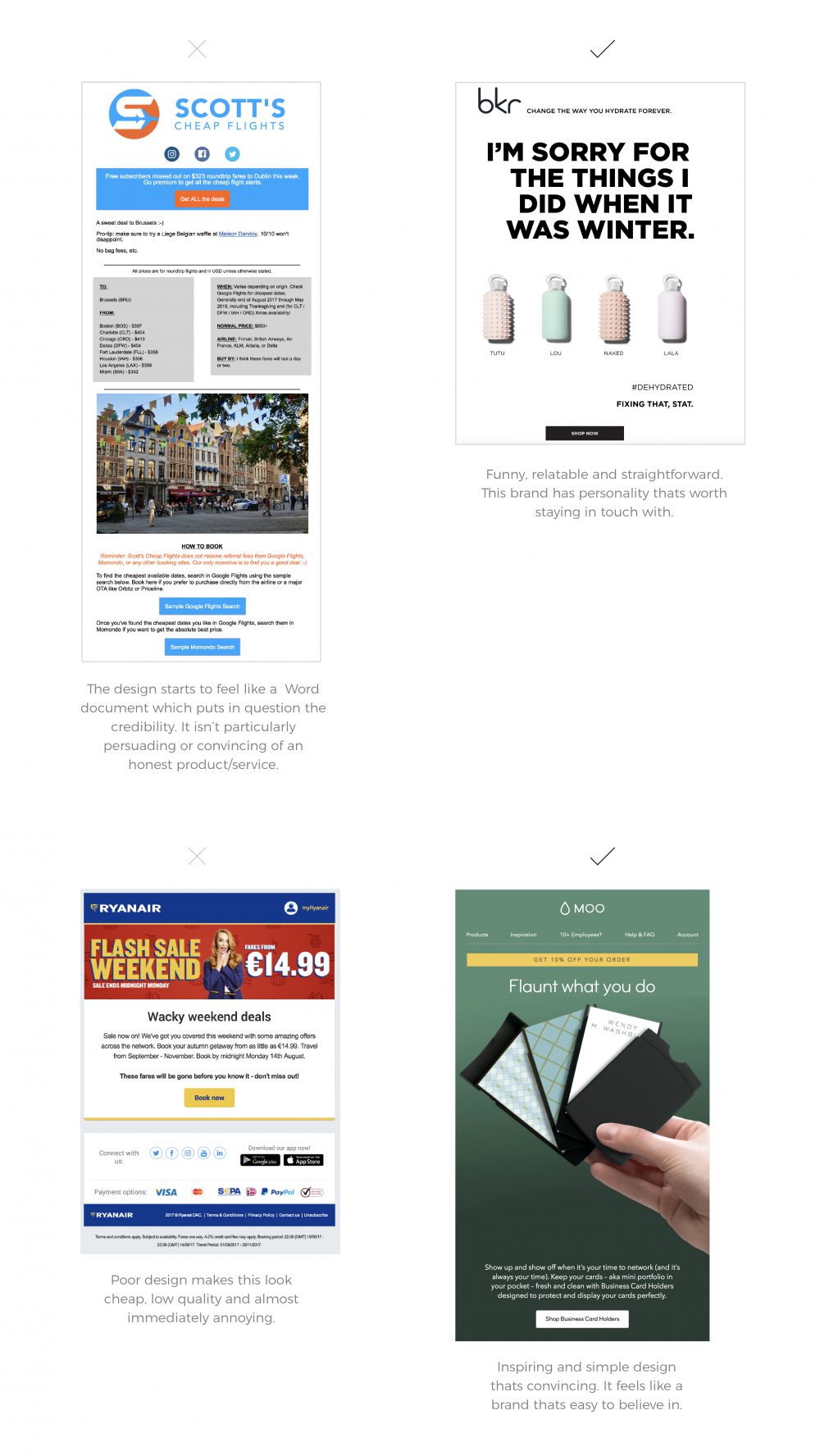
Belief is what bridges the gap between curiosity and commitment.
There’s a reason for the old adage don’t judge a book by it’s cover. It’s because we do! As consumers, we expect the quality of products/services to match their appearance. We don’t have time to be convinced that a certain brand/product/service is good, we should already be able to see that it is (or isn’t). A brand with good design is more convincing than a brand with bad design because we assume appearance reflects quality.
Have you ever found yourself wanting to purchase the organic or brand name cereal rather than the generic brand? We expect good packaging design to be the shell of a good product. Have you ever spent more money on a product just because it looks better than the cheaper version? By sole appearances, we assume more credibility with one brand than another, and we take one brand more seriously than another.
When design communicates quality clearly, customers are more willing to give you the benefit of the doubt.
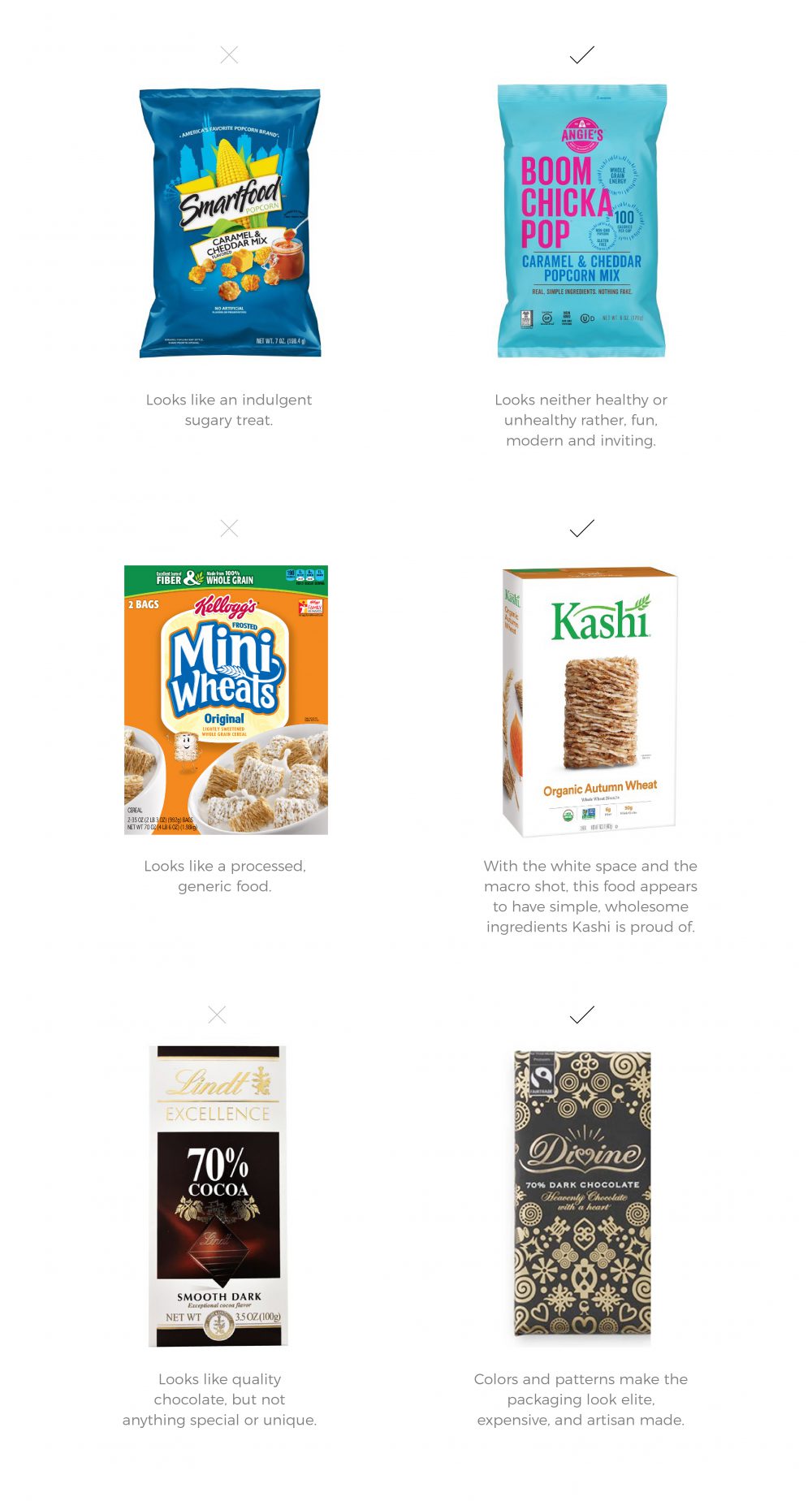
Brands with an up-to-date design make us feel like their product/service is likewise current and relevant..
Some brands stand out as cutting edge in their industry simply because they look the part. We’d be less likely to purchase a product from a website designed in the 90s, because we associate the outdated web design to the product/service. It’s as if we think, how can a product/service with a website from the 90s, serve the needs I have in 2026? There’s got to be another brand who is more current and fresh. With no progression in any aspect of design, it’s easy to assume there hasn’t been progression with the product/service either. A brand’s entire look and feel should show that it is leading the industry. Brands who look the part, convince their audience that they actually are.
Think of it like this: when design reflects forward momentum, audiences are more inclined to believe the brand can meet modern needs.
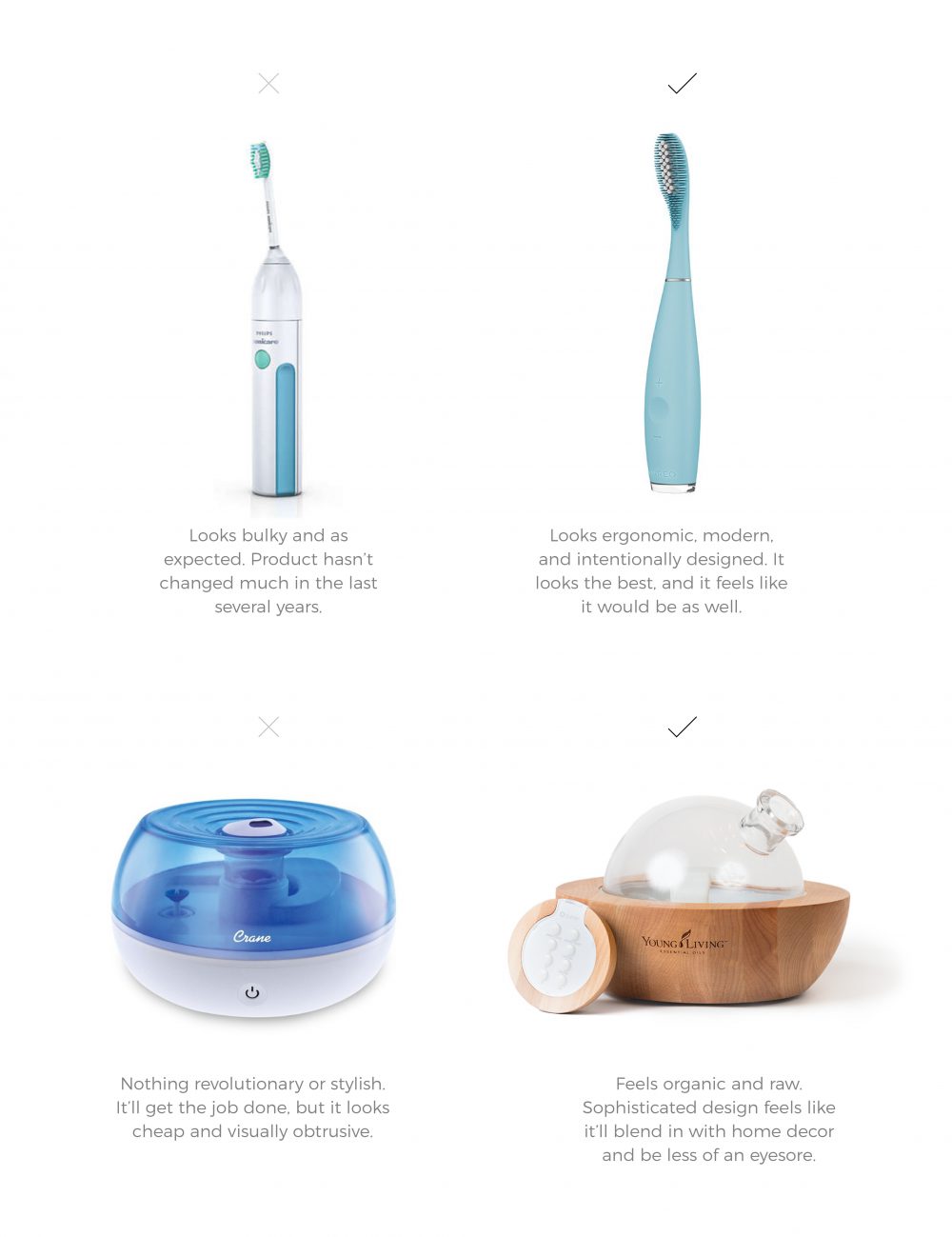
Design isn’t just how your brand looks; it’s how it feels. Feelings and instincts from good design cause positive behaviors. And the same goes for bad design causing negative behaviors.
Simply put, design dictates the user experience. So, take a second look at your brand. Does the design reflect the quality of your service/product? Is the design of your logo, website, flyer or whatever visual medium you’re using to communicate with your audience look like you’re a superior, dependable brand? Or do your visual mediums make viewers hesitate?
Visual design focuses on how an experience looks. UX design strategy focuses on how that experience works, why decisions are made, and how success is measured.
Psychology informs UX by explaining how people perceive information, form opinions, and make decisions. UX strategy uses that understanding to guide structure, flow, and priorities across the experience. Visual design then supports those decisions by expressing them clearly.
In terms of scope, UX design strategy is the broader of the two. It considers research, usability, business goals, and cross-functional needs. It is also measurable, with success defined through outcomes like engagement, conversion, and retention (rather than preference alone).
Building a UX design strategy requires intention, structure, and a willingness to learn from users. While every organization is different, most strategies follow a similar progression.
UX design strategy becomes clearer when viewed in context. Consider the following hypothetical scenarios:
These are, of course, only a few examples. The reality is when it comes to UX strategy, design must be adaptable to your product, your audience, and the specific situations where the two come into contact. A firm understanding of customer psychology, backed by reliable research, makes this possible.
UX design strategy matters because it shapes how users experience your brand and how confidently they move through it. When strategy is grounded in psychology and supported by research, design decisions become more justifiable and easier to scale. Teams gain clearer alignment, usability improves across touchpoints, and development effort is spent solving the right problems.
If you’re ready to build or refine your UX design strategy, 97th Floor partners with teams to create research-backed experiences that support both users and business goals.


