Reddit isn't the niche platform it once was. With roughly 500 million monthly active users, it's evolved into a massive hub where real conversations happen daily. But what makes Reddit special isn't just its size—it's the quality of those conversations.
"Reddit has a tendency to bring the honest opinion out from people and that is where the meat is when it comes to marketing," explains Kiersten Gaffney, a deep tech CMO who's built her content strategy around Reddit listening. Unlike Twitter threads or LinkedIn posts, Reddit's threaded conversation structure creates genuine depth and interactivity that reveals what audiences actually think.
The platform has shattered old stereotypes too. The gender split is now nearly 50/50, contradicting the male-dominated image many marketers still hold. More importantly for B2B brands, there's a massive audience gap that most companies are missing entirely.
Consider these numbers: 68% of Redditors aren't on LinkedIn, 45% aren't on Instagram, and 30% aren't on Facebook. That means while B2B brands flock to LinkedIn, they're ignoring huge chunks of their potential audience who live primarily on Reddit.
This shift represents a fundamental change in how audiences consume and discuss business topics. Reddit has kept its technical roots while expanding to capture professionals, decision-makers, and influencers who value substance over polish. For marketers willing to listen, it's a goldmine of unfiltered audience insights waiting to be discovered.

Effective Reddit listening starts with systematic keyword monitoring, not random browsing. The most successful approach involves using tools like Octalens to cast a wide net across multiple platforms while focusing primarily on Reddit conversations.
The process begins with identifying core keywords related to your industry, product, or audience challenges. Rather than diving straight into specific subreddits, start broad and let the tool surface conversations you might never have found otherwise. This approach reveals unexpected threads and communities where your audience discusses problems in their own language.
Daily monitoring becomes crucial here. Gaffney checks her keyword alerts every single day because conversations move fast and opportunities disappear quickly. "I'll be surprised by new Reddit threads that I wouldn't normally see," she notes. This consistent monitoring uncovers emerging topics before they become mainstream content themes.
The beauty of this system lies in its ability to surface authentic conversations across the entire platform. Instead of limiting yourself to obvious subreddits in your industry, you discover where your audience actually hangs out and what they really talk about when they're not being marketed to.
This discovery process often reveals gaps in your current content strategy. You might find your audience discussing challenges you never considered or using language that's completely different from your marketing materials. These insights become the foundation for content that genuinely resonates because it addresses real problems in familiar terms.
Once you've identified relevant Reddit threads, the next step involves systematic analysis using AI tools. The process is surprisingly straightforward but requires the right approach to extract meaningful insights.
The method involves copying entire Reddit threads and pasting them into AI tools like Claude or ChatGPT. But success depends on asking the right questions. The most effective prompt starts simple: "What is the most important takeaway from this topic?" This creates a foundation for deeper analysis.
Follow-up questions reveal content opportunities: "Are they missing anything? Should I talk about that? Should I write about it next?" These prompts help identify gaps in the conversation that your content can fill.
Tool selection matters for different tasks. Gaffney has found Claude excels at copywriting and any writing-related work, while ChatGPT performs better for research and data analysis. Many successful content creators use both tools for comparison, feeding ChatGPT's research into Claude's writing capabilities.
The key lies in treating AI as a research assistant, not a content creator. The tools help synthesize large amounts of conversation data into actionable insights, but they can't replace human judgment about what matters to your specific audience.
This analysis phase often reveals surprising insights about audience priorities, language preferences, and unmet needs. The goal isn't to find content topics you already knew about—it's to discover the angles, concerns, and perspectives you would never have considered without listening to actual conversations.
The transition from Reddit insights to published content requires a strategic approach focused on creating substantial pillar pieces rather than quick social media posts. This method has proven effective, with Gaffney reporting a 70% success rate when following this systematic process.
The destination for these insights should be comprehensive pillar content—detailed blog posts that thoroughly address the problems and questions discovered in Reddit conversations. This isn't about engaging directly in the Reddit threads themselves, but rather using those conversations as intelligence for creating valuable standalone content.
A smart validation approach involves testing topics first through smaller channels. Having a CEO or founder share the core insight in a LinkedIn post can quickly gauge audience interest before investing in a full pillar piece. If the post resonates, it validates the topic for larger content investments like detailed articles, webinars, or campaign sequences.
This crawl-walk-run approach minimizes wasted effort while maximizing learning. A successful LinkedIn post can expand into a comprehensive blog post, which can then become a webinar, email sequence, or even a full campaign. Each successful piece builds on proven audience interest rather than assumptions.
The content creation process benefits from the authentic language and specific concerns discovered in Reddit conversations. Instead of generic industry content, you're addressing real problems using the exact terminology your audience uses when discussing those problems with peers.
Marketing to technical audiences presents unique challenges that Reddit listening helps solve. Engineers, developers, and other technical professionals have built-in resistance to traditional marketing approaches, making authentic communication essential.
The fundamental principle for technical content is plain language accessibility. "Explain it like you're explaining it to your 10-year-old," Gaffney advises. If a technical audience can't understand your main point within 30 seconds, your content fails regardless of how sophisticated your solution might be.
Technical audiences particularly despise "smarketing"—the combination of sales tactics and marketing gimmicks that feels manipulative. This includes cheesy memes, overly promotional language, and content that prioritizes cleverness over clarity. These approaches backfire spectacularly with audiences who value substance and directness.
Success requires partnership with technical team members who provide expertise while marketers guide communication strategy. Engineers and developers aren't trained writers, but they understand the technical nuances that matter to the audience. Marketers bring the communication skills needed to make complex topics accessible.
The most effective approach focuses on helping technical audiences do their jobs better, faster, and more efficiently. Every piece of content should provide genuine value that improves their daily work experience. If your content doesn't help them solve real problems, they'll ignore it completely.
This audience can detect inauthentic content immediately. They've seen countless vendors trying to trick them into sales conversations through fake educational content. The only way to build trust is through consistently helpful, technically accurate, and genuinely educational materials.
Successful Reddit listening requires realistic expectations about scale and process. The goal isn't to produce hundreds of pieces of content, but rather to create consistently valuable content that genuinely serves your audience.
A sustainable approach involves creating one pillar piece per week that can be adapted into three to five channel-specific pieces. This might include the main blog post, a LinkedIn version, an email newsletter segment, a sales outreach template, and perhaps a social media series. Quality and consistency matter more than volume.
This recommendation particularly applies to founders and early-stage marketing teams without large content operations. As teams grow and add specialized roles like content marketers or developer relations professionals, the scale can increase proportionally. But starting small and building systematically prevents the quality issues that come with overambitious content calendars.
The current landscape includes many companies trying to automate content creation at massive scale, often producing generic content that gets flagged by Google for being AI-generated spam. These approaches hurt everyone by flooding channels with low-quality content that audiences learn to ignore.
Reddit listening prevents this trap by grounding content creation in genuine audience needs and language. When content addresses real problems using authentic terminology discovered through actual conversations, it naturally avoids the generic feel of purely AI-generated material.
The key metric isn't how much content you produce, but how well that content resonates with your intended audience. Better to create one piece per week that generates meaningful engagement than ten pieces that get ignored.
AI tools provide powerful assistance in the Reddit listening process, but they can't replace human expertise and judgment. Understanding this balance is crucial for success with AI-powered content creation.
The general rule suggests AI gets you about 75% of the way to finished content. That remaining 25% requires human expertise in product marketing and copywriting to transform AI output into content that truly serves your audience. This isn't just minor editing—it's substantial refinement that adds personality, brand voice, and strategic focus.
Effective AI use requires skill in both prompt engineering and post-output refinement. Some creators focus heavily on perfecting prompts to get better initial output, while others prefer to work with basic prompts and do more manual refinement afterward. Both approaches work, but success requires expertise in guiding the process.
The relationship between human and AI should be director to directed, not the reverse. As Gaffney discovered when training a founder to use Claude: "He was letting Claude direct him versus him direct Claude." When AI drives the process, results become generic and miss strategic objectives.
Template development helps maintain consistency across content creation efforts. Creating prompt templates for different content types and testing them repeatedly helps identify what works best for your specific needs. However, even with templates, AI outputs can vary significantly, requiring human oversight and adjustment.
The most successful approach treats AI as a research and drafting assistant that helps synthesize large amounts of information and create initial content frameworks. The human expert then shapes that framework into content that serves strategic objectives and connects authentically with the intended audience.
Reddit listening creates a bridge between authentic audience insight and scalable content creation. This approach solves the fundamental tension between understanding what audiences actually want and producing enough content to maintain consistent market presence.
The competitive advantage comes from truly understanding audience language and pain points rather than guessing based on industry assumptions. When content addresses real problems using familiar terminology, it cuts through the noise of generic industry content that dominates most markets.
Long-term success requires focusing on genuine value over clever marketing tactics. Technical audiences, in particular, can immediately detect when content exists primarily to generate leads rather than solve problems. Building trust requires consistent demonstration that your primary goal is helping them succeed in their roles.
This authenticity-first approach naturally leads to better business results because content serves real audience needs. When people find genuine value in your content, they're more likely to remember your brand when they need solutions you provide.
The Reddit listening framework provides a systematic way to maintain this authenticity at scale. Instead of running out of content ideas or falling back on generic industry topics, you have a continuous stream of real audience problems and interests to address.
The key is viewing community listening as an ongoing process rather than a one-time research project. Audiences evolve, new challenges emerge, and language shifts over time. Successful content marketing requires staying connected to these changes through consistent listening and adaptation.
Companies that master this approach create sustainable competitive advantages because they understand their audiences better than competitors who rely on assumptions or outdated research. In a world full of generic content, authentic understanding becomes increasingly valuable.
"Reddit has a tendency to bring the honest opinion out from people and that is where the meat is when it comes to marketing." - Kiersten Gaffney
03:05 - Reddit's honest opinions vs. other platforms
07:23 - Keyword monitoring with Octalens tool
08:31 - AI analysis: Reddit threads to content ideas
20:55 - Director vs. directed: controlling AI tools
25:28 - Marketing to technical audiences without "smarketing"
32:05 - Upcoming Maven course on Reddit mining
Attend a free 60-minute live demo with Kiersten on September 12, 2025 to see her whole in-depth process for transforming tiny insights into incredible content.
Register here: https://maven.com/p/a3bef8/turn-dev-complaints-into-content-gold-with-ai
Request a free AI Audit: https://97staging.com/ai-audit/
Connect with Kiersten on LinkedIn: https://www.linkedin.com/in/kierstengaffney
Connect with Paxton on LinkedIn: https://www.linkedin.com/in/paxtongray/
Looking for an agency that'll be worth the investment? 97th Floor creates custom, audience-first campaigns that drive pipeline and conversions. Get started here: https://97staging.com/lets-talk/.
Kiersten Gaffney is a CMO advisor helping deep tech software companies build their marketing growth engines. She’s advised hundreds of founders from companies like Airbyte, DragonflyDB, and Codefresh to build systematic, measurable approaches to marketing.
The difference between SEO at a small business versus a company like Walmart isn't just about scale—it's about treating search engines as customers. While small teams fight for engineering resources and squeeze SEO fixes between other priorities, enterprise SEO teams operate with a completely different playbook.
Patrick Kajirian knows this world well. As Senior Product Manager of SEO at Walmart, he's previously led SEO initiatives at Disney, ESPN, and Realtor.com—sites that serve hundreds of millions of pages to search engines daily. His perspective reveals how enterprise SEO really works and where the industry is heading as AI agents start browsing the web on our behalf.
The lessons from his experience offer insights that extend far beyond large companies, especially as the entire SEO landscape faces another major shift.
Google as a First-Class Citizen
At enterprise scale, SEO stops being a marketing afterthought and becomes a product function. "You treat the search engine as a customer in a way," Kajirian explains. This shift changes everything about how SEO gets executed.
Instead of begging for engineering time or waiting for approval to make technical changes, product-led SEO teams have direct channels to the people building the site. They work alongside dedicated data scientists, brilliant engineers, and experienced designers. The search engine becomes what Kajirian calls "a first-class citizen" in product decisions.
This isn't just about having more resources—it's about building SEO compliance and best practices into the foundation rather than retrofitting them later. When SEO requirements are "woven into the foundation of how you build stuff," they actually get executed correctly.
The practical impact is huge. Product-led SEO teams can build roadmaps, iterate on solutions, and test extensively. They're not stuck with one-shot implementations that have to work perfectly the first time. As Kajirian puts it, they can "release something, look at it long and hard, see if it worked, do something else, do something different, iterate."
Building SEO Into the Foundation
This product-first approach pays dividends when it comes to technical implementation. Features like structured data for rich snippets, proper metadata handling, and mobile optimization get built into content management systems from the start. SEO teams can create templates and workflows that make optimization automatic rather than manual.
The contrast with traditional marketing-led SEO is stark. Instead of fighting for resources and explaining why technical changes matter, product-led teams are part of the conversation from day one. They influence architecture decisions, database design, and user experience flows—all with SEO impact in mind.
Why Indexation is the Real Challenge
Here's something most SEO discussions miss: at enterprise scale, getting pages indexed is often harder than ranking them. Google has become increasingly selective about what makes it into their index, and sites with millions of pages feel this pressure acutely.
"It's pretty clear that in the last decade, Google's actually been putting the brakes on crawling and indexing the entire web," Kajirian notes. "They're being very judicious and very selective about what gets qualified to get represented in the index."
For a site like Walmart with a massive product catalog, or Realtor.com with pages for hundreds of millions of properties, this creates a fundamental challenge. Google will crawl hundreds of millions of pages, but they won't index all of them. The question becomes: how do you signal which pages matter most?
Strategic Link Rotation for Crawl Budget
Kajirian's team developed a sophisticated approach to internal linking that goes far beyond traditional site architecture. They identify pages with the highest crawl activity—typically starting with the homepage—then map out how search engines discover and move through the site.
The strategy involves creating link systems that rotate through target pages, funneling valuable crawl activity to content that needs indexation. "If you understand where the crawler is, where the highest amount of crawl activity is located," Kajirian explains, "you can generate link systems that can rotate through a number of links targeting pages that are highly relevant."
This isn't random internal linking. The team analyzes server logs to understand crawl patterns, identifies authoritative pages that search engines visit frequently, then creates dynamic linking modules that systematically expose important but under-crawled pages to bot traffic.
The results are impressive: "If you do that diligently and consistently, you'll find that those pages get crawled real quick, they get indexed real quick, and they tend to perform better in SERPs."
The Lifecycle Reality
Enterprise sites deal with constant content churn, especially in e-commerce where products come and go. This creates a natural lifecycle for indexed pages. High-quality, relevant pages that serve user intent tend to stay indexed. Pages that decline in quality or relevance eventually drop out.
Kajirian's team uses link rotation as a "churn system" to continuously surface new content for indexation while allowing lower-quality pages to naturally fall out of the index. It's a sophisticated approach to managing what is essentially a limited resource: Google's willingness to index your content.
The key insight is that internal linking isn't just about distributing PageRank—it's about communicating priority to search engines and managing crawl budget strategically.
Disney and ESPN: When Everything Changes
Few people have managed site migrations at the scale Kajirian has. Moving Disney from Flash-based architecture to responsive design while simultaneously changing domains required coordination across hundreds of websites and multiple years.
The Disney project involved creating an entirely new CMS platform called Matterhorn, complete with built-in SEO features for metadata, structured data, and mobile optimization. But the technical complexity was matched by logistical challenges—mapping pages, managing redirects, and coordinating with teams across different properties.
"There were only like three, four SEOs within Disney that were responsible for doing all that," Kajirian recalls. The scale required systematic approaches to problems that smaller sites handle manually.
Battle Scars and Learning Moments
Even with careful planning, migrations at this scale involve risks. Kajirian admits to accidentally taking down Disney Junior during a redirect implementation, affecting "four-year-old girls who wanted to get the Disney Princess coloring books" for over an hour.
These experiences teach important lessons about preparation, testing, and having rollback plans ready. At enterprise scale, small mistakes have large consequences, but they also provide learning opportunities that improve future migrations.
The ESPN migration was particularly challenging because of user reception—the redesign was "very polarizing" with roughly 50% of users either loving or hating the new experience. This highlighted the importance of balancing SEO technical requirements with user experience considerations.
Browser Agents vs. Cloud Agents
The emergence of AI agents that can browse and interact with websites represents another major shift for SEO. But not all agents work the same way, and the differences matter for how businesses should prepare.
Google's Project Mariner and OpenAI's approach involve cloud-based agents that require users to share credentials and authentication details. This creates privacy and security concerns, especially for e-commerce transactions where customer data is involved.
Perplexity's Comet browser takes a different approach—running agents directly in the user's browser where they're already logged in. "It's basically your browser," Kajirian explains. "You're logged in with your credentials, and you're executing tasks as if you were doing it."
This distinction matters because browser-based agents can access authenticated systems without sharing credentials, making them more practical for complex workflows that span multiple tools and platforms.
Real-World Applications for SEO Teams
The potential for automating routine SEO tasks is enormous. Kajirian describes a workflow where an agent could open multiple tabs in Google Search Console, apply filters across different properties, export data to spreadsheets, and perform analysis—all tasks that would normally take an hour but could be completed in minutes.
"What would normally have taken me, if I were to do this on my own, an hour to do, it'll take you two minutes to do it," he notes. This isn't just about speed—it's about being able to perform more comprehensive analysis across larger data sets.
The broader implication is that SEO teams will be able to handle more complex, strategic work as routine data collection and analysis becomes automated.
The Traffic Quality Trade-Off
As AI agents become more sophisticated at answering questions directly, traditional organic traffic patterns are changing. Many sites are seeing fewer clicks from search results, but the traffic they do receive converts at higher rates.
"What we are seeing is the people who do eventually come, they're highly qualified," Kajirian observes. "Even though the traffic's going down, they're more qualified."
This shift requires a fundamental change in how SEO success gets measured. Instead of optimizing purely for traffic volume, teams need to focus on conversion quality and user intent matching. The challenge is ensuring that when AI agents do refer users to websites, those sites provide clear value and competitive advantages.
Why the Wild West Days Are Back
Every major shift in search creates opportunities for those willing to experiment and adapt quickly. The rise of AI agents represents another "Wild West" moment where established practices get disrupted and new winners emerge.
"This is a really great time to be thinking about SEO in general," Kajirian argues. "We're thrown back into the Wild West days where you just had to study and test and experiment and see what works."
The key is balancing experimentation with solid fundamentals. While tactics and tools evolve, the basic principles of how search systems work remain consistent.
Constants in a Changing Landscape
Despite all the changes, SEO fundamentals haven't shifted as much as the noise suggests. Search systems—whether traditional algorithms or AI agents—still need to discover content, understand it, and match it to user intent.
"The fundamentals are still the same," Kajirian emphasizes. "You're still dealing with algorithms or agents or bots still having to discover your content, rank that content and serve it in the context of what the customer wants."
Site performance, content quality, structured data, and technical accessibility remain important. Crawl budget still matters. Pages still need to be indexed to appear in results, even AI-powered ones.
The tools and interfaces will evolve, but the underlying requirements for helping search systems understand and surface content remain constant.
Advice for the Chaos
For teams navigating this transition, Kajirian recommends focusing on fundamentals while staying open to experimentation. The community sharing knowledge through platforms like LinkedIn provides valuable insights about what's working and what isn't.
Most importantly, periods of uncertainty create opportunities for those willing to adapt. As Kajirian's interviewer noted, "new winners are made" during chaotic transitions when established players are slow to change.
The web isn't dying, but it's definitely evolving. Enterprise SEO teams have advantages in navigating these changes—dedicated resources, direct access to engineering teams, and the ability to implement systematic approaches to complex problems.
But the lessons from enterprise SEO apply more broadly. Whether managing a small business website or a massive e-commerce platform, the principles of treating search engines as customers, building optimization into foundations rather than retrofitting it later, and focusing on fundamentals while experimenting with new approaches remain valuable.
The future belongs to those who can master both timeless SEO principles and emerging technologies. In periods of rapid change, that combination of solid fundamentals and adaptive experimentation becomes the key to long-term success.
"This is a really great time to be thinking about SEO in general... We're thrown back into the Wild West days where you just had to study and test and experiment and see what works. The fundamentals are still the same." - Patrick Kajirian
02:26 - Enterprise SEO as a product function vs marketing function
06:24 - Google's indexation challenges and internal linking strategies at scale
16:47 - AI agents and agentic browser automation discussion
30:38 - Disney and ESPN migration war stories
46:51 - Traffic quality vs quantity in the AI era
Request a free AI Audit: https://97staging.com/ai-audit/
Connect with Patrick on LinkedIn: https://www.linkedin.com/in/patrickkajirian/
Connect with Paxton on LinkedIn: https://www.linkedin.com/in/paxtongray/
Looking for an agency that'll be worth the investment? 97th Floor creates custom, audience-first campaigns that drive pipeline and conversions. Get started here: https://97staging.com/lets-talk/.
Patrick Kajirian honed his career in technology and media in a broad range of roles that involved managing a full-service web design agency, operating world-class e-commerce and media websites, and driving user acquisition initiatives for global brands and fortune 500 companies. Patrick facilitated over a million daily Google searches as a principal product manager for SEO at Realtor.com. He currently works as a senior product manager in SEO at Walmart in the San Francisco Bay area.
Inevitably, you’ve discovered technical issues that are hampering your organic growth—and you need development to tackle these optimizations. But getting the ear and time of dev teams can be extremely challenging amongst all the non-SEO initiatives they’re tackling.
Frequently, SEOs will find themselves in these scenarios:
Josh Moody, 97th Floor Executive Director of Palomar, offers five tips for reducing the friction between SEO and development:
Instead of trying to bend development to your SEO-strategy, learn how your development team operates and consider how you can amend your SEO strategy to fit into their existing process.
Get curious about your dev team:
Adjusting your strategy cadence to be more development-friendly decreases frustration for both SEOs and developers.
Before sending over a long list of optimizations, consider how development thinks about implementation. To begin, they’re using a completely different vocabulary than you use. Why in the world are we talking to developers about “optimizations?” Let’s try “bug” instead. Submit tickets, not slide decks.
Ancestry’s Director of SEO John Crockett advises, “Understand a developer’s world enough to talk to them intelligently. I don’t get too much into the solution with them, but I do know enough coding and engineering to be prepared in those meetings with an idea of how we’d accomplish it. Doing the research has taken projects from being labeled as impossible to being done.”
Be respectful of the developer’s expertise. Don’t assume you know what a fix will require from them, but come speaking in their language to show you’re ready to collaborate.
Marketers are always trying to create a story for their target audience. For SEOs, developers are your audience and you should structure your story using the following three components: user description, functionality, and benefit.
Here’s the formula:
As a [description of user] I want [functionality] so that [benefit].
For example,
“As a new or existing website visitor, I want to ensure text remains visible during the page load, so that I can have a better user experience, especially if I’m on mobile devices with a slow network.”
This reads a lot better than “make text visible while the page is loading,” and helps a developer understand why your requests are worth their extremely-limited time.
Writing like a developer is a learnable skill, not a personality trait — Whitney Goldstein makes the case. This short video breaks down what it actually takes for a marketer to close that communication gap.
Get as clear as possible about the problem you are trying to solve and the role development will play in solving the problem.
There’s a huge difference between, “Could you add Google Analytics to the site?” and “Could you add the following JS tracking code to the site via each page’s header?”
A developer’s kryptonite is scope creep—changes made to the project push schedule, budgets, or resource allocation—and every time more clarification is needed, deadlines are at risk. Get clear by helping the developer know exactly what you need from start to finish—you’ll get more accurate estimates and preserve the relationship you’re working so hard to keep with them.
Need a change and want it a certain way?
Phrases like “Add some zing” or “make it more punchy” leave way too much room for interpretation. Whatever those phrases conjure up in your head are drastically different than what it may suggest to a developer. Obviously, you’d never use “zing” or “punchy”, but maybe you’re using other terms with subjective meaning.
Sharing examples side-steps this problem altogether. The best kinds of example you can share are:
Search around Dribbble and other sites to show development what you mean by “zing.”
Bonus Tip: Once a project is completed, share wins with the development team who helped you complete them. CC the boss. CC everyone. Get excited about the ways that SEO is improving customer experience and showcase how each person contributed.
SEOs, remember that your relationship with development is a partnership. Make dev your friends by understanding their world. Developers think literally. They are also extremely busy. Make their job as easy as possible, and your SEO implementations can happen faster and with greater precision.
Ascend.io provides an automated platform to manage data engineering & analytics workloads 10X faster by combining data ingestion, transformation, delivery, orchestration, and observability into a single platform.
Because their product is so technical and so niche, Ascend was a relatively unknown company. In fact, Ascend’s product is so unique that the company doesn’t have any direct competitors that do exactly what they do.
Desperate for leads, Ascend made a common B2B mistake—focusing only on the bottom of the funnel and their ads were performing poorly.
We got to work building out consumer personas based on Ascend’s audience knowledge and our own proprietary research and built out a Customer Journey Map for Ascend’s most valuable personas. We knew who our audience was, where they were spending their time, what questions they were asking, and what touchpoints to provide them.
Our strategy then unfolded in three parts: taking a full-funnel approach to existing platforms (LinkedIn & Google), launching on new platforms (Reddit, Twitter, and Terminus), and continually refreshing ad campaigns. Across all channels, we expanded the campaign objectives to include lead generation, website conversions, and website visits with a mix of ad formats, including single image, conversation ads, and document ads.
Leveraging content downloads, an increased focus on awareness, impressions and traffic from LinkedIn ads increased conversion metrics for each persona at every stage of the funnel.
Every measurable metric, including the most important metric of demo requests, skyrocketed thanks Ascend’s increased visibility across multiple channels and multiple stages of the funnel.
"97th Floor brings a lot of good ideas on how to refine what we’re doing." – Erick Frierberg, Chief Marketing Officer
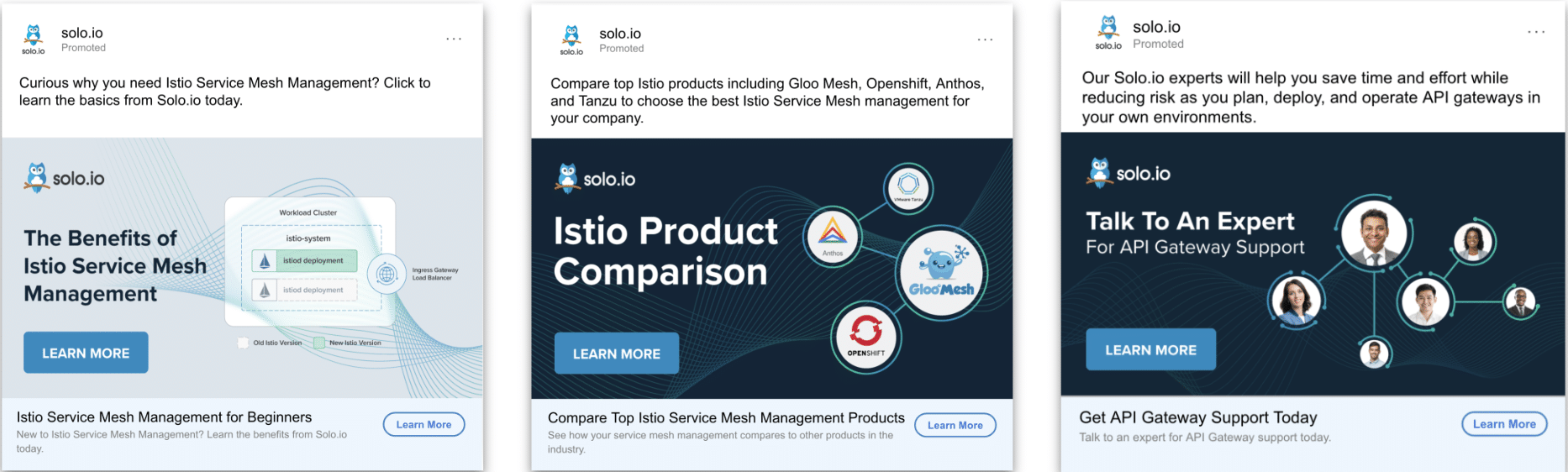
Solo.io is an Application Networking Platform enabling companies to take the next step in their cloud journey.
When Solo.io came to 97th Floor we established that they were missing out on impressions due to budget constraints and outdated geo-targeting, so they doubled their Google spend. This move enhanced their brand visibility, a key performance indicator.
Their prime objective, however, remained boosting Marketing Qualified Leads (MQLs) where a lack of mid-funnel strategies in Solo.io’s existing campaigns hindered their conversion efficacy.
Using in-depth persona research, we developed and pitched a full-funnel LinkedIn campaign that would target personas for Solo’s two main products: Legacy API Gateway and Gloo Mesh.
The campaign included newly designed and written ads at the awareness, interest and conversion stage to meet Solo’s market where they are and move them through the funnel.
Solo.io would deem the campaign successful if we achieved a Cost Per Lead Under $200.
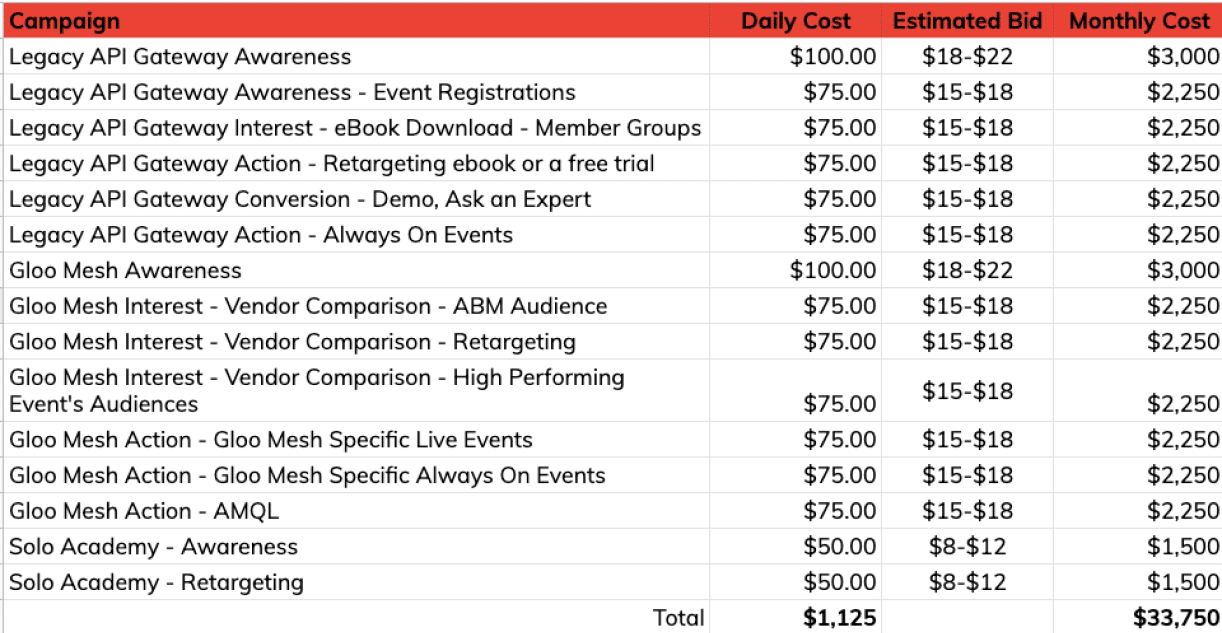
In just 4 months, the LinkedIn campaign generated 246 leads at a cost of $141/lead. This is a 26% increase in total leads and a 29% decrease in total cost per lead for Solo.
"If you need somebody to be dependable like they're internal and to really care about the outcomes of your marketing programs, then 97th Floor is a great partner." – Kate Evetts, Director of Digital Marketing at Chronosphere
Chronosphere is a SaaS-based, cloud-native monitoring solution for enterprise businesses. Chronosphere’s platform gives companies the ability to remediate issues faster with real-time insight while getting data growth under control.
When Chronosphere came to 97th Floor, their strategy was hyper-focused on target accounts and driving awareness. They had a lot of traffic but were not generating many leads. They partnered with 97th Floor to increase brand awareness, drive more traffic to their site, and most importantly, increase their number of demo requests—all at a lower cost per demo.


When we caught wind of major industry events on the horizon, we immediately saw a golden opportunity to spotlight Chronosphere to an engaged audience. With key events unfolding in New York City and Detroit, we zeroed in on a strategy that would ensure Chronosphere couldn't be missed.
Our move? We went big with out-of-home advertising, choosing the in-airport TV network ReachTV for our canvas. Timing was everything, so we aired our ads right when flights were buzzing in and out of the event cities—capturing attention before and after each event. But we didn't stop there. We made sure Chronosphere was the talk of the town, with our ads riding high on taxi tops, ferrying attendees through the hustle and bustle of the city streets. This wasn't just advertising; it was about making a statement where it mattered most.
Our out-of-home (OOH) ad campaign for Chronosphere significantly boosted engagement: US site traffic increased by 46%, with a standout 743% rise in Detroit and an 18% uptick in NYC. Impressions for “what is Chronosphere” jumped by 81%, while the “Chronosphere vs Datadog” comparison saw clicks and CTR surge by 400% and 381%, respectively.
Algorithmia offers software for building and deploying machine learning models.
Despite efforts on multiple advertising and organic channels, Algorithmia struggled to know where to invest growth resources in a way that would grow the business. After a few months of working together, 97th Floor knew which channels could reach Algorithmia’s highly technical target audience—an audience that despises ads.
Algorithmia needed strategic ads to break through the noise and connect with their skeptical audience.
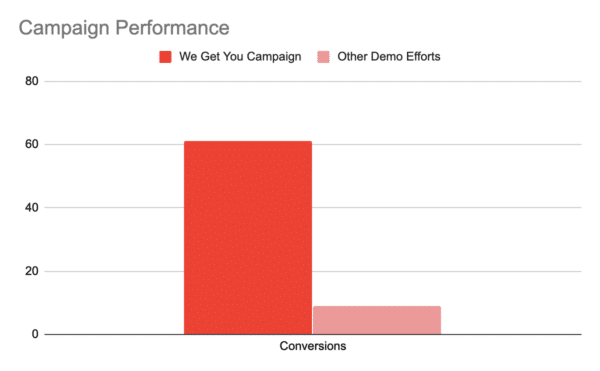
To start, 97th Floor teams dove into forums, social media groups and websites where key personas spent their time online. This in-depth persona research led to the “We Get You” campaign.
Campaign messaging expressed an understanding of the audiences’ jobs, pain points, and humor. The ads leaned into their audience’s ad aversion by providing a solution—clearing up both literal and figurative “clutter.” Instead of creating generic whitepaper ads, these ads provided actionable information we knew Algorithmia’s audience cared about.
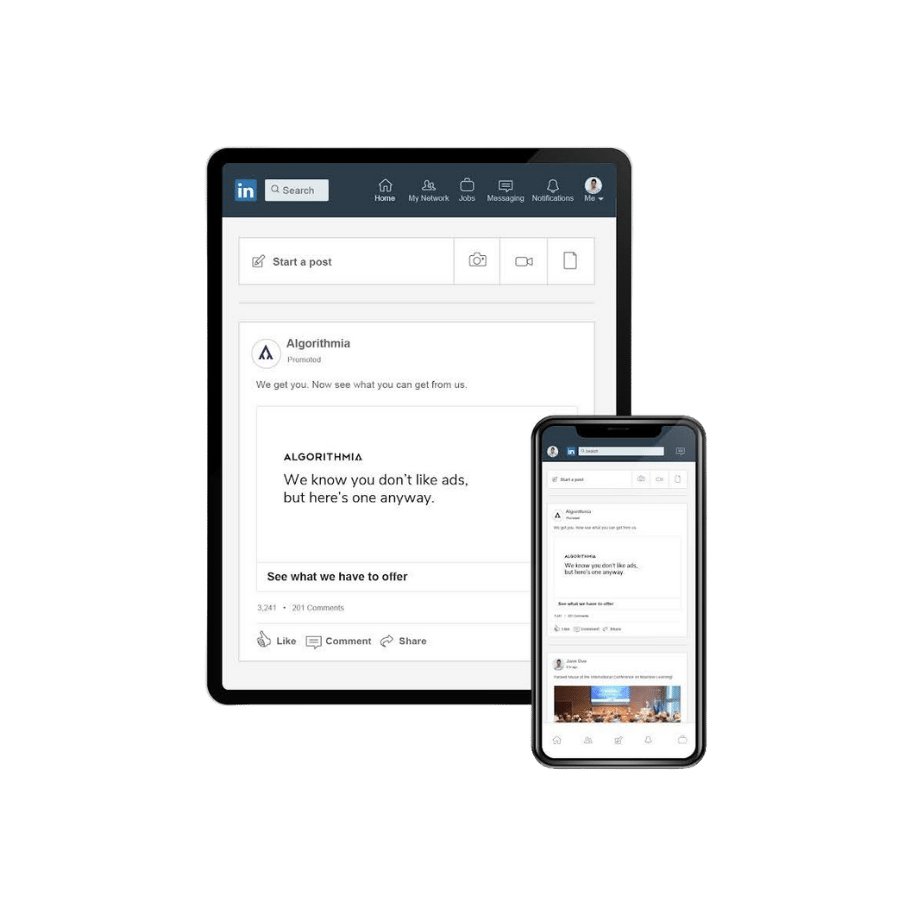
Using our new robust consumer personas and multi-service, multi-expertise approach involving content creation, advertising, design, and revenue operations, 97th Floor launched an ad strategy that broke through cluttered social media feeds and connected with Algorithmia’s audience. Algorithmia’s growth soon led them to be acquired by DataRobot.