



Citations and mentions are the closest thing AI search has to a ranking. That's exactly the problem. The instinct is to treat them like the old ranking report — log it, chart it, celebrate when it climbs.
That instinct is wrong. Not because citations don't matter, but because counting them tells you almost nothing about whether being cited did anything for you.
A citation, as Mike Witham, our Head of SEO, defines it, is "anytime a link is in place in a generative response, whether that's hyperlinked and actual text of the response or it's linked as a source, a cited source for the response."
Two kinds are worth tracking separately. An owned citation links back to your own domain. A third-party citation is when your brand shows up inside someone else's cited content, on a domain you don't control. Both count. Only one is inside your control.
We've covered the mechanics of tracking both, plus how citations differ from brand mentions, in What to Track in AI Search. This piece is about the harder question: what are you supposed to do with the number once you have it?
Should citation volume be a KPI? "With like everything in marketing it's 'it depends,'" says Alyssa Felix, Search Marketer. "We shouldn't be out there like, let's just get citations on everything, kind of like back in the days in SEO when you could put the word sunflower on your site fifty million times and rank for it. All citations should have to actually do with things that matter."
Citations are a means. The end is influence.
Traditional SEO trained us to chase traffic, but traffic was always a proxy for something else: educating and convincing a buyer. AI search skips the middle step. So the question isn't how often you show up. It's whether showing up changed anyone's mind.
Top-of-funnel citations are educational. Their job is to prove to a model that your brand is authoritative enough to source from in the first place.
Bottom-funnel citations, on decision-oriented prompts, behave much more like referral traffic. That's where being cited actually moves someone to click through and act.
This distinction showed up clearly on a recent account. "We noticed that all of their top of funnel prompts, they were not showing up, no competitors were showing up in terms of brand mentions," Blake Nielson, Head of Accounts said. "What we noticed was that virtually all of the citations in these top of funnel prompts were competitor citations."
The read wasn't that top-of-funnel citations don't matter. It was the opposite: this prompt set needed more top-of-funnel citation share before brand mentions could follow.
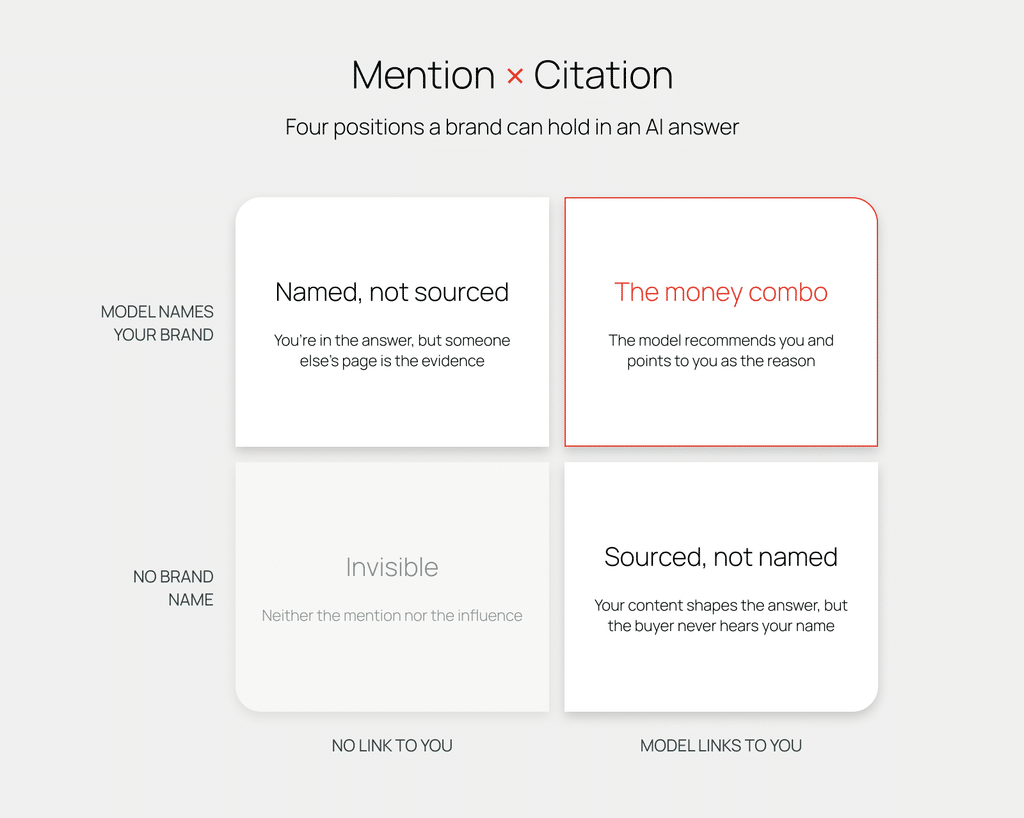
When a brand owns both the mention and the citation on a given prompt, Mike calls it the money combo — the strongest position you can put a brand in. The model names you, and it points to you as the reason.
Even without the mention, a citation on its own still does work. It signals credibility to the model and to the person reading the answer.
"In its most simple form, be the answer to the questions in your content," Mike says. "In a more complicated form, you have to be able to prove to an LLM that your entity, your brand, matches what's being asked and is directly connected to a topic."
That proof gets built through networks of content — call it topic clusters, hub and spoke, content pillars, or entity mapping into a knowledge graph — backed by unique data and a technically clean, crawlable site. It's the same discipline we walk through in our guide to optimizing content for generative AI.
Earning citations beyond your own site means giving up the idea that SEO lives in a website bubble. It takes PR, paid, editorial, and social working together, so that what lives on a brand's site also exists — from a different angle, in a different voice — on reputable external publications.
"The goal of a bot when it goes out to fetch information is to get as much information about a subject as possible and then come to a consensus, an aggregate, that it delivers back to the user," Mike explains. "If your brand is across the web, mentioned in connection with a topic you want to be known for, that is going to influence the LLM."
Sentiment isn't a binary read on whether a brand looks good or bad. The real question, per Blake, is "is your brand being represented correctly? Not just visible, but correctly across the LLMs."
That reframes everything above it. The content structure, the technical setup, the external mentions built through other teams — all of it exists to shape a narrative. Citation count is just one input into whether that narrative is yours.
When ChatGPT rolled out its 5.6 model, Reddit's citations in ChatGPT Search fell roughly 86% in four days, and the industry's reaction was immediate: Reddit is dead as a strategy, abandon ship. We wrote about why that read was wrong — the short version is that ChatGPT still appears to pull from Reddit, it just stopped showing its work. Losing a visible citation is not the same as losing influence over the answer.
Here's the part worth carrying forward. That shift wasn't universal — it was specific to one model. Google's AI Overviews remain by far the largest AI search surface, and they're still citing Reddit and YouTube heavily.
So being audience first now means tracking two things, not one: which prompts matter to your buyers, and which models your buyers actually use. Presence is only worth building on the surfaces where your audience is actually asking questions.
Citations were never the finish line. They're one input into a bigger goal: making sure the story a model tells about your brand matches the one you want told.
Want to know what the models are currently saying about you — and whether it's accurate? Let's talk.
If you've spent any time in Google Ads, you've probably clicked past a little tab called Asset Studio without giving it much thought. I know I had, and I've been in that account more times than I can count. It's where all of your assets live, and lately Google has been quietly stuffing it full of AI tools: image generation, image editing, video creation, even sharable preview links so clients can approve creative without needing their own login. At Google Marketing Live this year, they demoed it starting with a handful of product photos and ending with a full AI-generated video. Naturally, we couldn't just take their word for it. We had to go break it ourselves.
So the advertising team carved out some time, pulled up our own Google Ads account as a sandbox, and started poking around. First question on everyone's mind: is this actually different from just using Gemini, or is it Gemini wearing a Google Ads name tag? Turns out, it's the latter. It’s powered by the same "Nano Banana" model, just living inside the platform instead of a separate tab. The real value isn't the image generation itself. It's that it's baked into the place your assets already are, and it claims to let you build off the creative you've already uploaded instead of starting from zero every time.
We started simple: a text prompt for a pickup truck, since the ad was for a tire client. It did a decent job. It rendered the truck and laid our copy over the image cleanly, and when we pointed out that the manufacturer's decal was sitting right on the grille, which isn't ideal when the ad is selling tires and not trucks, it removed the branding without a fight. All perfectly fine. Nothing our designers couldn't have made themselves.

Where it started to slip was the moment our prompts got vaguer. We asked it to "add cool design elements," and what came back was, charitably, an education in why taste is one of the hardest things to teach a machine. It turns out "cool" means something very different to an algorithm than it does to a designer, which is honestly the whole ballgame right there.



Things got more interesting once we stopped trying to invent from nothing and gave it a real product photo to riff on. We uploaded a couch on a white background, asked for lifestyle variations across a few different home styles, and got back ten solid options in under a minute. A few were genuinely impressive, but others were obviously synthetic once you looked closely, like the guy whose legs didn't quite reach the floor.



The moment that actually got a reaction out of the room was turning a still product image into video. We had a product photo on hand for a past client that sells safety gear, one of those accounts where we've always had imagery but never real video footage, and Asset Studio spun it into a working clip in under a minute. It was fast enough that someone on the team said flat out that having this a few years ago would have been life-changing for that account. That's the kind of result that earns a genuine "this is awesome," not because the clip was flawless, but because it solved a real gap we've actually run into with clients before.
Where it fell apart was anything resembling a finished ad. The moment we tried to get an actual ad copy or a client logo onto the image, it flattened everything into one background, didn't crop our logo file correctly, and generally reminded us that this is an asset generator, not a designer. The video side maxed out at five to ten second clips stitched together, which is a long way from the full 30-second AI commercial Google showed off on stage. And if you're picturing that as your new B-roll department, budget a good laugh into the process. We ran it through a "funky bucket" music template and I don't think any of us have fully recovered.
So where does that leave us? Honestly, right where a healthy dose of curiosity should: not racing back to Asset Studio for daily work, but keeping it on the radar. If you're working on a big product catalog account and need a hundred lifestyle variations, this could genuinely save hours. For the intentional, considered creative we build for most of our clients, it's not there yet, and probably won't replace what our design team brings to the table anytime soon. But it's worth knowing it exists, worth testing again in a few months, and worth remembering that somewhere out there is an AI-generated couch party with a dog, two guys who refuse to stop reading, and a soundtrack that should never see the light of day again.
Ask most marketing teams how they research their audience, and you'll hear the same three answers: personas, keyword volume, and whatever demographic data came bundled with the last platform they bought. That's not wrong, exactly. It's just incomplete.
We've written before about how audience understanding is the thing that gets you through the AI wave, and every wave after that. The point of that article was that empathy for your audience is the one competitive advantage that doesn't erode every time a search platform changes the rules. This one picks up where that left off. If audience understanding is the advantage, where does it actually come from? Here's the honest answer: it comes from a handful of sources most teams either don't know about or don't use consistently, and from a process for turning what those sources surface into decisions instead of decoration.
We'll start with the least surprising one. SparkToro has been a reliable part of our research stack for a while now, and it earns that spot honestly: it's one of the fastest ways to see where an audience already spends its attention — what they read, watch, follow, and listen to — without guessing. It's a good starting point for anyone doing this work. And we do mean starting point — it tells you where an audience is, but it doesn't tell you why they're there, and it won't tell you what to say once you show up.
This is where research used to get expensive. Understanding what an audience actually talks about — not what they say in a survey, but what they say to each other — meant manually diving into subreddits, reading threads, and pulling out patterns by hand. It worked, but it didn't scale, and it ate hours we'd rather spend acting on the insight than mining for it.
AI changed all that. Now we can point a tool — sometimes something we've built ourselves, sometimes an assistant like Claude — at the relevant corners of Reddit and get it to crawl, cluster, and summarize at a scale a person never could. What used to take a day of manual reading now takes an afternoon.
We'd be doing you a disservice if we didn't add the caveat: Reddit is a messy, unpredictable place, and AI summarization has a real hallucination risk. We don't treat what comes back as gospel. We treat it as a strong signal worth validating — which, as you'll see below, is exactly the position we take with every alternative data source on this list.
This one didn't exist as a category a couple of years ago, and now it might be the most important addition to the stack. As more of your audience's information diet runs through AI tools instead of a search results page, how those models describe, summarize, and position your brand matters as much as how a person would. We use a dedicated tool to track exactly that — what AI systems are saying about a brand's reputation, tone, and standing — because that perception is quietly becoming part of the audience's first impression before they ever land on a website.
We'll be honest: whether this counts as "audience research" is a fair question, and it depends on the angle you take. It's not audience data in the direct sense — it's not telling you what your audience wants. But it is telling you where everyone else is already standing, which is exactly the information you need to identify potential gaps where you can carve out a niche. We use competitive tools to see the landscape a given audience is already being pitched by, so that positioning and messaging can be built to be distinct rather than redundant. It's audience-adjacent, and it earns its place in the process because of what it protects against.
Here's the one that doesn't get called "research" often enough, even though it's the most honest data source on this entire list. Every piece of content and every ad we run generates real behavioral evidence: what people actually clicked, read, scrolled past, converted on, or ignored. That's not a proxy for audience understanding. That is audience understanding, collected at the moment it matters most.
We treat performance data as a continuous research loop rather than a report card. The metrics from what we published and ran last month directly shape what we test next, on both the organic and advertising side. It's the same discipline in both places: lay out a deliberate testing strategy, learn from what the data says, act on it, and repeat. It's the least glamorous data source on this list and the one we lean on hardest.
Collecting all of this only matters if it changes what we do next, so here's where it actually shows up.
The biggest shift these sources make is where we start. Instead of opening a project with a blank page and a guess, we open it already knowing where an audience spends attention, what they're actually saying in their own words, how they're being perceived, and what has already worked in market. That means the first bets we make aren't really guesses anymore — they're informed decisions, and they're usually good ones.
It also makes your testing more impactful. When you skip the upfront research, what you might call “testing” is often just throwing several ideas at the wall and hoping one sticks. When you start from real audience signal, testing becomes validation and continuous improvement. You're not asking "did anything work?" You're confirming that the smart bet you already had reason to believe in actually performed the way the data suggested it would, and refining through your follow-up tests. That's a faster, cheaper, and considerably less stressful way to run a testing program.
On the ad side specifically, this research is what tells us which platforms to prioritize first and which messaging angles are worth leading with, before a dollar of media spend goes out the door. That's the difference between testing your way to an audience and starting with one.
And it's woven directly into how we approach GEO. Every part of that process — the topics we choose, the way we structure content, the actual prompts and structures we build around — starts with audience motivators and pain points before anything else. That's the same audience-first thinking behind our take on navigating AI search — the tools change, but starting with the actual human on the other end of the query doesn't.
None of these sources is a silver bullet on its own, and that's sort of the point. SparkToro tells you where they are. Reddit tells you how they talk. Sentiment tools tell you how they're perceived. Competitive intelligence tells you what to avoid repeating. And performance data tells you, with total honesty, whether any of it actually worked. Put together, they don't just describe an audience — they make every bet after that one a smarter one.
This might sound like a lot when reading it, but for us it’s a process we have down — and it’s remarkably efficient. It’s the process we run for clients every day: pulling the alternative signal, validating it instead of guessing, and building content, ad, and GEO strategy on top of it from day one. If you'd rather have a team already running this playbook than build the muscle in-house from scratch, let's talk about what that could look like for your brand.
Over the past few weeks we've made a case in pieces. A ten-minute exercise with no keywords surfaced a 40% gap in mature, keyword-researched content calendars. G2's buyer data showed that half of B2B software buyers now start their research in an AI chatbot — asking questions that generate no trackable search data at all. And before any of that, we argued that keyword research could no longer be step one of a content strategy.
Fair response: okay — then what is step one?
The answer is the same one it’s always been for us: the audience. What’s new is the discipline behind getting there — in July, we rebuilt the process our teams use to turn that belief into a repeatable strategy.
We’ve said “audience first” since before GEO was an industry term. What’s changing isn’t the belief — it’s the machinery underneath it, and the case for changing that machinery stacked up fast this year. Because of that, we built our new process around one irrefutable mission statement: it's our job to figure out what questions people are asking, and to make our clients become part of the answer.
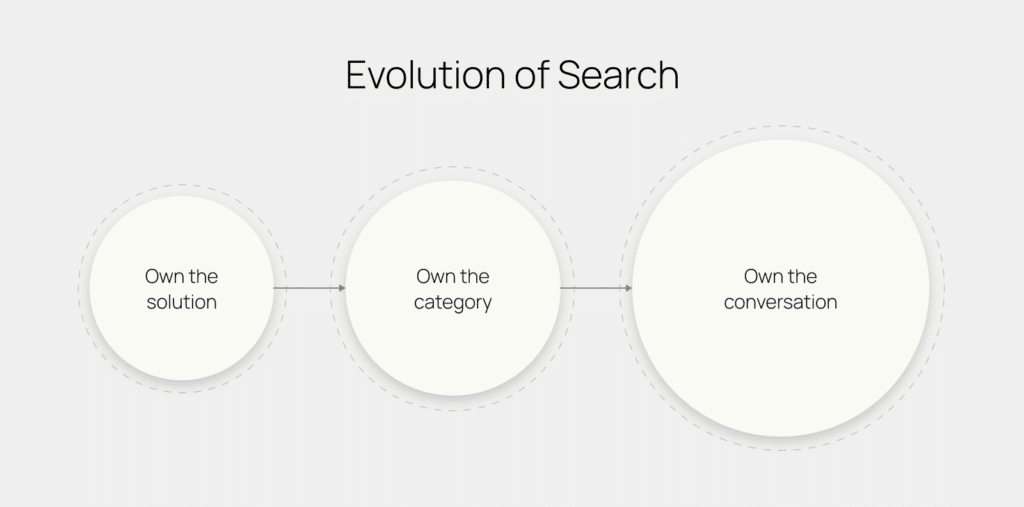
Search has gone through three eras of what winning meant. Early on, brands had to own the solution — people searched for the thing they already knew they wanted, and you fought to show up for it. Then search got bigger, people researched more, and it became our job to own the category — this is where classic keyword research was born: low-hanging fruit, content gaps, topical authority, hub and spoke. Now the search universe has exploded again, across AI assistants and conversational queries, and the job is to own the conversation — every question a buyer asks on the way to a decision, most of which no keyword tool can see.
Here's the friction, and we'll be honest about it because every experienced SEO feels it: a lot of this demand can still be captured by traditional keyword research. So why change anything? Because we tried the obvious shortcut — starting with keywords and expanding them into prompts — and it doesn't work. The prompts that come out of keywords are limited to the pool the keywords define, and when you push AI tools to generate them, you get generic, low-quality "what is X" questions. Starting from the audience produces a far larger universe of real questions; the keyword data then attaches to it, rather than defining it.
And to be equally clear about what we're not doing: we're not abandoning traditional SEO. Every client still has 5–10 non-negotiable core keywords tied directly to their product and revenue, each classified by the strategy it needs — Watch (already won, defend it), Win (can realistically capture #1), or Invest (long-term authority play). One of our e-commerce clients has held the #1 position for their money keyword for over five years, and we still track it, still build to it, still defend it. That work doesn't stop; it's just no longer the whole strategy.
Before the steps, the allocation decision that makes this a different process rather than the old one with new vocabulary: content volume is weighted roughly 45% problem-aware, 45% solution-aware, and 10% decision-stage.
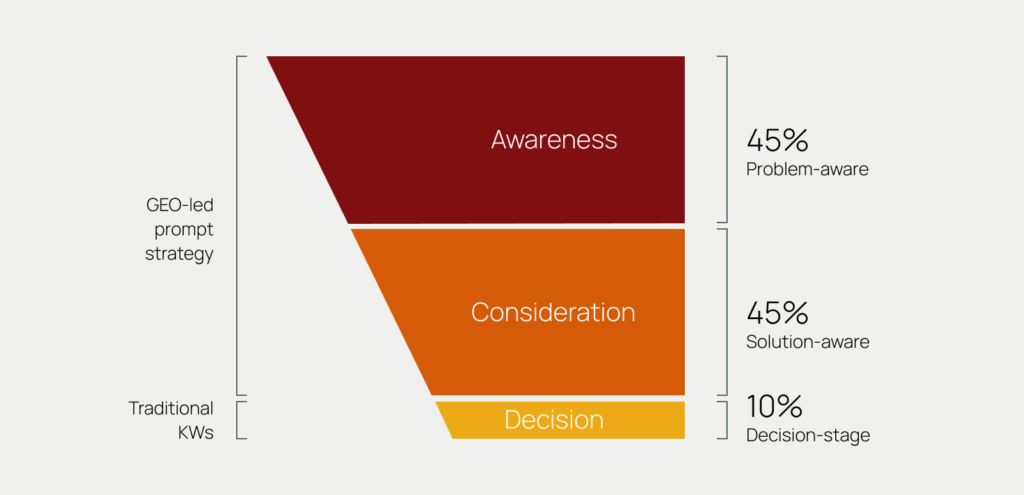
That looks inverted if you grew up on keyword-first strategy, because it puts 90% of the work where the trackable volume can’t be found. But the early and middle journey is where AI-era research thrives — the long, contextual questions that change buying decisions. It's also where most opportunity is undefended, because everyone in your category is working from the same keyword dataset and converging on the same expensive bottom-of-funnel terms. The decision stage still matters and still converts, but you need to support your core keywords.
The strategy is built by two roles working as a duet — a content marketer who owns the audience, and a search marketer who owns the data — creating a collaborative harmony that achieves our audience-first, data-backed output.
We start with personas built on audience research and client priorities — primary motivators and pain points guided by focus products/services and UVPs. We also look at how long their buying journey runs. That last detail shapes everything downstream: a quick-purchase product leans harder on traditional keywords and conversion content, while a long B2B sale needs a much bigger upper funnel.
At the same time, we classify the client’s 5–10 core keywords as Watch, Win, or Invest, and confirm with the client that we’re building on the right foundation before going further.
Now the exercise we ran company-wide becomes a formal step. For each persona, at each stage of their journey, instead of leaning on traditional keyword research, we write the real questions they’d ask — fears, objections, comparisons, buying concerns — sourced from customer interviews, sales conversations, and how the brand already shows up in AI search. Awareness-stage questions stay diagnostic (“why is my interest rate higher than expected”), not solution-focused (“which lender should I choose”), because that’s how real buyers actually think before they’re ready to decide.
Here's where keyword data re-enters — as evidence, not as the gate. Each question gets paired with the keyword that best represents it — chosen for how well it captures the question, not just its metrics — and scored on search volume, traffic potential, difficulty, and CPC.
Notice what the score does and doesn't decide. A prompt with weak keyword signals doesn't automatically die — it's flagged as a risk signal, and it might still be worth building for AI visibility. Search volume is evidence of demand, not the boundary of demand.
This is the most crucial stage: raw research becomes a prioritized strategy, and it happens through scoring rather than vibes.
Every topic gets three scores, one from each side of the duet, plus one that only exists because both sides agreed to be scored:
• Audience score: how many personas care, and how much the topic could sway a buying decision
• Client score: how directly it ties to the client’s revenue and stated priorities
• Demand score: search volume, traffic potential, keyword difficulty, and CPC, combined into one number
The three combine into a single ranked list. So when a team is staring at 150 possible topics wondering where to start, the answer is already sorted — by audience, business, and data together, with no single input allowed to take the lead. That’s the point. Plenty of teams claim to be audience-first right up until the sort-by-volume click. The scoring makes the claim structural.
Before building anything new, we check it against what the client already has. If an existing page is close to the mark, we optimize it instead of creating a duplicate — a small step that makes the most of existing resources (and as a bonus, saves a client from ever hearing “we recommend a new page” about something already sitting on their site).
From there, related topics get consolidated, and distinct audiences get split apart — for example, prompts would diverge for anxious parents and undergrads around the topic of student loan cosigning. These would be two content pieces, not one, because they're two audiences with two different intents.
Building the content calendar from there is easy — the strategic thinking already happened upstream.
Tracking starts the moment the calendar goes live, and it runs on layers rather than a single line. Traditional keywords and custom prompts are tracked side by side. Search Console gets watched for the long-tail, question-shaped impressions that new content should start earning. And around those, the downstream signals of AI visibility: brand mentions, citations, referral traffic from AI platforms, branded search, direct traffic, and — critically — conversion rates on high-traffic pages, because the endgame of zero-click research is a visitor who arrives already convinced and converts at a higher rate. Any one of those lines is easy to argue with. Layered together, the trend is hard to deny — which is exactly what reporting in a zero-click era has to be able to survive.
A process this concrete invites a misunderstanding: that GEO is only this. It isn't. Around the strategy build sit the factors that don't fit in a scoring column but move AI visibility anyway: technical optimization, original research and proprietary data (which win disproportionately in AI answers), unique points of view, content atomization and distribution, freshness — sometimes the right calendar entry is re-optimizing something you shipped eight months ago — and brand reputation, without which none of the rest gets very far. Those get their own treatment in how we brief GEO content versus SEO content and in why E-E-A-T matters more in AI search, not less.
None of this is keyword research's obituary. It's a reassignment. Keyword data is still genuinely excellent at four jobs: validating demand the persona work surfaced, forecasting the trackable portion of the opportunity, client education (numbers persuade stakeholders in ways personas don't), and the decision-stage plays it was always built for — including those 5–10 core keywords every client will always have.
What it lost is the job it was never qualified for: deciding what your audience cares about. Start with the human, weight the work toward where they actually are, and bring the data back in where it tells the truth. Trust us, it works — this approach grew one client's AI search results 261%.
That's the process now guiding how we build strategy for every client engagement. The next question is what it surfaces for yours.
Want to hear this philosophy debated out loud? This episode of The Campaign goes deep on audience-first marketing:
Want to see what this process would surface for your brand? Start with a free AI audit, or explore our GEO & AI Search services.
There's a version of the AI search conversation that treats all of this as a future problem. Someday buyers will research in ChatGPT. Someday AI answers will shape deals. Someday you'll need a strategy for it.
G2's research on B2B software buying says the someday already happened.
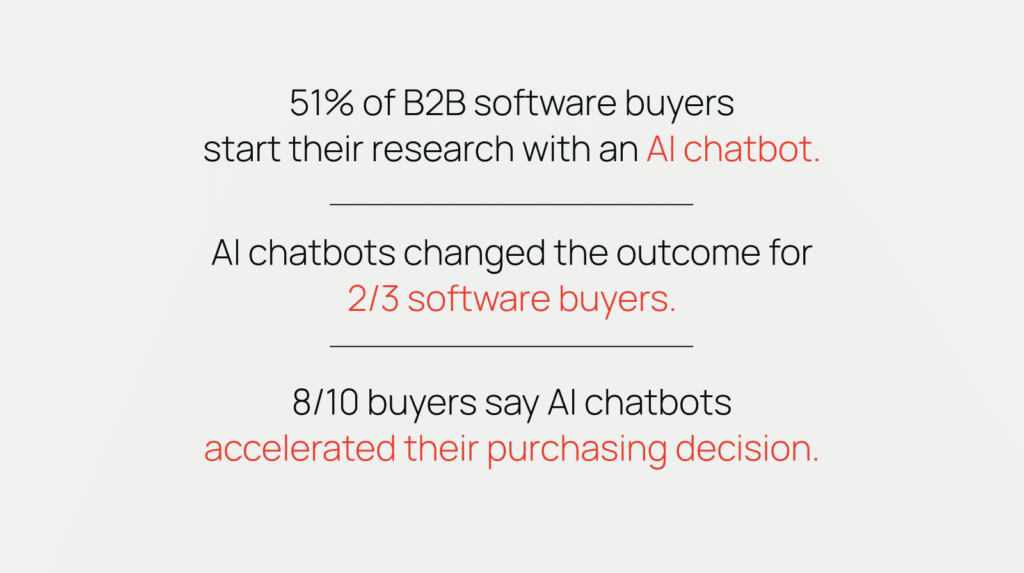
Per G2's report, The Answer Economy: How AI Search is Rewiring B2B Software Buying, 51% of B2B software buyers now start their research with an AI chatbot. Not "have tried one." Not "consult one at some point." Start there. The first touchpoint of the modern software deal — the moment a buyer goes from feeling a problem to naming it — is now, for the majority of buyers, a conversation with an AI.
We put this data in front of our entire company at our monthly meeting, because it reframes everything about how we think content earns pipeline. Here's why it stopped us in our tracks — and what we think it demands of every B2B marketing team.
The adoption number gets the headlines, but it's actually the least interesting of G2's findings. Buyers moving to a new research channel is a distribution story — marketers have navigated those before. The next two stats are a different kind of story.
AI chatbots changed the outcome for two-thirds of software buyers.
Read that again. Not "informed their thinking." Changed the outcome. Two out of three buyers who used AI in their research ended up somewhere different than where they were headed — a different vendor, a different category of solution, a different shortlist entirely.
This is the part that should reorganize your marketing priorities. A traditional search engine handed your buyer ten links and let them assemble their own conclusion. An AI assistant hands them the conclusion — a synthesized recommendation, a comparison table, a "for a team your size, I'd look at these three." The AI isn't a new place buyers gather information. It's a new participant in the decision. It has opinions, and buyers are taking them.
Buyers are discovering, evaluating, and comparing brands through AI. 97th Floor CEO, Paxton Gray, is joining WordPress VIP CMO, Jodi Cerretani, for a three-part series on what that means for enterprise brands.
And 8 out of 10 buyers say AI chatbots accelerated their purchasing decision.
Faster deals sound like good news, and for the vendors in the answer, they are. But think about what acceleration means mechanically: the research phase compresses. The weeks a buyer used to spend reading blog posts, downloading comparison guides, and sitting in your retargeting audience — the entire window where marketing traditionally worked on them — shrinks to a handful of AI conversations. Buyers are arriving at shortlists before most vendors' funnels even register that a deal exists.
Put the three numbers together and the picture is stark: the majority of buyers start in an AI, most of them are redirected by what it says, and nearly all of them move faster because of it. The buyer's journey didn't add a new step. It got a new gatekeeper.
Here's the mechanism underneath the "changed the outcome" stat, and it's worth understanding because it's genuinely different from how search shaped decisions.
In traditional search, the buyer did the synthesis. They'd search "best project management software," open six tabs, weigh the review sites against the vendor pages, and form a consideration set themselves. Your job was to be present at enough of those touchpoints that you made the list. Imperfect, but the buyer was the editor.
In AI-era research, the model is the editor. When a buyer asks, "We're a 40-person agency with clients in healthcare — what project management tools handle HIPAA compliance well?", the AI composes an answer from everything it knows and everything it retrieves — and the vendors named in that answer are the consideration set. There's no page two. There are no ten blue links to scroll past the answer. For a growing share of buyers, if you're not in the response, you were never in the deal.
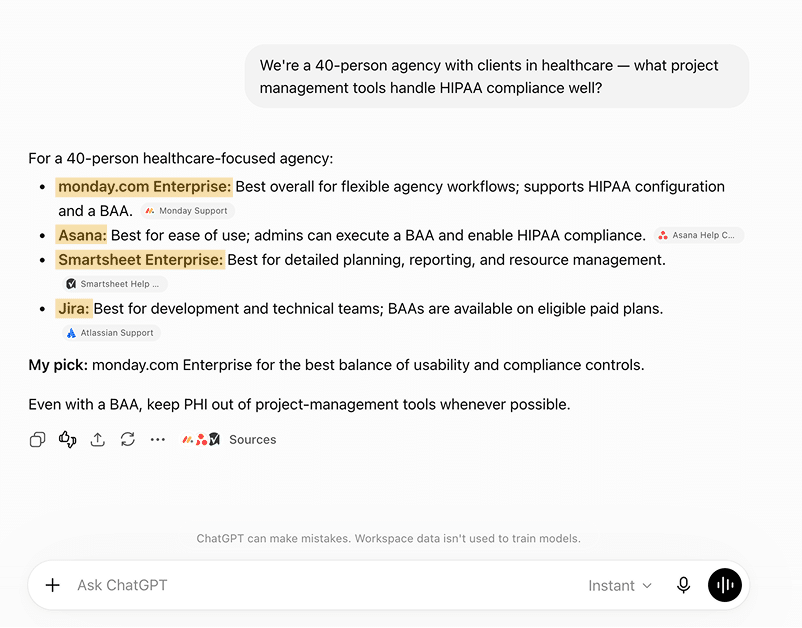
That's why buying outcomes are changing. The AI doesn't just reorder the same shortlist buyers would have built anyway — it builds a different one, weighted toward whichever brands are most legible to it: clearly explained, widely referenced, credibly reviewed, easy to cite. Brands that dominated the old game of rankings can be invisible in this one, and challengers with clearer, more citable material are showing up in answers next to incumbents ten times their size.
If your analytics look fine, that's not evidence this isn't happening to you. It's the nature of the shift.
Those AI research sessions happen off your properties, generate no impressions you can count, and mostly resolve without a click. The buyer who asked an AI four questions about your category, got steered toward a competitor, and never visited your site doesn't show up anywhere in your reporting. Neither does the one who was steered toward you — they arrive later as "direct" traffic, unusually educated, unusually far down the funnel, and your attribution model shrugs.
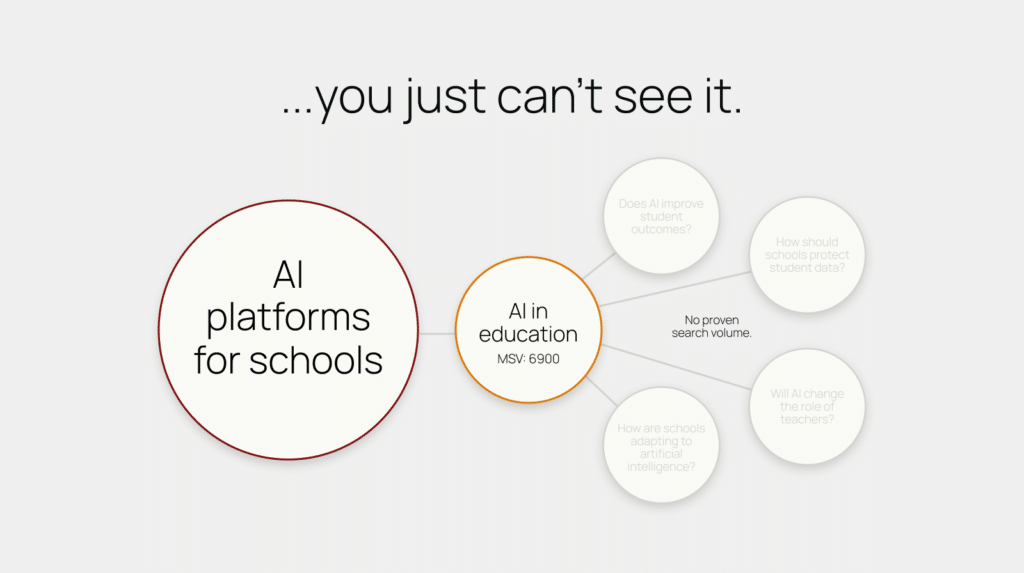
This is the same visibility problem we've written about across this series: the most important buyer activity in your category no longer produces trackable data. When we ran a keyword-free content exercise across our whole company, roughly 40% of the ideas our teams generated — the real questions real buyers ask — weren't covered anywhere on existing content calendars, because nothing in the keyword data ever pointed to them. The G2 numbers are the demand-side confirmation of the same story: the buyer conversation moved somewhere your dashboards can't follow.
Just because you can't see it doesn't mean it isn't happening.
The question every CMO should be asking isn't "should we respond to this?" The buyer already moved; that decision was made for you. The question is whether your brand is in the answers — and there's a concrete way to work on that.
Start by auditing your presence where buyers actually start. Ask the major AI assistants the questions your buyers ask — not your keywords, their questions. "What should a company like X consider when solving Y?" "Compare the top options for Z." Note who gets named, who gets recommended, what's said about you, and what sources the answers cite. This is the new SERP audit, and most teams have never run it. (If you want a head start, we run a free AI audit that measures exactly this.)
Then build for the questions, not the keywords. The prompts steering these deals — "I have $50,000 and a mandate; where's the highest-impact place to put it?" — have no trackable search volume and never will. They come from understanding your buyer: their fears, frustrations, objections, comparisons, and buying concerns at each stage of the journey. That's why we've stopped treating keyword research as step one and started from the audience instead, with keyword data brought back in later for validation and forecasting. Search volume is evidence of demand, not the boundary of demand.
Make your material easy to cite. AI assistants recommend what they can confidently parse and attribute: clear claims, specific comparisons, transparent pricing and capability information, third-party validation, structure a machine can lift an answer from. This is where E-E-A-T implementation for AI search stops being an abstract quality guideline and becomes a revenue lever. Vague thought leadership doesn't get cited. Direct answers to real questions do.
And measure the new funnel honestly. Sessions and rankings won't tell you whether you're winning in AI answers. Citation share, brand mentions across AI platforms, and the volume and behavior of branded and direct traffic will. This work compounds: one of our clients grew AI search results 261% with a topic cluster strategy built for exactly this environment. The teams that build this richer view of organic now are the ones who'll be able to show the work paying off — and keep investing in it — while everyone else argues with their attribution model.
Every stat in the G2 report will keep climbing. The 51% becomes 60%, then 70%; the buyers who haven't moved yet are the trailing edge, not the resistant core. Which means right now is the strange, brief period where the buyer behavior has already shifted but most vendors' strategies haven't.
That's not a threat. For any brand willing to move, it's the most asymmetric opportunity in B2B marketing: your competitors are still optimizing for a journey buyers are abandoning, while the new gatekeeper is still deciding whom to trust.
Half of your buyers are starting their next purchase in a chatbot. The only question left is what it says when they ask about you.
Want to know how your brand shows up in AI answers today? Get a free AI audit, or explore our GEO & AI Search services.
Some search marketers have been declaring SEO dead for over a decade. Yet every year, search keeps driving brand discovery and revenue.
What has changed is how visibility works. Google’s AI Overviews summarize answers before users click, and generative engines talk about the brand inside responses. Search behavior now also spreads across YouTube, LinkedIn, marketplaces, and AI platforms.
Now, we aren’t gaslighting you—we are also seeing the declining click-through rates and unstable traffic that were so different just five years ago. When people ask, “Is SEO dead?” they’re reacting to something very real, and it’s affecting industries across the board.
But SEO is not dead or even dying. Like most things being affected by technology and digital initiatives, SEO is simply changing. Technical excellence, authoritative content, and visibility across systems is still essential. Now, you just need to optimize for AI systems and search platforms, too.
The biggest shift is the rise of AI-generated answers directly in search results. Google’s AI Overviews and generative engines can summarize information before a user ever clicks a page. In many cases, the search experience ends right there on the results page. When teams see traffic dip even though rankings remain strong, it naturally sparks concern about the long-term value of SEO.
At the same time, search itself is no longer confined to Google. People discover products on Amazon, research ideas on YouTube, ask questions inside AI tools, and follow recommendations from LinkedIn or Reddit threads. That fragmentation means visibility is happening across a wider ecosystem than traditional search analytics tools were built to track. For a lot of businesses, it can feel like you have no control over so many channels.
Those two forces together have created real volatility in organic traffic. If you have historically measured SEO success only through clicks and sessions, these changes can feel like the ground moving underneath your entire strategy.
For brands willing to adapt, the opportunity is still massive. Strong search visibility now depends on building authority, technical clarity, and content that AI systems trust as a source. That kind of SEO strategy sits at the center of modern search growth.
The phrase “is SEO dead” is what marketers are saying when they see declining organic clicks and evolving search interfaces that don’t seem as compatible with classic SEO. AI-generated summaries, knowledge panels, and expanded SERP features often deliver answers before users reach a website, so why should businesses bother with SEO?
But this evolution of search optimization has not necessarily lost its relevance. In fact, all it really means is that the role of SEO has expanded. Instead of focusing exclusively on ranking individual pages, your strategy should heavily focus on building authority and structured visibility across search and AI ecosystems.
A few patterns tend to fuel the idea that SEO is disappearing:
Remember that, ultimately, organic search remains one of the strongest discovery channels on the internet. High-intent queries flood search engines every day that drive your revenue. People still rely on search to solve problems and evaluate options, and your brand needs to show up in those results.
Enterprise organizations still invest heavily in search because it contributes directly to their pipeline growth. As you become an authority in your space (rather than focusing so heavily on ranking), and have technical, structured content performance, your visibility will increase.
For years, SEO success looked fairly straightforward, but there are a couple of other players on the field.
Traditional SEO says that success looks like top rankings and organic traffic. If your page appeared near the top of search results, the assumption was that clicks and engagement would follow.
Meanwhile, AI Overviews and generative systems increasingly pull answers from multiple sources. When that happens, business influence shows up through citations, summaries, and brand mentions inside those responses.
In other words, when AI search systems generate answers, they rely on sources they trust. If your content becomes one of those sources, your brand shows up in the answer itself—even when the user doesn’t click.
“SEO” is also one slice of a much larger pie, where AEO and GEO are a part of a well-rounded strategy.
Answer Engine Optimization, or AEO, focuses on structuring content so search systems can extract clear answers. Generative Engine Optimization, commonly referred to as GEO, looks at how AI platforms summarize and reference sources. Both ideas reflect the same larger trend: search engines are becoming answer engines.
Modern SEO strategies bring these concepts together. Instead of separating them, organizations combine traditional ranking strategies with content structures designed for AI summarization and entity clarity. This approach is how you can be at the top of your game with AI search and how to optimize for the future of search engines.
Another major change is where discovery happens. Search behavior no longer lives inside a single engine.
Someone researching a product might start with a Google query, watch comparison videos on YouTube, scan reviews on marketplaces, and read thought leadership on LinkedIn. Users also ask questions inside AI assistants before visiting a website.
Brands that want consistent visibility build authority across multiple ecosystems where search intent appears. So yes, you need to optimize for Google—that’s not going anywhere. But you also need to show up where people compare products or services and ask questions. That might mean:
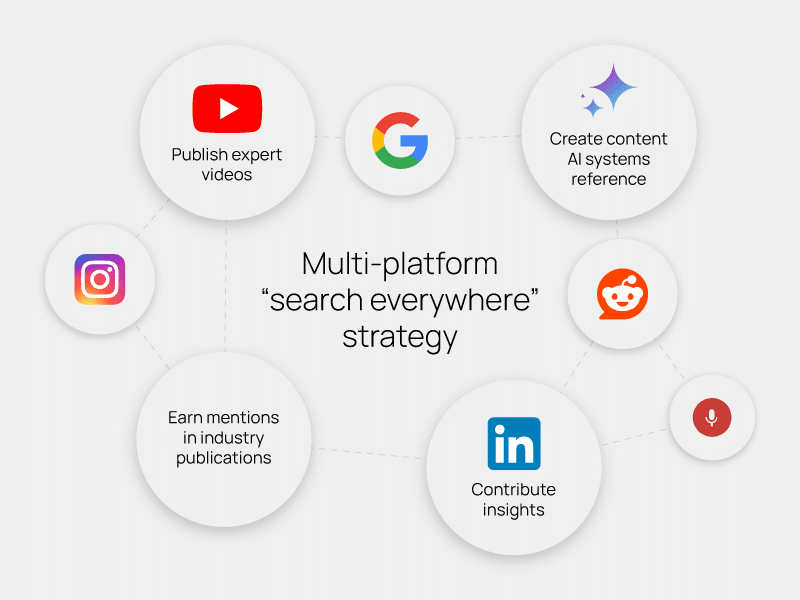
That broader presence strengthens the signals search engines and AI systems rely on when deciding which sources to surface. Over time, those signals reinforce brand authority in ways that pure keyword targeting never could.
Featured snippets started this trend years ago: search engines want to answer the question in the search bar without ever even visiting a website. Now, AI Overviews are taking it a step further.
Because more queries are answered directly in SERPs, AI Overviews have reduced the reliance on blue links for consumers—your audience.
So why are you pouring money into producing so much content for people to not even enter your website?
Because traffic declining does not necessarily mean your influence declines, too.
When your brand appears inside an AI Overview, a featured snippet, or a cited source within a generated answer, users still see your expertise. They may not click in that moment, but the exposure shapes awareness and credibility. Later, when they search again with a stronger intent, your brand is already familiar.
Instead of focusing exclusively on traffic, many organizations now look at a broader set of indicators:
The zero-click environment also forces some strategic decisions.
Chasing raw traffic can lead teams to prioritize high-volume informational queries that rarely convert. Meanwhile, focusing on authority and expertise often produces fewer visits but better downstream impact.
Enterprise organizations increasingly balance both sides of that equation. They invest in content that builds authority within a category while also strengthening owned channels like email, communities, and product education hubs.
Building authority earlier in the research process also helps teams connect search visibility to revenue attribution models, which track how organic discovery contributes to pipeline and closed deals.
We know that the technical side of SEO especially matters, but more than ever before, so does the human element of your content. Generic or recycled material just doesn’t quite cut it anymore. It’s your expertise and credibility that the AI models are going to trust.
Google describes these signals through E-E-A-T: experience, expertise, authority, and trust. This is exactly what it sounds like: search systems try to surface information that comes from knowledgeable sources.
AI-generated answers rely on the same signals. When models summarize content, they still look for sources that demonstrate real-world expertise and established authority within a topic area.
That’s why enterprise brands with recognizable subject matter experts, credible research, and original, real-world insights tend to perform well over time. They give search engines and AI systems a clear signal that their content is worth referencing.
Keywords do still matter, but even more important is writing for readers. Answer the search intent before you optimize for the algorithm to give yourself the best chance in AI search and future search strategies. This looks like having clearer explanations on the topic and practical solutions that actually help consumers make their decisions. Remember to:
Human-first content thrives when it’s supported by broader SEO principles. Successful organizations treat search visibility as a combination of these 6 disciplines of SEO working together.
If a site is difficult to crawl, poorly structured, or confusing to interpret, even great content struggles to appear consistently in search results. Think of it like building a library. You could fill it with incredible books, but if the shelves are disorganized and the catalog is missing, people will have a hard time finding anything.
Before a page can rank or appear inside an AI-generated answer, search engines have to find it and understand how it fits with the rest of your site.
That usually comes down to a few practical things:
When those fundamentals are in place, search engines have a clearer picture of what a site covers and which pages provide valuable answers.
Search engines are good at reading pages, but they still appreciate a little help.
Structured data acts like labels on a library shelf. It tells search systems exactly what they’re looking at. Product schema can identify price and availability. FAQ schema highlights clear question-and-answer sections. Review schema points to customer feedback.
Those labels help search engines surface the right information in rich results and AI-generated answers.
Entity relationships add another layer. When your brand consistently appears alongside certain topics across trusted sites, search engines begin to connect the dots. Over time, your brand becomes associated with that subject area, which makes it more likely to appear when people search for related information.
For enterprise organizations, technical SEO becomes even more interesting. Large websites often contain thousands or even millions of pages across different products, regions, and content hubs.
At that scale, small issues multiply quickly. Duplicate pages compete with each other. Important sections become buried several clicks deep. Old pages stick around long after they stop providing value.
That’s why enterprise SEO often requires governance systems and technical enterprise SEO playbooks that keep large sites organized. Without that structure, even strong content can struggle to gain traction in search.
You see a lot of the trending “SEO solutions” on your LinkedIn feed, but what is really going to move the needle? Let’s talk about it.
One of the biggest changes in modern SEO is the move away from pure volume. Today, that approach rarely produces lasting results. Search systems have become much better at identifying which sources actually demonstrate expertise within a topic.
That’s why many organizations now focus on building strong topic clusters around high-intent themes. Instead of publishing dozens of loosely related pages, they develop deeper resources that connect logically and answer related questions across the research journey.
The goal of these evolving SEO strategies is simple: become one of the sources search engines consistently associate with a category. That kind of authority tends to hold up far better than isolated rankings.
AI-generated answers have added another layer to modern AI SEO strategy.
Content now needs to be clear enough for AI systems to extract and summarize. Pages that explain ideas directly, use structured formatting, and answer questions clearly are more likely to appear in generated responses.
This often means writing in a more conversational, question-driven format. When a page mirrors the way people naturally ask questions, it becomes easier for AI systems to recognize and reference the information.
Ecommerce brands face a slightly different set of priorities.
Product pages need structured data that clearly communicates details like price, availability, reviews, and product attributes. Category pages often carry the responsibility of establishing topical authority for entire product groups.
At the same time, ecommerce SEO must compete within crowded SERPs filled with product listings, reviews, and comparison content. Brands that succeed often combine strong technical optimization with helpful buying guides, comparison pages, and educational resources that support the purchasing journey.
There are a lot of moving pieces to SEO now, and many organizations reach a point when their internal teams need help. This often happens when:
Working with a specialized team focused on AI-driven search can help organizations move faster while maintaining a clear strategic direction, which is why many brands explore working with an AI SEO agency.
By this point, one thing should be clear: modern SEO isn’t a checklist, but an entire system of connected strategies that all influence one another. When those elements operate in isolation, results tend to plateau. When they work together, search becomes a much more durable growth channel. 97th Floor is here to make sure every move you make is contributing to a healthy and modern SEO strategy.
97th Floor approaches SEO as a growth system rather than a content production engine. The strategy connects traditional search optimization with authority building, digital PR, and AI search visibility.
We can help you rank for keywords, but we also help your brand become a leading resource in your industry. Instead of chasing short-term ranking spikes, the focus moves toward durable visibility that supports sustained growth.
97th Floor focuses on building content systems and authority frameworks that continue performing even as search interfaces change. Search will keep evolving. How will your team keep up? Every algorithm update can work to your benefit as we help you master long-term authority and move beyond obsessive keyword ranking.
Let’s assess where your organization currently stands and see where you can start making changes for today’s SEO environment.
Start by looking at how your organization defines SEO success. The way performance is measured often shapes the entire strategy.
Next, take a close look at the technical foundation of your site:
Finally, consider how your brand appears compared to others in your category. Visibility gaps often become obvious when you look at where competitors show up in search and AI answers:
If these questions highlight opportunities for improvement, it may be time to revisit your SEO strategy. The search landscape is evolving quickly, and adapting early can make a significant difference in long-term visibility. Learn more about how our team approaches search strategy through our SEO services.
Is user confidence in online content at an all-time low? AI-generated content dominates many key topics, and users can easily find themselves frustrated when searching, finding articles they could have generated directly from a chatbot themselves. There is also an increasing volume of content that is becoming commonly known as “AI slop.”
And that’s without getting into the other struggle: LLMs are not only competing for eyeballs on regular search engines, but also stealing traffic directly. As a result, sometimes it can feel like the rest of us are left to fight over scraps.
If the current outrage over AI slop proves anything, however, it’s this: users still want good content. And marketers still want to give it to them. So — with the internet noisier and more crowded than ever — how can we complete the matchmaking experience and find each other?
At 97th Floor, we have cracked the code, and we can prove it.
A brief history lesson
The internet has always been noisy, overcrowded, and full of shoddy content churned out by marketers hoping to maximize their reach. While many of us like to think of marketing as a noble profession (we are helping people solve their problems!), there will always be those who act in bad faith, trying to game the system however they can. It’s the whole reason “black hat” marketing exists.
Luckily, Google is fighting the good fight, and every update they have made over the years is done so in an attempt to improve the experience of the user, and get them closer to the type of content they need. This means that those focusing more on gaming the system and less on quality content are the ones who are typically hit the hardest by algorithm updates.
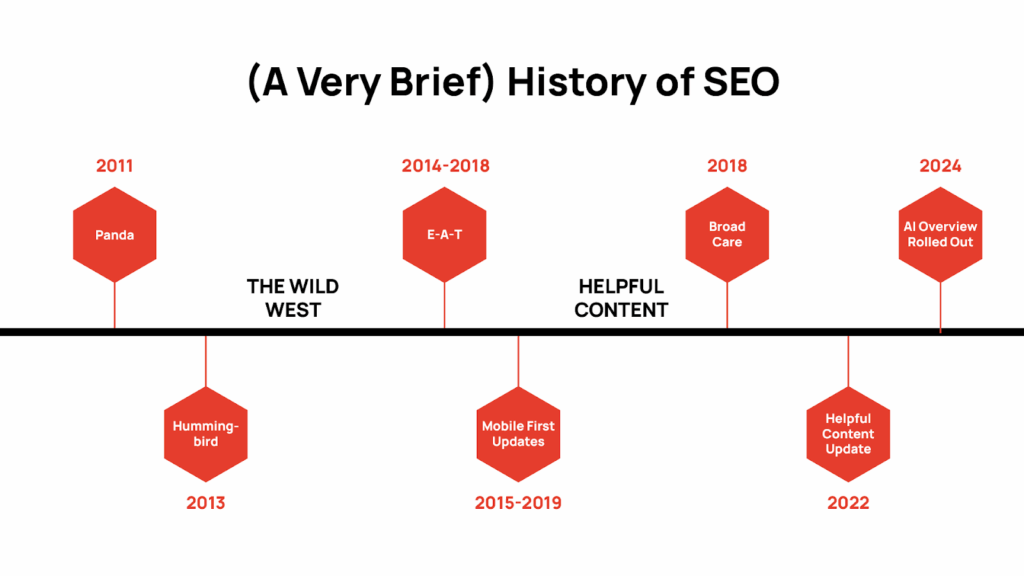
It’s the reason why, if you have been anywhere around content marketing, SEO, or even digital marketing in general for more than a few years, you will no doubt remember getting asked a question a million times, akin to “how do you balance SEO content and quality content.” Real ones know the truth: the best “SEO content” has always been high-quality content. And that kind of content is what has the power to withstand just about any algorithm update.
If that is not reason enough to focus on high-quality content, then let us also add this: The cost of bad content is steep. Analytics company CreativeX recently recently found that the average Fortune 500 company wastes approximately $25 million annually on content that fails to reach its intended audience or is not fully utilized.
It should come as no surprise, then, that the answer to combatting the current cacophony of AI slop is infuriatingly simple: produce high-quality content.
Ok, But…What Actually Is High-Quality Content?
I know, I know, that’s an incredibly unhelpful piece of advice. Because of course, anyone can claim to produce “quality content” but that means different things to different people. So, what do we mean when we say quality content? 97th Floor has a few principles that we have always lived by when it comes to both content and marketing in general.
1. High quality content is audience-focused
One of the main things that people get wrong about content marketing to this day is the how behind making the content itself audience-focused. As marketers, we can get caught up in how great we believe our solutions to be, that we get evangelical about the value that they bring — resulting in us pushing those solutions on our audience, rather than helping them. Quality content starts from a place of “what does my audience want or need?” rather than “what can we as a brand give our audience?”


| ❌ | ✅ |
2. High quality content is relevant to your brand
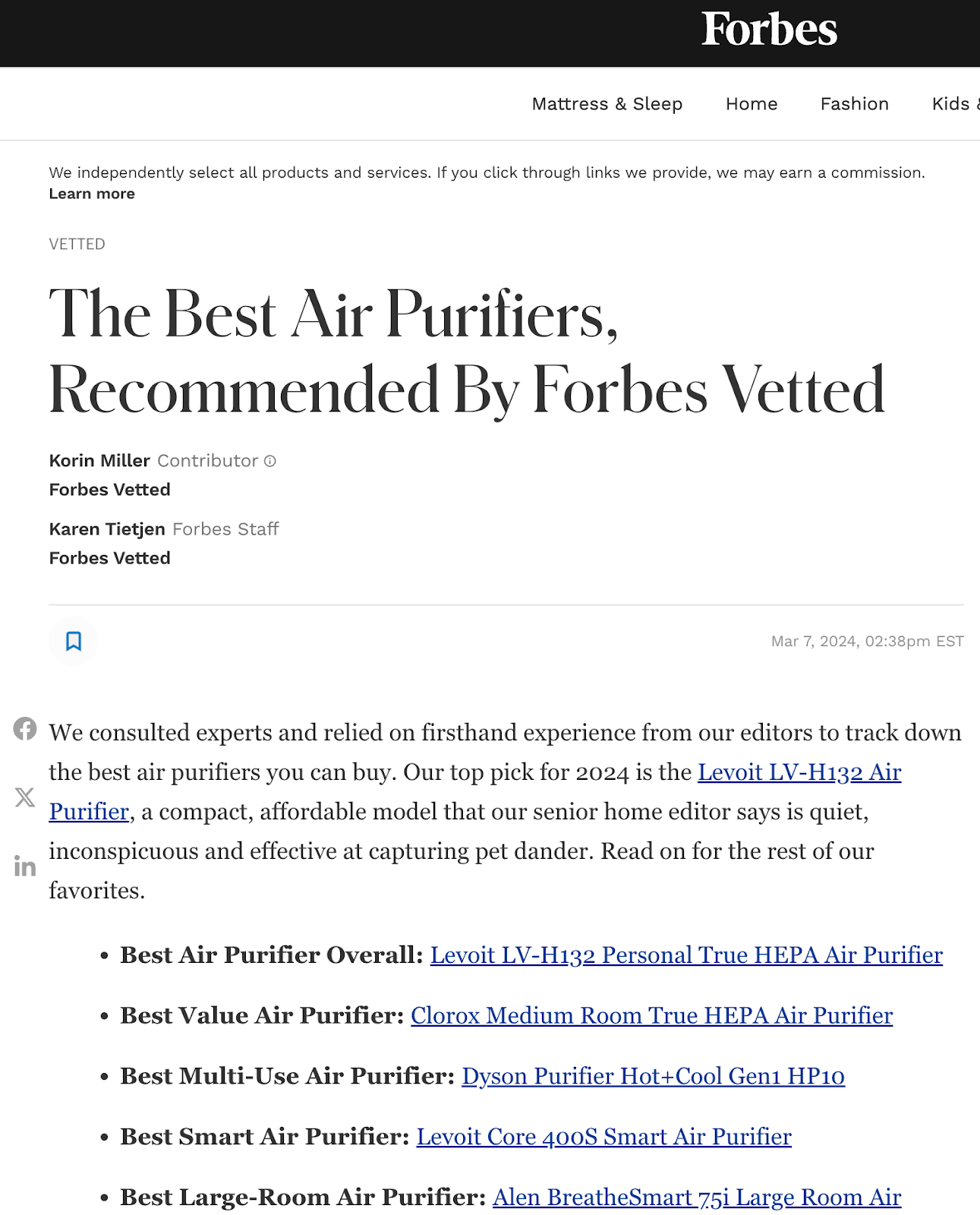
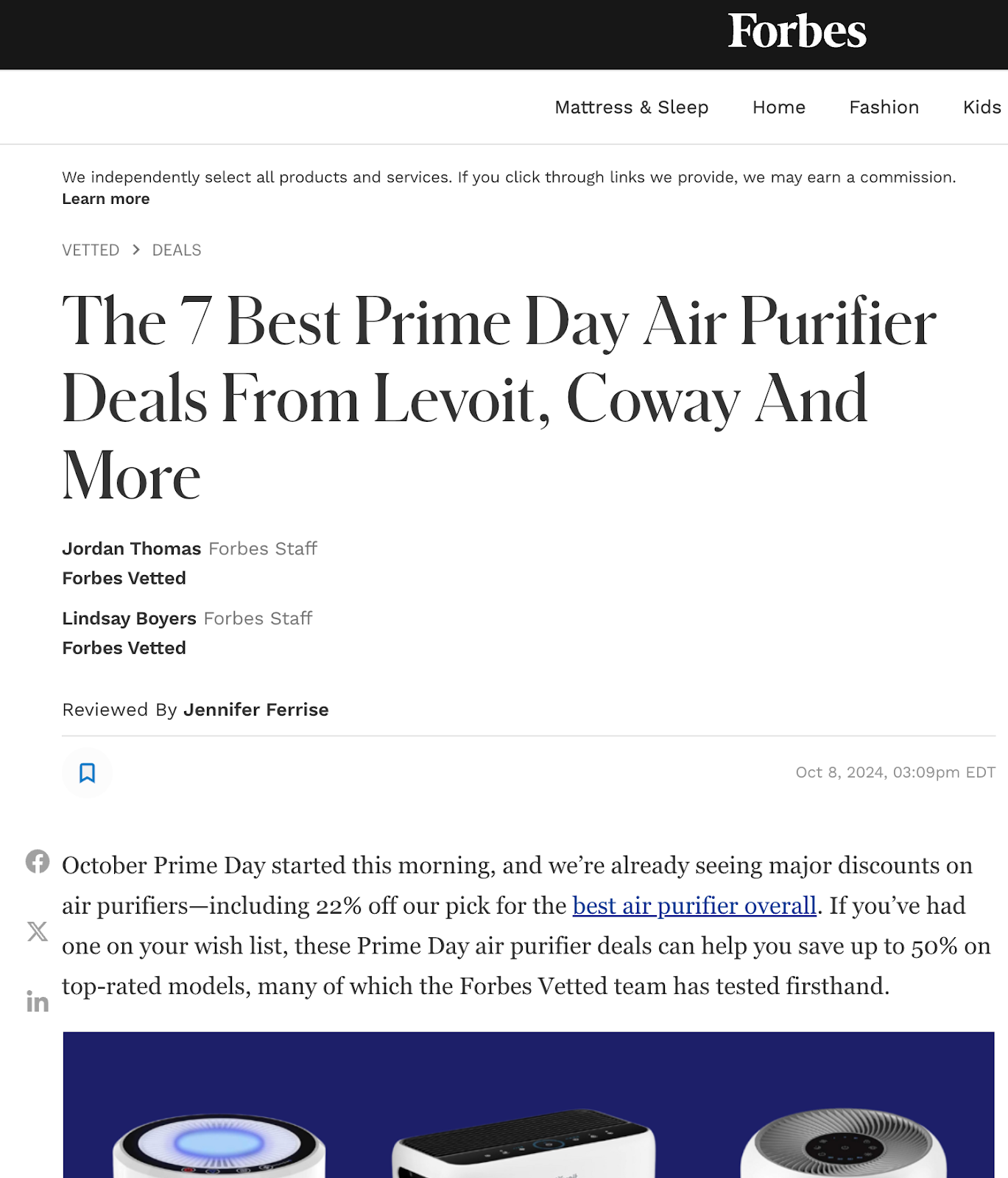
Ok, so you have figured out what the audience needs, and you have a ton of great content ideas. The next pitfall that marketers commonly fall into is trying to write everything. To illustrate: Take a quick moment to Google “best” anything and look at all of the sites that wrote about it, despite it being completely unrelated to their brand, product, or mission.

3. You are an expert and/or uniquely qualified to write this content
Authority matters. You might think this is the same as number two, but there’s a slight but significant difference. Something may be relevant to your brand, but you still have to prove yourself uniquely qualified to write it. This might come from expertise, experience, unique insights, or all three. This is also where the human element comes into play — even before AI, but especially now — users want content that they cannot simply generate by asking an LLM themselves. A unique and specialized point of view is more important than ever.
You may have noticed that our three quality content criteria and the use of AI are not mutually exclusive. On the contrary, we are not anti-AI evangelists. In fact, we use AI regularly to aid in efficiency and accuracy in the content creation process. However, it is rare (perhaps impossible) for a piece of content to match all three criteria without first passing by a human expert.
A survey conducted by consulting firm Baringa provides insight into opinions regarding AI-generated content by internet users. A majority of respondents identified at least one reason to value human-generated content above AI-generated content, with 81% citing “authenticity” as the key feature. However, users did not overwhelmingly state that they would avoid AI altogether — especially when it came to the younger demographics.
The fight for quality content is not a fight against AI, rather a delicate dance to make sure that it is used in the most effective way possible.
I Thought You Said You Could Prove It?
Ok, sounds like a nice theory, but does it actually work in practice? And can you prove it? In fact, we can. We have a proven history of this approach to content succeeding time and time again — surviving algorithm updates, changes in user behavior, and more. Here are a few examples.
Blendtec
Earlier, we made the claim that high-quality content will stand the test of time — and withstand algorithm updates. A perfect example of this is an article from way back in 2014 that we produced for Blendtec. A simple listicle of peanut butter smoothies, and accompanying recipes.
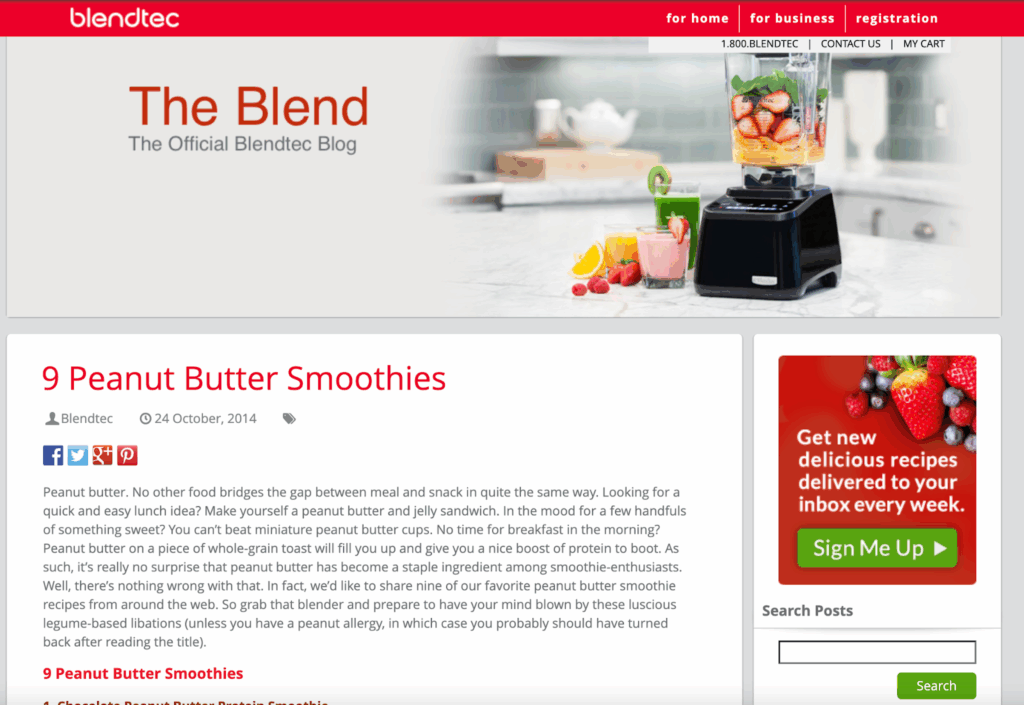
It meets our three criteria to a T and was incredibly successful when published. It continued to rank for several important keywords and survive several algorithm updates over the course of the next 10 years, to remain a top-three traffic driver for the site.
Dr Will Cole
Another example can be found in this guide on increasing progesterone levels for Dr Will Cole that we published and optimized in 2022.

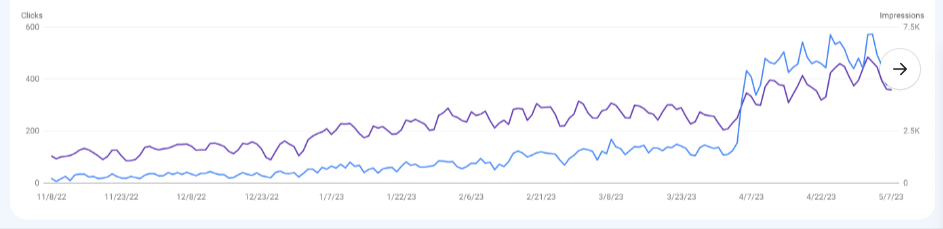
This article saw its biggest jump in traffic after an algorithm update in April 2023.
General Kinematics
But what about now? When AI is everywhere and AI Overview is stealing traffic from many pages. Well, we have countless examples of content that has survived the recent AI-pocalypse through following this simple formula for high-quality content. One such example this simple article for General Kinematics about uses for potash.
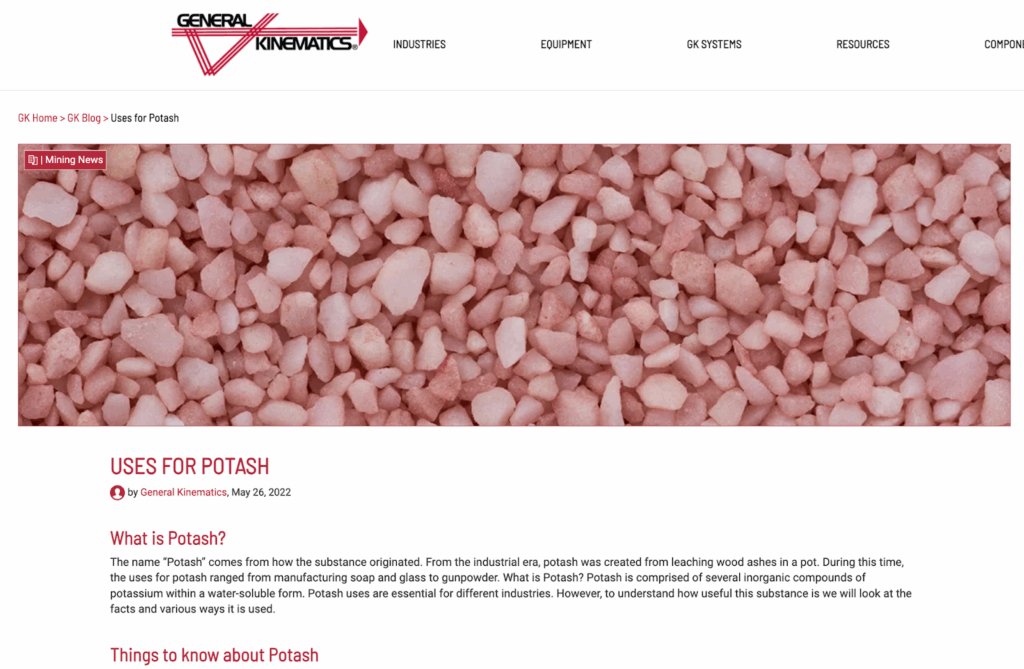
This content is audience-focused, brand-relevant, and something that General Kinematics — a producer of mining equipment — is uniquely qualified to write about. Published in 2022, it was automatically featured in AI Overview upon rollout of the feature in 2024, and has continued to do so since. What’s more: This page actually saw a 60.4% increase in traffic when you compare pre-AIO rollout to post-AIO rollout.
The bottom line: Google agrees with us. Every major and minor Google update in the past decade and change has been to get the search engine closer to prioritizing one of the three facets of quality content as identified by 97th Floor. For example:
1- Helpful content and other updates intended to prioritize user-first content.
2- Updates around brand authority, including recent updates that are deprioritizing irrelevant content for brands (or worse, brands that have spread themselves too thin and made it difficult for Google to assign authority).
3- This one goes beyond Google. Consider this: In a study of hundreds of thousands of citations, the most cited content type was product pages — by some margin. This means that this facet of quality content matters two-fold: Generic blog content is most likely to be directly replaced by LLMs, and product content — i.e. content that you are most uniquely qualified to write — is most likely to be cited. With optimizing both for and against LLMs becoming an increasing priority, this may be the most significant quality content guidepost of all.
I called out just three examples of this, but there are many more where that came from, and so will that continue.
The pattern across every one of those examples points to the same underlying truth. SEO expert Eli Schwartz makes the case that LLM visibility isn't a data or technical problem — it's a brand problem. This short video captures why the brands that consistently show up in AI-generated answers aren't winning on data. They're winning on authority.
Why It Matters Moving Forward
We talked about the ever-increasing noise of the internet. IBM predicts that AI will only continue to expand over the next decade, influencing more than content creation. High-quality content will continue to perform through both search engines and LLMs. The challenge or “noise” as marketers used to be different, but the solution is the same. If you put your audience first and prioritize quality content, the cream will rise to the top every single time.
Further Reading
Of course, that’s only part of the story. Sometimes you have to give even the cream of the crop the best chance to succeed. Next time, we’ll talk about how to get the most out of your content with an audience-first strategy.
If you're ready to show up in AI-generated results, let's build your strategy.
We’ve all felt it. You pour time into high-quality content, only to see your organic clicks drop—despite impressions climbing. What gives?
Welcome to the era of AI-powered search.
Google’s AI Overviews (AIO) and other generative engines are changing how people discover and engage with content. The game isn’t over—it’s evolving. And if you want to keep winning, it’s time to optimize not just for traditional SEO, but for AI-powered results.
At 97th Floor, we’ve spent the last year testing and refining strategies that help our clients show up and stand out in AI results. This guide breaks down what we’ve learned and how you can use it to grow.
Here’s a fast-track checklist that we stand behind:
We’re seeing a clear trend since the advent of Google’s AI Overviews:
This shift in metrics is significant. Your content is still being seen, but it’s not driving as many clicks.
This is largely due to AI Overviews, which are providing answers directly in search results—without users even having to visit your site.
In fact, research from Ahrefs revealed that AI Overviews reduce clicks by 34.5%. They analyzed 300,000 keywords and found that the presence of an AI Overview in the search results correlated with a 34.5% lower average clickthrough rate (CTR) for the top-ranking page, compared to similar informational keywords without an AI Overview.
This doesn’t mean SEO is dead. It means that SEO needs to evolve.
With this change in how users interact with search results, it’s important to note that KPIs are shifting. While clicks may be down, impressions are up—and brand mentions and search visibility are becoming increasingly valuable metrics. It's no longer just about tracking clicks; it’s about how your brand is being mentioned and perceived in the broader conversation.
At 97th Floor, we’re helping brands adapt to this new search landscape. We’re testing what works—and what doesn’t. In this article, we’ll walk you through how to optimize for AI and stay ahead of the curve.
AEO (Answer Engine Optimization) – Structuring content to appear in AI-generated answers and summaries (like Google's AI Overviews).
GEO (Generative Engine Optimization) – A broader strategy to improve how your content appears in LLM-powered results, including chatbots and voice assistants.
Other helpful terms:
Yes. But traditional SEO on its own won’t cut it.
GEO and AEO prioritize intent, clarity, and usefulness over keyword stuffing or link volume. Search engines (and AI tools) want to deliver satisfying answers, not just keyword matches.
Good keyword research still matters—especially when it covers both primary and secondary search intents.
Unlike traditional SERPs that rank blue links, AI search engines pull and generate answers using two main data sources:
They look for:
Here’s the opportunity: content that works well in LLMs often also ranks well in traditional SERPs. Optimizing for both doesn’t require two strategies—it just requires a smarter one.
AI content optimization is the process of structuring, writing, and formatting your content to be more useful and accessible to AI tools, without losing sight of your human audience.
Let’s be clear: the goal is not to “hack” the algorithm. The goal is to help people. To provide persona-driven content that resonates.
Too often, we see content stuffed with keywords or unrelated FAQs just to rank. That’s not helpful. It’s not what AI wants, and it’s not what readers want either.
Before you go all-in on optimizing for models instead of humans, this quick video breaks down why that approach can actually hurt your content’s real-world performance.
Start with your audience. Understand who they are, what they care about, and how they search.
Consider using audience insights to build Custom GPTs that speak in your brand voice and match your customers' tone. (Here’s a screenshot of what it looks like in ChatGPT to configure a custom GPT.)
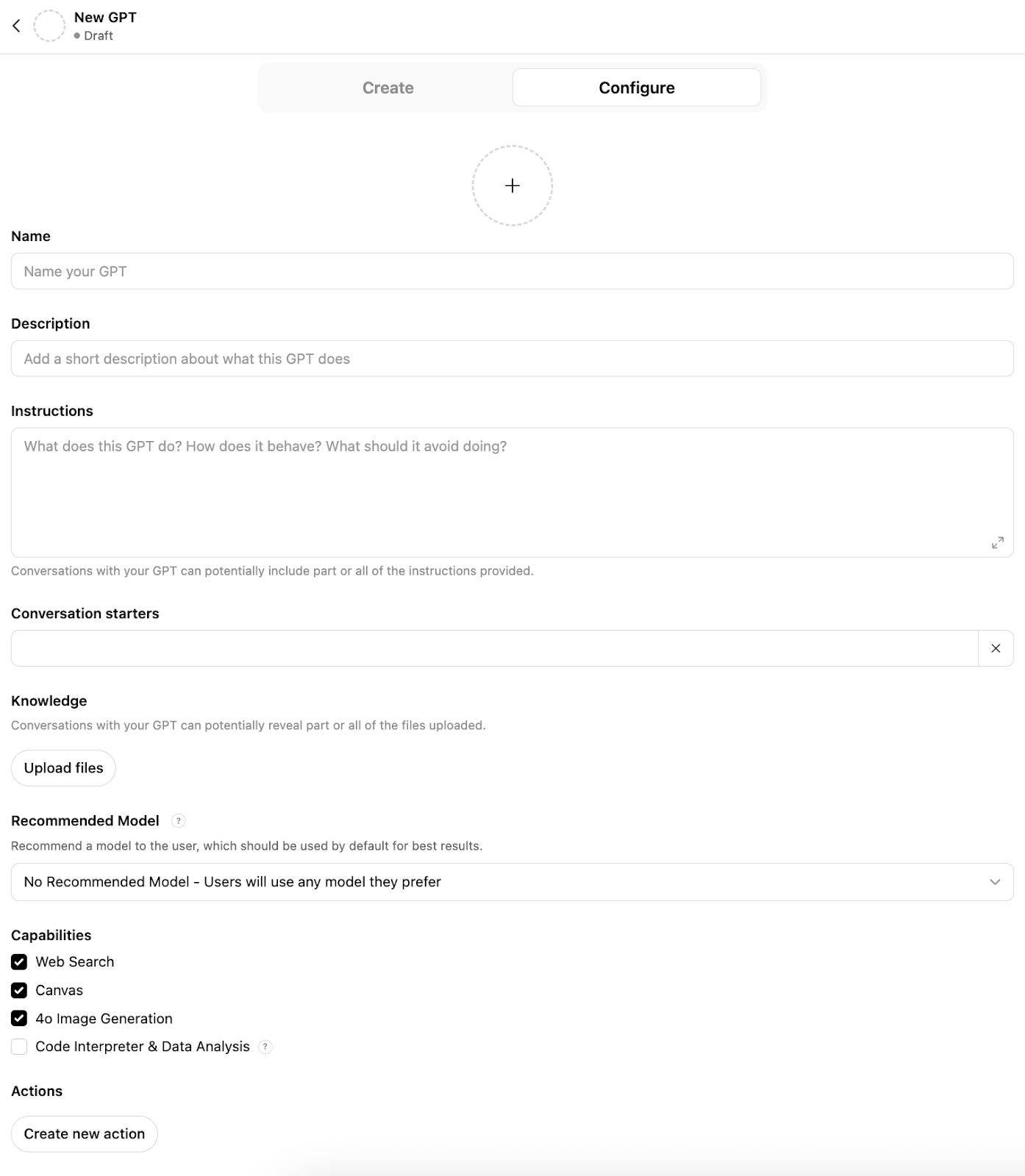
We also recommend:
Start with the answer, then explain it.
Example:
Q: How do I optimize for GEO?
A: Focus on clear, structured answers, semantic HTML, and direct responses to user queries.
Then go deeper.
Also:
AI favors content that’s easy to parse. That means:
97th Floor Test Results:
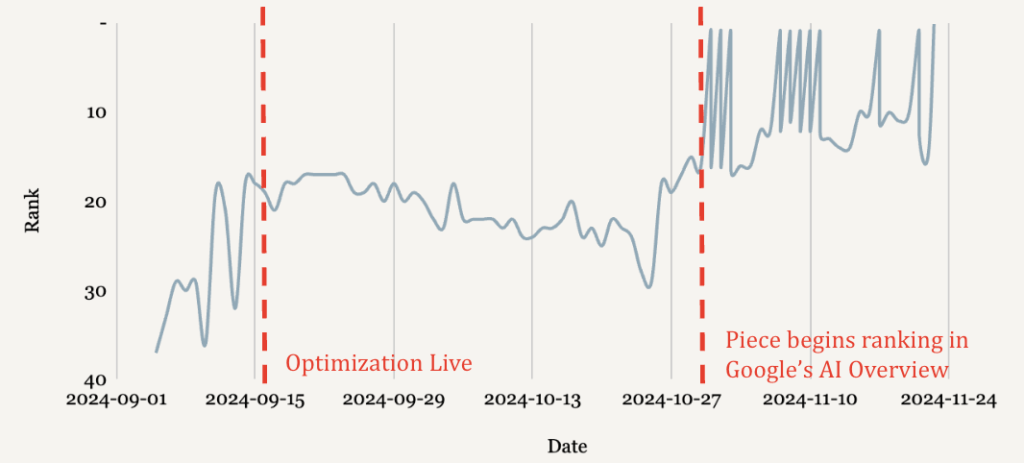
After adding bullet points and clear heading structure to a product page for a 97th Floor client, impressions and AIO rankings for an SEO-optimized article skyrocketed from ranking on the third page of the SERP to the first page (and ranking in Google’s AI Overview) in a short period of time. Here’s the results:
AI wants to serve trustworthy content. Show yours.
Ways to do that:
97th Floor Test Results:
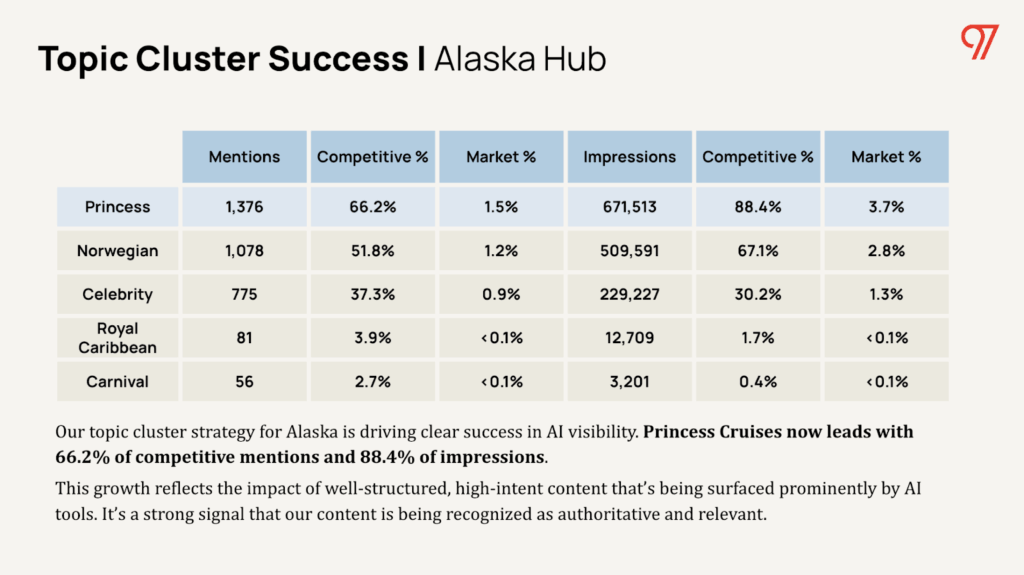
By focusing on tightly-knit topic clusters, we were able to achieve topical authority for Princess Cruises:
AI search engines increasingly value content from recognized, authoritative sources. This makes brand pages, like your About Us or Homepage, vital for building trust with both AI and human users. Additionally, third-party citations, such as mentions from reputable websites or reviews, are becoming more influential in how your content is perceived. Ensuring your brand is recognized across the web not only boosts authority but also increases your visibility in AI-driven search results.
AI is already reshaping how people find information—and how businesses earn attention.
At 97th Floor, we’ve helped our clients weather the shift from traditional SERPs to AI Overviews and GEO. Our strategies have earned AIO features early and consistently. And we’re continuing to test and refine what works as the landscape changes.
See how an audience-first approach translates to bottom-line results.
On all counts, the Oil and Gas market is more volatile than most. Globally, prices fluctuate, regulations evolve, and supply and demand shift. Regionally, each market has unique dynamics, all dependent on macroeconomic variables like rising material costs and high interest rates, not to mention unique location-specific changes in supply and demand. Being a marketer in this arena demands a solid foundation in industry trends to make the smartest marketing decisions. Maintaining a clear Oil and Gas marketing strategy is the blueprint that guides every touchpoint between your brand and your potential buyers. It outlines who you’re targeting, the channels you’ll use, the messaging that resonates strongest, and the tactics needed to generate meaningful revenue.
However, most brands in Oil and Gas haven’t refreshed their marketing strategies in years. This leaves an opportunity wide open for savvy digital marketers.
We've dug deep into the most recent industry data and our own two decades of experience to provide you with a how-to guide on how to take advantage of this exponentially growing market. We’ll walk through the core components of building that strategy — from segment analysis and target market selection to developing a strong brand position that resonates in this complex landscape. We’ll also break down how to build a comprehensive marketing plan and how to leverage digital channels that drive measurable growth for Oil and Gas companies. With the right foundation, your team can stand out in a market that’s more competitive and more opportunity-rich than ever. Let's get right into it.
The oil and gas market is broken down into segments. If you haven’t yet, a good first step is to analyze each to find where your brand best fits in the flow. This allows for targeted marketing, laser-focused on which part (or parts) of the market you’re planning to win. Whether you and your team choose to focus on:
You’ll need a full understanding of each segment's needs and challenges to build the marketing strategies that place your brand in an optimal position and maximize your ROI. Each market has specific advantages and drawbacks.
Evaluate the potential ROI and align your marketing goals with the most promising markets. Choosing the target can make or break your marketing efforts. Trust us, taking the time to do the research will be the difference between a major win or a budget-crushing fail.
Customer Profiling and Targeting
Always know who you’re selling to. In the oil and gas industry, this could mean large corporations, smaller service providers, or even local governments. Carefully identify these key players and tailor your marketing efforts to meet their specific needs. It’s your job to connect as deeply as possible with your target audience. Potential customers are looking for personal connections with the brands they buy from, currently an uncommon occurrence in this market. This opens a window for you to step in and step up.
That window stays open only as long as your competitors remain comfortable. Marketer Sterling Snow calls this advantage "creating the channel" — and the brands that claim it first rarely give it up. When every player in your category is competing for the same keywords, the same trade media, and the same conference floors, the real leverage is in the channel nobody's thought to build yet. This short video captures why owning an uncrowded distribution channel — before your market wakes up — is one of the most durable advantages in B2B marketing.
Once you've identified your customers, the next step is to understand their behaviors. What drives their purchasing decisions? What are their pain points? What motivates them? What risks are they concerned about? Think about every step they’ll take on the buying journey, how they make decisions, and how you can meet their specific needs.
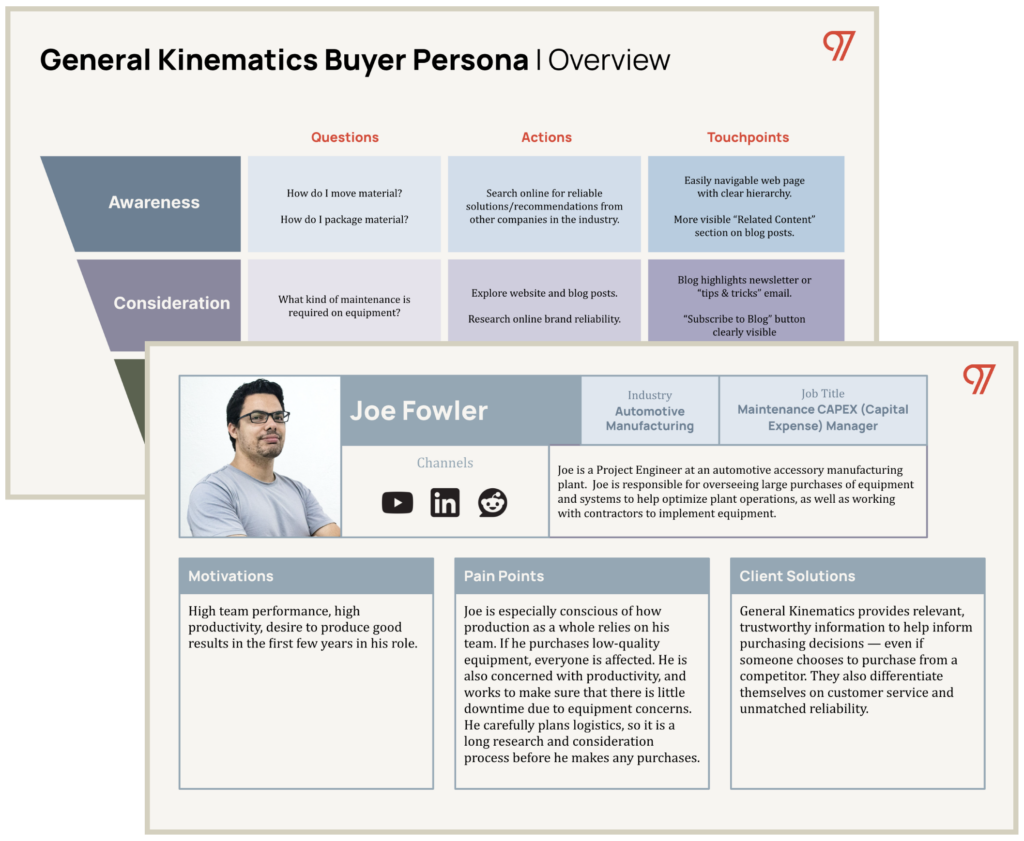
Once you’ve identified and worked to understand your audience, create a persona to represent your research. A clear, thought-out buyer persona will guide all your subsequent marketing efforts. Keep your persona in mind as you plan strategies and build campaigns. The more personalized and specific you are, the more likely your messaging will resonate with potential buyers. Here's an example Buyer Journey/Persona our team at 97th Floor recently created for General Kinematics.
Your brand identity is what sets you apart. Think it through – what makes you different from other businesses in the industry? What are your specialized offering points? Focus on what makes your company unique, whether it's innovative technology, exceptional service, or a strong commitment to sustainability. If you’re looking for a place to start, begin by collecting reviews or interviewing previous customers for their opinions on what you do best.
With your identity in mind, work to position your brand in a way that highlights these strengths to appeal to your target audience. Clear, consistent messaging across all marketing channels is key. To pinpoint what messaging resonates best, you can give A/B testing a shot. Most importantly, always look for new opportunities to demonstrate your value through every medium. Case studies, visual data representations, and customer reviews are common ways to do this.
The battle’s not won yet, sustaining your hard-earned digital clout isn’t an easy process. Building a strong brand reputation takes time and effort. Maintain transparency, deliver on promises, and engage with your audience consistently to keep your brand's reputation positive. This needs to be an integral part of your marketing efforts.
Developing a Comprehensive Marketing Strategy
Supported by your clear brand identity and ideal customer targeting, it’s time to build out a digital marketing strategy. First, define clear, achievable marketing objectives. Whether it's increasing brand awareness, generating leads, or boosting sales, having specific goals helps measure success. Keep track of your goals and efforts to achieve them to celebrate success and identify opportunities for improvement.
A well-developed marketing strategy, especially in Oil and Gas, involves sub-strategies including
Marketers across the field agree, almost every part of digital marketing revolves around a well-optimized website. It's no different in Oil and Gas, your website is your digital storefront – the place all potential customers will navigate to on their path toward a purchase. It needs to be user-friendly, informative, and most of all, optimized for search engines to attract organic traffic. Use tools like Google Analytics, Search Console, and HubSpot CRM to track visitor behavior and optimize performance. Learn more about SEO strategies here.
Social media platforms offer a space to connect with your audience, share industry insights, and showcase your company’s culture. Regular, engaging content helps build a loyal following. Depending on your business, goals, and strategies, social media may or may not be a place to focus your budget and time.
Quality content drives traffic and builds trust. Create valuable content that addresses your audience's pain points and positions your company as an industry thought leader. Publishing content also drives your SEO. Learn more on how to set up a consistent content strategy here.
Regularly analyze your marketing efforts to measure ROI. Use analytics tools to track performance and adjust strategies as needed for continuous improvement. Keep in mind that metrics like impressions and leads can be a great start, but the end-goal of marketing is to generate conversions. Successful marketers make money. If ROI is stagnant, the marketing strategy is too.
By targeting the right segments, fine-tuning your strategies, and focusing on persona-specific messaging, you can position your brand as a leader in this digitally stagnant market. In Oil and Gas, staying ahead requires a laser focus on your goals and your audience's needs. Find ways to set yourself apart and continuously refine your strategies. With a well-crafted Oil and Gas marketing strategy, you’re ready to take advantage of the market and win contracts like never before. Good luck!
Want to kickstart your marketing dreams? We're here to help.
For seasonal business owners, demand rises and falls with the changing weather. While seasonality is a unique and perhaps daunting challenge, the predictable rhythm of demand means that those businesses who can sync their marketing with the mandates of sun or snow can have success year-round.
97th Floor is no stranger to seasonal marketing; we’ve executed winning strategies for businesses including pool maintenance, sports equipment, cruise lines, pest control, lawn care, solar, and moving services, just to name a few.
In this article, our resident experts in SEO, content, and advertising share five actionable tips for seasonable business marketers.
Search Engine Optimization (SEO) is a long-term game, and waiting until peak season to focus on it can be a costly mistake. It's essential to begin your SEO efforts well in advance, ideally during the off-season.
Head of SEO Mike Witham says, “You need consistent year round efforts to maintain and improve rankings. If your peak season is in March, you should be ensuring you have solid rankings for core pages by no later than December. Do not start working on it the month before your peak season!”
For businesses serving multiple states or a large region of the country, seasonal demand may be different across these various geographies.
Enterprise advertising specialist Spencer Martin uses Google Keyword Planner to anticipate search volume fluctuations in different areas.
He shares, “We launch campaigns early so that we have 2 to 4 weeks to ramp up and capture the full demand. Campaigns need time to scale and learn, so if we wait until the season starts to launch we lose out on potential profits for our clients.”
While digital marketing is crucial, seasonal businesses can see major wins by looking at more traditional advertising. Enterprise Account Executive Nathan Hooper suggests non-digital forms of advertising, such as mailers or community events to target local audiences. Advertising on community calendar pages or local business directories can put your business in front of potential customers who may be researching local services.
Understanding your buyer and their motives for buying is essential for capturing demand at the right time.
Brandon Smithwrick asks what happens to your marketing instincts when you let AI do all the thinking. He breaks down how cognitive offloading quietly erodes the skills great marketers are actually built on.
Senior Director of Campaigns Jon Hammond shares that his clients in the travel industry refer to December through February as “The Wave.” This three-month period is the biggest sales period for travel as people look forward to summer sun during the cold, dark winter months. His clients maximize their ad budget and run major deals and promotions during this time to capture the demand.
Content Marketing Specialist Kaylee Baker emphasizes the importance of targeting specific demographics, such as 18-30 or 25-40-year-old males, who are the main consumers of seasonal services. Consider the platforms they frequent, such as YouTube, to tailor your marketing efforts accordingly.
When reporting to leadership, especially in industries with high historical seasonality, like cruises, it's essential to use Year-over-Year (YoY) data rather than Month-over-Month (MoM) data. This approach provides a more accurate depiction of progress or decline in traffic or sales over the seasons. By analyzing YoY data, you can better understand trends and make informed decisions to optimize your marketing strategies.
In conclusion, marketing a seasonal business requires careful planning, adaptation, and understanding of your target audience. By implementing these five tips, you can maximize your marketing efforts and capitalize on seasonal fluctuations in demand.
