




At our July company meeting, we did something that would have felt like malpractice a few years ago: we asked every team at 97th Floor to plan content for a real client with keyword research completely off the table.
No search volume, no difficulty scores, no SERP analysis — just ten minutes, one client, and a blank doc.
By the end, one team had run their list against the client's actual content calendar and found that roughly 40% of the ideas they generated weren't covered anywhere on it.
Here's the exercise, why we ran it, and what came out of it.
Every team picked one of their clients and got the same four instructions:
That's it. Ten minutes on the clock.
Some context, because this exercise didn't come out of nowhere. It was a stress test of a belief we've been building toward for a while.
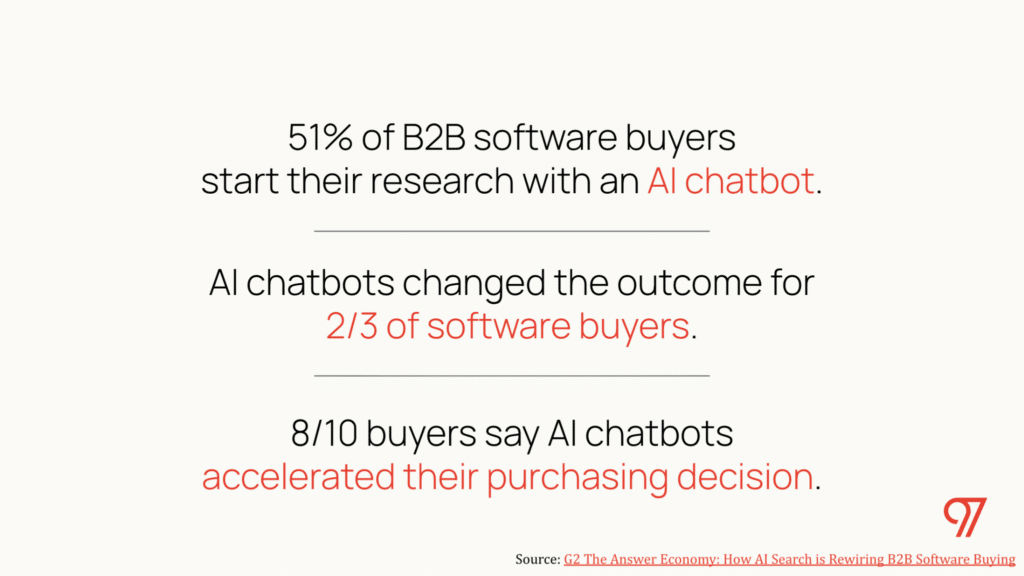
The way people search has fundamentally changed. Over a billion people a month are now using Google's AI Mode, and queries there are doubling every quarter. ChatGPT became the fifth most-visited website on the internet. And per G2's research on B2B software buying, 51% of buyers now start their research in an AI chatbot — and for two-thirds of them, what the AI said changed the outcome.
Here's the problem that creates for content strategy: keyword data only shows you the searches that happened often enough, in similar enough phrasing, to register as trackable volume. A keyword like "ai in education" shows 6,900 monthly searches. What it doesn't show you is everything orbiting it in AI search:
Three completely different intents, three completely different pieces of content — and none of them have trackable search volume. If your research process never surfaces these questions, your content won't answer them. And if your content doesn't answer them, someone else's will.
Internally, we've boiled this down to one line: search volume is evidence of demand, not the boundary of demand. (We've written before about why keyword research can no longer be step one of a content strategy — this exercise was us testing that thesis on ourselves.)
So the question became: if our strategists stopped looking at the data everyone else is looking at, and just thought like the actual human on the other end — what would they come up with that the keyword-first process misses?
To keep "think like the customer" from being hopelessly vague, every team worked from our customer journey map — the same framework we now use to build GEO prompt strategies for clients.
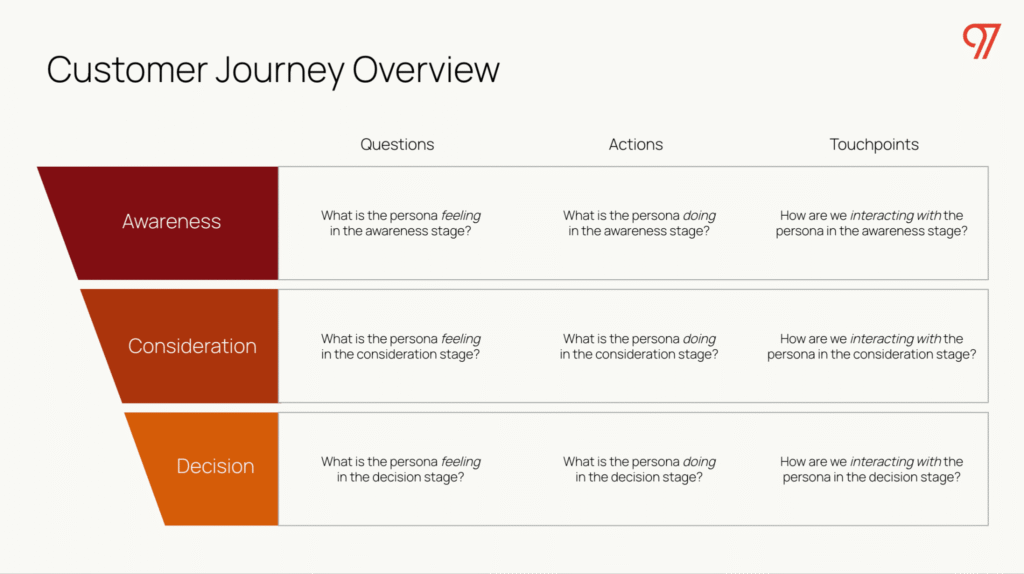
The short version:
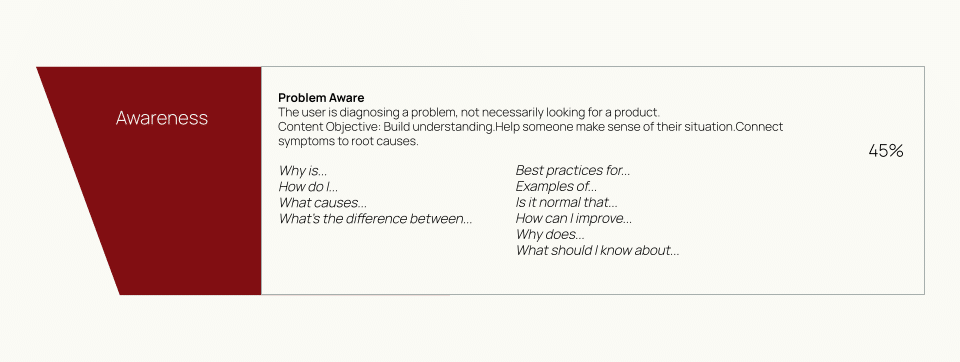
Awareness (problem aware). The user is diagnosing a problem, not shopping for a product. They're asking "why is...", "what causes...", "how do I...", "is it normal that...". The content objective is to build understanding — connect symptoms to root causes.
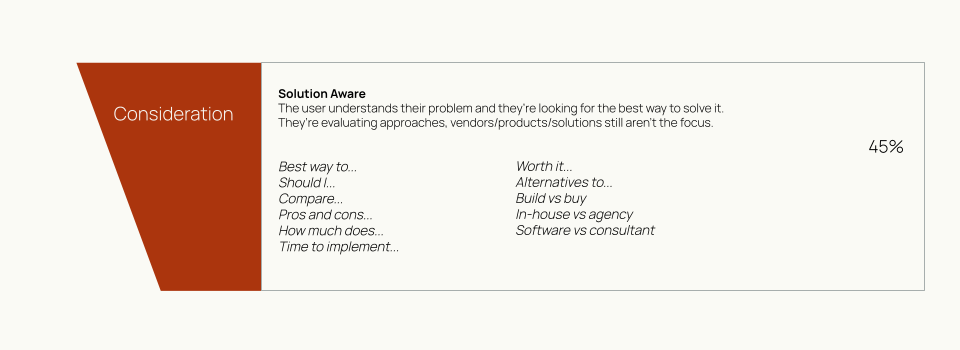
Consideration (solution aware). They understand the problem and are evaluating ways to solve it — approaches, not vendors. "Best way to...", "pros and cons...", "build vs. buy", "in-house vs. agency", "worth it...".
Decision (vendor/product aware). Pricing, demos, reviews, integrations, competitor comparisons. This is where traditional keywords still shine, because these searches are trackable and high-converting.
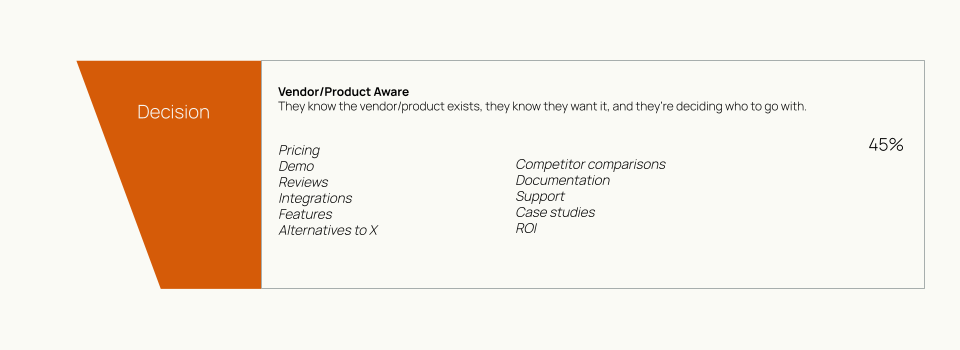
Note the weighting: roughly 90% of the content opportunity, by sheer quantity, lives in those first two stages — and those are exactly the stages keyword research is worst at seeing. Teams were told to focus there.
Across six teams, idea counts ranged from 13 to 76. But the counts mattered less than what was on the lists.
The answering service. One team works with a client that provides live answering agents for businesses, including medical practices. Their keyword-informed strategy centered on the product category. Thinking persona-first, they landed on questions like:
The eyewear brand. A team working with an affordable eyeglasses e-commerce brand started with one team member's real-life story about his glasses and worked outward into use cases: an affordable backup pair for traveling, buying glasses for my aging parents, and true beginning-of-journey questions like do I have to buy glasses from the same place I get my prescription?
The art gallery platform. A team supporting an art gallery CRM and marketing platform got past features entirely: guidelines for hosting a gallery event, international laws and regulations for marketing artwork across borders (their client's customers sell globally), and even a brand-play idea — a Michelin-star-style rating program for galleries, leveraging the client's authority in the art world.
The cruise line. A team working with a premium cruise line looked at everything through the lens of their primary persona — older retiree couples who want to see the world in a relaxed, premium way. Their existing strategy is heavily destination-focused. The persona-first list went broader: safest ways to see the U.S. or the world as an older couple, bucket-list destinations with no kids, travel questions that sit two or three touchpoints before anyone types a destination name.
That last team did something we didn't ask for, and it became the headline of the meeting.
They generated 51 unique ideas, then pasted the client's entire existing content calendar — every term and query on it — into Claude and asked how many of the new ideas were already covered.
The answer: about 60%.
Which means roughly 40% of the ideas a team produced in ten minutes, for a client with a mature, keyword-researched content calendar, weren't on that calendar at all. Not deprioritized. Not scheduled for later. Just never surfaced, because the process that built the calendar couldn't see them.
Not every list was a revelation. The eyewear team was upfront that, as an e-commerce brand, many of their ideas probably would have eventually shown up in keyword research — the exercise mostly forced them to think about the same demand differently. That's a fair result, and worth stating plainly: persona-first ideation isn't magic, and it doesn't replace everything.
We're also not abandoning the trackable stuff. Bottom-of-funnel keywords still convert, and we still want our clients showing up for them. The point is allocation and honesty: some bottom-of-funnel terms are so competitive that over-investing there while ignoring the untrackable early journey means leaving the majority of the opportunity untouched. If the persona research is strong, "no search volume" is no longer a reason to say no.
The point wasn't that every question belongs in your content strategy.
Some of these ideas are two steps away from a purchase. Others are twenty.
That's where strategy takes over.
Funnel depth matters. A B2B cybersecurity company with a six-month buying cycle has far more room to educate around adjacent problems than an ecommerce brand selling reading glasses. A luxury cruise line can justify investing in content that helps travelers decide whether a cruise is the right vacation in the first place, while continuing to own destination- and itinerary-specific searches later in the journey. A local service business may need to stay much closer to buying intent.
The exercise isn't meant to replace prioritization. It's meant to widen the aperture before you prioritize.
Once you've generated the questions, the real work begins:
Every idea should then be pressure-tested against business value, audience relevance, and the role it plays in moving someone closer to becoming a customer.
Ten minutes is enough to uncover opportunities. It isn't enough to decide which ones deserve investment.
That's strategy.
For our content strategies, keyword research is no longer step one. Topic research now starts with the persona and the product: what is this person asking at each stage of the funnel — their fears, frustrations, objections, misconceptions? Keyword data comes back in later, where it's genuinely useful: validating demand, forecasting, client education, and the decision-stage plays it was always good at.
If a ten-minute exercise with no data surfaced a 40% gap, the obvious question is what a rigorous, repeatable version of that process looks like — how you prioritize persona-driven prompts, validate demand without search volume, forecast, measure, and build a content calendar around it. We've now trained our entire company on exactly that, and it's what we'll be sharing next.
For now, steal the exercise. One client (or your own company), one doc, ten minutes, no keywords. Then check your list against your content calendar and see what percentage is missing.
We'd bet it's more than you think.
Google just gave content creators and publishers something they've been asking for: visibility into how content on other platforms performs on Search. On July 7, Google announced platform properties, a new Search Console property type built to show how your Instagram, TikTok, X, and YouTube content shows up in Google Search and Discover.
For an industry that's spent years piecing together search visibility from website data alone, this closes a real gap. You no longer need a website to know whether Google is sending people your way — a genuinely new option for creators and publishers who live primarily on social and video platforms.
Platform properties are a new type of property you can add directly in Search Console, separate from your usual site properties. Once connected, you can track which search terms lead people to your Instagram, TikTok, X, or YouTube content — and see how your audience is actually interacting with those posts once they land on them.
This follows an earlier, more limited experiment Google had been running, so the underlying idea isn't brand new. What's new is that it's now a real, general feature site owners and creators can set up themselves.
Once a platform property is connected, three reports become available:
Notably, this isn't an impressions-only report like the recent Generative AI reporting rollout — clicks are included from day one.
This is where it gets genuinely useful beyond just reporting. If you're running a topic cluster strategy, platform properties give you a new way to validate demand for a topic that goes beyond your own website's performance. If search terms are consistently driving traffic to a piece of social or video content on a topic, that's a real signal the topic has search demand — even if it hasn't shown up in your website's own Search Console data yet.
In other words: this isn't just a new report to glance at. It's a new data source for informing what to create next, and where.
Setup is straightforward, but it does require a verification step:
Keep in mind the rollout is gradual — Google has said platform properties will become available over the coming weeks, so don't be surprised if it's not live for every account right away. Full setup details are in Google's help center documentation.
This is worth bringing up in client or team conversations over the next couple of weeks — it's timely, it's genuinely new data, and it opens a real conversation about content strategy across platforms, not just the website. Where you have the access to do so, get the property set up directly. Where account permissions are the holdup, that's a good opening to walk the client or your team through what's needed on their end to get it connected.
We'll keep watching how this rolls out and report back on what the data actually looks like once more accounts have access.
Remember when brand visibility mostly meant ranking on page one? This was back when readers had to click on pages to get the info they were after and AI was relegated to science fiction. It was a simpler time.
Not necessarily better… but certainly more straightforward.
Now your brand can show up in an AI-generated answer, get cited from a page you forgot existed, lose ground to a competitor in a recommendation list, or influence a buying decision without the user ever touching a traditional blue link. Search has become a kind of interpreter or paraphraser, applying artificial intelligence to pull information from pages and present it to the user in a (hopefully) clear and accurate way. The result is that more than half of online searches are zero-click. And when Google cuts out the middlebot, it changes what marketers need to be watching.
What I'm trying to say is that if you want to know how to track brand mentions in AI search results, you need to widen your gaze. SEO no longer begins and ends with ranking. It now extends to questions like "Does AI mention us?" "Does it cite us, and does AI talk about the brand in a positive or negative sentiment?" "Which pages does it pull from?" "How often do we appear compared to competitors?" And "Does any of this turn into actual traffic, leads, or revenue?"
Tracking brand mentions in AI search means monitoring when and how AI-driven platforms reference your brand in generated answers, recommendation lists, summaries, and cited sources.
But here’s the thing: AI search does not behave like classic search. Google’s AI features (for example) can generate overviews that summarize a topic and link users to a range of sources, while Bing now offers AI performance reporting tied to how sites are cited across Copilot and related experiences. Google also makes clear that AI Overviews and AI Mode still rely on essentially the same fundamental search requirements as the traditional approach.
So yes, rankings are still important. However with AI search, simply ranking for a keyword with one page is not the end goal, there’s more to it:
For example, a brand can show up in an AI answer even when it is not the top traditional ranking. Or a page can get cited because it answers a narrow question clearly. A competitor might get mentioned because information across multiple pages for things like reviews, product info, or comparisons are easier for AI systems to synthesize.
The point is that the future of search will remain search. It has just become more conversational, more layered, and a little more expansive.
This distinction is one of the biggest places marketers get tangled up. So let’s be direct:
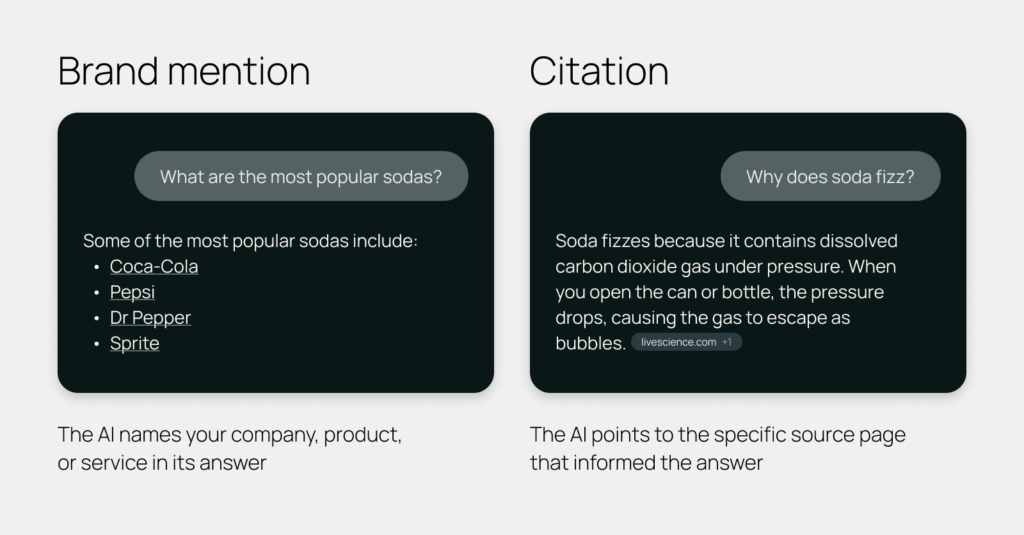
Which one do you want? Trick question, obviously; you want them both.
A mention can be flattering and still impossible to measure well. An owned citation can be less glamorous, but far more useful because it gives you something concrete to inspect. It's your page, and your site's analytics that can be measured and analyzed. Which page got referenced? How often? Did it receive traffic? Did users do anything useful after landing there? This is first-party data on the impact of AI search — which is more valuable than any AI search tracking tool, all of which are synthetic databases, or good guesses as to where and how you are showing up.
Or, think of it this way:
Google's documentation around AI features focuses heavily on how content becomes eligible for inclusion and how traffic from AI experiences is counted inside Search Console reporting. That suggests that source-level analysis should be part of the process.
OK. Let’s move beyond the academic: AI mentions, AI citations, cited URLs… does it all matter?
Yes. Unequivocally yes. Here’s why:
People are asking longer questions, more specific questions, and plenty of follow-up questions. Google has explicitly said AI search experiences are pushing usage in that direction, with users exploring more complex queries and broader source sets.
That means discovery is no longer confined to obvious high-volume keywords. Someone may find your brand while asking for the best agencies for AI SEO, the top platforms for generative engine optimization, tools similar to your product but better for mid-market teams with limited technical support and a weirdly aggressive CFO, etc., etc., etc...
The path from question to brand discovery is less clean and a lot less predictable. Measurement has to adjust to account for it.
AI assistants were built to assist, and that goes beyond just summarizing informational content. They can compare vendors, recommend providers, shortlist software, explain product categories, and shape buyer impressions before a click ever happens. As such, when a platform includes your brand in a recommendation set, you’ve already entered the buyer’s consideration stage — whether or not they ever visited your site.
And that’s great! It can also be unsettling.
If you’re going to let an opaque machine send potential customers to your virtual door, you’d better be paying close attention to how often it’s doing so, and on what terms. Otherwise, you’re letting the robot make your brand positioning decisions for you.
When your brand appears in AI-generated answers, it can function as a form of borrowed trust. Users are beginning to treat AI responses as synthesized expertise. But those answers are only as good as the sources underneath them.
The same qualities that make content useful for humans make it easier for AI to cite — one tactic leans into that more than any other. This short video breaks down the SEO move that Mike Witham and Blake Nielson from 97th Floor keep coming back to.
You should not confuse that with permanent authority. AI can be fickle, inconsistent, and occasionally wrong (and when it gets something wrong, it does so with supreme self confidence). Still, repeated inclusion shapes perception, and perception has a funny way of becoming influence.
If you’ve been in marketing for more than a few weeks, you’re probably already familiar with a tidy set of traditional metrics. You could follow rankings, traffic, click-through rates, and conversions, then build your strategy from there.
AI search adds some new layers to that picture by introducing answer inclusion, source citations, prompt visibility, and recommendation presence — all of which are signals worth tracking. That’s part of what makes AI search engine optimization a meaningful extension of the modern search strategy.

Brand visibility can show up in several kinds of AI-driven experiences. So, if you want to know where and how your brand is surfacing, you need to understand the environments in which those mentions appear:
Before you run off to buy seventeen subscriptions, start with the native data from the platforms (Google Search Console, GA4, Bing Webmaster Tools, etc.) themselves. That’s usually the best place to get a baseline view of how your site is appearing and performing.
Again, Google’s official guidance states that AI feature traffic, including AI Overviews and AI Mode, is included in Search Console’s Performance reporting for web search. It is not a perfect dedicated AI visibility dashboard, but it is still one of the best sources for understanding how your pages perform across Google search experiences.
Look at:
GA4 helps you connect visibility to behavior. Once users arrive on cited or AI-visible pages, what do they do? Do they engage? Bounce? Convert? Wander around aimlessly?
Even better, Google has added "AI Search" as a primary channel in GA4's default channel grouping. That means sessions arriving from AI search experiences can now be broken out and analyzed alongside your other acquisition channels — no custom regex gymnastics required.
Without that layer, you are measuring attention without taking outcome into account.
Bing’s AI Performance reporting adds a very useful angle. Microsoft says the report shows how your site’s content is used in AI-generated answers across Copilot and partner experiences, including cited pages and changes over time. This makes it one of the clearest native examples of AI citation tracking from a platform owner. Yeah, from Bing.
If you only track how often your brand name appears, you will end up with a very incomplete picture. AI visibility is bigger than that. Your measurement approach needs to be bigger as well.
So, in addition to the tried-and-true standards, what should you also be tracking?
Visibility without outcome is like getting dressed up to sit on the couch — you might look good, but you’re still not going anywhere. Tie cited or visible pages back to business performance by tracking sessions, engagement, leads, or conversions wherever possible. That kind of connection is what keeps AI visibility from turning into a vanity metric, and is increasingly central to evolving SEO strategies.
A practical tracking list might look like this:
The list of things worth tracking in AI search is longer than it used to be, but it's not unmanageable. Once you understand the difference between mentions and citations, know which environments your brand can surface in, and have a clear set of metrics tied to real business outcomes, you've built the foundation for a modern visibility strategy. Rankings still matter — they've just been joined by answer inclusion, citation sources, share of voice, and prompt visibility.
Of course, knowing what to track is only half the equation. The next step is actually doing it: building prompt libraries, running tests across platforms, monitoring citations, and optimizing the pages AI already trusts. (We cover all of that in our companion guide on how to track brand mentions and citations in AI search.)
And if you'd rather have a partner in your corner, 97th Floor can help you measure and improve your brand's presence in AI search. Contact us to see how we can help you strengthen your search visibility today… and as AI continues to revolutionize the landscape for years to come.
The buyer’s journey as we know it is changing again. Google’s latest product announcement that included agentic coding strikes another blow to marketer’s hopes of gaining that all-important website traffic and conversion.
But here’s the thing (at the risk of sounding like AI myself): Everything is changing, but really, nothing is.
While it’s sure to be a new challenge to track the updated journey (but then again, when isn’t attribution a challenge?), the actual reality is that your audience isn’t going anywhere, they’re just finding you differently. And our job as marketers remains largely the same, even if the details look different. What does that mean, exactly? Let’s get into it.
For a long time, SEO looked like this:
That made much of your optimization for steps 1 and 2 about getting traffic, and then step 3 was purely focused on site optimization.
But now, your audience converts in one of two ways:
So while we used to optimize for being found, then converting. We must now optimize for being recommended, and either converting warm visitors or converting off-site..
Both sides of this coin require the same foundation: genuine authority and frictionless user experience, which can only be achieved through a deep understanding of your audience’s real needs.
Not to toot our own horn (ok, that’s exactly what we’re doing) but 97th Floor has been talking about full funnel, audience-first marketing for quite some time. After all, you can optimize a landing page as much as you like, but if it’s not the right audience finding it, it’s not going to do anything.
We are going to see this more and more moving forward — a shift from CRO in isolation to full Conversion Path Optimization.
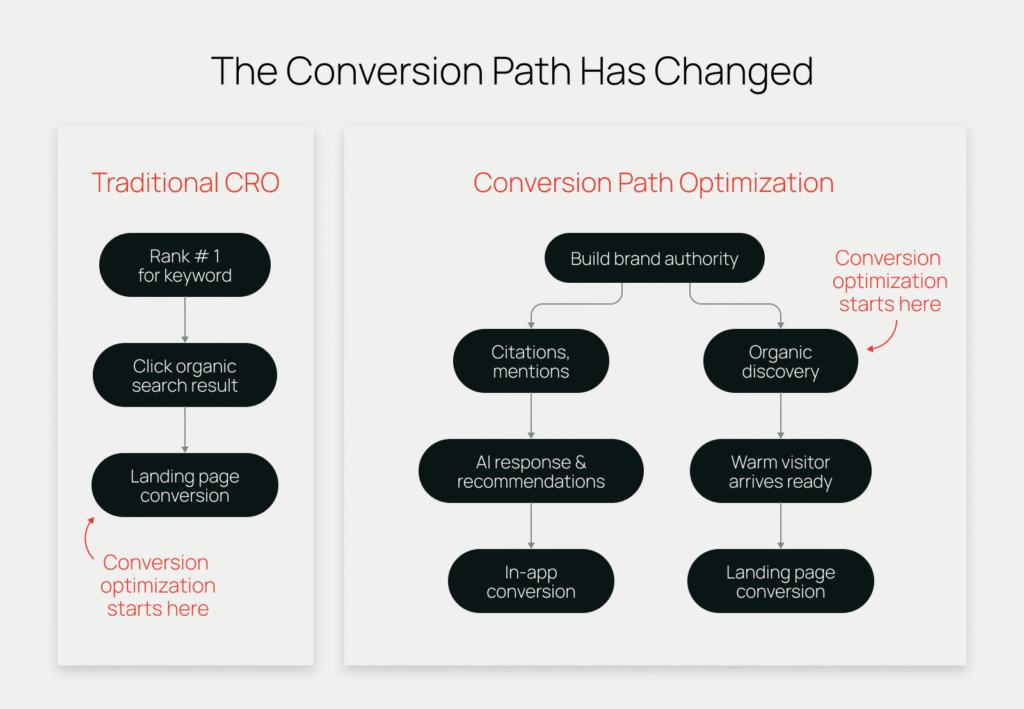
Here’s what we need to focus on:
AI agents having control over purchases might feel like marketers are losing control, but there is a lot that you can do to influence and optimize this process, even if it happens in an app instead of on your site. In fact, there are a few things we can focus on already in order to optimize that conversion path:
As agent recommendations will get increasingly more tailored, optimizing from discoverability right through to checkout will be have a huge impact on conversions.
Of course, not everyone is going to use an agent to make a purchase. If you look at in-app purchases on the social media side, adoption is significant, but not total (after all, there’s a whole generation that refuses to make “Big Purchases” on any device but a computer). That means that you still need to optimize for those visitors who, after completing all of their research with AI, will still arrive at your site to make their final purchase. Some places you can start:
This is a marketer’s bread and butter and, far from being redundant, it’s more important than ever.
Attribution models built on last-click or even session-based logic won't capture agent-assisted conversions. Conversion measurement will need to move past organic traffic/conversions and embrace new, mixed models that capture both visible conversions and agent-assisted ones.
At 97th Floor, we’ve long talked about high quality, audience-first content as the best weapon in a marketer’s arsenal in the AI era. That is holding more steadfast than ever with these latest Google updates. The following factors are more important to invest in than ever:
Audience insights
Who is your audience? What do they need? What are competitors missing?
Brand-building & authority signals
Yes, citations and mentions, but also things like thought leadership and media presence.
Innovative, unique content
Content should reflect unique insight, rather than just keyword optimization.
UX/checkout optimization
Frictionless transactions, whether by agent or human, will boost your conversion rates.
Full conversion path optimization is the way forward, and it starts right at the very beginning of your marketing strategy. A time where everything is changing so rapidly can be either scary or exhilarating for a marketer. If you embrace this chance to put the audience first and build your strategies around them, it’s all but guaranteed to be the latter. And hey, if that still sounds intimidating to you, give us a call!
Paid media has grown up.
Does this mean it’s simpler, calmer, or easier to manage? Hahaha. No. Quite the opposite, in fact.
In 2026, paid media lives at the intersection of automation, creative strategy, data interpretation, and business accountability. Platforms move quickly. Interfaces change often. AI touches almost every layer of execution. And budgets feel heavier than they used to, because expectations are heavier too.This is where the role of a PPC agency starts to look very different from what it did even a few years ago. What used to be about keyword bids and ad copy now looks much more like systems thinking, forecasting, and cross-channel coordination. Which is exactly why businesses continue to turn to PPC agencies: for guidance.
At its most basic, a PPC agency manages paid advertising across platforms like Google, Microsoft, Meta, LinkedIn, and emerging discovery environments (such as AI-driven search and retail media networks). That part hasn’t changed.
What has changed is how success gets defined and how work gets organized around it. A modern PPC management agency centers on business outcomes: qualified demand, revenue contribution, and scalable growth. Traffic still matters; it’s just not the only voice in the conversation anymore.Today’s PPC agency operates as a strategic partner. Campaign execution is supported by planning, forecasting, testing frameworks, and measurement models that extend beyond individual platforms. Heading into 2026, PPC agency models reflect this shift. Strategy, interpretation, and optimization layers now carry as much weight as execution itself.
Maybe not a huge surprise in this new era of autonomous, intelligent machines, but the most visible change is automation.
Bidding, targeting, and creative testing increasingly rely on machine learning systems that operate faster than any human team could. That reality shapes how a modern PPC agency adds value. Manual campaign management alone doesn’t always hold up well anymore. The real leverage comes from setting the right guardrails for automation and evaluating its impact. As such, PPC agencies now spend more time interpreting data, defining testing priorities, and connecting performance signals back to business goals.
Data integration plays a major role here. Performance spans analytics tools, CRM systems, lifecycle data, and attribution models rather than living in a single dashboard. A capable PPC agency knows how to connect those inputs so optimization decisions reflect actual business conditions.
No two PPC agencies present their services in exactly the same way. Still, the strongest ones tend to share a common foundation. Each capability reinforces the next, forming an approach designed to work cohesively as campaigns grow and evolve.
The impact of working with a PPC agency is rarely expressed as a single metric. It reveals itself over time, in how efficiently teams operate, how confidently decisions get made, and how resilient paid programs become as complexity increases.
Most teams tend to notice the value of a PPC agency when they suddenly realize that they have a moment to catch their collective breath. Budgets start to feel intentional instead of reactive. Testing moves forward with a clearer sense of purpose. Performance reviews become less about chasing fluctuations and more about understanding patterns. And as campaigns expand across platforms and audiences, that steadiness creates room to scale thoughtfully, without the anxiety-inducing feeling that everything needs to be fixed at once.
Paid platforms are in a constant state of motion, and keeping up with that change is practically a job in itself. Policies update, automation behaves differently, targeting options come and go, and none of it waits for anyone. A PPC agency lives in that reality every day so you don’t have to, tracking changes, pressure-testing assumptions, and making adjustments before small issues turn into expensive ones. That buffer matters most when budgets increase and leadership expects stability along with performance.
For leadership teams, the real value often shows up in how conversations change. Performance stops feeling abstract and starts making sense in the context of revenue targets, pipeline health, and growth plans. A strong PPC agency helps translate what’s happening in the platforms into signals leaders can actually use, whether that’s deciding where to invest next, when to pull back, or how aggressive to be with growth goals. That shared understanding tends to ripple outward, making planning smoother and decisions easier to stand behind.
Competitive markets have a way of exposing weak strategy very quickly. Costs rise, attention fragments, and small inefficiencies stop being small. This is where a modern PPC agency earns trust by bringing discipline, judgment, and a long view to every decision:
In crowded spaces, broad targeting gets expensive fast. Strong PPC agencies spend real time understanding who’s actually worth reaching and what signals indicate readiness. That work goes beyond basic audience definitions and into intent modeling, behavior patterns, and demand quality. Clarity makes budget decisions easier. Spend gets directed toward people who are actually nearing a decision, keeping efficiency from eroding even when competition gets fierce.
Most buying journeys don’t move in a straight line, and competitive markets certainly don’t change that fact. Effective agencies account for that complexity from the start. Awareness, consideration, and conversion campaigns are designed to work together, each playing a role at the right moment instead of fighting for credit. Messaging shifts as people learn more, pause, compare options, and return when the timing feels right.
In competitive auctions, creative fatigue sets in quickly. Ads that worked last quarter start blending into the noise. Strong PPC agencies counter this by treating creative as an ongoing system. Clear messaging frameworks shape what gets tested and why, while performance data guides what gets refined next. Over time, patterns become visible — which ideas consistently resonate, which formats hold attention, and which angles stall out early. That ongoing rhythm keeps accounts healthy and responsive, without forcing teams into constant, exhausting reinvention.
Maybe it goes without saying, but forecasting works best when it reflects how businesses actually operate. The best PPC agencies approach projections by looking at what has happened, what’s changing in the market, and how leadership defines growth. That framing helps teams understand what different budget levels are likely to support and where expectations should sit. This approach makes it easier to have honest conversations about tradeoffs, timing, and risk.
Clicks don’t tell the whole story, especially in competitive markets. But knowing what comes after the click? That’s where things start to get interesting. Context-driven optimization pulls insight from sales feedback, lifecycle data, analytics, and post-click behavior to show how paid traffic actually performs once it leaves the ad platform. That broader view changes decision-making. Keywords get evaluated based on lead quality. Creative gets refined using downstream signals, budgets shift according to what converts, and optimization reflects the kinds of real outcomes that matter.
Now, be aware that at some point, every paid media program hits a crossroads. Performance plateaus, complexity increases, and what once felt manageable starts to feel harder to steer. Choosing a PPC agency at that stage becomes less about day-to-day execution and more about finding a partner who understands how paid media fits into a broader growth system — one that connects strategy, data, and long-term direction.With that in mind, a few criteria tend to separate agencies that simply manage campaigns from those that help businesses grow:
| Strategic depth | Look for teams that can explain why they’re making decisions, not just what they’re doing. Strong strategy shows up in how campaigns are structured, how tradeoffs are discussed, and how priorities get set over time. |
| Transparent, outcome-driven reporting | Clear reporting connects spend to performance in ways leadership can actually use. That means fewer vanity metrics and more insight into efficiency, demand quality, and business impact. |
| Experience across industries and growth stages | Markets behave differently at different scales. Agencies that have seen multiple growth phases tend to anticipate challenges instead of reacting to them. |
| Responsible use of AI and automation | Automation plays a role, but judgment still matters. The right PPC agency knows how to guide and evaluate automated systems so performance stays intentional rather than opaque. |
| Alignment with internal teams | Paid media works best when it doesn’t operate in a silo. Agencies that collaborate closely with analytics, CRO, SEO, and internal stakeholders tend to drive more consistent results and clearer accountability. |
There probably isn’t a single moment when a business suddenly “needs” a PPC advertising agency. It usually shows up as a pattern. A few small frictions pile up. Questions take longer to answer. Confidence in decisions starts to wobble. Often, this is precipitated by symptoms that are worth keeping an eye out for:
At 97th Floor, PPC advertising strategy starts with a simple acknowledgment: paid media lives inside a much bigger system than it once did. Revenue targets, pipeline realities, internal constraints — all of that shapes what paid media can and should do. We take the time to understand those inputs early, because everything downstream works better when the destination is clear.
Paid search and paid social operate within shared frameworks, not separate silos. Insights move between channels, and performance signals actually get used instead of parked in dashboards. AI and automation play their part, but always with human direction. Our teams set guardrails, interpret results, and test assumptions so optimization stays intentional and grounded in outcomes that matter.But let’s be clear about one thing: That work only holds up when collaboration is real. That’s why our PPC teams partner closely with analytics, SEO, and CRO specialists to reflect how users actually move through the journey. Consider our work with JK Moving, where reshaping paid media around demand quality and intent alignment led to more qualified leads and better efficiency in a crowded market. This is what happens when strategy, testing, and cross-team coordination pull in the same direction.
Planning a PPC investment in 2026 requires more than setting a budget and choosing platforms. It starts with understanding where you are today and where paid media fits within your broader growth plans. As you get started, be sure to:
For more than 20 years, 97th Floor has helped enterprise brands grow through constant shifts in how media works — by staying curious, experimental, and deeply invested in what’s changing next. Our PPC management approach blends strategy, data, and execution into systems designed for modern platforms, AI-driven optimization, and the realities of today’s paid media landscape.
So, if you’re ready to build a PPC strategy that supports long-term growth and adapts as paid media continues to evolve, we’re ready to help. After all, paid media has grown up. And with our help, your business can continue to grow right alongside it.
Running an ecommerce brand in 2025 is like hauling feral cats out of a burning building — noble work, but try it alone and you’ll come out with more scars than survivors. That’s because ecommerce isn’t a single challenge; it’s dozens of moving, clawing parts that demand your attention all at once. Scaling an online store goes way beyond having great products. Visibility, customer experience, and platform mastery all play a role in turning browsers into buyers.
Ecommerce agencies step in as that extra set of hands. They handle the heavy lifting across SEO, paid ads, conversion rate optimization, design, and retention so you can focus on keeping your business upright and your capital from bleeding dry.
In this guide, we’ll cover what ecommerce agencies actually do, how to know if it’s time to hire one, what makes a ‘best’ agency stand out, and seven agencies in the U.S. worth your attention in 2025 — including ours (because, full disclosure, we’re really good at what we do).
If you’re reading this, you probably already have a sense of what an ecommerce agency does. Still, let’s not skip the basics.
An ecommerce agency is a specialized partner built to help online stores grow faster, smarter, and with fewer headaches. Unlike general digital agencies, ecommerce agencies focus specifically on the unique demands of online retail.
That means:
They’re measured by commerce-specific metrics like average order value (AOV), lifetime value (LTV), return on ad spend (ROAS), and retention — not just traffic or impressions. All of this is to say an ecommerce agency’s job isn’t finished once visitors land on your site. Their role is encouraging those visitors to stick around and actually buy something.
We’re not going to sugarcoat it: Hiring an ecommerce agency isn’t cheap. But the right one can more than pay for itself by uncovering growth opportunities you didn’t even know existed. It’s like figuring out which wire to cut on a ticking bomb after watching one YouTube tutorial. Technically possible, but maybe bringing in a professional would be safer?
In other words, the benefits go way beyond saving time (though that’s nice, too). Here’s why brands turn to ecommerce agencies in 2025:
Without checking any listings, we’re pretty confident in telling you that there are thousands of agencies out there ready to take your call. But what separates the good from the genuinely great? Flashy websites and slick pitch decks are nice, but results are what actually matter. The best ecommerce agencies prove their worth by showing exactly how they’ve helped brands move the needle.
Not every agency that slaps ‘ecommerce’ on its homepage is worth your budget. The best agencies share a few traits:
Statista projects that worldwide ecommerce sales will hit roughly $3.66tn by the end of 2025. And, if you’re like me and don’t immediately recognize ‘tn’ as a unit of measurement, it stands for trillion (12 zeroes). That’s a lot of potential growth; having a dependable agency by your side can help your business carve out its share instead of getting buried under everyone else’s.
You made it. This is the list you came here for. These seven agencies stand out in 2025 not only for their services, but for their ability to deliver measurable, platform-specific results. We’ll cover who they’re best for, what services they offer, and what makes them different in a crowded space.
Best for: Integrated growth across SEO, paid, and conversion optimization
Most agencies promise growth. 97th Floor has made a business of proving it. With deep roots in content, SEO, and analytics, 97th Floor doesn’t just help ecommerce brands ‘get more traffic’ — they work with you to align every marketing channel to generate more sales, more efficiently.
97th Floor is a full-service growth agency with a knack for turning ecommerce complexity into measurable outcomes. Their bread and butter includes:
If you want a partner that doesn’t just tweak one channel but instead pulls the whole system into alignment, 97th Floor is a top choice.
Best for: Content-driven ecommerce growth
Content is king, but only if it ranks — otherwise it’s just some obnoxious court jester that capers around the digital courtyard juggling outdated keywords (don’t mind me; just stress testing a metaphor). Siege Media built its reputation on creating research-backed, SEO-optimized content that ecommerce brands can use to win organic visibility. If you’re tired of writing blog posts that nobody reads, this is an agency that can change the story.
Strengths include:
If organic growth is your north star, Siege is the kind of agency that can help you outrank competitors without relying solely on ad spend.
Best for: Platform migrations and storefront optimization
Technology can be a brand’s biggest advantage — or its biggest bottleneck. 1Digital® Agency specializes in fixing that problem by making sure your storefront is fast, functional, and scalable, no matter which platform you’re on. Whether you’re moving from Magento to Shopify, need a WooCommerce overhaul, or want to unify your BigCommerce setup, they’ve been there.
They offer:
Overall, 1Digital® Agency is a good fit for brands with growing pains tied to their tech stack.
Best for: ecommerce SEO at scale
SEO may not be flashy, but it’s the backbone of sustainable ecommerce growth. WebFX has built a reputation on measurable outcomes, particularly around SEO. They’re a fit for ecommerce brands that want more organic traffic and are ready to invest in long-term visibility.
Services include:
They’ve worked with thousands of clients and have the scale to match complex ecommerce needs.
Best for: Amazon and marketplace strategy
For many brands, Amazon is both an opportunity and an obstacle — massive reach, sure, but also high fees, fierce competition, and limited control over the customer relationship. Nuanced Media helps navigate that complexity by giving you a strategy not only for your own storefront, but also for Amazon, Walmart, and other marketplaces where your customers are already shopping.
Highlights:
Great for brands that want to diversify beyond their own dot-com.
Best for: Conversion rate optimization and UX
If you’ve ever looked at your analytics and thought, Why aren’t more people buying? Inflow is the agency built to answer that question. They specialize in conversion rate optimization and user experience, making sure the traffic you already have does more heavy lifting.
Core strengths:
Traffic is great. Conversions are better. If your store has healthy traffic but underwhelming conversions, Inflow is a CRO partner to look at.
Best for: Performance marketing and paid growth
Growth often comes down to how well you spend your ad dollars. Upgrow focuses on performance marketing — paid search, paid social, and scaling strategies — so ecommerce brands can grow quickly without throwing money into the void.
They offer:
For ecommerce brands ready to put budget into scaling, Upgrow brings the paid expertise to do it properly and profitably.
This has been fun, hasn’t it? I mean who doesn’t love a good listicle. But it's worth recognizing that knowing who the top agencies are is only the first step. The real challenge is figuring out which one you actually want a long-term relationship with. You’re not swiping for a quick fling here — you’re looking for a partner who won’t ghost you when the budget conversation gets awkward.
Not every agency offers every service, but most ecommerce specialists fall into one or more of these categories. Think of it like a restaurant menu — you don’t have to order Ultimate Feast, but it’s good to know whether crab is available and if the lobster is fresh.
The service menu is broad, but most ecommerce agencies will cover some or all of these areas:
Do you need all of that? Maybe not. But if you’re building a working relationship with an ecommerce agency, then it might be a good idea to find one that can do everything in case your needs evolve somewhere down the line.
We sell ecommerce services, so maybe we’re not the most objective source to be asking. But we also get it: in an economy like this one, it doesn’t make sense to invest in something you might not need. If that’s you, and you’re wondering if ecommerce is the next step for your business, consider asking yourself the following questions:
In the ‘in-house vs. agency’ debate, the tipping point usually comes when you realize a single marketing hire can’t cover the breadth of expertise you need. Agencies provide a full team of specialists for the cost of one or two more employees.
At this point, you know what ecommerce agencies do, you know what makes a great one, and you know which names stand out in 2025. So why should you consider 97th Floor? The short answer: because we choose not to focus on optimizing channels and instead put our expertise to work optimizing outcomes.
97th Floor has helped ecommerce brands grow by aligning creative, technical, and analytical expertise into a single strategy. Our teams handle everything end-to-end:
At 97th Floor, the goal isn’t isolated channel wins. The goal is connecting those wins so they push the whole business forward (metaphorical cats and all).Ready to scale smarter? Let’s talk. Contact 97th Floor today to see how we can help your ecommerce brand grow in 2025 and beyond.
You’ve been watching traffic slide for months. Competitors suddenly show up in AI Overviews, while your brand barely appears. Reports keep pointing to “algorithm changes,” but no one on your team can explain why conversions are down.
With how quickly algorithms and AI features can change, it’s no wonder businesses are struggling to keep up. But this is exactly where an AI SEO agency proves its worth. They combine machine learning, automation, and a strong dose of human expertise, all to help brands surface to the top of a sea of generative results.
Here, we’ll show you what makes an AI SEO agency stand out and explore the benefits of partnering with the right agency.
An AI SEO agency is built for the way search works now, not the way it worked five years ago. Instead of relying only on manual keyword research and historical data, these agencies use artificial intelligence to uncover opportunities faster and adapt to changes in your industry.
The big shift is focus. Traditional SEO looks backward — analyzing what drove results in the past. AI SEO agencies look forward. With predictive analytics and natural language processing, they anticipate where demand is moving and position your brand to show up at the right time.
AI also takes over the repetitive work: technical audits, clustering topics, generating schema, or tracking where your brand appears in AI Overviews and chat results. That gives strategists more space to do what matters most — build campaigns, craft content, and connect your message with real people. The tech handles the scale and speed; the people make sure the strategy is thoughtful, creative, and aligned with business goals.
The big question for a lot of marketers or small business owners is: what is an AI SEO agency going to do that I can’t do myself? The right agency isn’t trying to sell you shiny new tools, but they are trying to make your job easier.
In short, the biggest benefit is peace of mind. You don’t have to second-guess whether your SEO strategy can keep up with how search is changing.
Not every agency that talks about AI is actually using it in a meaningful way. Some lean too heavily on automation, others promise results they can’t deliver. When you’re shopping for a professional partner, it pays to know both the green flags and the red ones so you can avoid trouble in the first place.
There’s no shortage of agencies talking about AI, but only a handful have proven they can use it to drive real results. Here are 7 different agencies that are taking AI SEO marketing by the reins and forging a path forward.
97th Floor has built a reputation for staying ahead of how search evolves, including with AI SEO. We blend that technical expertise with creative execution. Our experience has shown that it’s not enough to help clients simply rank, but to build lasting authority.
The approach centers on entity-led content, structured data, and technical optimization — all critical for visibility in AI-driven results. But what sets 97th Floor apart is how we tie these tactics back to measurable outcomes. Campaigns aren’t judged only by traffic; they’re evaluated on real business impact like qualified leads, revenue growth, and brand recognition.
As a full-service AI SEO agency, 97th Floor brings together strategists, analysts, writers, and developers under one roof. That integration makes it easier to adapt to search shifts and deliver cohesive campaigns. For brands that want both innovation and accountability, 97th Floor is a partner that delivers both.
Siege Media is known for combining SEO with content marketing, and they’ve quickly adapted those strengths for the AI era. Their focus is on creating high-value content that performs in both traditional search results and AI Overviews.
One of their core advantages is a data-driven approach to identifying opportunities competitors miss. Instead of chasing broad keywords, Siege Media zeroes in on topics where brands can earn visibility, citations, and long-term traffic value. Their emphasis on Generative Engine Optimization (GEO) positions clients to surface in emerging search formats like Google’s AI-driven results.
Directive Consulting specializes in SEO for B2B brands, and they’ve built their reputation on tying search efforts directly to revenue. Their approach to AI SEO reflects that same focus: less about vanity metrics, more about connecting demand generation to long-term business growth.
Where Directive stands out is in GEO. They design strategies that anticipate how AI will surface information and make sure that clients show up in the conversations and citations that influence buying decisions. Combined with their full-funnel approach, this helps brands capture visibility at every stage of the customer journey.
For B2B companies that want search strategies aligned with sales outcomes, Directive is a solid choice. Their emphasis on revenue impact makes them a strong choice for teams under pressure to prove ROI from SEO investments.
Spicy Margarita is a boutique agency that’s carved out a name in B2B by building content designed for AI visibility. Instead of focusing on keyword volume alone, their strategies emphasize answer-ready content — the kind of material that AI systems parse, cite, and elevate in Overviews.
Their specialty is blending content-led SEO with GEO. That means they are focused on crafting resources that address buyer questions directly and position brands as credible sources in emerging AI-driven results. Conversion is always at the center — rankings matter, but only if they lead to qualified leads and revenue.
uSERP is known for its focus on authority building in the age of AI search. Their approach combines technical SEO, advanced link building, and their proprietary Answer Engine Optimization (AEO) framework, which helps brands surface in AI-generated results and conversational queries.
Unlike agencies that chase short-term visibility, uSERP invests in strategies that strengthen a site’s credibility across multiple signals. That means better rankings in traditional SERPs and more frequent appearances when AI systems pull answers from trusted sources. Their track record includes hundreds of clients across industries.
iPullRank has earned respect in the SEO world for tackling enterprise challenges at scale. Their approach, called “Relevance Engineering,” blends semantic modeling with technical SEO to deliver strategies that line up with how search engines — and increasingly, AI systems — interpret meaning.
This focus on depth has led to billions in organic search value generated for clients. iPullRank’s strength lies in taking complex enterprise sites and making them more discoverable, structured, and ready for AI-driven interpretation. Their emphasis on technical precision and semantic relevance sets them apart from agencies that rely too heavily on surface-level tactics.
First Page Sage is known for its thought leadership approach to SEO. They specialize in creating research-driven content that builds authority, particularly for B2B SaaS and other industries where credibility is a key differentiator.
Their team has integrated generative AI optimization into this model, focusing on content that not only ranks but also earns trust in AI-driven environments. By combining long-form, authoritative resources with demand generation strategies, they position clients as the go-to source in their field.
There’s a point where DIY SEO or even a capable in-house team starts to hit a ceiling. You may be seeing:
Because AI is quickly becoming the foundation of how search works, our generative systems are rewriting the rules. Brands can optimize for blue links, but they also need to prepare content that is even more obviously structured, credible, and, most importantly, ready to be cited by AI. What we’re seeing from top SEO companies that are seeing results are things like:
Agencies that understand what SEOs need to know are already positioning clients to succeed. The pace of change is fast, but it’s not unpredictable. Strong AI SEOs already build for this future by focusing on clarity, authority, and adaptability — qualities that matter no matter how search evolves.
The right SEO agency isn’t a plug-and-play type of resource. Again, you have to balance the technical and creative sides of SEO to finally start seeing results. Consider these core services that the pros are offering:
Plenty of agencies are experimenting with AI, but 97th Floor has already built a track record of driving results with it. Our team combines technical SEO, content strategy, and analytics to help brands show up where it counts. We’ve got the traditional search results mastered, but we’re also paving the way forward for brands like yours. Entity-led optimization, structured data, and performance tracking are core to how we work.
What makes 97th Floor different is the integration of people and process. Analysts, strategists, and developers work side by side, which means campaigns are cohesive and built to scale. That’s how we turn AI SEO from a buzzword into growth you can measure.
Learn more about our AI SEO services or start with a free audit. Let’s Talk // Get an AI Audit.
You’re busy running a business, and you shouldn’t have to spend so much effort figuring out the ins and outs of the marketing industry. When you partner with a marketing agency, they can handle understanding complex buying cycles, nurturing leads, SEO, content marketing, and ultimately delivering measurable results. A B2B marketing agency can specifically help companies that make products for other companies, instead of for the general public.
Whether your goal is to accelerate pipeline growth, expand into new markets, or enhance customer engagement, partnering with the right B2B marketing agency can turn your marketing investment into tangible, revenue-generating outcomes. Read on to learn more about working with a B2B marketing agency and how to find the right one.
A B2B marketing agency is a specialized firm focused on helping businesses market their products and services to other businesses rather than individual consumers. Unlike B2C agencies, which often prioritize mass reach and broad engagement to help you find customers, B2B agencies are designed to reach companies and target top decision-makers in order to draw clients to your company. The agency will work on generating high-quality leads and strengthening your brand in the spaces where your potential clients are.
A B2B marketing agency usually covers a wide spectrum of services, including content marketing, digital campaigns, marketing automation, analytics, and account-based marketing (ABM). At the core of their work is brand positioning—helping companies articulate their value proposition, differentiate from competitors, and establish authority in their markets.
Below are industry-recognized agencies, each with a unique strength to help you compare and choose.
Best for Full-Funnel Strategy & ROI-Driven Growth
97th Floor specializes in full-funnel marketing strategies, combining SEO, paid media, content marketing, and design services. We generate sustainable growth for B2B companies from startups up to the Fortune 500 list—including Salesforce, AT&T, LG, Google, and Celebrity Cruises. Our in-house proprietary tool, Palomar, also helps inform strategy with real-time market intelligence and competitive insights.
Best for SEO + Content Marketing
Siege Media is known for high-quality, keyword-driven content that improves rankings and conversions in SaaS, fintech, and e-commerce sectors. They focus on creating content that drives organic traffic and builds brand authority.
Best for Performance Marketing
Directive Consulting is an expert in paid media, SEO, lifecycle marketing, and demand generation within complex SaaS and enterprise markets. They elevate the focus of B2B marketers from MQLs to qualified pipelines.
Best for Agile Tech Company Marketing
New North excels in multi-channel strategies tailored for tech firms, combining agility with long-term strategic planning. They help B2B technology companies grow with better marketing and offer personalized strategies and dynamic campaigns.
Best for Lead Generation & ABM Strategy
Ironpaper focuses on data-driven demand generation, content sprints, ABM, and conversion optimization for tech clients. They align marketing and sales to drive measurable outcomes.
Best for AI-Enhanced Growth Marketing
Avenue Z combines narrative clarity, AI visibility strategies, and CRM-integrated campaigns for enterprise and professional services. They position brands at the top of their category by turning complex offerings into digestible thought leadership.
Best for Research-Driven Campaign Design
Elevation B2B delivers omnichannel campaigns rooted in strategic insights for brand awareness, lead generation, and growth. They focus on providing full-service, data-driven marketing solutions specifically for B2B companies in tech.
Best for Professional Services Thought Leadership
Hinge Marketing specializes in branding and marketing strategies tailored to professional services firms. Their research-driven approach and emphasis on thought leadership help build authority and pipeline impact.
Best for Holistic Digital Campaigns
Power Digital delivers SEO, PPC, content marketing, and social media with data-driven precision and proven lead-gen results. They offer a comprehensive suite of services to drive growth and optimize marketing ROI.
Best for Visual Brand Storytelling
Column Five are experts in brand strategy, content, data visualization, and multimedia—especially for SaaS and tech brands wanting engaging storytelling assets. They focus on creating compelling narratives that resonate with target audiences.
A B2B marketing agency offers specialized services designed to address the unique challenges of marketing products and services to other businesses. At the heart of effective B2B marketing is creating a marketing strategy that aligns with your business objectives. Agencies collaborate with you to develop comprehensive plans that encompass market research, competitive analysis, and customer insights to create this strategy and help you achieve your goals.
B2B marketing agencies provide a suite of services tailored to the intricate needs of business-to-business marketing, usually including:
B2B marketing agencies can help your company grow thanks to a combination of strategic planning, technology, and data-driven execution. Their focus is attracting great and promising leads and also nurturing those relationships. Below are three ways working with a B2B marketing agency can help your company find the growth you’re looking for.
A core function of B2B marketing agencies is identifying and nurturing high-quality leads. They focus on marketing qualified leads (MQLs)—prospects who have shown interest or engagement with your brand—and work to convert them into sales qualified leads (SQLs), who are ready for direct sales engagement. By aligning marketing and sales efforts, agencies ensure a smoother handoff and higher conversion rates.
B2B marketing agencies often use automation and CRM tools like HubSpot, Marketo, and Salesforce to manage campaigns, track prospect interactions, and deliver personalized messaging at scale. Automation allows agencies to nurture leads while also reducing manual work, so you can see results.
To demonstrate impact and optimize strategies, agencies employ marketing attribution models that track performance across all touchpoints your company needs. These models help your business understand which campaigns, channels, and messaging strategies contribute the most to revenue generation. By analyzing ROI and attribution data, agencies can continuously refine their tactics and help you create a great budget that leads to measurable growth.
Selecting the right B2B marketing agency is the first step to getting the results you want to see. The best partnerships are built on expertise, alignment, and trust, so it’s important to ask the right questions and look for key indicators of reliability. Here are some tips to help you pick out the right fit for you.
Before committing, consider asking potential agencies questions that reveal their capabilities, approach, and fit with your business:
A trustworthy agency demonstrates transparency, flexibility, and proven results. Look for clear reporting practices, adaptable engagement models, and a track record of delivering measurable growth for clients. Ask for case studies and see if this agency’s strategies and efforts would work for your company.
When choosing an agency, avoid making decisions based solely on cost. Sometimes it’s worth paying more for a higher quality B2B agency where you’ll see results. Also consider whether or not the agency will be a cultural fit for your company—just as you would for an employee. Taking the time to vet agencies thoroughly ensures a partnership that drives real results.
For more guidance, read our full Agency Success Playbook for in-depth tips on selecting a high-performing B2B marketing agency.
B2B marketing agencies can help a wide range of industries grow, but certain sectors see especially strong results.
For technology and SaaS companies, marketing agencies focus on subscription models, reducing churn, and increasing customer lifetime value—all of which can help your company grow. They implement targeted campaigns, content strategies, and ABM approaches to engage decision-makers and accelerate adoption.
Learn more about SaaS industry marketing
Learn more about cybersecurity marketing
Manufacturing and industrial businesses often face long sales cycles and niche target audiences. B2B marketing agencies help these companies identify and engage the right buyers, craft tailored messaging, and build campaigns that support complex buying decisions.
Learn more about construction equipment marketing
Learn more about industrial sector marketing
Professional services and healthcare organizations rely heavily on authority and trust. Agencies in these sectors focus on thought leadership, content marketing, and reputation-building strategies that demonstrate expertise and credibility to prospective clients.
Learn more about financial services marketing
Learn more about health and wellness marketing
Want to see how B2B marketing can transform your company? Here are a few case studies to get you started:


See more success stories to get an idea of how a B2B marketing agency can help you.
Measuring success is critical to understanding the impact of your B2B marketing efforts and optimizing for growth. Agencies use a combination of quantitative and qualitative metrics to track performance, inform decisions, and maximize ROI.
97th Floor is a trusted partner for B2B companies looking to drive measurable growth through strategic, data-driven marketing. With proven expertise across digital marketing disciplines—including content, SEO, paid advertising, design, and emerging AI-powered SEO tactics—our team helps businesses generate leads, accelerate pipeline growth, and maximize ROI.
We prioritize transparent communication and consistently deliver results backed by analytics, so that every campaign is aligned with your business objectives. What sets 97th Floor apart is our deep industry experience combined with flexible engagement models. We tailor strategies to your unique needs and scale as your business grows.
See how an audience-first approach translates to bottom-line results.
Is user confidence in online content at an all-time low? AI-generated content dominates many key topics, and users can easily find themselves frustrated when searching, finding articles they could have generated directly from a chatbot themselves. There is also an increasing volume of content that is becoming commonly known as “AI slop.”
And that’s without getting into the other struggle: LLMs are not only competing for eyeballs on regular search engines, but also stealing traffic directly. As a result, sometimes it can feel like the rest of us are left to fight over scraps.
If the current outrage over AI slop proves anything, however, it’s this: users still want good content. And marketers still want to give it to them. So — with the internet noisier and more crowded than ever — how can we complete the matchmaking experience and find each other?
At 97th Floor, we have cracked the code, and we can prove it.
A brief history lesson
The internet has always been noisy, overcrowded, and full of shoddy content churned out by marketers hoping to maximize their reach. While many of us like to think of marketing as a noble profession (we are helping people solve their problems!), there will always be those who act in bad faith, trying to game the system however they can. It’s the whole reason “black hat” marketing exists.
Luckily, Google is fighting the good fight, and every update they have made over the years is done so in an attempt to improve the experience of the user, and get them closer to the type of content they need. This means that those focusing more on gaming the system and less on quality content are the ones who are typically hit the hardest by algorithm updates.
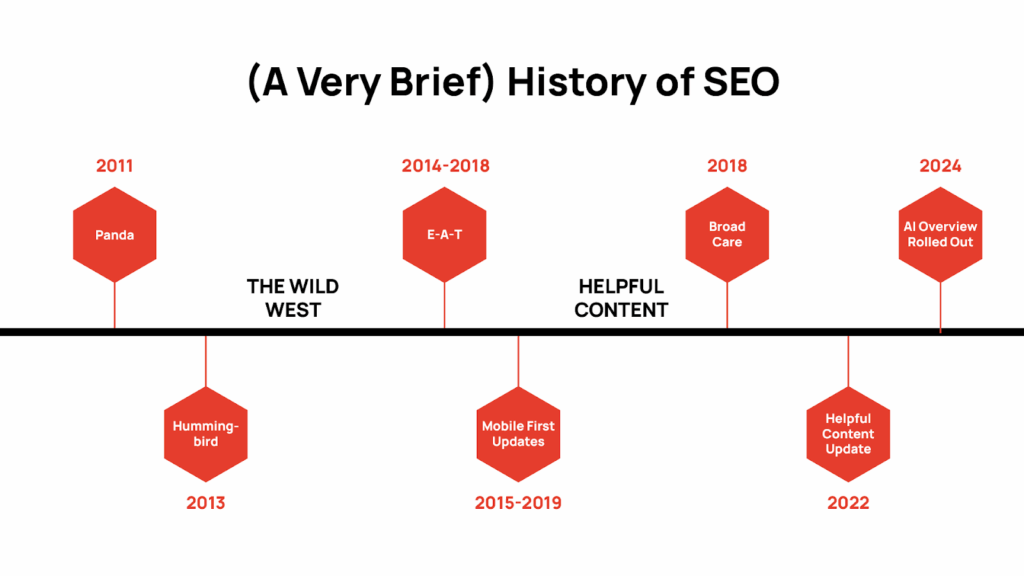
It’s the reason why, if you have been anywhere around content marketing, SEO, or even digital marketing in general for more than a few years, you will no doubt remember getting asked a question a million times, akin to “how do you balance SEO content and quality content.” Real ones know the truth: the best “SEO content” has always been high-quality content. And that kind of content is what has the power to withstand just about any algorithm update.
If that is not reason enough to focus on high-quality content, then let us also add this: The cost of bad content is steep. Analytics company CreativeX recently recently found that the average Fortune 500 company wastes approximately $25 million annually on content that fails to reach its intended audience or is not fully utilized.
It should come as no surprise, then, that the answer to combatting the current cacophony of AI slop is infuriatingly simple: produce high-quality content.
Ok, But…What Actually Is High-Quality Content?
I know, I know, that’s an incredibly unhelpful piece of advice. Because of course, anyone can claim to produce “quality content” but that means different things to different people. So, what do we mean when we say quality content? 97th Floor has a few principles that we have always lived by when it comes to both content and marketing in general.
1. High quality content is audience-focused
One of the main things that people get wrong about content marketing to this day is the how behind making the content itself audience-focused. As marketers, we can get caught up in how great we believe our solutions to be, that we get evangelical about the value that they bring — resulting in us pushing those solutions on our audience, rather than helping them. Quality content starts from a place of “what does my audience want or need?” rather than “what can we as a brand give our audience?”


| ❌ | ✅ |
2. High quality content is relevant to your brand
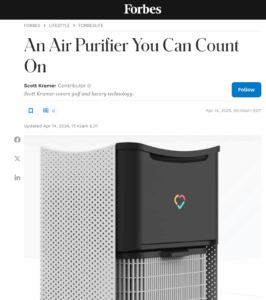
Ok, so you have figured out what the audience needs, and you have a ton of great content ideas. The next pitfall that marketers commonly fall into is trying to write everything. To illustrate: Take a quick moment to Google “best” anything and look at all of the sites that wrote about it, despite it being completely unrelated to their brand, product, or mission.
3. You are an expert and/or uniquely qualified to write this content
Authority matters. You might think this is the same as number two, but there’s a slight but significant difference. Something may be relevant to your brand, but you still have to prove yourself uniquely qualified to write it. This might come from expertise, experience, unique insights, or all three. This is also where the human element comes into play — even before AI, but especially now — users want content that they cannot simply generate by asking an LLM themselves. A unique and specialized point of view is more important than ever.
You may have noticed that our three quality content criteria and the use of AI are not mutually exclusive. On the contrary, we are not anti-AI evangelists. In fact, we use AI regularly to aid in efficiency and accuracy in the content creation process. However, it is rare (perhaps impossible) for a piece of content to match all three criteria without first passing by a human expert.
A survey conducted by consulting firm Baringa provides insight into opinions regarding AI-generated content by internet users. A majority of respondents identified at least one reason to value human-generated content above AI-generated content, with 81% citing “authenticity” as the key feature. However, users did not overwhelmingly state that they would avoid AI altogether — especially when it came to the younger demographics.
The fight for quality content is not a fight against AI, rather a delicate dance to make sure that it is used in the most effective way possible.
I Thought You Said You Could Prove It?
Ok, sounds like a nice theory, but does it actually work in practice? And can you prove it? In fact, we can. We have a proven history of this approach to content succeeding time and time again — surviving algorithm updates, changes in user behavior, and more. Here are a few examples.
Blendtec
Earlier, we made the claim that high-quality content will stand the test of time — and withstand algorithm updates. A perfect example of this is an article from way back in 2014 that we produced for Blendtec. A simple listicle of peanut butter smoothies, and accompanying recipes.
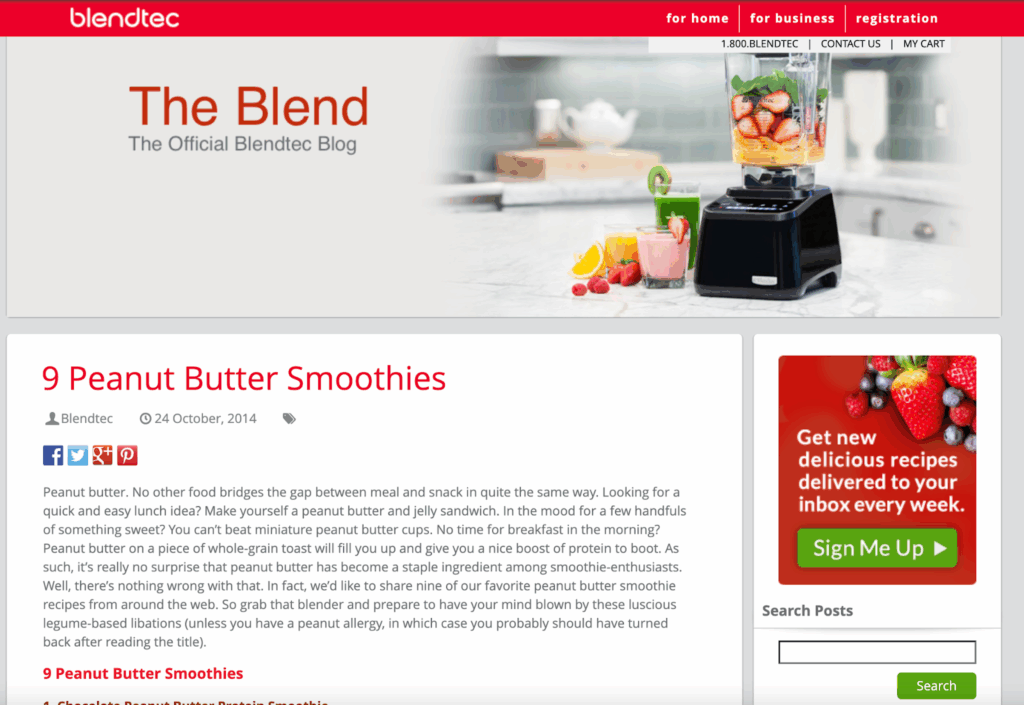
It meets our three criteria to a T and was incredibly successful when published. It continued to rank for several important keywords and survive several algorithm updates over the course of the next 10 years, to remain a top-three traffic driver for the site.
Dr Will Cole
Another example can be found in this guide on increasing progesterone levels for Dr Will Cole that we published and optimized in 2022.

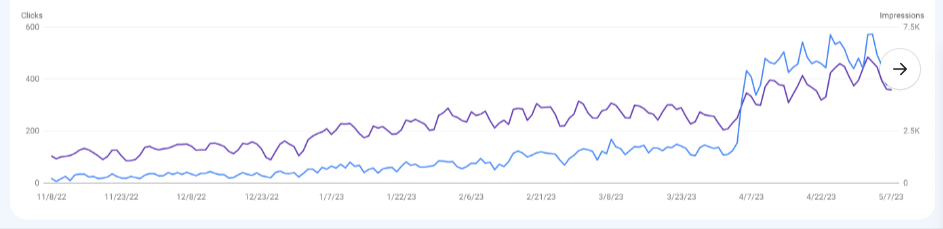
This article saw its biggest jump in traffic after an algorithm update in April 2023.
General Kinematics
But what about now? When AI is everywhere and AI Overview is stealing traffic from many pages. Well, we have countless examples of content that has survived the recent AI-pocalypse through following this simple formula for high-quality content. One such example this simple article for General Kinematics about uses for potash.
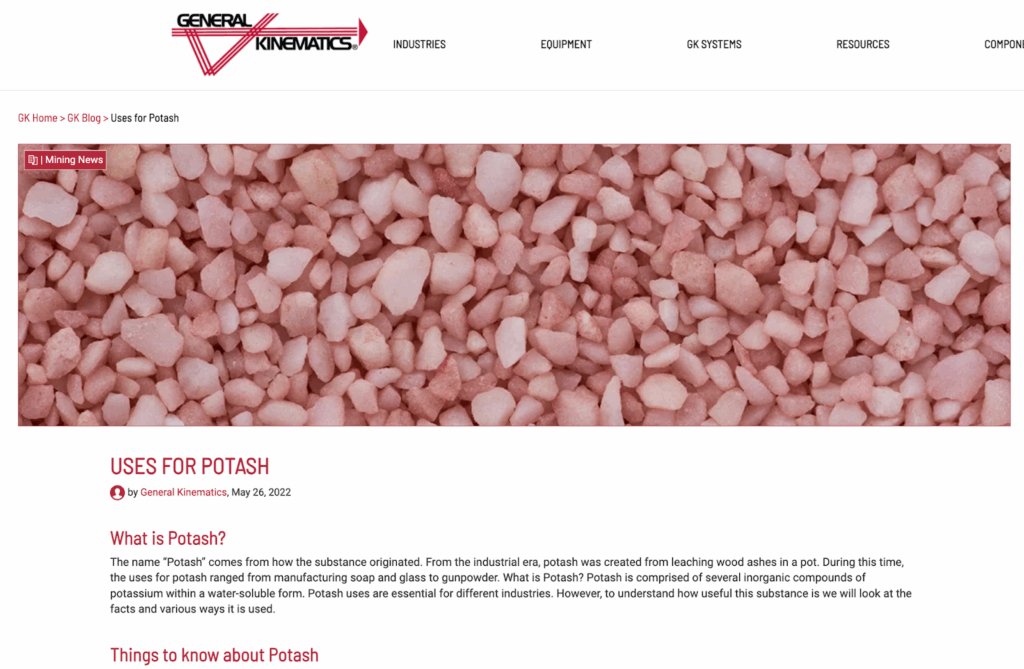
This content is audience-focused, brand-relevant, and something that General Kinematics — a producer of mining equipment — is uniquely qualified to write about. Published in 2022, it was automatically featured in AI Overview upon rollout of the feature in 2024, and has continued to do so since. What’s more: This page actually saw a 60.4% increase in traffic when you compare pre-AIO rollout to post-AIO rollout.
The bottom line: Google agrees with us. Every major and minor Google update in the past decade and change has been to get the search engine closer to prioritizing one of the three facets of quality content as identified by 97th Floor. For example:
1- Helpful content and other updates intended to prioritize user-first content.
2- Updates around brand authority, including recent updates that are deprioritizing irrelevant content for brands (or worse, brands that have spread themselves too thin and made it difficult for Google to assign authority).
3- This one goes beyond Google. Consider this: In a study of hundreds of thousands of citations, the most cited content type was product pages — by some margin. This means that this facet of quality content matters two-fold: Generic blog content is most likely to be directly replaced by LLMs, and product content — i.e. content that you are most uniquely qualified to write — is most likely to be cited. With optimizing both for and against LLMs becoming an increasing priority, this may be the most significant quality content guidepost of all.
I called out just three examples of this, but there are many more where that came from, and so will that continue.
The pattern across every one of those examples points to the same underlying truth. SEO expert Eli Schwartz makes the case that LLM visibility isn't a data or technical problem — it's a brand problem. This short video captures why the brands that consistently show up in AI-generated answers aren't winning on data. They're winning on authority.
Why It Matters Moving Forward
We talked about the ever-increasing noise of the internet. IBM predicts that AI will only continue to expand over the next decade, influencing more than content creation. High-quality content will continue to perform through both search engines and LLMs. The challenge or “noise” as marketers used to be different, but the solution is the same. If you put your audience first and prioritize quality content, the cream will rise to the top every single time.
Further Reading
Of course, that’s only part of the story. Sometimes you have to give even the cream of the crop the best chance to succeed. Next time, we’ll talk about how to get the most out of your content with an audience-first strategy.
If you're ready to show up in AI-generated results, let's build your strategy.
We’ve all felt it. You pour time into high-quality content, only to see your organic clicks drop—despite impressions climbing. What gives?
Welcome to the era of AI-powered search.
Google’s AI Overviews (AIO) and other generative engines are changing how people discover and engage with content. The game isn’t over—it’s evolving. And if you want to keep winning, it’s time to optimize not just for traditional SEO, but for AI-powered results.
At 97th Floor, we’ve spent the last year testing and refining strategies that help our clients show up and stand out in AI results. This guide breaks down what we’ve learned and how you can use it to grow.
Here’s a fast-track checklist that we stand behind:
We’re seeing a clear trend since the advent of Google’s AI Overviews:
This shift in metrics is significant. Your content is still being seen, but it’s not driving as many clicks.
This is largely due to AI Overviews, which are providing answers directly in search results—without users even having to visit your site.
In fact, research from Ahrefs revealed that AI Overviews reduce clicks by 34.5%. They analyzed 300,000 keywords and found that the presence of an AI Overview in the search results correlated with a 34.5% lower average clickthrough rate (CTR) for the top-ranking page, compared to similar informational keywords without an AI Overview.
This doesn’t mean SEO is dead. It means that SEO needs to evolve.
With this change in how users interact with search results, it’s important to note that KPIs are shifting. While clicks may be down, impressions are up—and brand mentions and search visibility are becoming increasingly valuable metrics. It's no longer just about tracking clicks; it’s about how your brand is being mentioned and perceived in the broader conversation.
At 97th Floor, we’re helping brands adapt to this new search landscape. We’re testing what works—and what doesn’t. In this article, we’ll walk you through how to optimize for AI and stay ahead of the curve.
AEO (Answer Engine Optimization) – Structuring content to appear in AI-generated answers and summaries (like Google's AI Overviews).
GEO (Generative Engine Optimization) – A broader strategy to improve how your content appears in LLM-powered results, including chatbots and voice assistants.
Other helpful terms:
Yes. But traditional SEO on its own won’t cut it.
GEO and AEO prioritize intent, clarity, and usefulness over keyword stuffing or link volume. Search engines (and AI tools) want to deliver satisfying answers, not just keyword matches.
Good keyword research still matters—especially when it covers both primary and secondary search intents.
Unlike traditional SERPs that rank blue links, AI search engines pull and generate answers using two main data sources:
They look for:
Here’s the opportunity: content that works well in LLMs often also ranks well in traditional SERPs. Optimizing for both doesn’t require two strategies—it just requires a smarter one.
AI content optimization is the process of structuring, writing, and formatting your content to be more useful and accessible to AI tools, without losing sight of your human audience.
Let’s be clear: the goal is not to “hack” the algorithm. The goal is to help people. To provide persona-driven content that resonates.
Too often, we see content stuffed with keywords or unrelated FAQs just to rank. That’s not helpful. It’s not what AI wants, and it’s not what readers want either.
Before you go all-in on optimizing for models instead of humans, this quick video breaks down why that approach can actually hurt your content’s real-world performance.
Start with your audience. Understand who they are, what they care about, and how they search.
Consider using audience insights to build Custom GPTs that speak in your brand voice and match your customers' tone. (Here’s a screenshot of what it looks like in ChatGPT to configure a custom GPT.)
We also recommend:
Start with the answer, then explain it.
Example:
Q: How do I optimize for GEO?
A: Focus on clear, structured answers, semantic HTML, and direct responses to user queries.
Then go deeper.
Also:
AI favors content that’s easy to parse. That means:
97th Floor Test Results:
After adding bullet points and clear heading structure to a product page for a 97th Floor client, impressions and AIO rankings for an SEO-optimized article skyrocketed from ranking on the third page of the SERP to the first page (and ranking in Google’s AI Overview) in a short period of time. Here’s the results:
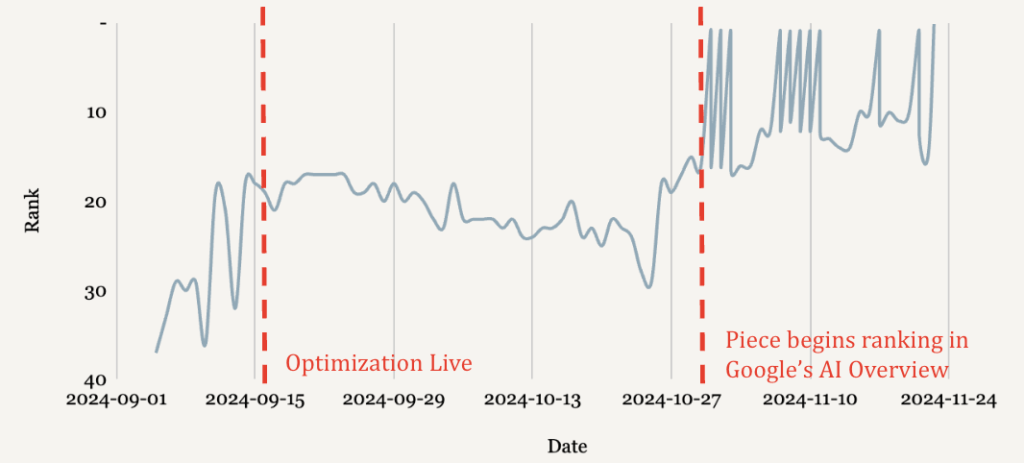
AI wants to serve trustworthy content. Show yours.
Ways to do that:
97th Floor Test Results:
By focusing on tightly-knit topic clusters, we were able to achieve topical authority for Princess Cruises:
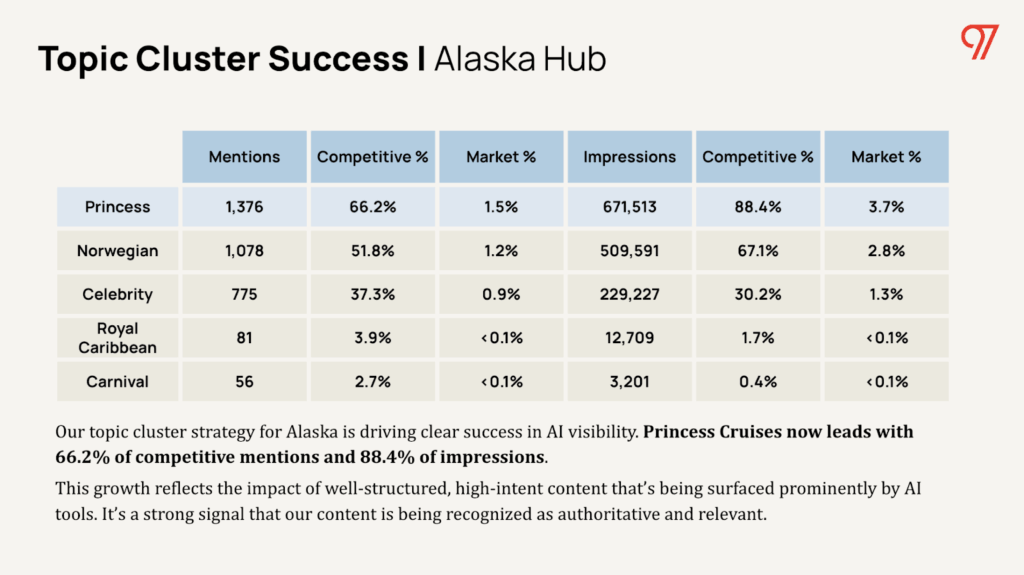
AI search engines increasingly value content from recognized, authoritative sources. This makes brand pages, like your About Us or Homepage, vital for building trust with both AI and human users. Additionally, third-party citations, such as mentions from reputable websites or reviews, are becoming more influential in how your content is perceived. Ensuring your brand is recognized across the web not only boosts authority but also increases your visibility in AI-driven search results.
AI is already reshaping how people find information—and how businesses earn attention.
At 97th Floor, we’ve helped our clients weather the shift from traditional SERPs to AI Overviews and GEO. Our strategies have earned AIO features early and consistently. And we’re continuing to test and refine what works as the landscape changes.
See how an audience-first approach translates to bottom-line results.
Google promises better results with just one click—“Apply All Recommendations.” But what if those recommendations aren’t actually in your best interest? At 97th Floor, we’ve seen firsthand how blindly following Google's automated suggestions can drain budgets and derail strategy. So we put it to the test. In a head-to-head experiment, we pitted Google’s recommended setup against our tailored, expert-built campaigns. The results were eye-opening—and could change the way you manage your ad spend.
We tested campaigns with three of our clients to compare the effectiveness of Google’s automated recommendations with the hands-on approach taken by our experienced advertising team at 97th Floor. Each campaign was structured to align with specific goals, but the key difference was in how they were managed:
| 97th Floor | ||
|---|---|---|
| Objective | Select one | Select one |
| Conversion actions | Auto-select | Manually select |
| Campaign type | Search | Search |
| How you reach goals | Visit website | Visit website |
| Bidding | Start with conversions | Start with clicks |
| Max CPC limit | Don’t start with one | Start with one depending on client; not too restrictive (e.g., under $10) |
| Networks | Allow Search partners and Google Display Network | Turn Google Display Network off; test Search partners if... |
| Location | Set a location as presence or interest | Set a location as presence only |
| Audience Segments | Observational targeting | Observational targeting |
| Broad match | On | Off |
| Automatically created assets | On | Off |
| Ad rotation | Optimize for best performance | Optimize for best performance |
| Ad schedule | None | Add if needed |
| Campaign creation | Go through Google's process | Go through 97th Floor's process |
| Ad copy | Use Google's suggestions | Written by expert content marketer |
| Budget | Equal budget | Equal budget |
| Optimizations | Turn on auto apply recommendations for this campaign | Optimize manually |
Here are the settings we kept the same between the control and test group. These are Google’s recommendations that we agree with.
| 97th Floor | ||
|---|---|---|
| Objective | Select one | Select one |
| Campaign type | Search | Search |
| How you reach goals | Visit website | Visit website |
| Audience Segments | Observational targeting | Observational targeting |
| Ad rotation | Optimize for best performance | Optimize for best performance |
| Budget | Equal budget | Equal budget |
When you feed a smart bidding system bad signals, you get bad results. We focus on signal quality to guide the algorithm toward actual business growth — not just form fills or button clicks that look good on paper.
| 97th Floor | ||
|---|---|---|
| Conversion actions | Auto-select | Manually select |
Smart bidding needs data to perform well. Jumping straight to "Maximize Conversions" without historical data is like trying to sprint before you've learned to walk. Our approach allows us to build a strong foundation — minimizing waste while setting the campaigns up for smarter automation later.
AI tools speed up the work — whether they're improving it is a different question. Whitney Goldstein draws the line, and this short video breaks down how to tell which one your workflow is actually delivering.
Without a CPC cap, Google can overspend on low-quality traffic. We applied reasonable limits to protect budget efficiency.
| 97th Floor | ||
|---|---|---|
| Bidding | Start with conversions | Start with clicks |
| Max CPC limit | Don’t start with one | Start with one depending on client; not too restrictive (e.g., under $10) |
The Display Network may offer more impressions, but not always better ones. Especially early on, we want every click to count — and that means keeping the focus tight on search intent, not expanding blindly into display.
Advertising to someone thinking about your market is not the same as advertising to someone in your market. Having your location set as presence or interest allows Google to waste your dollars on the wrong users.
Google's default runs ads 24/7. We customized schedules to align with peak engagement and business hours when necessary.
| 97th Floor | ||
|---|---|---|
| Networks | Allow Search partners and Google Display Network | Turn Google Display Network off; test Search partners if... |
| Location | Set a location as presence or interest | Set a location as presence only |
| Ad schedule | None | Add if needed |
Broad match can open the floodgates — sometimes usefully, sometimes recklessly. We prefer a controlled expansion. Typically, we prioritize stricter match types, like phrase or exact. We use broad match strategically, mostly on longer tailed terms since the intent is more spelled out. It’s important to test broader match types strategically—you don’t want to waste ad spend but you do want to take into account that 15% of searches every day are new. People could be in the market for your product or solution but type it in differently than your keywords. Broad match keywords are a good way to mine for new keyword ideas.
| 97th Floor | ||
|---|---|---|
| Broad match | On | Off |
Auto-generated ads often sound robotic and generic, or can state things that are outright wrong. We believe brand voice is too important to automate away — especially when you have just seconds to grab a user’s attention and build trust.
| 97th Floor | ||
|---|---|---|
| Automatically created assets | On | Off |
In every case, the campaigns managed by 97th Floor outperformed those set up using Google’s automated recommendations. Here's a breakdown of the results:
The data speaks for itself—relying solely on Google’s recommendations can leave performance on the table. While Google’s automation offers convenience, it lacks the precision and strategic insight required to maximize advertising budgets effectively. 97th Floor’s campaigns delivered better results, proving that expertise and human intervention are essential for optimal ad performance.
If you're relying entirely on Google’s automation, you could be spending more without seeing the results you deserve. At 97th Floor, we offer expert campaign management that outperforms Google’s one-size-fits-all approach. Contact us today to see how a professionally managed campaign can transform your advertising results.
See how an audience-first approach translates to bottom-line results.
