



SEO is changing.
Oh, you’ve heard that one before? It’s true; SEO has been many things in the twenty or so years that it’s been around, but static has never been one of them. What began with simple keyword stuffing and quantity-over-quality link building has evolved into a deeply strategic and data-centric discipline — one that prioritizes intent over tricks, clarity over cleverness, and exploration over exploitation. So, yeah SEO is changing and always has been. But 2026 hits a little differently.
This new year is the dawn of a new era. Search is no longer just a list of links politely waiting for users to click them. It’s answers, summaries, recommendations, and increasingly confident machines stepping in as intermediaries to decide whether your content deserves to exist at all. AI-driven search is adding a new and somewhat unforgiving layer to SEO. It’s not an entirely new game; traditional ranking factors still matter, it’s just that they don’t carry the same weight they once did. And that changes what it means to be visible.
Simply put, the rules of SEO have evolved, and the brands that adapt to meet these changes will come out on top.
The biggest shift is in where and how those changes are showing up:
Which brings us to the inevitable question: If SEO now depends on how content is interpreted (rather than simply ranked), where does that leave the growing pile of labels we use to describe it?
The SEO lexicon is growing: Generative engine optimization (GEO), Search Everywhere, AI Search Optimization (AIO)... It’s a whole new world of terminology. And don’t you dare close your eyes, because these terms are symptomatic of how search itself now operates across more systems than a traditional SERP ever could.
Modern visibility includes rankings, citations, summaries, and recommendations that appear across AI tools, discovery platforms, and search-adjacent environments. Evolving SEO strategies account for all of these surfaces by focusing on interpretability, credibility, and usefulness at scale.
So, whether we’re talking about SEO or GEO, we’re ultimately describing the same responsibility: ensuring that your content can be found, understood, trusted, and reused wherever search behavior shows up.
And wouldn’t you know it? In 2026, that responsibility extends beyond ranking signals and into how information is structured, contextualized, and validated across systems that are increasingly taking on the role of interpreters. Strategy lives in the connective tissue — how ideas relate, how authority is demonstrated, and how consistently value is delivered across touchpoints.
Labels will keep changing. The underlying work remains focused on building visibility that travels well and earns its place wherever discovery happens.
But "wherever discovery happens" increasingly includes systems that surface answers very differently than a traditional SERP — and those differences aren't cosmetic. Blake, Account Director at 97th Floor, takes on the question every SEO team is quietly wrestling with: is AI search a meaningful shift or just the next version of the same game? His answer cuts through the noise with a practical lens on what actually changes and what stays the same. This short video breaks down the real distinction between traditional search and AI search — and what it means for how you build visibility today.
Have we belaboured the point enough? If not, let’s just come right out and say it. 2026 isn’t being defined by a single update, tool, or announcement. What’s changing is the environment in which search operates and the expectations placed on the content that moves through it. Search marketers now operate in a space where content gets evaluated repeatedly — by users, by traditional search systems, and by AI-driven interfaces that summarize, filter, and recommend information at scale. That layered evaluation changes where effort pays off and where shortcuts tend to collapse.
Let’s take a look at the most consistent pressure points shaping evolving SEO strategies this year:
When it comes to AI search, generative systems interact with content very differently than traditional crawlers. Instead of indexing pages and ranking them in isolation, they ingest large volumes of information, identify relationships between concepts, and reconstruct answers dynamically.
That process places real weight on how content is constructed. Definitions that arrive early, terminology that stays consistent, and sections that stay focused all influence how information survives interpretation. When ideas are clearly framed and logically ordered, they remain intact even after being separated from their original page.
This changes how teams need to approach content creation. Planning now includes AI-search considerations and thinking about how information might be extracted, summarized, or recombined elsewhere. Content that holds together under that pressure tends to surface more often and persist longer across AI-driven environments.
Authority now grows through accumulation.
Search engines and AI systems pay close attention to how thoroughly a site explores a subject, how consistently it answers related questions, and how naturally its content interconnects. And yes, individual pages obviously still matter. It’s just that their performance increasingly reflects the strength of the entire surrounding ecosystem. Topic clusters support this by creating continuity. Internal links guide readers through related ideas while giving machines a clear sense of scope and relevance. Over time, this builds a reputation for depth that benefits new content as soon as it enters the system.
For organizations publishing at scale, this approach also introduces stability. Authority spreads across related assets instead of concentrating on a single page. And as authority accumulates, new content enters the conversation with momentum already behind it.
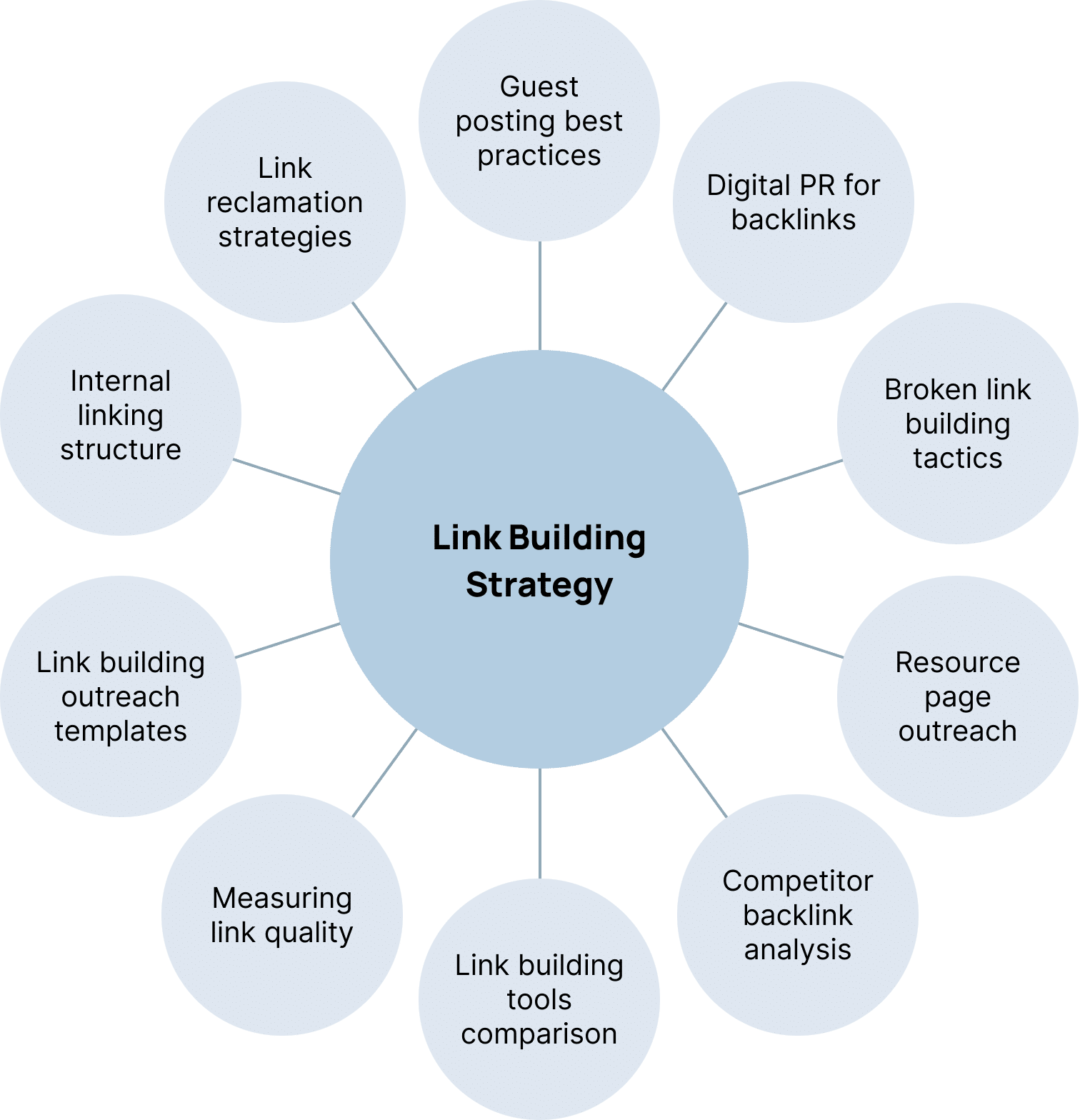
Experience shapes perception long before rankings enter the picture. In practical terms, this is where user experience (UX) and search experience optimization (SXO) converge, shaping how people interact with content and how search systems interpret those interactions.
When content loads quickly, reads clearly, and flows logically, users engage with confidence. Those behaviors generate signals that ripple outward across search systems. Structure plays a central role here. Clear headings support scanning. Thoughtful spacing reduces cognitive load. Consistent formatting helps readers orient themselves as they move through complex topics. And this is just as true for LLMs as it is for human readers.
It may seem strange to suggest that AI would care about design, but it absolutely does. Or, to put it another way, content structure is often among the first signals a system uses to understand the navigability and coherency of the information on the page (even before it evaluates overall subject matter).
As search surfaces continue to prioritize usability, experience becomes inseparable from visibility.
Credibility rarely announces itself directly. It accumulates quietly, through patterns that repeat over time. Readers, on the other hand, pick up on those patterns almost immediately. They notice when content reflects lived experience instead of abstract advice. They notice when examples feel earned, when sources make sense, and when a brand sounds like the same brand from one page to the next. That familiarity builds confidence, even if the reader can’t quite articulate why.
AI systems likewise pay attention to many of the same cues. Authorship, sourcing, topical consistency, and historical performance all influence which information gets prioritized. Content that demonstrates experience and expertise in small, repeatable ways tends to travel even farther in 2026.
This is what Google refers to as E-E-A-T: Experience, Expertise, Authoritativeness, and Trustworthiness — the signals that help determine what content earns visibility. For teams working on evolving SEO strategies, this realigns the focus from chasing isolated wins to building a reputation. Clear authorship, transparent sourcing, and original insight all contribute to that reputation.
Just be aware that this credibility is both cumulative and fragile. Each accurate, useful interaction reinforces the next, creating credibility that’s difficult to fake. But at the same time, when content gets stale or expert advice gives way to generic advice, that credibility quickly and quietly starts to erode.
Discovery rarely happens in a straight line. People don’t sit down, type a query, read one page, and call it a day. They skim an article, review an AI overview, glance at an image, save something for later, and circle back when the timing feels right. Some of those moments happen in long-form content, where depth and detail matter. Others happen through visuals, short videos, structured summaries, or quick references designed to help ideas click faster. Each platform shapes how information is absorbed and remembered, even when the underlying message stays the same.
This shifts how content earns longevity. Ideas that translate across formats tend to stay visible longer because they meet people in different states of attention and curiosity.
For evolving SEO strategies, this flexibility supports consistent presence across a widening ecosystem. Content that travels remains discoverable, recognizable, and useful as platforms and behaviors continue to evolve. Alternatively, non-traveling content puts all its eggs (visibility) into one basket (surface), losing relevance everywhere else as discovery habits shift around it.
Site visitors show up carrying context: how much they already know, how urgent the problem feels, how close they are to making a decision, etc. Sometimes they’re trying to understand a concept for the first time. Other times they’re pressure-testing an option, looking for reassurance, or even just sanity-checking a choice they’ve mostly already made.
Content that works acknowledges those mental states explicitly. It anticipates the questions that naturally follow and answers them in an order that feels intuitive. When that happens, the content feels relevant almost immediately, because it meets readers where they already are instead of asking them to recalibrate.
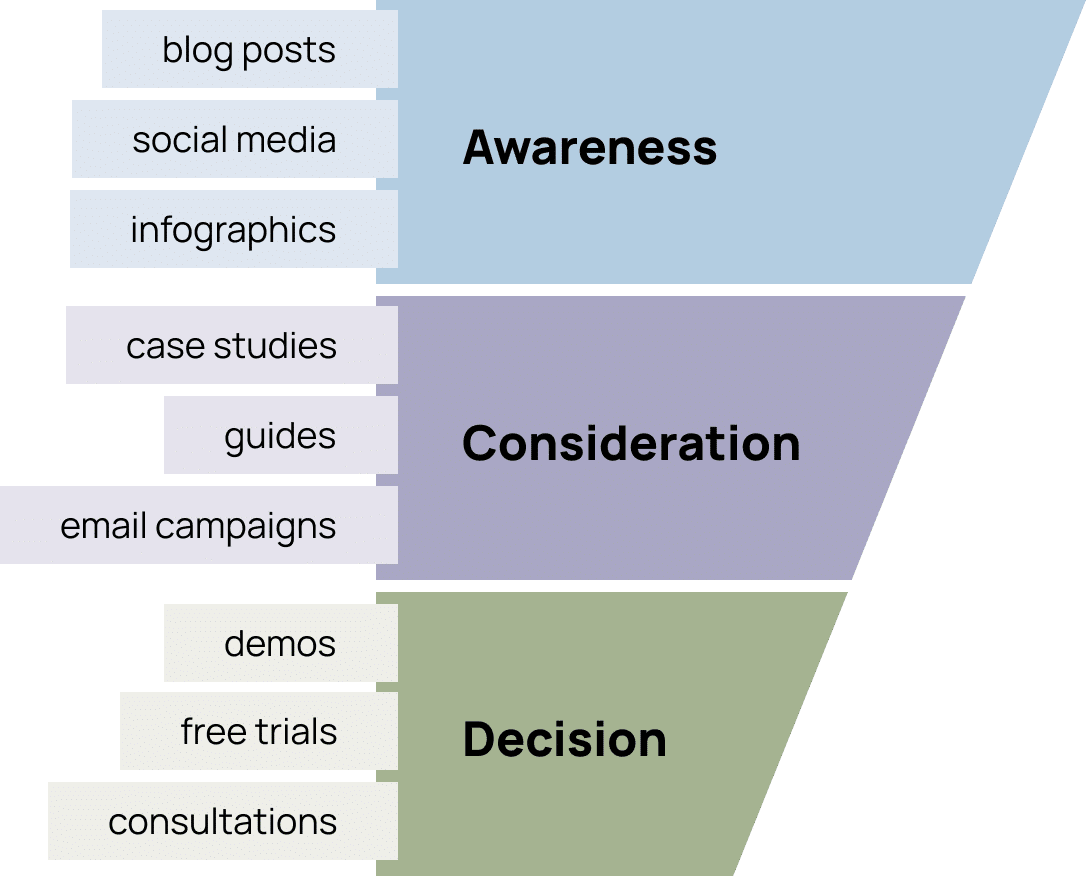
Early-stage content helps people understand what problem they’re dealing with. Mid-stage content helps them sort through their options. Later-stage content helps them decide what to do next. Together, these pieces form a throughline that reflects how real decisions unfold over time. When intent is baked into structure, it’s easier to read, easier to trust, and easier to decide whether it’s actually useful — both for readers and the systems evaluating how that content performs.
Measurement has gotten messier. Why? Because influence now shows up in more places than a traffic report can easily capture. Modern SEO metrics now include:
When measurement evolves alongside strategy, SEO becomes easier to defend, easier to scale, and easier to integrate with the rest of the business.
So, where are the mistakes happening? As with many roads to hell, these ones are paved in good intentions applied a little too narrowly.
They say that the journey of a thousand miles starts with a single step. We’d suggest that it starts before that step, by taking a look at where you’re standing right now.
At 97th Floor, SEO and AI search solutions are built around how search actually works today, and how it continues to change.
Our SEO services integrate AI search considerations, technical SEO, and content strategy into a unified framework built for modern discovery. The focus stays on building durable authority, improving interpretability across platforms, and aligning search visibility with meaningful business outcomes, all while ensuring that the human element doesn’t get lost along the way.
That work is supported by proprietary frameworks, deep analytics, and close collaboration across SEO, paid media, and measurement teams. The result is a strategy designed to hold up across platforms and continue performing well even as search behavior evolves, making 97th Floor one of the best AI SEO agencies available today.
SEO is changing… and it will keep changing. Our role is to help brands stay visible through that change by building strategies rooted in clarity and adaptability, optimizing for the future of AI search even as we keep sight of those fundamentals that will always remain relevant.
If you’ve ever Googled something in the last year, you’ve likely seen an AI summary pop up at the top of the SERP page. Whether you read that answer or not, having those AI summaries on search engine results has changed the way users interact with websites and the way SEOs are approaching optimization.
Even though SEO is shifting, there’s no reason to worry about its future. SEO is around to stay—and so is AI. The key is learning how to use both together in an effective way to get your content to your audience and to help you reap the benefits of online visibility. Read on to learn all about AI and SEO, best practices for adjusting your strategy, and where the future of search is going.
SEO is what helps your page show up on search engines to meet user queries. However, recently, the top slots are going to an AI summary, and the AI tool will search across pages to find information to fuel its responses. AI SEO also includes using AI like machine learning (ML), natural language processing (NLP), and predictive analytics as a tool in your own SEO process. It’s all about getting your website to display in AI searches as well as using it to help you improve your own work.
Unlike traditional search optimization, which largely focused on keyword placement, backlinks, and static algorithmic signals, AI-enabled SEO adds several new dimensions:
Here are some concrete examples of how AI capabilities are already being applied in search and SEO:
AI is reshaping the SEO landscape by powering smarter search engine results pages (SERPs) and fueling the rise of AI-driven answer engines. Instead of delivering a list of ranked blue links, modern SERPs often feature AI-generated summaries and at the top of a SERP to answer questions directly—reducing the need to click through to websites.
This shift moves the focus of SEO from traditional rankings to retrieval and representation. It's no longer just about being on page one—it's about being cited or summarized by AI models that interpret and surface the most relevant content from across the web. As a result, user behavior is evolving. Click-through rates (CTRs) on traditional organic listings are declining in some categories, while zero-click searches are increasing.
The goal now is to curate your content in a way that makes it easy for an AI tool to retrieve and summarize it.
Understanding which AI platform your content needs to perform in just got a lot clearer. SEO expert Eli Schwartz breaks down what Apple's partnership with Google Gemini means for the future of search — and why it cements Google as the dominant AI search platform you need to be optimizing for. This short video captures exactly how Google won the AI search war, and what that means for the strategy you're building right now.
As generative AI becomes more integrated into search engines and digital assistants, SEO strategies need to evolve to make sure your pages are staying on top and showing up in the right searches. AI usually considers these three key factors when choosing content to cite:
Certain formats tend to perform better in AI summaries, including:
AI can also help you work smarter, not harder. AI tools can automate keyword research, detect content gaps, and personalize experiences across channels to help you find the right areas to create content.
Integrating AI into your SEO strategy doesn’t need to be overwhelming. As SEO experts, we’ve worked hands-on with AI search optimization across many industries, and we’ve identified four best practices that can help your team adopt AI.
The best way to begin is with low-risk, high-visibility pilot tests. Try AI tools on smaller tasks—like keyword clustering, meta tag suggestions, or content outline generation—and track performance over time. Use these early experiments to measure output quality, workflow impact, and time savings. Once you understand where the tech shines (and where it doesn’t), you can scale up confidently.
Choose AI tools that work well within your existing SEO stack. You’re likely using CMS platforms like WordPress and Webflow or analytics tools like GA4, Looker Studio, or Search Console, and you want AI tools that work with those. Don’t just chase “shiny” AI features. Make sure they fit into your real-world systems.
AI is a powerful assistant but not a decision-maker. Use it to automate repetitive tasks, surface insights, and speed up processes, but keep humans in the loop for critical thinking and decision making. Humans need to make big decisions, look over AI content, and check for brand consistency.
AI in SEO is not a static playbook—it’s an ongoing evolution. Keep your team learning with hands-on training and encourage experimentation with new tools and techniques. Look for ways to bring real value into daily workflows: faster content ideation, smarter optimization, better insights. All of this will help you optimize for AI search SEO.
While AI gives you a wide range of advantages with SEO, there are some new challenges to prepare for, including:
As AI transforms how search works, the role of SEO professionals is evolving just as quickly. Instead of spending time on purely manual tasks—like keyword tagging, metadata updates, or technical audits—SEO pros are stepping into more strategic roles. Their job isn’t just to optimize for algorithms, but to understand how people and machines interact.
AI is a powerful tool, but it complements—not replaces—human expertise. Machines can generate content, identify trends, and automate repetitive tasks, but they can’t replicate human creativity. SEO teams must now balance automation with context, voice, and long-term vision.
At 97th Floor, we’ve embraced this shift by changing the name of our SEO department to the Search Department. This rebrand reflects a broader mandate: we’re no longer optimizing only for search engines—we’re optimizing for how people experience search across AI chat, answer engines, smart devices, and traditional SERPs.
As AI reshapes how people discover and consume content, the way we measure SEO success must also evolve. Here are our tips for measuring success.
The future of SEO is about aligning with how AI understands, retrieves, and delivers information. Several key trends are shaping what’s next:
To stay competitive, SEOs must prepare for ongoing shifts by adopting agile processes, investing in AI literacy, and building systems that track visibility across traditional and AI-powered platforms.
If you want to see what can be done with AI SEO strategy, look no further than 97th Floor’s campaign with Princess Cruises. We helped Princess Cruises move beyond siloed pages toward a tightly interlinked topical cluster model. The aim was to layout content in a way that signals topical authority, which helps AI systems find more contextually rich responses and increases the chance that Princess content is cited or summarized in AI-driven overviews.
The results were dramatic:
By marrying strategic direction with hands-on execution, we turned AI‑centric theory into concrete gains—while proving that human judgment, agility, and domain knowledge remain indispensable.
If your SEO team is wondering whether AI‑driven search is already rewriting the rules—this case shows it is, and early wins are possible. The shift is not hypothetical. It's real, and the rewards go to teams that think differently about content structure, authority, and AI visibility.
If you'd like to explore how generative search can work for your brand—or see how 97th Floor can help you architect a strategy and workflow—learn more about our AI SEO services.
Curious about how to get your brand noticed on Perplexity Search? You’re not alone. With Apple’s rumored acquisition of Comet making headlines, marketers everywhere are wondering if this AI-powered browser might be the next big thing in search. Whether you’re here to stay ahead of the curve or simply want your site to pop up in more AI-driven answers, you’ve come to the right place. Let’s dive into what makes Perplexity tick—and how you can use it to your advantage.
More than 2-thirds of smartphone users in the United States use an iPhone as their smartphone of choice. About 50% of all internet traffic starts on a mobile device in the United States. Being the default browser and search engine for 68% of half of all internet usage in the United States sounds pretty great right? That might be the reality for Perplexity and their new browser, Comet, as Apple is currently determining if they will go through with the 14 billion dollar acquisition. That is an eye popping amount of money for an acquisition of a company that has never turned a profit (actually lost $65 million in 2024). However it could be a leap forward in AI development for Apple who is severely behind its big tech competitors.It would also mean a real threat to Chrome and less reliance on using Google products on Apple devices. A true threat to Google Search is something that Google has not experienced in decades. The threat is given even more credibility by the fact that Comet is actually quite good and those who have tested it rave about the AI-enhanced browser with built in perplexity search engine. Even if the acquisition from Apple does not go through, it is interesting enough of a search product to look into ranking organically on the Perplexity search and optimizing web content for LLMs in general as the jump in AI-search queries has increased from 250m to 1.1 billion in the last year alone!

In one of our tests, we found that the top ranking page on Google, for non-branded terms, was never the same as the top result in Perplexity. Even more alarming was that each 1:1 query resulted in 85% unique results across Google and Perplexity. While there will be some principles of Search Engine Optimization that remain the same, the results are different enough that a close examination of the top ranking factors for perplexity was necessary. After analyzing SERPs using queries and prompts from multiple industries on Perplexity, we have compiled our top ranking factors for Comet, and the Perplexity search engine here.
The best way to strategize for Perplexity Search is to like traditional SEO, break it out into on site, or on domain optimizations and off page or off domain optimizations. Only off page and on page optimizations don't mean quite the same thing for LLM optimizations as they do for traditional SEO. Below are the most impactful on page and off page optimizations for perplexity search.
From tests we have been running with our clients, we found that the first place that an LLM bot will go to find information about your brand and how it fits into the market, is by analyzing the brand’s own domain. The home page, about us page, any solutions, services or product descriptions, are all very common sources of information for the Perplexitybot and other LLMs. Which is great news for marketers and website managers, that is owned content that is generally very easy to optimize. The LLM will go to your brand’s domain for information about what you do and who you serve, then look to external sources in your industry to back up the claims you made on your own domain. The following are off page optimizations that will boost your presence when your audience is searching on Comet.
Perplexity user experience is much different than OpenAI GPT, Google’s Gemini, or Claude, primarily in its use of source cited and clickable elements in the generative responses. If traffic is still a metric SEOs and website managers are interested in increasing, Perplexity winning the AI race seems to be the best chance website owners have at seeing increases in referral traffic. So how is optimizing for Perplexity Search? Here are a few things to consider:
The team at 97th Floor is doing the work to find every opportunity to increase brand awareness on new and tried and true platforms. Perplexity’s new browser, Comet, has real potential to be a widely used search engine and make a dent into Google's Search market share dominance. When and if that happens, we will be fully prepared to optimize for Comet. Lets connect, our team will do an AI-search competitive analysis for your brand free of charge, to identify opportunities in AI search and if your audience is already adopting Perplexity Search and using the Comet Browser.
Use these free tools to unburden your site of low-value content that prevents an LLM from understanding your brand. Watch your SEO performance skyrocket.
Marketers have a lot going on in 2025.
Marketing budgets are at an all-time low post-pandemic. At companies feeling especially strained, what little budget remains is controlled by a CFO whose concern is for immediate ROI instead of long-term strategy.

Search is undergoing its own metamorphosis as AI continues to dominate SERP results and Google pushes out more algorithm changes than ever before. Gartner predicts that search engine volume will drop 25% by 2026 as audiences turn to AI chatbots and social platforms for information.

To sum up, marketers are expected to do more with less budget, grow at the whims of Google, and learn how to use AI while also combatting AI.
The response to the chaos is to focus on the core tenets of marketing–aligning our messaging to the audience and our CTAs to a robust full-funnel strategy.
Brands that will reach their audience across the entire funnel know that a message is more important than the channel through which it is sent.
Dollar Shave Club (DSC) came onto the scene in 2011 with a pioneering direct-to-consumer subscription model for high-quality razors delivered monthly for just a few bucks. The startup's messaging positioned themselves as the long-sought-for alternative to overpriced razors loaded with gimmicky features. DSC was scrappy, smart and spoke directly to their audience’s desire to save money.
Unilever bought DSC in 2016 for $1 billion cash, surely with intentions to turn the brand into a profit machine. But Unilever misunderstood DSC’s audience.
DSC was cool precisely because it wasn’t part of a massive conglomerate. Its audience loved a rugged brand born out of a viral YouTube video that offered them an alternative to $35 shaving kits.

But all that Unilever could see was the sexy world of commercials. In 2019 Unilever produced a new video for their brand DSC, inviting men and women of all kinds to “join the club.” Actually, Unilever made a slew of commercials with the same deadpan style as the 2011 hit that made DSC go viral. But it wasn’t shirtless bodybuilders squeezing shampoo bottles or sphynx cats in a shave butter heaven that made DSC successful. Okay, well kind of.
DSC subscribers love funny videos. But if the funny video doesn't have the right messaging, it still misses the mark. Unilever was too focused on channels to really understand the audience and message that DSC customers were so fanatical about.
In an effort to maintain profit margins in retail, Unilever expanded DSC’s offerings to include products such as hair cream, cologne, face moisturizer, and sunscreen. But these products cost anywhere from $10-50.
The same customer that wants quality razors for just a few bucks isn’t going to spring for a $50 bottle of cologne.
In 2023 Unilever sold their majority stake in DSC after seven fumbling years trying to grow their profit margins.
Don’t be Unilever. Know your audience. Listen to them. Create messaging that speaks to their core desires and don’t be distracted by flashy new channels.
That last part is the trap. "Flashy new channels" are usually demand channels in their prime — which means they're also the channels that will plateau, saturate, and eventually stop delivering. Udi Ledergor, former CMO at Gong, warns that every demand channel has a lifespan, and brands that build their entire growth engine on today's working channel are building on borrowed time. This short video captures what it looks like when a channel stops working — and what smart teams are already doing about it.
Something is happening to the marketing funnel. It’s waist? The core middle section that holds all those essential organs? Itty bitty. Hourglass. Nearly invisible for far too many brands.
Top of funnel content is fun! It’s exciting, it’s new, it’s engaging. Bottom of funnel strategy gets the bulk of the resources. “Leads leads leads,” we hear the CEO chanting as we ask for more SEO spend. And the mid-funnel? Forgotten.
Developing a strong mid-funnel strategy is the most crucial effort that marketers can make to increase engagement in 2025.
Mid-funnel content is the heavy hitter—or it should be—in helping your audience to trust you, become true experts in the solutions that can address their problem, and feel prepared to make a decision. This is where your audience wants to hang out.
B2B buyers are self-navigating their way to purchases. They’re not including sales people; they’re doing extensive research on their own. The brands that deliver robust early and mid-funnel content to these B2B buyers will win engagement and ROI.
A report published by Demand Gen reveals that B2B buyers consider the following to be characteristics of early- and mid-funnel content memorable enough to warrant a sales call:

The report also identified interactive content as important in the mid-stages of the buyer’s journey. This content can look take many forms, but respondents prefer:
Build mid-funnel content that allows your audience to do the research that they want to do anyway, but with you.
Ever read an article with a title like “Ten Motivational Quotes for a Tuesday” only to be hit with a “try our complicated SaaS platform” CTA?
All over the internet we’re seeing bottom-of-funnel CTAs slapped on top-of-funnel content. It’s jarring.
In 2025, engagement will hinge on how well marketers align their CTAs with the specific stage of the buyer’s journey.
Marketers should judge every single CTA against two factors: value and relevance.
First, a CTA should continue offering value to your audience. They should get something or learn something that continues to guide them on their journey and help them solve their problem.
Second, a CTA needs to be relevant to the content it appears with. A motivational quote article doesn’t need a CTA for a demo, but maybe a CTA for a productivity guide? That’s closer.
CTAs should mirror the knowledge and intent of your audience. Ask yourself this: if I were engaging with this content what would I want to know or do next that would get me closer to a resolution? That’s your CTA.
Successful marketing strategies employ multiple CTAs, each tailored for their audience’s specific needs at each stage in the funnel.
If marketing is undervalued, brand marketing is the poster child for it. Convincing leadership to lend a budget for top-of-funnel awareness plays can feel impossible in the face of a recession scare.
But marketers know the truth: having a strong brand protects performance dips in every other channel–especially organic and paid.
A strategic brand campaign can have massive ROI that rolls in new business for a long time after the campaign concludes.
One of the most overlooked brand channels is already built into your product. Former Slack CMO Bill Macaitis explains why every free user is quietly acting as a member of your marketing team, spreading awareness and pulling your brand into new organizations. This short video breaks down why your free users may be your most underutilized marketing asset.
Back to the earlier point about the mid-funnel, building strong mid-funnel strategies and CTAs along the full funnel mitigates some of the risk of investing in top-of-funnel brand marketing. Put in different terms, if you want the buy-in for your top-of-funnel dream campaigns, build the mid-funnel first and connect the dots for upper leadership.
A brand marketing campaign should not be a drop-off.
Create a journey. Make your upper-funnel content work for you by hooking your audience on valuable content that logically follows through a whole network of truly useful resources and touch points.
If we had published this article even a year ago it may have felt elementary. Of course we need mid-funnel and multiple CTA. Of course we need to focus on messaging that hits home with our audience!
But in 2025, it feels necessary to re-center on these core tenets of building a brand that audiences trust.
This year we're giving you the tools to succeed by digging into the strategies that top B2B leaders use to turn marketing challenges into meaningful wins. Subscribe wherever you enjoy podcasts.
Locked away in a vault for nearly 150 years, the Coca-Cola formula is one of the most secretive and highly-guarded pieces of proprietary information in US company history. The only rival worth comparison is the one and only Google Search Algorithm, that great unknown that dictates the lives of SEOs determined to win rankings.
Google rarely shares how it decides what pages to show for which search queries, leaving SEOs to wrestle with the wimpy scraps of information that Google does reveal. However, scrappy SEOs have successfully reverse engineered the algorithm over the last two decades to determine the most impactful ranking factors.
But it seems that the more SEO professionals discover about how the Search Algorithm works, the more Google tries to protect their “secret formula”.
Hardly has a breakthrough graced the front page of Search Engine Journal before Google is issuing carefully worded public statements that confuse the true meaning, all in the name of protecting the algorithm.
What reasons does Google have to hold their ranking algorithm so secretive? Here are a couple to consider:
Well, last week the “vault” malfunctioned. From credible sources, there was a reported internal Google API Docs leak that shed some light for the first time on what Google considers when ranking pages for keywords. Given the history of secrecy and occasional dishonesty from Google around their algorithm, this is a really big deal! Before we jump into our biggest takeaways from this leak it's important to note a couple of things:
There is no information on a scoring system that Google uses to weight these ranking signals that were discovered in this leak. So testing is still very much necessary in determining the impact of these ranking signals.
While it is very exciting to have confirmation of long suspected ranking signals, these ranking signals still very much fall in the middle of these two categories. Without a scoring system, we do not know how important or unimportant they are without testing for a wide range of keywords.
Even though it has long been denied by Google that they use user click and interaction data as a ranking factor, ranking signals found in the leak contradict this claim. The click data metrics measure whether users found what they were looking for when they clicked on the page in the SERP or not.
Why Does it Matter?
This knowledge opens the door to increased emphasis on creating a user experience that matches what the searcher intent is. Obviously this has always been of high importance, but now we can run user experience tests and competitor analysis in the name of ranking higher for intended keywords. One example of what this could look like is testing different pricing strategies to determine if the price of our product does not match expectations, causing the user to bounce after seeing the price, and how that affects our rank on the SERP.
It's important to know that Google is a hoarder-of data. Google saves nearly everything it crawls. According to this leak, the last 20 versions of a page are considered when ranking a page.
Why Does it Matter?
We can now have a better idea of how long Google will take to understand which keywords we want to rank for when a site goes through a rebrand or re-positioning in a market.
The quality and user experience of the homepage of a site is considered every. single. time. a page is ranked by Google. We also suspect that it matters if what is found on the home page is on topic with the content on the page being considered by Google
Why Does it Matter?
The home page can be used as a way to test if Google is considering it as a significant ranking factor for a focus keyword.
The leak showed that Google attempts to find the date of a page in various places: the URL, the title or in semantics of the body text of a page. The date is then considered in rankings in order to determine the freshness of the content.
Why Does it Matter?
If a page has a date in the title or the URL, it is going to indicate to Google whether it is recent information or not. Sometimes this is not a problem, say if you are trying to rank for the keyword “best 2024 baseball bats.” However if you are trying to rank for a more evergreen keyword like “best youth baseball bat brands”, having a date in the URL may harm your ability to rank long term.
One of the pillars of great marketing at 97th Floor is Empathy. All of our marketing efforts are driven by what matters most to the audience we are marketing to. We are connecting real people who have problems that our clients can solve. Nothing about that approach will change given this data leak or any future revelations about the workings of the algorithm.
What this data leak will allow us to do is test and experiment new optimization techniques and tactics to determine what will get our clients the most visibility in front of the intended audience.
Reaching the right audience takes more than targeting — Ardath Albee, B2B content strategist and author, argues that most personalization misses the point entirely. This short video breaks down what buyer-relevant content actually looks like.
97th Floor is expert at getting results from our SEO efforts. We already know our processes drive significant results, but now we have a better understanding on enhancing those processes.
Marketing leadership faces quite a predicament — organic is consistently a website’s highest-converting channel, while also being completely dependent on an ever-fluctuating search engine.
SEOs need a series of checks and protocols — a response plan — not just to weather the algorithm storms, but to proactively leverage them for growth. They need to quickly assess damages, discover opportunities in the shuffle, and lay out next steps whenever updates roll out.
Yes, Google’s search algorithm is constantly changing. By some estimates, minor updates happen up to six times every day — over 2,000 minor algorithm updates every year — to say nothing of the significant core updates Google pushes about five times every year.
In this algorithm emergency response guide, we outline six critical steps to take in the event of a suspected algorithm update:
An SEO’s job isn’t just to grow a website’s organic traffic, but to communicate to leadership the impact that organic is having on the bottom line. This guide will help you know what to do and what to communicate.
Let’s dig in.
With over 2,000 yearly updates to the algorithm, it’s very possible you won’t see a traffic-impacting update coming your way. It may also be difficult to decipher whether fluctuations are coming as a result of your optimization and backlinking efforts or if Google’s been tinkering again.
Luckily, there are brilliant SEOs with massive access to data and key connections within Google who are constantly reporting. As with any news source, there’s also a fair amount of speculation that can be difficult to sift through.
Here are a few trustworthy sources we immediately turn to when suspicion is running high:
Following these entities and/or setting up Google Alerts for them will ensure you’re aware when an update hits.
The key when assessing every algorithm update is to understand what Google appears to be “targeting” with its update: quality of content, page speeds, backlinks, etc.
Beyond looking for the specific targets, it’s also essential to step back and review Google’s high-level goals. Google makes money by providing the best possible information to users searching on its engine. Every update is made with that goal, so every reactive response we make to these updates should be in the pursuit of improving our end users’ experience.
You need to get your arms around this and it’s best to start with the bottom line. Your leaders’ first question will be: are we making money or losing money as a result of this update?
Using your analytics tools, measure the percentage of loss or gain in both traffic and organic-sourced revenue. Keep tracking this every day for at least two weeks as algorithms tend to roll out gradually.
Digging deeper, you need to know which keywords are shifting.
We use STAT for this because it keeps historical, daily data of Google Rank and Google Base Rank for any keywords you’re tracking, providing precise detail around when rankings change.
Historical ranking data in STAT

Examine how rankings have changed over time to pinpoint precisely when specific keywords could have been impacted by an algorithm update.
You’ll notice that if one keyword has shifted, often other keywords within the same topic will also have moved. This is why it’s best to analyze losses and gains on a page-level.
My favorite way to see this is by pulling up Google Analytics and creating a comparison that only shows you traffic coming from the “google/organic” session source/medium. This is done by going to Reports > Add comparison at the top next to All Users > Include Session source/medium > Dimension values: google/organic > Apply. You can deselect the All Users audience to only see the audience just created.
Building comparisons in GA4
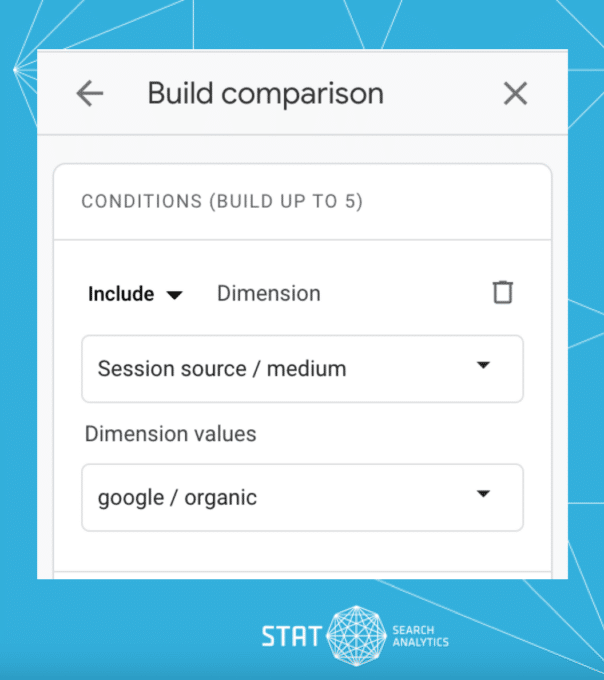
Simply set the conditions for your comparison as shown to isolate your organic traffic in Google Analytics 4.
Once you’ve created your comparison, head over to Reports > Engagement > Landing Page. You’ve now got a list of all your pages that are visited first as a result of an organic search. Start looking at before and after comparisons of the data to see which pages have fluctuated in traffic.
It is at this moment that you must decide whether the algorithm update is so impactful on your rankings, traffic, and revenue that you need to inform top-level leadership. You have the industry reports and you’ve captured the impact on your website — we advise over-communicating with leadership, letting them know that you’re aware of what’s going on and that you’re digging deeper.
Now that you know which of your pages and keywords are seeing fluctuations, it’s time to identify the “winners” and “losers” of the update. The best place to start, regardless of your specific rankings on the SERP, is to analyze the top 10 listings.
STAT’s Archived SERPs feature shows the top 10 listings for any date after which tracking was set up.
The Archived SERPs tab in STAT

Go back in time by selecting a date to see detailed listings of what was on the SERP that day.
First start by asking these questions:
Next, ask:
SEO execution is broadly thrown into three categories: on-page content, off-page authority, and technical — one page at a time, we need to evaluate how our page stacks up to the new standard of the update for each.
On-Page Content
One of the quickest ways to compare your content with the top 10 results is to compare H2s. Does your content address the same subtopics as Google’s favorite results?
You’ll also want to pay attention to characteristics like structure, length, metadata, and multimedia usage such as video and images.
Also consider how other listings are meeting E-E-A-T factors. Does the content have an updated or recent publish date that seems fresh? Is the content author reputable? What sources establish the author’s credibility?
Off-Page Authority
Next up, tune into the off-page authority of competing pages. Look at metrics such as:
Is your page stacking up against competitors well with backlinks or is the discrepancy in volume and/or quality tanking your ranking?
Technical
Finally, investigate the technical page-level components.
Start with the site map. Is this specific page in the site map? Check that the page is not excluded in robots.txt.
Remember to use canonical links to prevent duplicate pages from cannibalizing your page ranking.
Look at your page speed, compare structured page data with other ranking pages, and write alternate text for any images. This consideration for sight-impaired visitors isn’t about ranking, but compliance with ADA requirements improves user experience and may become relevant for ranking down the road.
You may have just discovered a series of important page-level factors that need to be addressed. However, we sometimes run this page-level analysis and find it to be a competitive wash — everyone in the top 10 can look nearly identical from an on-page, off-page, and technical perspective. So, what gives?
Google’s E-A-T guideline identifies Expertise/Experience, Authoritativeness, and Trustworthiness among its most important ranking factors in its algorithm.
This is not only demonstrated on a page level, but on a domain level. It’s the reason why a website could have a page that is arguably “better” than what’s found on the top 10, but not rank. Google needs to see that your domain — and your entire entity — demonstrates these values.
Domain-Level Content
If your domain-level content is suffering, you need to establish topical authority.
“Topical authority is a measure of authority built up through proven expertise and trust in your field. The more high-quality, informative pieces of content there are on your site, the more likely your website is to be perceived as a trusted source of information on a particular topic.” — Zoe Ashbridge, Senior SEO Strategist, Forank (How to earn topical authority in 2022 and beyond)
If your site is hurting here, do keyword research to find the related content keywords, organize your keywords into clusters or pillars, and get to work building and linking new authoritative content.
Domain-Level Authority
Your domain-level authority comes from backlinks. Zoom out and survey your site’s overall domain rating and your overall backlink profile compared to competitors. There are lots of helpful tools that can help you accomplish this — one example (that you can use for free) is Moz Link Explorer.
Domain-Level Technical
Finally, scan your site for glaring technical issues. Check in for these common failures:
With a much clearer picture of what has changed, how it is impacting your business, and what it will take to “win,” you’re ready to execute. More importantly, you also have the ammunition to communicate to key stakeholders.
It’s becoming increasingly rare that an SEO has the skills or access to make all necessary changes to their website. It’s time to communicate with developers, content writers, and top leadership.
Give them a brief that rolls together all of your findings:
And then give them their specific tasks. Do this and you’re on track to mitigate losses, seize opportunities, and prove why you’re an essential asset to the company when so much is dependent on Google.
We sat down with Eli Schwartz, Arpana Tiwari, and Todd Friesen to learn about the journey of an SEO through the past decade of search, the essential skills SEOs need to develop at the moment, and what the future of Search could look like.
Danny Allen: [00:00:00] I'm danny. I'm the VP of marketing at 97th floor. We're an enterprise digital marketing agency. We have Eli Schwartz with us, growth advisor and SEO strategic consultant, also author of Product Led SEO, the book. Uh, we have Arpana Tiwari, who is the director of organic growth at Eventbrite. Uh, used to be at Adobe, Google, Facebook, Walmart, Apple, everywhere. I'm sure I missed a couple others. And then we have Todd Friesen as well. Uh, at, uh, well, you're a free agent right now. Formerly at Vimeo and then previously at Salesforce for, for just about 10 years. Correct. Incredible to have all three of you. Thanks for jumping on. I actually gathered all of you together because, uh, we work with a lot of Like top notch SEOs, top notch digital marketing leaders, and a lot of them are kind of coming to us with these questions about the role of organic right now with so much influx.
They're kind of re evaluating where this fits, does it fit? Obviously it still fits, but to what degree? What they should be thinking [00:01:00] about? All that kind of stuff. I just attended MozCon, and there's just a lot of those questions floating around, like, you know, what should we be expecting of ourselves right now?
And, uh, with all the change coming, right? So, with each of you having Uh, over a decade of experience, plus, uh, working at the highest levels of SEO, I think you have a really important perspective that you can share, and I want to kind of pull that out of you. So, uh, just to kind of kick this off, though, maybe kind of for fun, I was thinking about, let's all think back a little about 10 years ago, 10 to 15 years ago, where, where you were, what you were facing, and we're going to bring it up to, to what we're dealing with right now.
But, for fun, I did a couple, like, searches on Google from back in like 2008, 2012. Trying to understand what people were searching for. This was kind of a funny one. Uh, I found a Search Engine Land article that said this. It was citing a study. It said, 64 percent of companies said finding an SEO specialist was more difficult than finding other skilled employees.
The whole point of this article was that there's like a shortage of SEO people. We need more SEO people. This thing is This thing is growing like crazy. Um, in the same study it says, companies with a significant SEM [00:02:00] spend, and then they put in parenthesis, over 25k a month. Which is kind of, which is kind of funny, right?
That 25k a month was a significant SEM spend. But it says, uh, those companies ranked, um, hiring skilled SEO staff on par with other technical or implementation based SEO challenges. Basically just finding people was, was the, the challenge. Another kind of funny nugget was a article from Moz in 2012. And it listed some of the top skills that SEOs needed.
It said, uh, number one, be the best person to work with at the office. Uh, number two, always talk about SEO from the perspective of people, not robots. Number three, don't rely on data to tell your story for you. Number four, help your colleagues meet their goals before asking them to support yours. Number five, go agile from a project management perspective.
I thought some of this stuff was funny, just thinking back, like, and I was really young in my career at that point, but I still remember this feeling of like, no one will give us The, the time of day. How do I get anyone to believe in SEO? And, and even though now SEO and organic as a channel is, is huge everywhere, I still [00:03:00] feel like some of these things still apply.
Some of these challenges are still felt. Everyone kind of still says the same thing. I can't get buy in. I can't. Anyway, I don't want to spend the majority of our time together talking about the past, but I do want to like ask you, feel free to speak when, you know, but what were, what were your, what are your memories from those days?
I don't know if you want to kick it off, Eli.
Eli Schwartz: So we go back like 10, 11, 12 years. There was those. I think that's an SEO change. That's when like smart SEO died because Google took away all the tricks like between Panda and penguin, like Panda was the algo update that got rid of all the thin content and it's, it's baked into the algo today.
So like the whole idea, like we're, it's Panda applies today when we talk about gen AI. So if you think about. There was a plugin, Todd and Arp and I remember this, it was called caffeinated content on WordPress. That was gen AI. What it did was you took RSS feeds and it from different sites and then it used like, I don't know, some sort of synonym matching, but it wasn't that smart because it operated in your own server and your own WordPress instance, [00:04:00] do synonym matching and just replaced words and merged all together and created other crap, like non readable crap, but it had keywords in it.
You even put your keyword in and it sprinkled your keyword in that's. Like 20, that's 2008 version of gen AI and we've gone today. So that whole concept stopped existing after Panda. When like Google looked at the value and quality and quantity of content and penalize sites. Now it doesn't penalize sites for Panda, just penalizes content.
So, you know, the whole gen AI question is like, Oh, can you get away with it? Well, if you figure out how to write a lot of good content at scale that readers like, then yes, but if you create crap, no. And then penguin. I guess in 2012 that like neutralized all the bad shady linking. So there's still a lot of shady linking, but it is, you have to put way more effort and you have to like plant the link and real content and you can't just use plugins and all that.
So that's what I think about like going back to that, like SEO used to be fun and creative and you come up with hacks and like. We had all these secrets and we were talking earlier about like going to conferences. That's when you shared all the secrets. Like someone, I probably learned about caffeinated content at a conference [00:05:00] and then like I couldn't wait to like install it.
I probably did in my hotel room and now you go to conference and like there aren't those secrets. Like there's nothing you'll learn at a conference that you wouldn't read on search engine land or search engine roundtable. So SEO was a lot more fun back then. Uh, I think it's better for users that it's, it's less fun.
More, not as much fun for us,
Danny Allen: not as fun for you on a day to day basis.
Todd Friesen: All right. Yeah, I fully agree with that. It became, you know, much more like, like we were talking earlier, like project management and coming up with the list of the things that need to be done. And then waiting your turn in line with all of the other engineering projects that needed to go to the front end team or to the backend team, if it was a deep enough technical problem.
And you just, and you, and you go, okay, well, let's move to agile and be part of engineering and get in sync with that, uh, and, and get into, and then measurement became a much bigger thing. Like, we actually became much more concerned with the whole funnel than we get with [00:06:00] being number one for the vanity set of key terms that the, that the CEO had.
I mean, when I, 10, you go back to 2012, for example, Eli, as you mentioned, that was, that was when I moved from agency to in house and started at Salesforce. And we spent an inordinate amount of time chasing the number one ranking for CRM, which, I mean, let's be honest, great keyword, tons of traffic, very much vanity.
Like it was, it was so far up the funnel that it produced very little in the way of going down the funnel. But that became a big thing, you know, of course, when, when Google took away the keyword level, uh, referral data. And you're like, so all of a sudden you're like, well. And even to this day, like how, how long ago was that?
Was that 2000, was that eight, eight, nine years? That was almost 10 years ago. Now they took away that referral data. And to this day we still deal with people going, well, Google gives you that. And like, no, they haven't for 10 years. And I think that's the bigger thing that we're still dealing with over the last 10 years is [00:07:00] outside of the SEO world.
It's still this weird black box and it's still this pile of misinformation. It seems to be about 10 years old that, you know, CEOs and CMOs and a lot of the leadership sort of have that, that it never evolved, I think, is where sort of where I'm sitting at this point.
Arpana Tiwari: Yeah, I think from my standpoint, similar to what Eli and Todd have shared, the simplicity is lost.
Uh, if I was to think about 10 or 15 years back, you walk in, you look at a site and immediately things pop out at you in terms of, you know, these are very clear ways you can serve the customer better, you can serve the business, you can bring the two together. And fast forward to today, it's become more of a business of managing SEO, especially at enterprises.
There's so much that comes along with it that is, I think, administrative from the standpoint of, uh, what kind of tools do you want to use? There's, uh, there were probably five really solid, good tools we used to be able to use in the past. And now, you know, every week somebody's [00:08:00] pitching a new tool. And so, like, how do you Can I keep that at bay?
And then, um, the team, um, then all of the work, no site is, I would say, untouched. Uh, and 10, 15 years back, you would come into a site where nobody had touched SEO on it. And now it's probably, you know, you're cycling through, maybe there's a lot of experts prior who've done it, who've tried it. Um, and you're going into a system where you have to pitch a lot more versus in the past, you'd try something, it would work.
Now there's. A lot of tech debt associated with things. Um, so I think all that additional complexity, um, has made it much more rigorous process, um, which takes out some of the creativity in my
Eli Schwartz: view. I think, I think it's good. I mean, I, I think the internet used to be like the wild west where, you know, Let's say, let's say, let's say something standard, like e commerce, you searched an e commerce query in 2005 on one thing, you'd see Amazon and another, you'd see eBay and another, you'd see Walmart, right?
And now [00:09:00] it's very, it's standardized. Like these are the e commerce, these are the commerce players. For apparel, for example, it's it's Macy's. It's Nordstrom. It's, you know, it's those brands. So those brands dominate search. And I know like people will complain. Oh, Google favors brands. And that's because users favor brands.
You don't go into the mall and go to the brand new store that you never heard of and spend all your money. You go to the brands and you trust the brands. We buy clothes that come from brands. So Google is a representation of that. And I think we're living in a world where the algo has figured out how to catch up to that and surface brands because that's what keeps people coming back to Google.
And I think that's where it. Bing maybe suffers a little bit because you don't see being, you see more random sites and that's maybe off putting users like, well, I was just searched like iPhone case and you're, you're showing me something I never heard before. I don't know if I could trust your results and go to Google and like this looks standard.
No matter what query I search, it's standard. These are the brands that trust, you know, some sometimes number one, sometimes number three, but like it looks, it looks the way I expect it to. So I think it's, it's a good industry
Todd Friesen: change. Well, [00:10:00] and that's, I mean, that's a piece that we used to talk about all the time is.
Everybody wants it to be this completely, um, like 100 percent unbiased ranking algorithm that you can tick the boxes and get to be number one or number two on the front page. And it completely leaves out that Google's user experience is a driving force for Google in its entirety. And just to echo exactly what you said, if people show up and they don't like the search results They're going to, you know, either not click an ad or like whatever they're going to not do.
They want to like those search results and that's, we can't as SEOs really approximate that level of user satisfaction with a site that doesn't meet that criteria. Like that, that's outside of what we can do as SEOs or as, as marketers to a large degree.
Arpana Tiwari: And I think what's exciting about now is that SEO seems to be going back full circle into marketing.
I think we started out [00:11:00] with, it's a channel to market where there's value, bring users and businesses together. And then it got into a lot of automation and scaling and you're trying to be everything to everybody. Uh, and you're trying to just maximize the traffic. And I think now it's coming back to where is the value.
And I think SEOs should really think beyond search and they should be thinking of any surface. Where people are looking, so it really goes back into organic. It could be organic search, because people are searching on almost every surface. So you really want to go back into organic. Where are your users, uh, and what are they looking for, versus one search engine.
Yes, it gets most of the traffic, but sometimes you lose the insights if you're just looking at that one. If you split it into more of the niche engines, you're going to start to see insights that can actually help you on the big one too.
Eli Schwartz: Yeah, well that,
Todd Friesen: I mean that was. And that and then things like when you talk about service like the app stores and things like that fall into that bucket.
I was uh, scrolling [00:12:00] job listings on LinkedIn the other day and just, you know, seeing what's out there. And, and I came across one that was a, it was SEO related and digital, I had all this stuff in it. And one of the criteria that it called out, which I hadn't seen in a job description in a long, long time was.
Um, expert knowledge in app stores and app deep linking and like it was very very like somebody had very specifically written out this part and it was a mobile related company, but it was very specific around apps and links to apps and deep linking from apps out to sites and vice versa and stuff like that, which is.
I mean, that's a very specialized part of SEO that very few SEOs have really gotten into.
Eli Schwartz: And I think there's one thing, and I always tell this to potential clients that people don't realize, which is a very, very high percentage of websites in the entire world don't do SEO because they don't know it exists.
I'd put that as high as 90%. Like whatever the IRS of some country, like there's 180 countries in the world. Most of those countries, the governments don't know how to do SEO. So Google [00:13:00] has to compensate for the fact. That 90 percent of the world is not doing SEO. So if you search for the IRS of Congo, how do you find that?
You're looking for the parliament of some small country. How do you find the parliament and make sure you're not finding like some fake website that represents parliament, or if again, like, like, um, if you're in. I don't know, Papua New Guinea and you're searching some health query. How do you find the right health site or like a correct health site in whatever language you need?
So Google has to compensate for all that. And that's what Google is doing. So they're not going to give that like extra advantage to some site that knows SEO and knows how to get links and knows how to optimize content. Google covers that. And I like, I like Arpana's point around other search engines. I always tell any potential client to really think of the user in search and that they're arriving from a search engine at some point in time.
Like I always, I predicted two years ago, I was like, Oh, we'll see another search engine. I didn't think it would be chat GPT, right? Chat GPT is kind of becoming that other search engine and it's rivaling Google, which is why Google is freaking out. But like. One day decide that they no longer want to send spotlight over to Google and they'll do [00:14:00] search.
Like, okay. Search is not that hard, like great search. Like Google is pretty hard, but like, okay. Enough search, like duck, duck, go does okay. Enough search. And like a lot of search engines. So Apple could do it. Facebook could do it. Amazon could do it. You know. There are other products that could just decide that they were Firefox could do it again.
They will not have a huge market share, but they could just do their own search and not send it to Google. So is, uh, is, you know, right now as SEO, we only think of Google with 95 percent plus market share, but there could be a world where like Google has 70 percent market share and you need to figure out that other 30%.
And you do that not by understanding the algo, but by understanding the
Todd Friesen: user. Well, and that's a, I mean, that starts to throw you back to the, you know, the really old days of. You know, Web Crawler, Excite, HotBot, InfoSeek, Lycos, InfoSearch, like just, and that was, I mean, that was a fun world. I would like to go back to that, to a certain extent, just to get some diversity in traffic, to have some opportunity where, if you're not on the first page of Google, it's so business impacting.
And I used to say all the time, like, when [00:15:00] Google would do the updates, back in the days of monthly updates, and you'd get these stories at conferences and stuff like that, or something like that, Google wiped out my entire business and I had to lay four people off because they, they updated and they kicked my site out and I wasn't doing anything black hat and so on and so forth.
And we used to always say, well, you're an absolute, it's foolish to base your entire business and to hire people based on where you rank on Google. But fast forward, you know, 15 years and we're, we're there. Like there is absolutely businesses that exist entirely based on search rankings. I might be overstating that a little bit.
I mean, The Amazons of the world and stuff, they get, you know, a boatload from that, but they're also destination sites. So you have to throw those out of that mix.
Danny Allen: Yeah. Well, and Google's coming for their lunch as well. Um, so yeah, I mean it's as an agency ourselves, right? We, we started an SEO, we started as an SEO agency 18 years ago and that's like, that's all we would think about.
But, but in the last 10 years or so, we had to [00:16:00] realize ourselves that. That's a rough train to hook yourself to, uh, if, if things change, right? And so that's where most of our clients now, we have, we, we try wherever possible to include advertising, to include other forms of content, to include all of it, because we didn't want to be, I think a lot of people are actually just Google specialists.
They're not even SEO specialists, right? They've become so attached to Google, and they're just like, I'm an expert in Google. Uh, and then what you're suggesting, it seems like, all of you, is you SEO specialist anymore. You've got to be. Um, and then you've got to be a marketer really, you've got to be thinking about every other aspect of, of, of how to reach somebody and no searches place in that, but it's not as big as it used to be, um, or at least that that's shifting, right?
So with, with, I know Eli, you've been posting a lot about SGE, about everything that's changing on the SERP and there's some things that would be very concerning to people who are like attached to Google and only Google. Uh, but I mean, I guess what, how are those conversations impacting your. How are those changes impacting your conversations with leadership right now?[00:17:00]
What are, what are you currently hearing? Are people freaking out? Are they kind of pretending it doesn't exist? How's that
Eli Schwartz: going? They're not aware. I mean, we live in, in SEO, we live in a bubble. And we think everyone knows everything. And, and like the word S G E, only we know it. You know, regular people don't watch Google I O.
Regular people don't read search blogs. Regular people don't look at SEO on Twitter. So they have no idea. And it's, it's whoever's looking at SEO. For a company or at an agency, they're the ones that are responsible to be telling leadership there is this nuclear bomb hiding in the corner and it could destroy everything.
And I think the big, a big problem right now in the SEO industry and to call out some people in the SEO industry is that they're trying to pretend it's nothing. And mostly because they're scared of their own jobs and it's, it's scary, but I don't think saying it's nothing is helpful to anybody because when it blows up, like.
Google is huge, right? Like Google could do things and mess everything up and then fix it six months later, not really impact their revenue, but it will mess everything up for SEO, mess everything up for the users there. And you know, [00:18:00] what are you going to do? So they may, I actually think Google is about to launch it very, very soon from what I hear.
The Google may not launch it till the beginning of the year. Whenever they launch it, it will cause a lot of chaos. So pretending it doesn't exist, or I heard someone say, Oh, it's a beta thing. Google's never going to launch it. I mean, you don't know that Google could, it could be a beta thing and they'll still launch it and still ruin everything.
So I think business leaders don't really know what's out there and it's our job to tell them it's out there. The second thing is just to, uh, you know, to anyone's horn that is looking for a job or that isn't consulting, this is going to be the greatest thing ever for the SEO industry because it's going to create so much turmoil.
And for everyone that has not been warned, they're one day going to just watch everything flip and they're going to be desperate. So turmoil is good for us. Uh, turmoil will make, you know, the phones ring off the hook. Let's say the range is, let's say even a company loses 5 percent of their traffic or 10 percent of the traffic.
It's a big deal. I mean, you go to wall street and you say, we lost 5 percent of revenue, 10 percent of revenue. Your stock goes down 30%. I think it's going to be for informational companies. It could be as [00:19:00] close to 50 percent of traffic. So when they lose that, they'll be really desperate to keep the 50 that's left.
I mean, I was at a company that lost 60 percent of the traffic the morning that Panda launched. And there were a lot of tears, right? So, like, this is going to be global, actually, maybe not global, right? I think Google is going to be restricted to launching SGE only in the U. S. first, because the E. U. is very litigious.
Uh, so they'll launch it in, like, the U. S. and Canada and, like, maybe Latin America. But they're not going to do E. U. Whatever it is, it's going to be hugely impactful. And, uh, I, my prediction will be that you will hear references to it in earnings updates from public companies within, you know,
Todd Friesen: three months of when they launch it.
Oh, 100%. Bing's already playing with something similar. Like, I, I, I've got, I've used the Edge browser just out of spite, you know. And, uh, and I, so I have built in Bing search, which for the most part, you know, it works fine. It gets me through anything I want to, I want to find, whether it's shopping or whatever.
Every now and again I'll actually go to Google to, [00:20:00] to get a more refined search. But over the last just couple weeks, I've noticed like I type in my search and I get this full Bing GPT and it's it's awful. It's completely unusable. The UX is terrible and and I can't figure out how to get out of it Which is sort of the biggest thing, but you're trapped You're you're just you're in it and you got a it sits there for a minute and you start scrolling and then eventually scrolls up But it's a full screen takeover And there's nothing there.
There's, there's no results to click on, there's just refinements to come. And, I mean, I find it super annoying, but there's gonna be a whole swath of the world that just rolls with it. And, and then they get those refinements and you wind up with one result at the end. It's gonna be really, really, really interesting to see what happens there.
Arpana Tiwari: I think compared to any other time, this is the time where the group mindset is going to really surface. Because when things change, it's going to go back to me. What do we do now? Like, where do we start? Um, and from the initial labs data that I'm seeing, [00:21:00] um, again, there may not be tools right out the gate where you can look at this at scale, so it is going to go back to the basics of, as a user, for my site, for, you know, the queries that my users are typing in, what am I seeing in, in real time?
So somebody who's willing to, you know, um, Get into the weeds, go and be in the trenches and start to look at the journeys for the users and like, start from scratch. Um, and you had initially brought up, how does that work with connections within the company? I think that credibility, if you've built that initially, which is not just based on tactics or tools, but you're actually thinking about the user and you've built those connections where you can go back now and say, This is what we need to do, and I think for all the teams out there, monitoring right now is going to be so key, because even if it's not live for everybody, there are a lot of signals that you can start seeing, uh, and for somebody who's been in search or has that training to know what to look for, you're going to start to pick up on things, which if you add to your roadmap, [00:22:00] um, can get you, like, will help you, set you up better than, um, others will come out of the gate and then be figuring
Danny Allen: out what to do now.
Yeah, it seems like this is the time to, we're going to see what everyone's really made of. And, and also, it's not to say that it's too late, but everything that you've done, all the goodwill that you've built, is going to be coming, coming to help you or hurt you, uh, depending on where you left off. So, Arpanay, you brought up a couple things that we can do, some, some, a lot more on the monitoring side, a lot more on, on gaining that credibility, and, and Eli, you also talked about bringing it up to leadership, being the ones to introduce it before the bomb drops, right?
Uh, kind of to close this up, what would you say are going to be the skills that SEOs need to be focusing on in the next, I mean, six months, but in the next couple years as well? What should they be, maybe they're listening and they're saying they're kind of freaking out because everyone's freaking out about a thing that could impact our job, right?
And it could take away from maybe our comfort or whatever we're settled into. Uh, so where should they be putting their time? [00:23:00] as far as their skill set.
Arpana Tiwari: I can go. I think, um, know your business, know your user, and then be confident in your search abilities because those are the three that are going to surface.
And don't worry about, you know, what has been taken away, but feel the confidence of where is it going? And if you know your user, and you're looking at the results, you can back into what, um, could be causing that. And I think the last thing is diversification. Uh, think growth and think overall marketing versus just search marketing.
And it's totally okay to be a team player and say for the short term, we might see a dent. And during that time, I want to give you a heads up to go invest in other channels till we can get back up. So it's okay to be, you know, everybody talks about like being vulnerable and being a team player, but this is the time also to do that.
Um, sharing that you don't know what exactly it is going to be because nobody knows [00:24:00] how it is going to impact different businesses. So, prepping the teams, I think, will also increase the credibility.
Todd Friesen: Yeah, I'd agree with that. I mean, it depends a little bit too on where you want to go as an SEO and what you want to do with your career.
Like, if you want to, like, I know some people that want to just, like, they're SEOs and they want to stay, they're happy to be pigeonholed as the SEO guy. Which Personally, I hate being pigeonholed as the SEO guy because they're like, I can do all these other things. They're like, yeah, but you're just, you're the SEO guy.
And they sort of leave you out of those, those higher level conversations. But I mean, if you, if you want to grow your career and you want to move up the ladder and add different titles to your name, director, senior director, VP, and those sorts of things, you have to do the other things. You have to know how to hire and run an engineering team, typically front end when, when it comes to SEO.
You have to understand UX. You have to know user research. You have to know analytics. If you're going to build out a proper SEO team itself, it needs to have engineering resources. It needs to have analytics resources. It needs to [00:25:00] have an operations person. It needs to have a program manager. Like, you need to be almost a mini company within a larger marketing organization to get done what you need to do across that.
So if you want to just stay in SEO, that's great. You're going to need to be You're going to need to know SGE. You're going to need to know all these things. You're going to need to be the clear expert. If you want to climb the ladder in the marketing world, you need to add these other disciplines to what you're doing.
And running an engineering team is a really, really interesting challenge that a lot of people aren't ready to take on. But that will put a massive, that one thing alone is a massive feather in your cap if you want to
Eli Schwartz: grow. And I completely agree with both Arvind and Todd. Those are definitely things you need.
And like Todd said, like, if you want to grow, you've got to learn other things. But I think you can't. Rest on your laurels and SEO anymore because I think the rules are about to change. So I, I think that links don't matter nearly as much as everyone thinks they do. And they're going to matter even less with SG because you don't see them really taken into account.
I think that keywords don't matter. Like keywords hardly matter now, but [00:26:00] they're going to matter so much less rankings of course go away. So the typical SEO skills now completely. Flip and they're gone. So the big thing I think anyone's needs to focus on, of course, like what Todd and Arpana said, really even beyond that to think big picture, like how do you move the ball forward in growing organic traffic?
What do you need to create? So really like some sort of product mindset. And the last thing that I think not enough SEO people really focus on and should learn and like take classes on it or take courses, you know, or get coached is communication. So there's always this natural thing, especially in agencies to do like CYA, like, and avoid the bad news and sell the good news.
Like who you CYA for your CYA for Google. Like you don't work for Google. So like dump on them, like say like Google is about to destroy us blame Google. Cause it's not you and over communicate. And, you know, if the hurricane doesn't happen, great, like at least you warned that it could happen. So I, I'd say like SEO needs to do a way better job of communicating what's happening, what could happen, what will happen, all of those things and learn those, those things.
Like I, [00:27:00] an example I always use on communication, which is like probably one of the best things ever happened in my career is I was being called into a meeting with the CEO. We were about to lose budget for SEO and because they wanted to prove it didn't work. And this CEO was like a huge sports fanatic.
And I explained what SEO was to the CEO. Why? Using a GIF on a PowerPoint of a basketball player doing an assist, like grab, like catching the ball, bouncing it, and then passing it over to someone who dunked. And it just does this one second GIF over and over and over again playing while I explained that SEO was an assist.
And when I walked out of that meeting, I had an extra head count. I was about to lose my team and I got more because. I communicated what I was doing. Like I was being judged like SEO doesn't make us any money. You're failing. There's no revenue. And I explained that I was not failing. I was doing better.
They just were looking in the wrong place. So SEO needs to communicate and over communicate and blame Google, blame whoever you want, but communicate and just say what's happening and like how you'll fix it.
Danny Allen: Wow. Incredible advice, right? We gotta look, we [00:28:00] gotta look at our leaders or those who we're answering to as our peers and say, here's my real advice, like, this is where I'm coming from.
I love what you said, Arpana, about being vulnerable and saying, here's what I don't know, here's what I do, and being really confident in what SEO does do, what organic does do, like you said, Eli. All of you, I feel like I just had an incredible, Out of body experience, no. Having all three of you though in the same room, hearing from your experiences is incredible.
Um, and, uh, I, you know, you can find all three of these incredible people on social media. Reach out to them, ask them questions. Uh, Todd is a catch. Uh, wherever he ends up, it's going to be an incredible, uh, you know, ad to their team. And, um, thank you all for jumping on today. It's been really great. Thank you for having
Eli Schwartz: us.
Arpana Tiwari: I appreciate it.
Eli Schwartz: Thanks.
We’re at the home stretch of 2020, and as much as we’d like to live these last few weeks in comfort, Google had other plans for SEOs. Say happy holidays to the December 2020 Core Update.
It seems like awkward timing. However it’s better than it happening one week earlier, possibly disrupting Black Friday and Cyber Monday online sales. So I suppose there was some level of kindness baked into this release.
The update appears to have begun rolling out on 1pm ET December 3rd (about two and a half hours after Google’s announcement), but it’s likely we’ll see the rollout affecting SERPs for the next week or two, as is typical with these core algorithm updates from Google. However many online, and within 97th Floor's clients have seen fluctuations happening earlier this week, possibly indicating a soft rollout earlier than the official announcement.
Granted it’s been only 24 hours since the results started rolling in, but even still, there are some trends to make note of.
First and foremost, E-A-T (expertise, authority, and trust) has come out as a prevailing set of metrics that determine a positive outcome for sites during this unforeseen update. It’s worth taking a second to remember the May 2020 Core Update, which was a larger than average update, negatively affecting many sites that were not prioritizing E-A-T. It seems that authoritative backlink profiles are a major factor, as they were in the May update.
When reading between the lines on all the forms online concerning the update, it’s possible to infer that many old-school (AKA blatant black-hat) SEOs are feeling the burn of decreased rankings and traffic right now. Much of the May 2020 Core Update also systematically penalized these kinds of sites as well, and it seems that sites that continued to avoid holistic SEO fixes are feeling the heat today.
Ever since the infamous Medic Update of August 2018, many are looking for specific industries hit by these updates, which hasn’t been the case in the same severe way the Medic update was. However, the auto industry seems to be taking more than its share of shake ups today. I would also note that legal sites (and heavily regulated industries in general) are seeing fluctuations.
As helpful as it is to hear Google say, “Our guidance about such updates remains as we’ve covered before,” I want to provide more specifics.
First and foremost, make E-A-T a priority for your site in every aspect, especially link acquisition. A number of big brands are gaining valuable ground on their SERPs, which in itself is very insightful. However, when looking at these brand’s backlink profiles, we’re seeing big link wins in the past 6 months. Double down on real link-building, the kind that passes authority, is indexed, and respected by Google. This can be done by leaning on things like guest post link building and branded link mention reclamation campaigns
Make sure you are accurately documenting your site's success or failure during this update. This update is terribly hard to diagnose with recent traffic, given that last week was a major holiday in the US. So when looking at your position, trust keyword positions over traffic for the time being.
As always, be sure to report this information to your team members and managers with a link and some screenshots from your own ranking and traffic numbers. Explain what E-A-T is and then devise an action plan of what E-A-T means for your site and brand, it will likely involve better content and links.
Reach out to me on Twitter @Joe_Robledo_ with any questions or updates.
COVID-19 cancelled a lot of plans in 2020. Teachers. Doctors. CEOs. Politicians. Parents. Children. Travelers. They’ve all had to adapt to The New Normal. With Black Friday approaching, we’ll add retailers to that list.
Most retailers rely on Black Friday doorbusters to make their year profitable, and this year Black Friday is even more important to many retailers as they’ve suffered with shutdowns, lockdowns, and letdowns.
97th Floor has helped hundreds of brands find success during their holiday marketing push, but we’ve never done it in a year as unique as 2020. We wanted to know how shoppers would react to these changing times, so we commissioned an independent research study of 1,000 US shoppers to understand their hopes, fears, and behaviors when it comes to crowded malls, bustling stores, and online shopping this holiday season.
We’ve put together some of the most interesting insights in this article, but all the data can be seen in the PDF download attached to this article.


It’s true that this has been a difficult year for business. However, there are steps that you can take to safeguard your own sales as the holiday season approaches. Our advice? Focus your efforts online. 97th Floor will be releasing a small series of in-depth articles covering these topics deeper.
Sign up for our monthly newsletter to make sure you don’t miss one.
Some SEO tactics take months to see results, but the holiday shopping season is already upon us. So, this year we’d recommend finding that sweet spot between SEO that works for ecommerce sites and the SEO practices that yield results quickly. A few “quick wins” you should look at to increase the readability and user-friendliness of your site are product schema markup, proper rel=canonical for duplicate product pages (for holiday special prices for example), appropriate redirects, claim unlinked brand mentions, strategic internal links, and title tag adjustments.
Many brands can expect an influx of traffic during the next two months, so this could be a good time to roll out some testing in order to capture revenue from as much of that traffic as possible. Small changes can make a big difference on your site — one of our clients saw a 29% increase in revenue in just 18 days, without any increase in traffic at all. Imagine the possibilities as traffic does increase this holiday season. Our advice? Get started testing as quickly as you can. That way, when traffic really starts to peak, you know you’re getting that traffic to the most optimized versions of your pages.
It’s difficult to predict what will happen with ad auctions and CPCs during the holidays, but it’s certain prices will go up. Perhaps more this year than any other year since so many brands are hoping to make up for poor performance in previous quarters. Work to get more traffic right now, so that you can form remarketing campaigns later, which will be cheaper and more effective than cold ads. This might mean getting ads out the door earlier than you may have planned. Additionally, get all of the pixels you can active on your site. Even if you are only running Facebook Ads right now, still include pixels for Pinterest, LinkedIn, and Google if appropriate. Doing this will allow you to quickly pilot to new platforms if rising prices caused by holiday influxes on your platform of choice push you out. This will help you keep a steady ROAS.
Keep in mind that people are more likely to try a new product or business during the holidays, so if gaining new customers is a focus for your business, this is your time to shine. Monitor all of your channels closely, as well as CPM and CPC. Become hyper-aware so that you don’t end up paying more than you’d like per ad. Also, build your remarketing pool earlier and be ready to pivot.
Email is a channel that deserves more attention this holiday season. Work on more specific segmentation, increase your email frequency. A greater volume of emails is much more acceptable by most users this time of year, so it’s a great time to show them all the value you can), and be sure to keep it personal. There are little things you can do to add personalization to your emails, such as personalization in both copy and context, that make a big difference to those on the receiving end. Email your contacts based on their interactions with you, as well as the information you already know about them. When the situation is more specific, your emails are more likely to be effective.
There is no doubt that this holiday season will look different than any that has preceded it. Yet, even in 2020, there is still room for success when you plan strategically. Strive to work with the times rather than against them. The data collected in this study can be used to help tell a more accurate story this holiday season. And, taking to heart these suggestions, you can be armed to take this challenge head on — and hopefully see incredible results in the process. We’re going to be dropping more specific articles on our blog throughout this season, so be sure to follow us on social media and subscribe to our newsletter so you don’t miss a thing!
Political campaigns are some of the most visible, wide-reaching, and polarizing marketing campaigns. They operate off of enormous budgets with highly condensed timelines, and digital strategy has become an increasing priority as audiences shift online. But even Presidential marketing has its oversights and faux pas.
At 97th Floor, we were curious about how these two campaigns were tackling digital, so we decided to utilize our expertise in performing large-scale audits for both the Biden and Trump 2020 campaigns. We have the best specialists in all of these fields, and we asked our teams to treat these campaigns just as they would a client, auditing every inch that they could.
After pulling thousands of digital ads, reviewing millions of dollars in ad spend, pouring over scores of website pages, reading hundreds of emails, and scouring mobile apps and social media accounts, we found hoards of fascinating insights. It’s a drama-- massive oversights, well-timed reactions, wasted dollars-- but I’ll step aside and let the data tell the story.
After combing through both audits we cherry-picked and pulled the most engrossing snippets into the final version on GetThatVote.com. Read ahead here to see just a few of those highlights.

On a grand scale, the Trump campaign acts as one might expect: big budgets, pushy messaging, and dated tactics. But, while wasted budget is never a pro, the Trump campaign seems to understand its core audience. The campaign’s focus and budget, as well as messaging, are highly targeted to dyed in the wool, red “Patriots.” Team Trump’s digital tactics mirror that of the entire campaign — braggadocious — largely catering to those who are already his fans. Additionally, the Trump campaign presses much harder for donations, which could be one explanation for its ability to outspend the Biden campaign at every turn.
In contrast, Biden’s team hones in on the fringes and the undecided — those who have been historically election-determining, an obvious audience for this (and every) election. This showcases itself in a strong focus on swing states with budget, and a somewhat-humble focus on “togetherness” and “unity” in messaging. The Biden campaign also pushes for a professionalism and issue-based copy that Trump has largely overlooked. A little surprising is the consistently smaller budget from the Biden side, however it’s possible that Team Biden is holding back to increase spending when it matters most, that last month.
Overall, each site caters to the strengths of its candidate. The Biden site emphasizes unity in diversity, with photos of Biden with others rather than alone, and copy that includes words like “together.” Trump’s site leans into the fame of Trump himself. Mentions of specific goals or stances are overtaken by Trump-focused photos and messaging.

As far as general user experience and intuitive flow, Trump’s site takes the cake. Biden’s site overlooks clear messaging in conveying how to volunteer or get involved, and funneling every user into a narrow set of options. The Trump site uses very clear “get involved” messaging in their header, and gives various actions a user could take in order to show support for the campaign. Additionally, Biden’s website feels busy, and lacks an easily navigable hierarchical structure. Trump’s site is well structured, pushing users to either shop or donate.

We also couldn’t help ourselves in looking at the 404 pages. Both perfectly represent their target audience: Biden’s responsible mask-wearers, and Trump’s anti-Bidens.
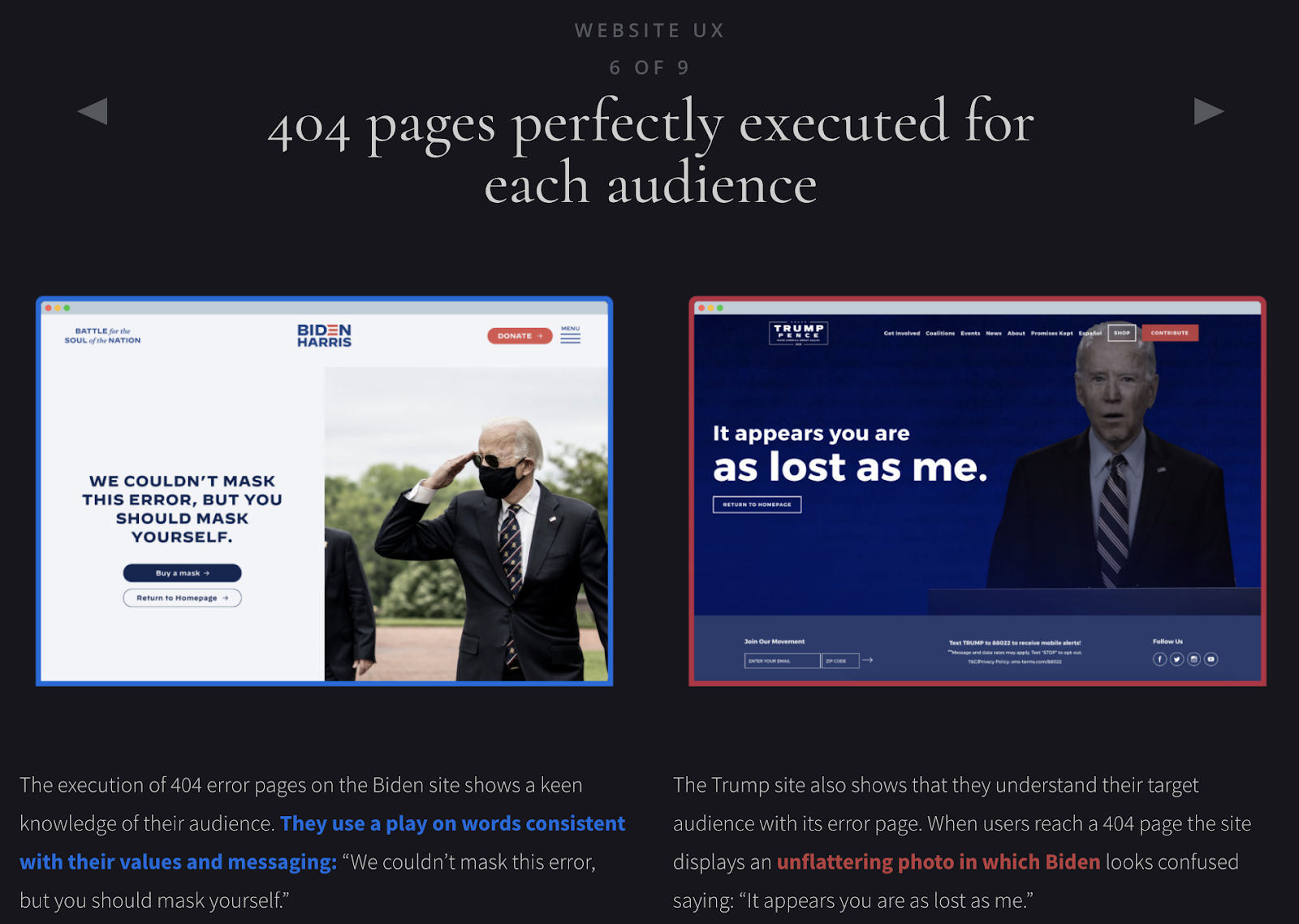
Neither campaign is leaning into search advertising heavily, with text-based search ads accounting for 11.48% and 10.09% of the Biden and Trump campaign’s Google Ad’s budgets respectively. They both make good use of the video elements of Google’s platforms, which may be based on the fact that video is a more immersive experience for the viewer, however it is unusual to see so little budget devoted to image ads given their ability for cheap, but effective remarketing.

The biggest misstep? The Trump campaign paid for the keyword “how to impeach trump.” One might think that this strategy is fascinating, and indeed it could have been, if paired with the right landing page. But when you look at other terms that received significant clicks, you’ll also find terms like, “speedo swim trunks,” “men’s xxl swim trunks,” “trump is a disaster,” and “trump fraud.” The Trump team was apparently not looking at their own search terms report. This oversight is easily fixable by adding negative search terms to their strategy.

Another key difference in strategy is that Biden’s team is using search to prioritize issues, while Trump’s team is here to sell hats (and other merch). Overall, team Biden is performing better in the Google Ads game. However, this is largely due to the fact that they’ve made fewer obvious blunders rather than their own strength on the platform.

I wasn’t impressed by the Trump campaign’s email strategy. The subject lines are flashy, even misleading, resorting to bait and switch tactics. Trump’s email team is pushing hard for donations. Ironically, however, the Trump campaign falters big time when it neglects to add emails entered into the footer of the website into any sort of followup email funnel.

With an average of 2.7 emails sent per day, one has to wonder about unsubscribe rates on the Trump campaign’s emails. The intended strategy may be to hit the audience hard to get recurring donations before they unsubscribe due to email fatigue.

The Biden campaign, on the other hand, seems to want to turn subscribers into advocates, only occasionally asking for donations. His campaign sends significantly fewer emails than Trump’s, with an average of one email every other day. The Biden campaign keeps the issues of their campaign central, and their subject lines helpful and professional. Overall, Biden’s email strategy has a clear advantage over Trump’s in its use of best practices.

Both candidates are running predictable and moderate social media campaigns. Biden is more active on Instagram than Trump, but it’s still surprising that neither candidate makes greater use of Instagram, considering the app’s large demographic of young, often swing voters.

The campaigns’ followers describe themselves in predictable ways: “she/her,” “feminist,” “activist,” and “liberal” for Biden and “KAG,” “patriot,” “conservative,” and “retired” for Trump. However, with only 1.3% of crossover between followers of these accounts, users are essentially tweeting into a political echochamber. It’s also interesting to note that in an analysis of how Biden and Trump advocates speak on social media found that Trump site visitors are twice as likely to talk about the opposing party compared to Biden site visitors.

The most creative social media push from either the campaigns is the Biden campaign’s podcast. This is new territory for presidential campaigns, and while its success has been mostly negligible (it seems Biden supporters are more likely to engage on other channels) it was a creative effort.

The Trump campaign uses divisive ads, intending to both sow distrust in leaders of the democratic party, and raising funds. These ads often include asking users to take a one-sided survey with titles such as: “Official Democrat Corruption Accountability Survey.” These tactics might be duplicitous, but we’d also give them some credit for stepping outside of the box. Both candidates ask for donations, just with a different focus. It seems likely that Trump is receiving more funds from his tactics, but Biden is likely creating more “ownership” from those who do support him by focusing on specific issues and local state battles.

Both campaigns run well-timed ad campaigns with a focus on state-driven ads, a smart strategy for their specific aims. The Trump team consistently spends more but the Biden team places a greater priority on swing states. The Biden campaign spends more in three of the five top contested states, while Florida gets the most attention from both budgets. And, while the Trump team consistently spends more, the Biden team is moving fast, increasing their spending quickly over the past three months.

Many know that SEO is renowned for its lengthy timeline to see results. So, with a fast-paced campaign like the presidential elections, SEO is, and really should be, a lower priority. However, both campaigns are making some pretty simple SEO mistakes that could be avoided with a simple two-hour audit. And, no matter the priority, easy fixes like that are always worth it.

Currently, the Trump team leads in gross organic searches. This is likely due to the fact that their top keyword “trump” has a 10X lead on the Biden team’s “joe biden.” However, the Biden site has the barebones of a non-branded strategy, with pages for terms like “gun safety” and “immigration.” They also make fewer elementary mistakes (homepage errors, missing H1 and H2 tags, the absence of canonical links, poor meta descriptions). While the Trump site carries more weight at the moment, if the campaign were to run for years rather than months, we’d put our money on the Biden site faring better over time.

A candidate’s logo is the centerpiece of the entire campaign. It reflects the values and strengths of a candidate. Logo design goes to Biden for its ability to be transferred to different colors and backgrounds, but Trump makes better use of logo variations for different subgroups. Their campaign colors match their demographic targets. The Biden team chose a bright navy and candy apple red, imbuing a lively, youthful energy, while the Trump team opts for a dark, rich navy and deep, crimson red to suggest seriousness, and an established foundation.

Looking to the campaign sites as a whole, the Trump site is more intuitively designed. Biden focuses on the human element, with copy like “chip in” and a casual, friendly lifestyle video. Trump’s site makes use of a full-screen design, maximizing on-page real estate and making mobile transition easier.

On the Biden site, the navigation is less intuitive, with a nearly overlapping “menu” title. Trump’s site navigation is more intuitive, and the white text allows for a nice eye flow. However, sometimes the white text runs into readability issues when photographs aren’t dark enough to create proper contrast.

The Trump app is a conversion machine, while the Biden app feels like a bit of an afterthought. Trump’s app holds the hand of the user throughout the entire app experience, with easy navigation, clear calls to action, and incentives for those who donate. Biden uses his app to share his vision, conveying a sense of togetherness and altruicity.

While not an essential part of a campaign, superfans will certainly download and use the campaign apps, so it’s definitely not an avenue to ignore. Both apps could definitely use some attention, but overall, the Trump app makes better use of the unique app format by giving benefits that are only available in the app.

Commercial strategy might be the greatest failing in the Trump team’s digital campaign. Their strategy is largely national, with little attention to specific state markets, including swing states. For example Florida, the state that has the most money going into it from both candidate’s Facebook and Google Ads, is being completely ignored by the Trump campaign. This is hardly strategic, seems more like an oversight.
MozCon 2020 is a wrap.
We heard from many speakers covering many industries, but even more compelling than the voices we heard, was the common themes between them.
I worked with my fellow attendees from 97th Floor to pull together the common themes and action items from MozCon 2020. In no particular order, here's the themes we saw, and what marketers and brands should be doing next.

As always Moz leads by example when discussing difficult, but necessary, topics. Like addressing the current economic, social, and civil situations. Sarah Bird kicked the conference off by acknowledging the current environment, and Dr. Pete gave a heartfelt opening to his address on keyword research. Immediately Dr. Pete had my heart and attention as he drew the connection between today's circumstances and how these factor into the fundamentals of SEO. Specifically topical research.
Of course today's economic climate is affecting each of the businesses we work for. Wil Reynolds closed the conference by introducing us to the new CMO, or rather, the lack thereof. We were all given stark evidence that our careers and success as marketers hinge on being able to effectively communicate in the language of the board.

The Takeaway: I think I speak for everyone when I say I’m sick of hearing “unprecedented times” in brand messaging. Let’s skip getting things back to normal and instead make things better. No doubt, the past few months have changed some foundational elements of everyone’s lives, but as marketers let’s make sure this change is for good, and is long lasting.
Look at your current marketing efforts and ask, "Are we trying to get back to "normal"? Or are we using this as an opportunity to get better?
I think I speak for all the attendees when I say that day 2 of MozCon 2020 was filled with equal parts intrigue and trepidation. Of course we've all known for a long time 97th Floor has already believed in the power of unconventional data sets for practical SEO use. (We're so close to launching something big around this, stay tuned!)
I think most SEOs understand and respect the different methods of deep technical SEO, but many don't know what's possible, or how to begin. Enter Moz's Senior SEO Scientist Britney Muller, who walk gave every attendee the chance to dip their toes into machine learning and automaton.

Britney continued on with examples and uses cases, but perhaps none was more interesting than entities from Google. Essentially it's a score that indicates Google's topical associations with a given URL. I'm excited to dig deeper into this later.
Of course every attendee this year remembers Michael King's one of a kind theatrical experience showcasing the many use cases of data scraping, machine learning, big data crunching, and artificial intelligence.

This address was maybe the heaviest conference address I've ever heard, but the format of a ~30 minute film and story made it actually digestible. In the traditional setting, my eyes may have glazed, but today, they were glued. Today, we witnessed a new medium for virtual conference addresses. Well done Michael!

The Takeaway: The technical inspiration shared today could come across as fiercely intimidating. But you can take it for a fact that these advanced scripts, and machine learning setups aren't conceived out of nothing (even for the pros). If you are enthralled by the idea to get busy with scripts, machine learning, and automations start slow and be patient with yourself. It's a brave new world! Also rewatch those sessions when the recordings come out.
Stay glued to the 97th Floor social accounts and newsletter to be of the first to know when we drop our own software that accomplishes a lot of the technical crunching we've seen seen at MozCon.
How can you get customers if you don't know them? Even before Coronavirus, the industry has been seeing subtle shifts to growth-driven marketing. Or in other words, measurable marketing.
Quickly Wil Reynolds had the audience's attention with the line, "The less you understand your customer, the more you spend to acquire them."

If we really care about bottom line budgets, we should start acting like it. Wil went on to call out mistakes he's seen of advertisers spending inefficiently because they didn't have their customer map dialed in. He made the case that saving money comes when you understand the customer journey and all marketing facets work in unison to perfect the customer journey experience.

Branding expert Flavilla Fongang uncovered timeless branding expertise with many notable tactics like:

But perhaps none was more resounding to me than her declaration that customer engagement is a company-wide effort. Innovation must be built into the company culture to retain and delight customers.
The Takeaway: The customer journey is not only knowing your audience, it's anticipating their next move. The customer journey is crucial to bottom-line success. There are too many options in your space for you to just meet needs, we need to exceed customer expectations. And that only comes when we know our audience.
Invest in a real customer journey map (not just audience insights), paired with your published content. Hopefully you find gaps in the journey, filling those gaps with customer-focused content is your next homework assignment.
A great place to start on this a guide we put together on building a bullet-proof buyer persona.
I love transparency, but even more I love the vulnerability that took place at MozCon 2020. Speakers were eager to share what didn’t work for them. Phil Nottingham shared a story of setting three different budgets for a set video ads, $1,000, $10,000, and $100,000.
Obviously this would mean huge differences in the production value of these campaigns, and you might think that a better video ad would lead to better traffic.

Crazy right?
But we learned that spending more doesn’t mean it’ll produce proportionally more results.
Shannon McGuirk also spared no punches in reviewing her past work in link acquisition. I love this honesty, because this is how we (as a community) go further. Link acquisition is something that most are shy to share, so I was especially glad to see Shannon’s blunt honesty about what didn’t work (and what did).

The above graphic from Shannon shows what our marketing efforts tend to look like. You can see that majority of the activity is bringing in steady results. We can all see this is a healthy balance of activity, yet too often marketers only focus on the "huge wins" and consider everything else a fail. Embrace the steady performing campaigns and learn from your fails.
The Takeaway: None of us have ever marketed through a global pandemic before (unless someone at MozCon 2020 was marketing during the Spanish Flu 100 years ago). Let’s grant ourselves a little leeway and break a few eggs while we make a marketing omelet in this new world.
So don't shy away from getting after something our of your comfort zone. Whether you win or lose, the world keeps spinning. So get after that crazy idea you've been pushing off.
You know that building and selling to an audience isn’t cheap. You didn’t need to pay for a MozCon ticket to hear that, but it’s important to be reminded that people aren’t waiting around online for a brand to win their loyalty. Phil Nottingham encapsulated this feeling when he said, “The number of impressions is not the number of people impressed.”

A number of speakers today expressed renewed focus on audience building, especially through the lens of the unique health, economic, social, and civil circumstances everyone is facing today.
The Takeaway: Be empathetic and understanding with your audience. Rerun your keyword research because volumes and interests have changed dramatically in the past few months. Being quick on an SEO/paid media/content strategy for up and coming keywords in your space will be rewarded with more traffic. Now comes the fun part of turning that traffic into an audience, which was discussed today by many presenters.
Get fresh keyword and audience data, then restructure your traffic and audience source.
This isn’t a new topic for MozCon, or any digital conference for that matter, but today it matters more than it did in the past. Just within the past several months, spending and consuming habits have changed dramatically. If SEOs are working purely off keyword data that is 6-12 months old, they are missing out on huge opportunities.
Utilizing Google Trends at this time is a great place to start, and Dr. Pete took us on a journey of just how to grab that data. Who else was excited to learn about Pinterest Trends?

Many others at MozCon shared truly cool ways to collect and crunch data that give you deep and actionable understanding your audience, for example...

And don't write off knowing your own business. Heather Physioc laid down the foundational truth that before any significant marketing can be conducted, we need to understand the brand we are marketing for. Including our values and competitive edge. A good tip for defining your competitive edge is finding the collection of words that describe your businesses that end in "est" (i.e. quickest, cheapest, etc.).

The Takeaway: Your audience, along with their wants and needs, has likely drastically shifted over the last six months. If you aren't on top of those new insights, you are bleeding money. Lucky for you, there’s data out there to inform your audience strategy. Of course there’s some readily available data sources from traditional tools, but through custom scrapers and unique data pulls/crunches you can get clean data that actually informs strategy.
Make every effort to obtain audience data, build real personas, and then use those personas throughout your marketing team.
Another way to say this is to invest in your brand.
This is another trend that isn’t exclusive to this MozCon, but we’ve been saying the same thing for years. However, I think most brands are feeling this exaggerated effect given the economic hardships associated with the Coronavirus pandemic.
It was mentioned multiple times by many speakers; Capture and delight your audience, and then nurture them on your own platforms. Be it your copy, website, videos, or email.
Phil Nottingham gave a great example of this such as Uber creating Uber Presents, or Mailchimp creating Mailchimp Presents, or Wistia creating Brandwagon, a late night style talk show for marketers.

All of these projects are great examples of companies creating content for their audience. They become the media their users seek, rather than spending a ton of money to annoy users on other media platforms.
When Brian Dean started by dropping some Star Wars themed slides, he had me. But the data kept me! For example he confirmed what many have already assumed, but not with the hard data behind it. Your email subscribers are more likely to get to your content than your social followers.
 Not to mention Brian's presentation also discussed specifics of how to invest in your brand. He asserts (and I agree) that marketers need to spend more time on the promotion of their content, especially when compared to how much time we spend creating it. He called for an end to the "
Last week, Google announced a new set of metrics that will play an integral part in the future of Google’s algorithm called, Core Web Vitals. Google is giving a whopping 6+ months head’s up for SEOs and webmasters, and it looks like we’re going to need it.
This update will not take effect until 2021.
From Google, “The ranking changes described… will not happen before next year, and we will provide at least six months notice before they’re rolled out.”
I’ll go into it in detail later on the Core Web Vitals, but they are essentially an organized set of loadability metrics Google believes contribute to positive user experience. These contribute to the encompassing term from Google, page experience, which is core to this upcoming update.

At a glance, page experience is a set of signals that measure how users interact with a web page beyond its strictly informative elements. It includes Core Web Vitals, which is a set of metrics that measure real-world user experience for loading performance, interactivity, and visual stability of the page. Once this update rolls out, Google will be combining the Core Web Vitals ranking signals with the existing Search signals of mobile-friendliness, safe-browsing, HTTPS, and intrusive interstitial guidelines in order to create a more complete and measurable picture of the user’s on-page experience.
The focus on page experience seems to be a signal from Google that holistic SEO matters more now than ever. It’s clear that content or links alone don’t determine the ranking of a given webpage, although Google has made it clear that content still plays a vital role in the future of the core algorithm.
A good page experience doesn’t override having great, relevant content. However, in cases where there are multiple pages that have similar content, page experience becomes much more important for visibility in Search.
Content still tops the list when optimizing a page or site, but it seems page experience can solve tie-breaker situations.
Core Web Vitals are encompassed within Google’s definition of page experience. At this time, it appears that three vitals will be measured when this core update launches:
Google has made it clear that this list is not set in stone, and there could be new metrics added to this group down the line. 97th Floor will continue to give updates on Core Web Vitals as more information is made known, and we have more time to test.
SEOs have long been able to use tools provided by Google like Page Speed Insights, Google Search Console, and Chrome User Experience Report. As of last week, they have each been updated with new elements pertaining to the Core Web Vitals.

Marketing leaders need to ensure that their SEOs and development team members are properly integrated to ensure the testing, and execution of these improvements take place.
The world has at least 7 months before this rolls out, but that’s no reason to sit until that time comes. Because much of what will go into page experience will require web developers to optimize, it’s critical that SEOs begin having those conversations now to ensure they have the bandwidth for technical fixes in the months to come.
Curious SEOs have already started digging into the tools provided by Google to see how their site’s fare:

Effective immediately 97th Floor is including LCP, FID, and CLS into our site audits for all clients. Of course, Google has mentioned that the effects of these fixes will not directly help sites until the update officially rolls out in 2021, but some sites could see longer runways to rollout than others, and henceforth will require ample time to execute fixes. We recommend SEOs begin utilizing their Google testing tool of choice.
For the next six months double down on content that cuts to the heart of the user’s questions. I suggest SEOs review high traffic pages and ensure that new content conveys clear messaging and gives users a reason to stay on the page.
For example, if your web page has a chart that lists out the qualifying times for the Boston Marathon, turn that into a calculator, provide graphics that illustrate training regimens, and link to your existing articles about the Boston Marathon.
One way that you can identify the pages that could use the most attention would be to hop into Google Analytics and filter down to Google / organic pages that have a session duration that is below the average session duration for your site. This list could then be sorted by the ones that have been getting the most conversions in order to ensure you’re prioritizing the pages that will drive the most return for your site going forward.
I’d also add one last plug for SEOs to continue optimizing sites for the areas Google has called out in previous updates like mobile-friendliness, safe browsing, HTTPS security, and intrusive interstitials so that once the update goes live, you’ll be ahead of the curve on those areas as well.
As a whole, SEOs should take time with each initiative they undertake to ask themselves, “is this creating a better user experience?” Gone are the days when SEO was only concerned with acquiring links, and creating good title tags. SEOs need to appeal to the human algorithm more and more, which means they need to understand their unique audience and create an experience tailored to their needs.
