



Most marketing teams are measuring the wrong thing with AI. They're tracking speed. How many blog posts they wrote. How fast they shipped. How many tools they're using. And because those numbers go up, it feels like progress.
Whitney Goldstein, Director of Marketing at Gorilla Logic, isn't buying it. She told her team to stop optimizing for speed and start asking a harder question: does it actually work better?
Goldstein has stepped into new marketing leadership roles more than once, and she's developed a clear philosophy for how to start. She's direct with her team from day one about why she's there and what direction they're heading, even when that direction is still taking shape. She meets with every team member individually to understand what they like, what they don't, and where they want to go in their careers. Even when she doesn't have authority to make big changes, she looks for what she can shift.
The biggest mistakes she's seen leaders make, including herself, come down to pace:
The right call depends on the organization, its history, and how much change the team has already absorbed. "You have to be really cognizant and respectful of the team members that have gone through those," she told Paxton Gray on The Campaign.
Gorilla Logic is a software engineering firm. For a marketing team to do its job well, it has to understand deeply technical work and talk about it with credibility. That gap is hard to close from a distance.
Goldstein's approach is to close it head-on. She has her marketing team learn the technical pitches and practice delivering them internally. Not because anyone on the marketing team will ever sit in a real client meeting, but because it signals something important to the engineering teams. It shows that marketing is invested enough to do the hard work of understanding the product. "Showing that we're invested enough to be able to do it ourselves and raise our hand in front of a group of people and say, 'We're going to show what we've got. And if it's not right, we're happy to take critiques and feedback' — I think it's really shown that the marketing team is invested in what we're doing."
That willingness to be vulnerable builds trust faster than any cross-functional meeting. When that trust exists, things move. When it breaks, no process or tool will save you.
When competitors started launching AI agents and token-based subscriptions, Gorilla Logic made a deliberate choice to go the other direction. The pitch isn't a new platform or a new product. It's the same thing Gorilla Logic has always done: build digital products and platforms for clients. The methodology has changed, the tools have changed, but the fundamental value hasn't.
Their two AI-related offerings reflect this:
At the end of an engagement, clients own what was built. They're not locked into a subscription or dependent on another platform. "We're not pushing another subscription. It's not another thing that they're locked into. It is still our expertise at the end of the day that we are delivering to them," Goldstein said.
The market response has been mixed, as it often is when a category shifts and uncertainty sets in. But the buyers who do respond are clear about why: they're tired of being sold tools. And internally, the contrarian stance has given her team something to rally around. When a team believes in what they're saying and knows it's different from everything else in the market, they show up with real energy.
When Goldstein joined Gorilla Logic, every department was expected to use AI and report on how. The results, across the board, were thin. She points to research showing 95% of AI projects fail to produce measurable outcomes. Her team is behind on adoption. That's intentional.
The trap most teams fall into is treating efficiency as the goal. AI can produce content faster, so teams optimize for volume and speed. But faster output with no business impact isn't a win. And in many cases, the time savings aren't even real.
The efficiency trap creates real problems:
Time spent editing AI output often exceeds time saved. Her team found they were spending more time editing AI output than the tools were saving them. Add in the governance concerns and the security issues that come with integrating these tools into platforms like Google Ads and Google Analytics, and the math stops working.
Team stress increases without measurable results. Asking people to squeeze AI experimentation into the gaps of their regular workday means constant context-switching — "10 minutes or 30 minutes in between their work day task switching or multitasking on getting this out the door and then also playing with AI and trying to come up with a metric that is proving that it's working."
Everyone optimizes for the wrong KPI. Volume of content. Speed of production. Number of tools in use. None of these measure what actually matters: does it work better than what came before?
Goldstein's solution is to separate exploration from execution entirely. Instead of squeezing AI experimentation into the gaps of a regular workday, she blocked real time for it. Every two weeks, her team spends four hours on a Friday doing nothing but testing and playing with AI tools. No deliverables. No metrics to report.
The goal isn't to find efficiency hacks. It's to discover what's possible. "I'm not asking for you to solve the world's problems. I'm not asking you to come up with a new solution of how we're going to create graphics or ads. I just want you to learn and explore. And then we can come up with a holistic way of how we're going to implement this that makes sense for the entire team, not just one person."
It's a close parallel to Google's practice of setting aside dedicated time to build new things, which produced some of their best-known products. Results have already come out of those sessions at Gorilla Logic. For an upcoming sales kickoff, the team found ways to combine video tools that produce high-quality output without new subscriptions or significant spend. They built the workflow themselves and can repeat it. Not doing the same things faster. Doing things they couldn't do before.
Speed and volume are secondary. The only metric that matters is whether the output performs better than what came before. Goldstein puts it plainly: if AI is writing ad copy and creating images, "it also should have a metric at the end of it that's saying they're performing better than the human ones. If they're not, then why are we using it?"
The KPI should never be:
Those metrics are easy to hit and easy to report. They say nothing about business impact.
The efficiency-over-quality trap also shows up in how marketers position themselves, and it's costing them seats at the table. Fewer CMOs sit in executive functions today. More marketing leaders report up to the C-suite rather than sitting in it.
Goldstein sees two things holding marketers back:
1. Failing to connect marketing data to business goals. Marketing teams get excited about their own metrics and struggle to tie them to what the CFO is reporting. When every other department talks pipeline and revenue and marketing shows up with click-through rates and open rates, the executive team tunes out. The fix is deliberate education: explaining what marketing-generated pipeline is, how it feeds sales pipeline, and why both numbers tell part of the same story.
2. Over-specialization. For years, marketers were rewarded for being specialists. Paid ads. SEO. Content. Demand gen. Each in its own lane. That era is over. "We all have a marketing background, we work in a marketing team, we work on integrated campaigns. We all need to be doing more in our roles and saying that I can be a Swiss army knife. That means I can do anything that you throw at me and I will take it and I will learn from it and I will excel."
PR now rolls up to Goldstein, something she hadn't done in 10 or 15 years. She didn't push back. The mindset is simple: never say it's not your role.
The willingness to stretch beyond a lane usually traces back to a leader who made it feel possible. Goldstein's approach with her own team: go to people directly, tell them you think they'd be great at something outside their scope, and show genuine excitement about it. "I think if more leaders went to their team and showed excitement and trust that they could do something that they haven't done, more people would continue to expand their horizons."
That excitement signals confidence even when the team member doesn't feel it yet. The alternative, waiting for someone to ask for a stretch opportunity, or defaulting to "that's not your job," produces a team that stops growing.
When Paxton Gray asked for parting advice for leaders trying to shake things up, Goldstein came back to one word: space.
Space to be creative. Space to learn. Space to make mistakes. Space to bring whatever is going on in your life to work and work through it. Her reminder to her team: "Thank goodness we are not saving lives. At the end of the day, we do not save lives and that's a blessing."
That's not permission to coast. It's permission to take real risks. "We can push the boundaries and it's okay to fail. Sometimes the best thing to do is to fail fast. Try something and say, this was unsuccessful. We have to try the next thing and move on quickly."
The teams chasing volume and speed will have dashboards full of activity. The teams asking whether it actually works better will have something more valuable: proof.
Connect with Whitney on LinkedIn: https://www.linkedin.com/in/whitneygoldsteinmba/
Connect with Paxton on LinkedIn: https://www.linkedin.com/in/paxtongray/
Looking for an agency that'll be worth the investment? 97th Floor creates custom, audience-first campaigns that drive pipeline and conversions. Get started here: https://97staging.com/lets-talk/.
02:48 - Leading with truth and honesty when taking over a team
05:06 - The biggest mistakes marketing leaders make: moving too fast or too slow
13:38 - Why Gorilla Logic isn't "just another AI company"
18:46 - The dedicated exploration time approach: 4 hours every two weeks
35:20 - The Swiss Army Marketer: why specialists won't make it to the boardroom
43:50 - Creating space for teams: "This is PR, not ER"
With nearly 10 years of marketing experience, Whitney’s strategic direction as a B2B Marketing leader encompasses mission, vision, and strategy. Currently, Whitney serves as Director of Marketing at Gorilla Logic.
Traffic is falling. But your customers are not gone.
Click-through rates are down across nearly every website. Zero-click searches have taken over. The old playbook (rank high, get traffic, win) no longer holds.
But people are still buying what you sell. The demand did not disappear. The path changed.
Here is how to measure success when the clicks stop coming.
"There's a lot of people that are positioning it as an entirely new thing," says Blake Nielson, Head of Accounts at 97th Floor. "But when you start to look at the ingredients of AI search versus traditional SEO, it's a lot of things that we've always been seeing."
Content still matters. Technical SEO still matters. Site structure still matters. Offsite signals still matter.
What changed is the outcome you are chasing.
Traditional SEO chased traffic. AI search chases recommendations. "We're not necessarily trying to get a ton of traffic to a site," Mike Witham, Head of Search at 97th Floor explains. "We're trying to get recommended by the LLM and be mentioned in the right way."
Blake puts it plainly: about 80% of AI search is the same as SEO. The other 20% is where things get different. Things that mattered before now matter more. That shift changes how you measure success.
Organic traffic used to be easy to hide behind. If it looked good, everything seemed fine. Not anymore.
"Organic traffic now looks different," Blake says. "Click-through rates have gone down for virtually every website because zero-click searches are everywhere now."
The answer is not to drop traffic metrics. It is to expand what you track.
The core metrics for AI search success:
AI search changed the customer journey. People use LLMs for top-of-funnel research, then run branded searches to go deeper.
Mike walks through a clear example. Someone searches "best gray sweatsuit." Nike shows up in the AI response. The user likes what they see. Their next search is "Nike gray sweatsuit," which takes them to Nike's site and drives the conversion.
"What Nike would do is say, have the searches for Nike gray sweatsuit increased since I started showing up in the LLM for gray sweatsuit?" Mike explains.
You track this in Google Search Console, not Ahrefs or SEMrush. Those tools will not capture new branded queries with low search volume. Search Console is your source of truth.
The big insight: if you search "gray sweatsuit" today versus last year, that number is down. But Nike's branded sweatsuit searches are up. They are not losing customers. The customers are just entering the funnel a different way.
"The people who want shoes are still buying shoes," Paxton says. "AI hasn't changed market demand for shoes. They're just coming through in a different way."
Traditional SEO taught hub and spoke. One pillar page. Supporting blog posts. Internal links. Done.
AI search asks you to zoom out further.
"We need to pull it out a little bit further," Mike says. "It encompasses so much more than just your blog and the internal links that go to a hub page."
Start with the customer journey. If you sell baseball bats and you write "best baseball bat for 12-year-olds," the message needs to hold across all of these:
"Everything, all of the messaging across all the different types of pages about that subject, should match and be cohesive," Mike explains. "The LLM can see your authority and see that it's backed up in multiple places."
LLMs want to validate what they find. The more sources that confirm your expertise, the more likely they cite you.
The fastest wins come from what you already control.
Owned citations are links from the LLM back to your website. These are the best kind. They drive real referral traffic.
Third-party citations are links to Reddit threads, blogs, listicles, and affiliate sites. Useful for authority, but harder to control.
Start with what you own:
Your website. Make sure you have enough indexed pages covering your topic with real depth. There is a correlation between indexed pages and brand mentions. More quality content means more chances to get cited.
Social platforms. YouTube, LinkedIn, and Reddit are three of the most cited domains across all LLMs. "Two of those, your brand could have almost complete control over," Blake points out. YouTube and LinkedIn are yours to own.
Make your social content match your website messaging. Google indexes social content now. ChatGPT and other LLMs cite it heavily.
Listings and directories. Google Business Profile, Yelp, industry directories. Update every one. Match your messaging. This is low-hanging fruit.
Only after you have locked down what you own should you move to third-party plays, like PR outreach, affiliate partnerships, or Reddit engagement.
Should your brand be on Reddit?
"In some industries it's everything. In other industries it doesn't matter," Blake says.
LLMs like Reddit because it is user-generated content that is harder to game. Moderators keep spam out. It reads as authentic.
If your users ask questions about your product on Reddit, be there. Create a brand account. Engage in the right subreddits. Answer questions. Be useful.
"You can't just go and post promotional stuff on most subreddits," Blake warns. "It's about community. If it makes sense for your brand to answer those types of questions, if you're an espresso machine where people are asking a lot of questions and need help, that's a good opportunity."
But if your audience is not on Reddit, do not force it.
Blake uses a sharp example: "If I'm a lip balm company, users aren't hanging out on LinkedIn talking about chapstick. They're in the ski subreddit asking questions."
Do the research first. Search your product category across different LLMs. See what gets cited. Let that drive your strategy.
For years, SEO held that affiliate and sponsored links do not pass value. They are nofollow. They do not help rankings.
AI search flipped that.
"When Google really went all the way in on AIO, that was one of the most shocking things to me," Blake says. "We were seeing all these citations for affiliate and sponsored posts."
If content lives on a high-authority site, LLMs will cite it. Sponsored or not.
This opens a real tactic: paid placement on authoritative sites that LLMs already trust. You can even build backlinks to those sponsored posts to push up their rankings, which raises the chance of citation.
"That's kind of the intersection of ad spend and AI search," Blake notes.
The 97th Floor AI task force ran a test with a client that had an eight-month-old website. Low page count. Not getting crawled much. Not getting noticed.
They did two things:
"LLMs are just lazy robots," Mike explains. "They just want to find the easiest answer as fast as possible. Schema markup gives them helpful hints."
Within one week, the site went from zero citations and zero brand mentions to four dozen. All from the pages that had the new schema.
The catch: you need to know what schema to use and why.
"What type of schema am I implementing? What do I want the LLM to parse out?" Mike asks. Do not add article schema or product schema because an influencer said so. Identify what data matters most, whether that is review schema, FAQ schema, or something else, then implement with a purpose.
"My hot take is to ignore hot takes," Mike says.
Every day someone claims they found the secret: schema is everything, you have to be on Reddit, Google reviews are all that matter. "Marketers will just pick up on that and go full blast without actually verifying it's going to do something for them," he explains.
The right move is to start with your audience.
Does your audience even use LLMs for this type of purchase? In travel, LLMs matter enormously. In industrial manufacturing, less so. Still worth optimizing for, but the urgency is not the same.
Before chasing any tactic, ask: Is this relevant to my industry? Will the LLM care about this for the topics I want to own? What outcome am I after?
Start with research. See what gets cited in your space. Then build your plan.
97th Floor runs AI search audits that reveal three things:
Where you show up. Which topics get you mentioned across major LLMs.
How you show up. What is the sentiment? Are they recommending you or pointing out flaws? Are they describing you the way you want?
Where competitors are winning. What topics do they own that you could contest?
One audit for a major tractor company found a competitor closing fast through comparison content. "They're doing a ton of competitive comparisons and that type of content is really being picked up by the LLMs," Paxton and Mike found together. "That's a huge opportunity the company didn't take advantage of yet."

Zero-click searches are not killing your business. They are changing how customers find you.
The demand still exists. The purchases still happen. You need different metrics to track the journey.
Stop watching only traffic. Start tracking brand mentions, citations, impressions, and branded follow-up searches. Expand your content clusters beyond your website. Own your citations before chasing third-party placements. Use schema with intent. Ignore blanket advice.
AI has not changed what people want. It has only changed how they search for it.
Your job is to show up in that search, even when the click never comes.
Request a free AI Search Audit: https://97staging.com/ai-audit/
Connect with Mike Witham on LinkedIn: https://www.linkedin.com/in/michael-o-witham
Connect with Blake Nielson on LinkedIn: https://www.linkedin.com/in/blakejnielson/
Connect with Paxton on LinkedIn: https://www.linkedin.com/in/paxtongray/
Looking for an agency that'll be worth the investment? 97th Floor creates custom, audience-first campaigns that drive pipeline and conversions. Get started here: https://97staging.com/lets-talk/.
1:13 - AI search vs. SEO
5:22 - Measuring impact in the AI age
10:47 - Follow-up searches & Search Console
16:05 - Rethinking topic clusters
23:31 - Offsite strategy: Reddit, YouTube, LinkedIn
30:18 - Hot takes & schema markup experiment
Mike Witham is the Head of Search at 97th Floor, where he has spent the past seven years leading SEO strategy and performance for enterprise and high-growth brands. Based in Lehi, UT, he specializes in building data-driven search campaigns that achieve bottom-line results for clients. With his ability to create holistic, full-funnel marketing campaigns, Mike helps teams turn organic search into a highly profitable, revenue-driving channel.
Blake Nielson is the Head of Accounts at 97th Floor, where he partners with enterprise and high-growth brands to turn organic search into a measurable revenue channel. With deep expertise in SEO and AI search, he helps clients translate complex shifts in the search landscape into clear business strategy. Blake specializes in building strong client relationships, aligning teams around growth goals, and making sure every campaign ties back to bottom-line results.
Some search marketers have been declaring SEO dead for over a decade. Yet every year, search keeps driving brand discovery and revenue.
What has changed is how visibility works. Google’s AI Overviews summarize answers before users click, and generative engines talk about the brand inside responses. Search behavior now also spreads across YouTube, LinkedIn, marketplaces, and AI platforms.
Now, we aren’t gaslighting you—we are also seeing the declining click-through rates and unstable traffic that were so different just five years ago. When people ask, “Is SEO dead?” they’re reacting to something very real, and it’s affecting industries across the board.
But SEO is not dead or even dying. Like most things being affected by technology and digital initiatives, SEO is simply changing. Technical excellence, authoritative content, and visibility across systems is still essential. Now, you just need to optimize for AI systems and search platforms, too.
The biggest shift is the rise of AI-generated answers directly in search results. Google’s AI Overviews and generative engines can summarize information before a user ever clicks a page. In many cases, the search experience ends right there on the results page. When teams see traffic dip even though rankings remain strong, it naturally sparks concern about the long-term value of SEO.
At the same time, search itself is no longer confined to Google. People discover products on Amazon, research ideas on YouTube, ask questions inside AI tools, and follow recommendations from LinkedIn or Reddit threads. That fragmentation means visibility is happening across a wider ecosystem than traditional search analytics tools were built to track. For a lot of businesses, it can feel like you have no control over so many channels.
Those two forces together have created real volatility in organic traffic. If you have historically measured SEO success only through clicks and sessions, these changes can feel like the ground moving underneath your entire strategy.
For brands willing to adapt, the opportunity is still massive. Strong search visibility now depends on building authority, technical clarity, and content that AI systems trust as a source. That kind of SEO strategy sits at the center of modern search growth.
The phrase “is SEO dead” is what marketers are saying when they see declining organic clicks and evolving search interfaces that don’t seem as compatible with classic SEO. AI-generated summaries, knowledge panels, and expanded SERP features often deliver answers before users reach a website, so why should businesses bother with SEO?
But this evolution of search optimization has not necessarily lost its relevance. In fact, all it really means is that the role of SEO has expanded. Instead of focusing exclusively on ranking individual pages, your strategy should heavily focus on building authority and structured visibility across search and AI ecosystems.
A few patterns tend to fuel the idea that SEO is disappearing:
Remember that, ultimately, organic search remains one of the strongest discovery channels on the internet. High-intent queries flood search engines every day that drive your revenue. People still rely on search to solve problems and evaluate options, and your brand needs to show up in those results.
Enterprise organizations still invest heavily in search because it contributes directly to their pipeline growth. As you become an authority in your space (rather than focusing so heavily on ranking), and have technical, structured content performance, your visibility will increase.
For years, SEO success looked fairly straightforward, but there are a couple of other players on the field.
Traditional SEO says that success looks like top rankings and organic traffic. If your page appeared near the top of search results, the assumption was that clicks and engagement would follow.
Meanwhile, AI Overviews and generative systems increasingly pull answers from multiple sources. When that happens, business influence shows up through citations, summaries, and brand mentions inside those responses.
In other words, when AI search systems generate answers, they rely on sources they trust. If your content becomes one of those sources, your brand shows up in the answer itself—even when the user doesn’t click.
“SEO” is also one slice of a much larger pie, where AEO and GEO are a part of a well-rounded strategy.
Answer Engine Optimization, or AEO, focuses on structuring content so search systems can extract clear answers. Generative Engine Optimization, commonly referred to as GEO, looks at how AI platforms summarize and reference sources. Both ideas reflect the same larger trend: search engines are becoming answer engines.
Modern SEO strategies bring these concepts together. Instead of separating them, organizations combine traditional ranking strategies with content structures designed for AI summarization and entity clarity. This approach is how you can be at the top of your game with AI search and how to optimize for the future of search engines.
Another major change is where discovery happens. Search behavior no longer lives inside a single engine.
Someone researching a product might start with a Google query, watch comparison videos on YouTube, scan reviews on marketplaces, and read thought leadership on LinkedIn. Users also ask questions inside AI assistants before visiting a website.
Brands that want consistent visibility build authority across multiple ecosystems where search intent appears. So yes, you need to optimize for Google—that’s not going anywhere. But you also need to show up where people compare products or services and ask questions. That might mean:
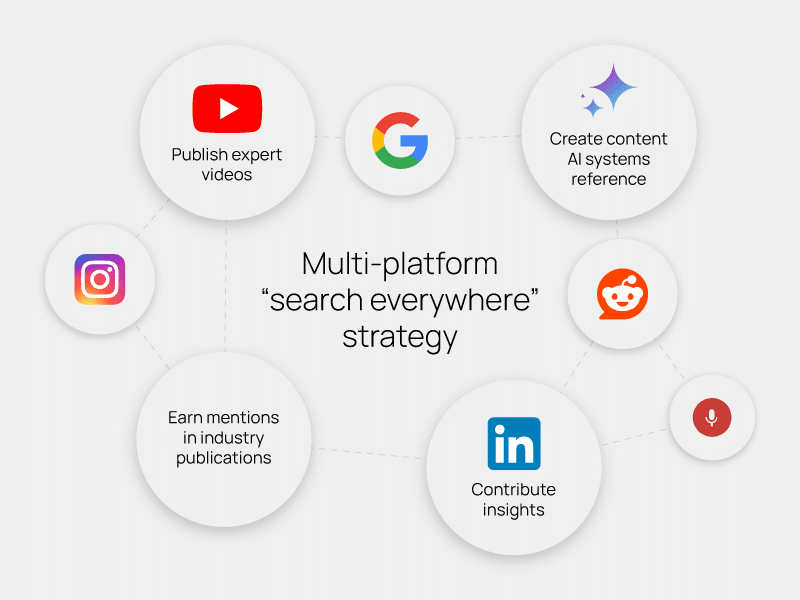
That broader presence strengthens the signals search engines and AI systems rely on when deciding which sources to surface. Over time, those signals reinforce brand authority in ways that pure keyword targeting never could.
Featured snippets started this trend years ago: search engines want to answer the question in the search bar without ever even visiting a website. Now, AI Overviews are taking it a step further.
Because more queries are answered directly in SERPs, AI Overviews have reduced the reliance on blue links for consumers—your audience.
So why are you pouring money into producing so much content for people to not even enter your website?
Because traffic declining does not necessarily mean your influence declines, too.
When your brand appears inside an AI Overview, a featured snippet, or a cited source within a generated answer, users still see your expertise. They may not click in that moment, but the exposure shapes awareness and credibility. Later, when they search again with a stronger intent, your brand is already familiar.
Instead of focusing exclusively on traffic, many organizations now look at a broader set of indicators:
The zero-click environment also forces some strategic decisions.
Chasing raw traffic can lead teams to prioritize high-volume informational queries that rarely convert. Meanwhile, focusing on authority and expertise often produces fewer visits but better downstream impact.
Enterprise organizations increasingly balance both sides of that equation. They invest in content that builds authority within a category while also strengthening owned channels like email, communities, and product education hubs.
Building authority earlier in the research process also helps teams connect search visibility to revenue attribution models, which track how organic discovery contributes to pipeline and closed deals.
We know that the technical side of SEO especially matters, but more than ever before, so does the human element of your content. Generic or recycled material just doesn’t quite cut it anymore. It’s your expertise and credibility that the AI models are going to trust.
Google describes these signals through E-E-A-T: experience, expertise, authority, and trust. This is exactly what it sounds like: search systems try to surface information that comes from knowledgeable sources.
AI-generated answers rely on the same signals. When models summarize content, they still look for sources that demonstrate real-world expertise and established authority within a topic area.
That’s why enterprise brands with recognizable subject matter experts, credible research, and original, real-world insights tend to perform well over time. They give search engines and AI systems a clear signal that their content is worth referencing.
Keywords do still matter, but even more important is writing for readers. Answer the search intent before you optimize for the algorithm to give yourself the best chance in AI search and future search strategies. This looks like having clearer explanations on the topic and practical solutions that actually help consumers make their decisions. Remember to:
Human-first content thrives when it’s supported by broader SEO principles. Successful organizations treat search visibility as a combination of these 6 disciplines of SEO working together.
If a site is difficult to crawl, poorly structured, or confusing to interpret, even great content struggles to appear consistently in search results. Think of it like building a library. You could fill it with incredible books, but if the shelves are disorganized and the catalog is missing, people will have a hard time finding anything.
Before a page can rank or appear inside an AI-generated answer, search engines have to find it and understand how it fits with the rest of your site.
That usually comes down to a few practical things:
When those fundamentals are in place, search engines have a clearer picture of what a site covers and which pages provide valuable answers.
Search engines are good at reading pages, but they still appreciate a little help.
Structured data acts like labels on a library shelf. It tells search systems exactly what they’re looking at. Product schema can identify price and availability. FAQ schema highlights clear question-and-answer sections. Review schema points to customer feedback.
Those labels help search engines surface the right information in rich results and AI-generated answers.
Entity relationships add another layer. When your brand consistently appears alongside certain topics across trusted sites, search engines begin to connect the dots. Over time, your brand becomes associated with that subject area, which makes it more likely to appear when people search for related information.
For enterprise organizations, technical SEO becomes even more interesting. Large websites often contain thousands or even millions of pages across different products, regions, and content hubs.
At that scale, small issues multiply quickly. Duplicate pages compete with each other. Important sections become buried several clicks deep. Old pages stick around long after they stop providing value.
That’s why enterprise SEO often requires governance systems and technical enterprise SEO playbooks that keep large sites organized. Without that structure, even strong content can struggle to gain traction in search.
You see a lot of the trending “SEO solutions” on your LinkedIn feed, but what is really going to move the needle? Let’s talk about it.
One of the biggest changes in modern SEO is the move away from pure volume. Today, that approach rarely produces lasting results. Search systems have become much better at identifying which sources actually demonstrate expertise within a topic.
That’s why many organizations now focus on building strong topic clusters around high-intent themes. Instead of publishing dozens of loosely related pages, they develop deeper resources that connect logically and answer related questions across the research journey.
The goal of these evolving SEO strategies is simple: become one of the sources search engines consistently associate with a category. That kind of authority tends to hold up far better than isolated rankings.
AI-generated answers have added another layer to modern AI SEO strategy.
Content now needs to be clear enough for AI systems to extract and summarize. Pages that explain ideas directly, use structured formatting, and answer questions clearly are more likely to appear in generated responses.
This often means writing in a more conversational, question-driven format. When a page mirrors the way people naturally ask questions, it becomes easier for AI systems to recognize and reference the information.
Ecommerce brands face a slightly different set of priorities.
Product pages need structured data that clearly communicates details like price, availability, reviews, and product attributes. Category pages often carry the responsibility of establishing topical authority for entire product groups.
At the same time, ecommerce SEO must compete within crowded SERPs filled with product listings, reviews, and comparison content. Brands that succeed often combine strong technical optimization with helpful buying guides, comparison pages, and educational resources that support the purchasing journey.
There are a lot of moving pieces to SEO now, and many organizations reach a point when their internal teams need help. This often happens when:
Working with a specialized team focused on AI-driven search can help organizations move faster while maintaining a clear strategic direction, which is why many brands explore working with an AI SEO agency.
By this point, one thing should be clear: modern SEO isn’t a checklist, but an entire system of connected strategies that all influence one another. When those elements operate in isolation, results tend to plateau. When they work together, search becomes a much more durable growth channel. 97th Floor is here to make sure every move you make is contributing to a healthy and modern SEO strategy.
97th Floor approaches SEO as a growth system rather than a content production engine. The strategy connects traditional search optimization with authority building, digital PR, and AI search visibility.
We can help you rank for keywords, but we also help your brand become a leading resource in your industry. Instead of chasing short-term ranking spikes, the focus moves toward durable visibility that supports sustained growth.
97th Floor focuses on building content systems and authority frameworks that continue performing even as search interfaces change. Search will keep evolving. How will your team keep up? Every algorithm update can work to your benefit as we help you master long-term authority and move beyond obsessive keyword ranking.
Let’s assess where your organization currently stands and see where you can start making changes for today’s SEO environment.
Start by looking at how your organization defines SEO success. The way performance is measured often shapes the entire strategy.
Next, take a close look at the technical foundation of your site:
Finally, consider how your brand appears compared to others in your category. Visibility gaps often become obvious when you look at where competitors show up in search and AI answers:
If these questions highlight opportunities for improvement, it may be time to revisit your SEO strategy. The search landscape is evolving quickly, and adapting early can make a significant difference in long-term visibility. Learn more about how our team approaches search strategy through our SEO services.
A few years ago, ranking on page one felt like the finish line. If your page showed up near the top, traffic followed.
Now, being at the top of SERPs is valuable, but it doesn’t pack the same punch. When you ask a complicated question, the search engine often answers it immediately. AI Overviews summarize sources, or generative engines simply write explanations. In many cases, the user never clicks a link at all.
As a brand trying to gain visibility with your consumers, this change in search results affects how you approach. Pages still matter, but the real opportunity now is becoming one of the sources AI systems rely on when they generate answers.
Answer engine optimization is a large piece of that puzzle, which focuses on how content gets extracted and referenced inside AI responses. In this guide, we’ll show you how answer engine optimization fits into your overall AI search strategy and how to show up in relevant online spaces.
When AI systems generate a response, they choose a handful of sources to build that answer. If your brand is one of those sources, your expertise shows up immediately. If it isn’t, competitors shape the narrative instead.
Decision-makers are asking longer, more contextual questions than they used to. It’s less short phrases like “CRM tools,” and more questions about how a CRM integrates with existing systems or which platforms work best for a specific business model. These often appear during real evaluation cycles, which means the answers influence purchasing decisions.
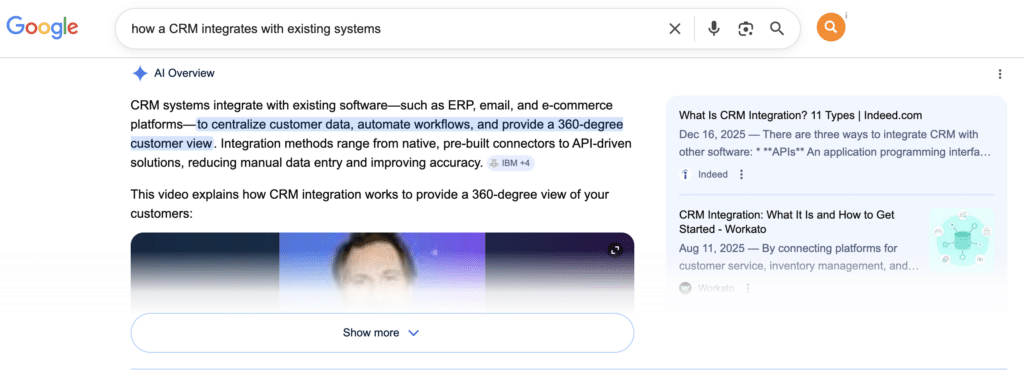
Because of that shift, the goal of search strategy is expanding. Ranking still matters, but influence now depends on whether AI systems trust your content enough to extract it as a direct answer.
Answer engine optimization is one of the ways you can make your content more visible under these new search conditions. AEO focuses on structuring expertise so AI systems can interpret it clearly and reference it when generating responses. Many teams now integrate AEO alongside traditional optimization, authority development, and technical SEO as part of a largerAI search strategy.
Over time, brands that consistently appear in AI answers gain an advantage that rankings alone cannot provide. Their expertise shapes the information buyers see at the very beginning of research.
That advantage starts earlier than most brands realize — at the moment a buyer types their very first query. SEO expert Eli Schwartz reveals what today's AI-aware searchers are actually typing into Google, and why those queries look nothing like what most content teams are optimizing for. This short video breaks down the search behavior shift that determines whether your brand shows up at the start of the research cycle — or gets skipped entirely.
When someone asks an AI system a question, it doesn’t search the web the same way a person does. It analyzes sources, pulls relevant information, and generates a response.
Answer engine optimization focuses on influencing which sources that response comes from.
Answer engine optimization is the practice of structuring and validating content so AI systems recognize it as a reliable answer to a specific question.
Instead of optimizing only for rankings, AEO focuses on how information is interpreted by AI systems. That includes how clearly a concept is defined, how expertise is demonstrated, and how easily an answer can be extracted.
The objective is representation. When AI systems summarize a topic, the brands cited in that answer help shape how buyers understand the category.
Traditional SEO and answer engine optimization address different layers of search visibility.
| SEO | AEO |
| Focuses on ranking pages in search results | Focuses on being extracted, summarized, or cited in AI responses |
| Optimizes for keywords and backlinks | Optimizes for questions, structured answers, authority signals, and machine-readable clarity |
| Performance is measured in clicks | Performance includes visibility within AI answers, brand mentions, and authoritative citations |
For most organizations, AEO complements traditional SEO since you still need SEO to rank—now, you are more deeply considering how your brand appears in AI-generated explanations.
Content optimized for answer engines typically follows a simple structure.
Start with a question that reflects how people actually search. Place a concise explanation directly beneath it, usually 40 to 60 words. Then expand with supporting context, examples, or strategic insights, especially when you can back up your ideas and claims with real experience. You also need to cut back on ambiguity wherever possible.
That format makes it easier for AI systems to identify the core explanation quickly while still giving readers the deeper context they need.
AEO works best when it’s built into how content is planned and structured from the beginning. Teams that try to retrofit answer visibility after publishing usually find the results inconsistent. Meanwhile, when you have a solid architecture from the beginning, you can design pages around the kinds of questions buyers actually ask and make it work for the digital world.
AEO content planning usually begins with mapping the questions buyers actually ask during research. These are usually the “what is,” “how does,” and “why does” questions.
For example, a software company might map queries like:
Each of those questions becomes a distinct section with a clear answer followed by deeper explanation. You can make sure you are covering topics with enough depth by using semantic clusters, which are groups of closely related questions and subtopics that help search systems understand the full scope of a topic.
This structure does two important things. First, it mirrors how buyers research a topic. Second, it gives AI systems clearly defined answers they can extract without needing to interpret a long block of text.
Answer engines rely heavily on structured information to interpret content. Structured data provides that clarity by labeling important elements on a page so machines can understand them more easily.
Schema markup helps identify things like the organization publishing the content, the author responsible for the expertise, frequently asked questions within the page, and relationships between related topics. This added context helps search systems interpret who is providing the information and what the page is about.
For example, a consulting firm publishing a guide about marketing attribution could use schema to define the organization, the author’s professional role, and the FAQ sections within the article.
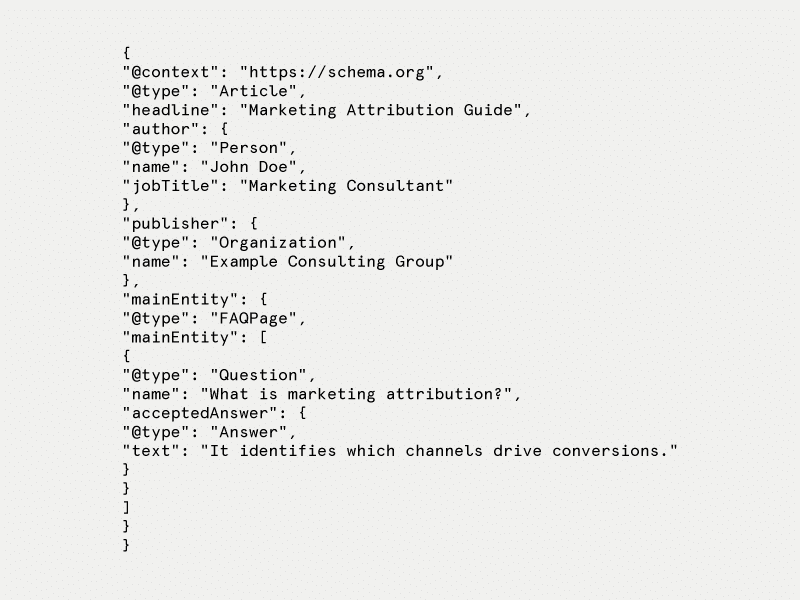
When those elements are clearly labeled, AI systems have a much easier time interpreting the page and connecting the expertise behind it to the topic being discussed.
Answer engines prioritize sources that demonstrate credible expertise. Google refers to these credibility indicators as E-E-A-T: experience, expertise, authority, and trust.
In practice, this means content should reflect real knowledge of the subject. Generic definitions only get you so far — strong AEO content includes insights drawn from actual work, industry experience, or original analysis.
For example, a cybersecurity firm writing about threat detection might reference internal research or share examples from real client engagements.
These types of details signal that the organization understands the topic in practice. Over time, consistent publication of this kind of expertise helps AI systems associate the brand with authority in that subject area.
Answer engines interpret questions the way people naturally ask them. That means content often performs better when it reflects natural language instead of rigid keyword phrasing.
For example, someone researching marketing attribution might ask:
Structuring sections around questions like these helps AI systems match your content with real user queries.
Strong AEO content also anticipates follow-up questions. A page explaining marketing attribution might include sections about data accuracy, implementation complexity, or how attribution influences budget decisions.
Connecting those related ideas helps search systems understand the topic more completely and reduces fragmentation across multiple pages.
Clear hierarchy also matters. Question-based headings followed by concise explanations make it easier for AI systems to summarize or extract specific sections when generating answers.
Answer engine optimization focuses on preparing content for the process of assembling responses from credible sources and summarizing it for the user. When information is structured clearly and supported by credible expertise, AI systems have an easier time referencing it while generating answers.
Content that appears inside AI-generated responses usually follows a predictable structure. It explains a concept clearly, avoids filler, and provides enough supporting context for the system to validate the information.
If you want to understand how to optimize content for generative AI, begin sections with a concise explanation of the topic, followed by examples, data, or deeper analysis that reinforces the credibility of the answer.
For example, a page explaining marketing attribution might begin with a definition, then expand into implementation considerations, measurement challenges, and how attribution influences budget decisions. Structuring content this way makes it easier for AI systems to extract the core explanation while still giving readers useful context.
Let us say it again: answer engine optimization works best when it supports a broader search strategy. It’s a core pillar, but it isn’t the whole coliseum of AI search SEO.
AEO focuses on how answers are structured and interpreted. Traditional SEO still influences how pages are discovered and how authority develops around a topic. When both approaches work together, brands are more likely to appear during the research stages where buyers gather information.
A company building authority around marketing analytics might publish in-depth resources on attribution models and data integration strategies. Over time, that connected coverage strengthens the brand’s association with marketing measurement.
Generative search does not exist on a single platform, either. AI Overviews, Perplexity, and other answer engines each generate responses differently.
Because of that variation, it helps to monitor how your brand appears across these environments. Some platforms may reference your research frequently, while others rely on different sources when generating answers.
A company might discover that its insights appear regularly in one AI platform but rarely in another—maybe they need to improve visibility on Perplexity. Observations like that can reveal gaps in how expertise is structured or referenced across the web, which becomes clearer when examining how brands appear in systems like Perplexity’s search engine and browser.
So, how do you actually evaluate whether your content is positioned to appear in AI answers? This is where the right tools can make all the difference.
AEO tools typically analyze how well content aligns with the structures AI systems rely on when generating answers.
One common area is entity clarity. Tools look at how consistently a brand, topic, or product appears across pages and whether the relationships between those entities are clearly defined. If your company publishes content about multiple services, for example, these tools help determine whether those services are clearly connected to your brand and expertise.
Another area is semantic coverage. Platforms often evaluate whether a topic includes the related questions and supporting explanations that give AI systems enough context to understand the subject. A page explaining marketing attribution might also need sections about attribution models, implementation challenges, and reporting accuracy for the topic to feel complete.
Many tools also examine question-to-answer structure. This includes identifying whether pages contain clearly defined explanations that AI systems can extract without needing to interpret long paragraphs.
Finally, platforms often review authority indicators such as citations, references, and how often your content appears across relevant sources on the web.
Not every platform labeled as an AEO tool is built for enterprise teams. Many focus on content analysis alone, which can leave large organizations without visibility into the broader search ecosystem.
When evaluating answer engine optimization platforms, look out for these capabilities especially.
The best platforms provide actual, actionable information on how AI systems interpret your expertise rather than simply pointing out missing keywords.
Tools can show you important gaps, but they rarely solve the strategic challenge on their own.
Answer engine optimization requires coordination across several departments. Content teams shape the explanations AI systems extract. Technical teams manage structured data and site architecture. Digital PR and communications teams strengthen authority across the web.
Without that coordination, even the best tooling will only surface problems rather than help solve them.
Over time, the organizations that succeed with AEO treat tools as diagnostic support while focusing most of their effort on building authority and expertise.
By the time most organizations start exploring answer engine optimization, they’ve already noticed something unusual in their search data since AI systems are taking the lead.
At 97th Floor, answer engine optimization isn’t treated as a standalone tactic. It’s integrated into a broader shift toward AI-driven search, where content structure, authority, and technical clarity all influence how a brand shows up online.
Enterprise organizations rarely struggle with producing content. The challenge is aligning that content so it reinforces expertise across a category.
That alignment requires several moving parts working together. Content needs to answer the right questions. Technical teams need to support structured data and site architecture. Digital PR helps strengthen authority signals across the web. We make sure all of your best people and AEO efforts actually work together and make progress.
AEO should never be measured by visibility alone. What matters is whether that visibility influences the conversations buyers are having when they research a category.
At 97th Floor, answer visibility is connected to the areas that actually drive revenue. Content is structured so AI-generated answers reference the topics that matter most to the organization’s services and solutions.
Over time, this approach shifts the goal of AEO from general awareness to category influence. When buyers encounter explanations that consistently reference your expertise, your brand becomes part of how they understand the problem itself.
Search will continue evolving as AI platforms mature. New answer engines will emerge, and existing platforms will refine how they interpret and summarize information. That’s why strong AEO strategies focus on building durable authority rather than chasing short-term optimization tactics.
Are you ready to shift into a new gear with answer engine optimization? Here are some questions you can ask yourself to know if it’s time.
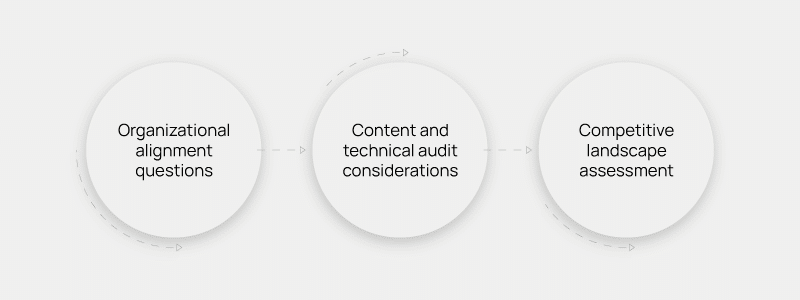
Answer engine optimization often requires teams to rethink how search visibility is measured and managed.
Start by looking at how your organization currently approaches search.
These conversations usually surface quickly whether AEO can be implemented smoothly or whether internal alignment still needs work.
The next step is examining whether your existing content can actually support answer visibility. Key questions to review include:
Finally, it helps to look outward.
In many industries, answer engines already reference certain organizations repeatedly when explaining a topic. Those brands effectively shape how buyers learn about the category. Ask yourself:
These observations often reveal whether your brand is currently influencing the conversation or watching it happen from the sidelines.
If these questions surface opportunities, it may be time to develop a structured AEO strategy.
At 97th Floor, answer engine optimization is approached as part of a broader AI search transformation that connects technical SEO, authority development, and content strategy. Organizations exploring how to improve their answer visibility often begin by examining how their content aligns with modern search strategies.Discover how we can help you in the new age of AI search!
Some people only climb a mountain when they know what is on the other side. Others just climb.
Daniel Nissan has spent 30 years building companies that did not fit any existing map. He joined a tiny startup in 1992 when no one had heard of the internet. He helped launch the first internet phone product. He built a nationwide grocery delivery service before e-commerce existed. And now, after 26 years leading Structured, he is throwing away the platform he built and starting from scratch.
The reason is the same as it has always been: he sees what is coming before most people know to look.
In 1992, a group of developers reached out to Nissan. They had built sound cards for desktop computers and ended up stuck with a warehouse full of inventory no one wanted. Their solution: create an office intercom so everyone could talk over microphones and speakers at their desk.
Nissan's first reaction was blunt. "This is a stupid idea," he thought. "I don't see why people need an intercom in their office. Who would talk about it? Privacy, everybody has a phone on their desk."
But he noticed something. The team kept mentioning a network called the internet. Almost no one had heard of it. Nissan had. He saw it differently: if you could route that office intercom through this new global network, people could talk to each other for free anywhere in the world.
He joined. The company was five or six people and had just raised $1.5 million from a local VC.
It took three years of technical work to make the idea real. Protocol limitations. Hardware constraints. An industry that had not yet matured enough to support what the team was trying to build.
Nissan made the first test call around 1993 or 1994. There was only one place in Israel with a fast enough internet connection to try it. He drove to Jerusalem. Another person waited near Tel Aviv. They connected.
"I couldn't hear anything, but I heard the grubble and something went through," Nissan said. "And I was so excited. So this is going to work."
A few days later, after sorting out a protocol issue, the next test worked well. In 1995, they launched the first internet phone product under the name "iPhone" -- internet phone. The company went public on NASDAQ in 1996.
One thing led to another. While selling the internet phone software at VocalTec, Nissan built what may have been the first online commerce transaction: a simple web form where customers entered their credit card and received an unlock code by email. They sold nearly $10 million worth of software in a year.
That experience got him thinking about what else could be sold online. He teamed up with a co-founder who knew the consumer packaged goods industry. Together they built NetGrocer, one of the first online grocery delivery services in the country.
The company grew from four or five people to about 200 at its peak. The core promise was simple: order groceries from home, get them delivered to your door nationwide, pay 25 percent below what your local supermarket charges.
The hardest part of NetGrocer was not technology. It was logistics. To deliver groceries across the country, Nissan needed a partner with national reach.
He emailed Fred Smith, the founder of FedEx. His pitch: NetGrocer would deliver steady volume in local neighborhoods year-round, which would help fill FedEx's B2C network that typically only peaked around the holidays. Smith replied, invited Nissan to Memphis, and FedEx became their delivery partner.
That one deal changed everything. A warehouse in one location could now ship nationwide on FedEx planes and trucks. It gave NetGrocer a story no local competitor could match, and it brought attention from CNN, Good Morning America, and others covering the promise of e-commerce.
NetGrocer was not just a supermarket. Nissan saw it as a network connecting brands with consumers in ways that had never existed. To lock in that position, the company bought exclusive advertising inventory across AOL, Excite, AltaVista, and Yahoo for consumer packaged goods, household supplies, and over-the-counter drugs.
"If you're a consumer packaged goods company and you want to go and advertise online, we own the inventory," Nissan explained.
They also built tools that did not yet exist anywhere else. Nutrition facts were tagged for every product in the store so customers could filter by calories, sugar, or dietary needs. Automatic replenishment lets customers subscribe to regular deliveries with a single click. And brands like Procter and Gamble received weekly data on purchases, flavors, repurchases, and promotions sliced by region and state.
The company raised over $50 million and was set to go public in 1998. Two weeks before the roadshow, a crisis tied to a hedge fund called Long-Term Capital Management shut down the IPO market for over a year. NetGrocer was burning a million dollars a month with no path to more capital.
"Running like a train, bullet train on the track," Nissan said. "One day you hit a wall and there is no way to overcome that."
Two or three days after NetGrocer collapsed, Nissan got a phone call from his investors. They had a $500,000 check ready. What did he want to do next?
He came to their office on a Friday afternoon with a pitch: give him a million dollars to evaluate ten ideas over a few months, then pick the right one.
They smiled, opened their eyes wide, and said, "Go home. Come on Monday with one idea."
He went home, worked through his list, and came back Monday with Structured Web. Got his $500,000. The rest is 26 years of history.
The insight was simple. Nissan had been using the internet since 1992. By 2000, he still could not book an appointment at his doctor's office online. Most businesses had no website at all. The ones that did had scanned a brochure and posted the image.
Building a real website required data centers, servers, HTML knowledge, and constant upkeep as technology changed. No small business had time for that.
Nissan's answer: build vertical marketing solutions for specific industries. Ready-made websites for chiropractors and travel agents. Put in your logo and opening hours, click save, and you are up and running in five minutes. The company handles all the technology underneath.
The first vertical launched in summer 2000. Chiropractors. The core principle -- give businesses ready-made marketing programs they can use without managing the technology -- has stayed the same ever since.
Today, Structured helps the world's largest brands run distributed marketing for their channel partners globally. Companies like Microsoft, IBM, ServiceNow, Google, and Zoom run their partner marketing through Structured's platform.
In January 2025, Structured took its first outside capital in over two decades: a $30 million majority investment from Invictus Growth Partners. The goal was to fund a shift Nissan had already begun two years earlier.
That shift was not to add AI features to the existing platform. It was to throw the platform out and rebuild it from the ground up.
Most companies are bolting AI on. Adding a chatbot here. Dropping an "AI-powered" label on a feature there. Nissan argues that this approach misses everything.
The current Structured platform works the way most marketing tools do: log in, click menus, scroll, search, find what you need, drag and drop, edit in a Canva-style interface. The new platform works differently.
"The new product, just type: change the colors, learn the way I present my business and change the email," Nissan said. No menus. No searching. Just tell it what you want.
Nissan put it plainly: trying to retrofit AI onto an existing platform is like taking a 2006 website and adjusting it to work on mobile. It never feels natural. Mobile-first means built for mobile from the start. AI-first means the same.
Nissan sees marketing AI moving through distinct phases. Today, AI acts as an assistant: create content, analyze data, but a person is still doing most of the work. The next stage, arriving soon, is conversational platforms where everything happens through prompts and natural language replaces menus.
After that comes agentic AI. "Not just create the content for me, but do the actual work of sending it, analyzing it, following up on it," Nissan said. His goal is a complete marketing machine that businesses can run with no direct day-to-day involvement by the end of 2026.
The new Structured platform, built entirely in this new architecture, is set to launch in early 2026.
Two years ago, when Nissan told his team they were going to rebuild using AI, the response was skepticism. Earlier this year, when he sat down with his R&D team and said they needed to have it done by the end of the year, the first response was: "It's impossible."
So he sat with them for a week. Not lecturing. Working through it together. Breaking it down piece by piece. Showing what could be done.
"At the end of that week, they came back to us and said, you know what? Not only that we can do it, we can do it faster than you think."
The shift did not come from motivation. It came from clarity. Nissan observed that many people need to see what is on the other side before they will commit. His job as a leader is to draw that picture clearly enough that they can believe it.
"If they understand it, it starts to be like magic, it starts to spread. Then you can sit back and just watch it happen."
Nissan is direct about AI and employment. "150 years ago, there were people in town that would go in the evening before sunset and would light the gas lights," he said. "I don't see people like that in my town anymore, but I don't see people unemployed in my town either."
Jobs change. Work evolves. But only if people choose to move with it.
"If you sit there and say, it's not changing, I have nothing to do, my job was taken, yes, it will be taken."
Thirty years ago, Nissan had to fly overseas and attend trade shows just to learn basic things about a company. Today, all the tools are free and available online. There is no excuse for standing still.
When Paxton Gray asked what advice Nissan would give marketers right now, the answer was short.
"Go out and learn and explore and try." The world is changing faster than it ever has. That is not a threat. It is an opening.
"As I say to a lot of my friends: jump in the water and start to swim. You cannot learn to swim if you're not in the water."
The marketers treating AI as a nice-to-have feature are the same people who thought office intercoms were a stupid idea in 1992. The ones willing to rebuild from scratch are the ones making tomorrow's first calls.
"Some people when they climb, they will climb the mountain only if they know what's on the other side of the mountain," Nissan said. "And some people get thrilled, but not knowing what's on the other side of the mountain."
Which one are you?
04:27 - Why join a "stupid idea" startup
05:03 - Making the first VoIP call
51:20 - Traditional platforms vs AI conversation
52:38 - Agentic AI timeline
55:10 - Getting teams to believe
57:50 - The lamplighter analogy
See what Daniel’s up to at https://structured.ai/.
Find Daniel Nissan on LinkedIn: https://www.linkedin.com/in/danielnissan/
Connect with Paxton on LinkedIn: https://www.linkedin.com/in/paxtongray/
Looking for an agency that'll be worth the investment? 97th Floor creates custom, audience-first campaigns that drive pipeline and conversions. Get started here: https://97staging.com/lets-talk/.
Daniel founded Structured in 1999 and leads the company’s strategic vision across marketing, engineering, and product development efforts. From 1996 to 1999, Daniel was the President and CEO of NetGrocer, which he led to be a highly recognized and established leader in the field of eCommerce. He served as a Vice President of Marketing for VocalTec Communications, Ltd. (VOCL) from 1993 to 1996. Part of the original VocalTec group that created the Internet Phone, Daniel was responsible for its breakthrough product concept, marketing, and strategy development.
Best practices are boring practices. By the time everyone is doing something, you are already losing.
"Courageous marketing is about leaving behind the so-called best practices, which in reality are boring practices because by the time anything becomes the best practice, everyone's doing it," Udi Ledergor says. "So all you're going to get are mediocre average results."
The alternative is a sharp, new, unique point of view applied to everything, from content marketing to brand awareness to event experiences to demand gen.
Jeffrey Moore wrote about it in Crossing the Chasm: the gap between early adopters and the early majority is where most companies die. Early adopters will try any new tech. The early majority wants proof. Reference customers. They want to know you will still be around in two years.
"How will you go about selling to these large enterprises when they don't want to buy from startups?" Ledergor asks. "They don't think the product is built out and stable enough. You don't even have enough reference customers."
His answer is a six-step formula that makes any company appear two years ahead of where it really is. He has used it for Times Square billboards, a Super Bowl commercial, and cars wrapped in branding at major conferences, all on far smaller budgets than people assume.
Step 1: Pick a medium tied to large advertisers.
Times Square. The Wall Street Journal. The Super Bowl.
Step 2: Find an affordable way in.
Digital billboards in Times Square cost $500 for one day if you buy online. The Wall Street Journal's West Coast edition costs 20% of the national rate. Super Bowl spots in three strategic regions cost about 5% of a national buy.
Step 3: Get creative.
Ledergor showed a VP of Sales sitting alone in an empty office during COVID for his Super Bowl spot. He used Times Square billboards to celebrate outstanding employees, making their teammates want to be on that billboard the following year.
Step 4: Hire a photographer.
"Put someone in Times Square. If you know that your billboard is going to be up for one hour, make sure they're sitting there 15 minutes before." Get great photos with all the hustle and bustle of the city and you have memorialized an iconic moment.
Step 5: Share to your real audience.
Gong has over 300,000 followers on LinkedIn. "I don't care about the random tourists on their way to see Phantom of the Opera. I care about the people following Gong on LinkedIn." They are the ones who need to see it.
Step 6: Mobilize your team.
Gong has 1,600 employees. Assume 500 followers each. If half share the post, that is hundreds of thousands or even millions of impressions. Free.
"That's where Apple promotes their new iPhone. That's where Netflix promote their new series," Ledergor says. "The medium is the message."
Ledergor hears the same question every time he teaches at Pavilion CMO school or works with VCs and accelerators: how do you get approval for any of this? He gives four answers.
Preemptive budgeting.
Every budget Ledergor submitted included a line for "marketing experiments," set at 10% of his program's budget. A team member named Russell stopped him from labeling it "Udi's crazy ideas" before it went to the CFO. The pitch rests on two arguments. Every channel you rely on will stop working at some point. You just do not know when. And there will be opportunities next year that you cannot see during budget season. You need room for both.
Run pilots.
"I look for a way to do it small enough that I can go under the radar. If I spend a few thousand bucks and it doesn't work out, there's probably a good learning in that." Once something works, show the numbers and ask for more. Go from a quiet $5,000 pilot to a $20,000 task with results to back it up.
Avoid death by committee.
Ledergor cites British writer G.K. Chesterton: "I searched all the parks in all the cities and I found no monuments or committees." Committees push every decision toward a mediocre middle. Everyone gets a little of their way. The result is a mess that excites no one.
In early stages, keep the room small. In later stages when committees are unavoidable, use a framework like RAPID to set roles up front. Recommender, approver, performer, informer, decision maker. "I'm the recommender, my CEO is the decision maker, all of you are informers, which means I would love to hear your opinion. Don't expect it to necessarily show up in the final product."
Know when to leave.
"Sometimes you're a great marketer not in a great environment. If you've tried everything and you're still coming up with blocks after blocks, you might be in the wrong environment." Ledergor talks in the book about how to vet companies before you join, including how to assess product market fit, which he calls the most underrated factor in marketing success.
"Life is too short to work with jerks or people who don't give freedom to your creative courage."
Attribution obsession can stop you from doing the right thing for the business. If you hold back on a campaign you believe in because you know measuring it will be hard, you are letting the dashboard drive strategy.
Gong CEO Amit Bendov frames it directly: if you run a campaign and the phone is ringing off the hook, you do not need a dashboard to tell you it worked. If you get crickets, you know that too. The problem is when the truth falls somewhere in the middle.
Ledergor's advice is to run the experiment anyway, and to ask for that freedom when you are already hitting your targets. When the numbers are good and you have budget left, asking for $20,000 to try something you cannot fully measure is a much easier conversation than asking for a Hail Mary when you are already behind.
That said, Ledergor found ways to measure where others gave up. After one Super Bowl commercial, he went into Gong and found 452 sales conversations that mentioned it. He tracked 40 buyers who came in quoting the episode of the Michael Lewis podcast he had sponsored. Exact numbers. Not guesses.
"I've never seen a company succeed when sales and marketing operated in silos," Ledergor says. "I just don't think it can be done."
Ledergor dedicated the entire last chapter of his book to this topic, practically co-writing it with Ryan Longfield, his longtime CRO at Gong.
At Gong, marketing regularly uses the platform to listen to sales calls. AI tools surface trends before anyone even hits play on a recording: top pains, competitive mentions, how buyers describe the product in their own words.
"Imagine knowing exactly how your customers describe their pain so you can mirror that on your website and in your ads. Imagine understanding how the market sees your competitive differentiation."
Ideas can come from anywhere on the team. An SDR named Nicolette heard Gong was planning its first customer conference and pitched calling it "Celebrate," a nod to selling and a celebration of salespeople. That name stuck. Six years later it is still the name.
Another SDR, Sarah, started posting on LinkedIn about her path from SDR to AE. Marketing noticed. They brought in a videographer, posted the series on Gong's official channels, and gave her a much bigger audience. It ran for months. Sarah got her promotion and moved on.
Then there is the content side. The first two people who had the biggest impact on Gong's content marketing, Chris Orlaub and Devin Reed, had never held a marketing job. Both had been salespeople. Gong sells to salespeople. Having writers who had lived that life made all the difference.
"I can teach anyone how to be a decent enough writer," Ledergor says. "But I can't teach anyone an experience that I haven't been through."
When a former salesperson writes a post that opens with "It was the last day of the quarter. I was 150K short on my quota. I didn't know if I was going to make it," salespeople want to keep reading. That is something you cannot fake.
Ledergor has seen both, and the bad use has a direct predecessor.
Fifteen years ago, CMOs boasted about outsourcing blog posts to writers for $50 each. Writers who had never worked in the industry, did not know the culture, and produced fluff built from a few Googled facts loosely tied together.
"Back to present day, I'm seeing marketers abuse AI to create content because they feel they have a quota to fill. I need a blog post every week. AI can do that, can do 10 of them a day if you want, but who's going to read that? Anything you're asking AI to write for you is a regurgitation of everything that people have already written."
Good AI use is repurposing. Take one piece of content and let AI slice it into social posts, a long-form SEO version, and variations for different platforms. Fast, and it works.
For original ideas, Ledergor points to a method from CMO Kyle Lacy. Ask ChatGPT for 10 campaign ideas. Then put all 10 aside and never look at them again.
"Now we have our creative juices flowing. We can actually create something interesting and original because these 10 ideas that ChatGPT gave us are the most worn out, overdone ideas in the world because that's how ChatGPT was designed." It read all the state of the art and regurgitated it. Now go make something else.
Paxton Gray talked about how he was a Gong customer before he ever spoke with Ledergor. He heard Gong sponsor podcasts in the business and leadership space over and over for months during his evening walks.
"I probably listened to maybe 9 or 10 commercials before finally I thought, I'm going to check it out."
That is not luck. Show up where your buyers are. Stay consistent. Make it impossible to ignore.
"Get out there, be bold, put the best practices behind you, do something creative," Ledergor says. "You either end up with a great story and a great learning, or you actually drive the business outcomes that you're after."
Get your copy of Courageous Marketing: The B2B Marketer’s Playbook for Career Success here: https://www.amazon.com/dp/B0F22HWR3C
See what Gong can do for your business: https://www.gong.io/
Follow Udi on LinkedIn: https://www.linkedin.com/in/udiledergor/
Connect with Paxton on LinkedIn: https://www.linkedin.com/in/paxtongray/
Looking for an agency that'll be worth the investment? 97th Floor creates custom, audience-first campaigns that drive pipeline and conversions. Get started here: https://97staging.com/lets-talk/.
00:19 - What is courageous marketing
01:29 - Punching above your weight concept
06:57 - The six-step formula breakdown
30:29 - Sales and marketing alignment
31:08 - AI use and abuse in marketing
34:37 - Using AI for ideation properly
Udi Ledergor, a five-time B2B marketing leader, served as CMO during Gong’s rise from new SaaS startup to industry dominance. By building a playful, human-centric brand with a lighthearted tone, he captured buyers’ attention and dollars and turned them into raving fans. He later led the creation of the revenue intelligence category, which helped Gong go from zero to hundreds of millions in revenue, earning major industry awards and achieving a multi-billion-dollar valuation. Over his 20-year career, Udi has led marketing teams at successful companies, advised startups, served as a board member and angel investor, and mentored hundreds of marketers. His work reveals how courage and creativity can build iconic brands, connect with audiences, and drive measurable results.
Most marketing advice won't work for your startup. That's not a problem. It's the reality.
Sterling Snow, Co-Founder and CEO at Redo, has learned this lesson three times over. What worked at his first company failed at Jive. The Jive playbook crashed at Divvy. And the Divvy wins? Useless at Redo. This pattern isn't random. It's the core truth about early-stage marketing that most people miss.
The industry sells playbooks, templates, and proven strategies. Marketing leaders want someone to hand them a list of tactics that work. But here's the hard truth: great marketing only works once. "Great marketing will never work again for another company at a different time," as Paxton Gray puts it. It only works right now, for this exact audience, at this exact company.
The real skill isn't copying someone else's success story. It's building the muscle to create channels nobody else has found yet. Welcome to the anti-playbook.
Every startup begins in what Sterling calls the "haystack phase." Picture it: a huge pile of potential marketing tactics, and somewhere buried inside is the needle, the thing that actually works. The problem? Nobody knows what the needle looks like.
Most marketers respond by overthinking. They build complex attribution models. They debate where good ideas should come from. They claim to be data-driven. Sterling's response is blunt: "People who say they're data-driven in the haystack phase, like there's no data, so what are you talking about?"
The haystack phase needs a different approach. Forget perfect strategy. Focus on action. More action creates more insights. More insights lead to faster iteration. Speed beats precision every time.
Sterling's formula strips away the complexity: find the cheapest CPM out there, pair it with a bold offer, then take it to as many channels as you can. No overthinking. No analysis paralysis. Just rapid testing with clear rules for success.
This approach makes traditional marketers squirm. They want to be strategic, thoughtful, measured. But in the early stages, those instincts kill momentum. The goal isn't to find the perfect channel through careful analysis. It's to run enough tests fast enough that you stumble into something that works.
"Finding a needle in a haystack is basically about your ability to create insights off of your activity," Sterling explains. Not insights that lead to action. Action that creates insights. The order matters.
Define clear tests. Set time limits. Know what success looks like. Then run as many as you can handle at once. When something shows promise, double down now. When something fails, move on. The winners will show themselves through results, not theory.
Performance marketing, SEO, content marketing, these are table stakes. Every rival has access to the same Google Ads platform, the same LinkedIn targeting, the same email tools. Playing only in known channels means competing on execution alone. For an early-stage startup, that's a losing game.
"Good marketers create new channels instead of just allocate money and energy into the ones that exist," Sterling says. The difference matters. Channel creation isn't just another tactic. It's life or death for early-stage companies.
Sterling learned this the hard way at Divvy. Channels that worked at Jive were failing. He was spiraling, convinced he'd be fired. The breakthrough came from a simple question: where are the buyers when they're not on LinkedIn or Google?
Finance pros, it turned out, read niche business newsletters. Not big publications, but small, focused ones like Owler that sent fancy Google alerts in email format. These newsletters had audiences but no ad model.
Sterling called Owler directly. The pitch was simple: "Can I pay you a thousand bucks and see what this does?" They'd never sold ads before. They were curious if it could work for them. That thousand-dollar test generated hundreds of demo requests.
The channel exploded. Sterling quickly expanded to Morning Brew and The Hustle, often becoming their first advertiser before they had formal ad programs. Not everything worked. A deal with the New York Times flopped completely. But newsletter advertising became Divvy's number one channel for years.
Here's the key: this channel worked because Sterling created it. Once rivals noticed and followed, the edge vanished. The cycle repeated. Find a new channel, exploit it, watch others copy it, find the next one.
Creating proprietary lead flow means looking where others aren't. It means calling companies that don't sell ads and getting them to try. It means building partnerships before partnership programs exist. It means being comfortable without a roadmap.
Traditional marketing teams organize around specialties. Companies hire an email marketer, a paid ads specialist, a content writer, an SEO expert. Each person owns a channel, optimizes their metrics, stays in their lane. This makes sense for companies with proven channels. For early-stage startups, it's death.
The anti-playbook needs different people. Not specialists who execute set strategies, but thinkers who figure out which strategies to pursue. Not copywriters, but people who decide what copy needs to exist in the first place.
When hiring, Sterling looks for a specific pattern: people whose brains just work differently. He described a candidate who had a lawn mowing business as a teenager. Nothing unusual there. What was unusual is what he did next. He had ten clients. He went to each one and said, if you go post about me in your community forums, I'll mow your lawn free for a month. Overnight, his demand grew five times over.
"If you can find people who their brains just sort of think like that, they're a little more hacker, a little bit more artist, a little bit more mad scientist," Sterling says. Those are the people who create channels. Performance specialists who are very good at spending money in known channels have their place. They just shouldn't be your first hire.
This hiring philosophy connects to how Sterling builds culture. He doesn't think in terms of a marketing team and a sales team. He thinks in terms of a revenue team, where each person owns a different leg of the relay race. To reinforce that, he compensates people one level deeper in the funnel than their direct role. Marketers get measured closer to revenue, not just on MQLs or ROAS. It forces tighter alignment and clears out credit seeking fast.
Sterling pairs this with a goal-setting framework he calls budget, quota, and stretch. Budget is the board number, the floor you have near-certain confidence in. Quota is the team number, a real win that reflects a healthy business. Stretch is the ceiling, where extra rewards kick in, whether that's trips, faster promotions, or additional comp. The system pushes the team to empty the tank while still protecting the business.
The result of building this way? "Really great marketers love it because they sort of shine through," Sterling says, "and really bad ones absolutely hate it because there's just like nowhere to hide."
The traditional B2B sales motion is dying. The SDR role, that cornerstone of predictable revenue, is going away. Not because sales development doesn't matter, but because a dedicated human SDR no longer makes economic sense.
Sterling's companies tell the story. Jive and Divvy ran heavy SDR motions, the classic Utah sales playbook. Redo has zero SDRs. The shift isn't philosophical. It's practical. Every handoff adds cost. Every transition point loses customers. In an era demanding efficiency, those inefficiencies are fatal.
The future Sterling sees: full-cycle reps handling everything from first touch to close, backed by heavy automation. Tools like OneMind, which Sterling calls "quite wild," act as AI SDRs and SCs. They flip through decks, answer questions, qualify leads, book meetings. The technology isn't just helping human SDRs. It's replacing the role.
"Anything that comes that's inbound, I think is highly likely to be mostly automated in the very near future," Sterling predicts. The human touch stays critical for complex, outbound, strategic deals. Everything else becomes a technology play.
On the marketing side, Sterling also points to Clay and Unify as tools providing real value right now. Not silver bullets, but the next iteration of how B2B teams work. And as AI continues to make cold outreach easier for everyone, he expects the real alpha to shift back toward human, high-touch approaches: micro events, in-person interactions, and targeted ABM-style plays that cut through an inbox everybody's learned to ignore.
Freemium debates miss the point. The question isn't whether to give something away free. It's how to make money while giving something away free.
"I love freemium, but I don't like not making money," Sterling says. Traditional freemium hopes free users eventually upgrade. Sterling's model makes money on free users from day one.
Divvy proved it. The software was free. Revenue came from interchange fees on transactions. Users paid nothing directly but generated revenue through usage. Redo follows the same logic: free software, monetization on usage. The customer gets value without paying. The company makes money without charging.
"If you put your head down, you can figure out how to make money on something that's free," Sterling says. The constraint forces new thinking. Partnership agreements, usage-based back ends, revenue flows that don't depend on a subscription. If the product must be free but the company must make money, the answer is rarely obvious at first. But it's there.
The search for marketing playbooks makes sense. Playbooks offer comfort. They promise that someone, somewhere, has figured it out, and all you need to do is follow their steps.
But early-stage marketing doesn't work that way. Success comes from creating unique channels, not optimizing ones that exist. It comes from hiring creative thinkers, not task doers. It comes from rapid testing, not careful planning.
Stop looking for what worked elsewhere. Start building the muscle to discover what works for you. The anti-playbook isn't about rejecting all frameworks. It's about developing the ability to create your own.
The future belongs to marketers who find needles in haystacks through sheer action. Who spot proprietary channels before they become common. Who build business models that make free profitable. The playbook for that doesn't exist. And that's exactly the point.
See what Sterling is building at https://redo.com/en
Connect with Sterling on LinkedIn: https://www.linkedin.com/in/sterling-snow-051baab5/
Connect with Paxton on LinkedIn: https://www.linkedin.com/in/paxtongray/
Looking for an agency that'll be worth the investment? 97th Floor creates custom, audience-first campaigns that drive pipeline and conversions. Get started here: https://97staging.com/lets-talk/.
00:41 - The haystack phase: activity beats strategy
04:07 - Creating proprietary channels vs. following playbooks
05:25 - The $1,000 newsletter ad that changed everything
26:23 - Why SDRs are becoming extinct
28:42 - Making freemium actually profitable
Sterling Snow is the CEO and Co-founder of Redo, a customer experience platform for online brands.
He's a member of Utah's oldest and largest early-stage venture firm.
He was a former Senior VP or Revenue at BILL, a former Chief Revenue Officer at Divvy, and a former Marketing and Sales Director at LogMeln.
Sterling is also an angel investor mainly in the seed and Series A rounds His investment portfolio includes Kaedim (AI for 2D and 3D image modeling) and Trinsic (full-stack identity platform).
SEO is changing.
Oh, you’ve heard that one before? It’s true; SEO has been many things in the twenty or so years that it’s been around, but static has never been one of them. What began with simple keyword stuffing and quantity-over-quality link building has evolved into a deeply strategic and data-centric discipline — one that prioritizes intent over tricks, clarity over cleverness, and exploration over exploitation. So, yeah SEO is changing and always has been. But 2026 hits a little differently.
This new year is the dawn of a new era. Search is no longer just a list of links politely waiting for users to click them. It’s answers, summaries, recommendations, and increasingly confident machines stepping in as intermediaries to decide whether your content deserves to exist at all. AI-driven search is adding a new and somewhat unforgiving layer to SEO. It’s not an entirely new game; traditional ranking factors still matter, it’s just that they don’t carry the same weight they once did. And that changes what it means to be visible.
Simply put, the rules of SEO have evolved, and the brands that adapt to meet these changes will come out on top.
The biggest shift is in where and how those changes are showing up:
Which brings us to the inevitable question: If SEO now depends on how content is interpreted (rather than simply ranked), where does that leave the growing pile of labels we use to describe it?
The SEO lexicon is growing: Generative engine optimization (GEO), Search Everywhere, AI Search Optimization (AIO)... It’s a whole new world of terminology. And don’t you dare close your eyes, because these terms are symptomatic of how search itself now operates across more systems than a traditional SERP ever could.
Modern visibility includes rankings, citations, summaries, and recommendations that appear across AI tools, discovery platforms, and search-adjacent environments. Evolving SEO strategies account for all of these surfaces by focusing on interpretability, credibility, and usefulness at scale.
So, whether we’re talking about SEO or GEO, we’re ultimately describing the same responsibility: ensuring that your content can be found, understood, trusted, and reused wherever search behavior shows up.
And wouldn’t you know it? In 2026, that responsibility extends beyond ranking signals and into how information is structured, contextualized, and validated across systems that are increasingly taking on the role of interpreters. Strategy lives in the connective tissue — how ideas relate, how authority is demonstrated, and how consistently value is delivered across touchpoints.
Labels will keep changing. The underlying work remains focused on building visibility that travels well and earns its place wherever discovery happens.
But "wherever discovery happens" increasingly includes systems that surface answers very differently than a traditional SERP — and those differences aren't cosmetic. Blake, Account Director at 97th Floor, takes on the question every SEO team is quietly wrestling with: is AI search a meaningful shift or just the next version of the same game? His answer cuts through the noise with a practical lens on what actually changes and what stays the same. This short video breaks down the real distinction between traditional search and AI search — and what it means for how you build visibility today.
Have we belaboured the point enough? If not, let’s just come right out and say it. 2026 isn’t being defined by a single update, tool, or announcement. What’s changing is the environment in which search operates and the expectations placed on the content that moves through it. Search marketers now operate in a space where content gets evaluated repeatedly — by users, by traditional search systems, and by AI-driven interfaces that summarize, filter, and recommend information at scale. That layered evaluation changes where effort pays off and where shortcuts tend to collapse.
Let’s take a look at the most consistent pressure points shaping evolving SEO strategies this year:
When it comes to AI search, generative systems interact with content very differently than traditional crawlers. Instead of indexing pages and ranking them in isolation, they ingest large volumes of information, identify relationships between concepts, and reconstruct answers dynamically.
That process places real weight on how content is constructed. Definitions that arrive early, terminology that stays consistent, and sections that stay focused all influence how information survives interpretation. When ideas are clearly framed and logically ordered, they remain intact even after being separated from their original page.
This changes how teams need to approach content creation. Planning now includes AI-search considerations and thinking about how information might be extracted, summarized, or recombined elsewhere. Content that holds together under that pressure tends to surface more often and persist longer across AI-driven environments.
Authority now grows through accumulation.
Search engines and AI systems pay close attention to how thoroughly a site explores a subject, how consistently it answers related questions, and how naturally its content interconnects. And yes, individual pages obviously still matter. It’s just that their performance increasingly reflects the strength of the entire surrounding ecosystem. Topic clusters support this by creating continuity. Internal links guide readers through related ideas while giving machines a clear sense of scope and relevance. Over time, this builds a reputation for depth that benefits new content as soon as it enters the system.
For organizations publishing at scale, this approach also introduces stability. Authority spreads across related assets instead of concentrating on a single page. And as authority accumulates, new content enters the conversation with momentum already behind it.
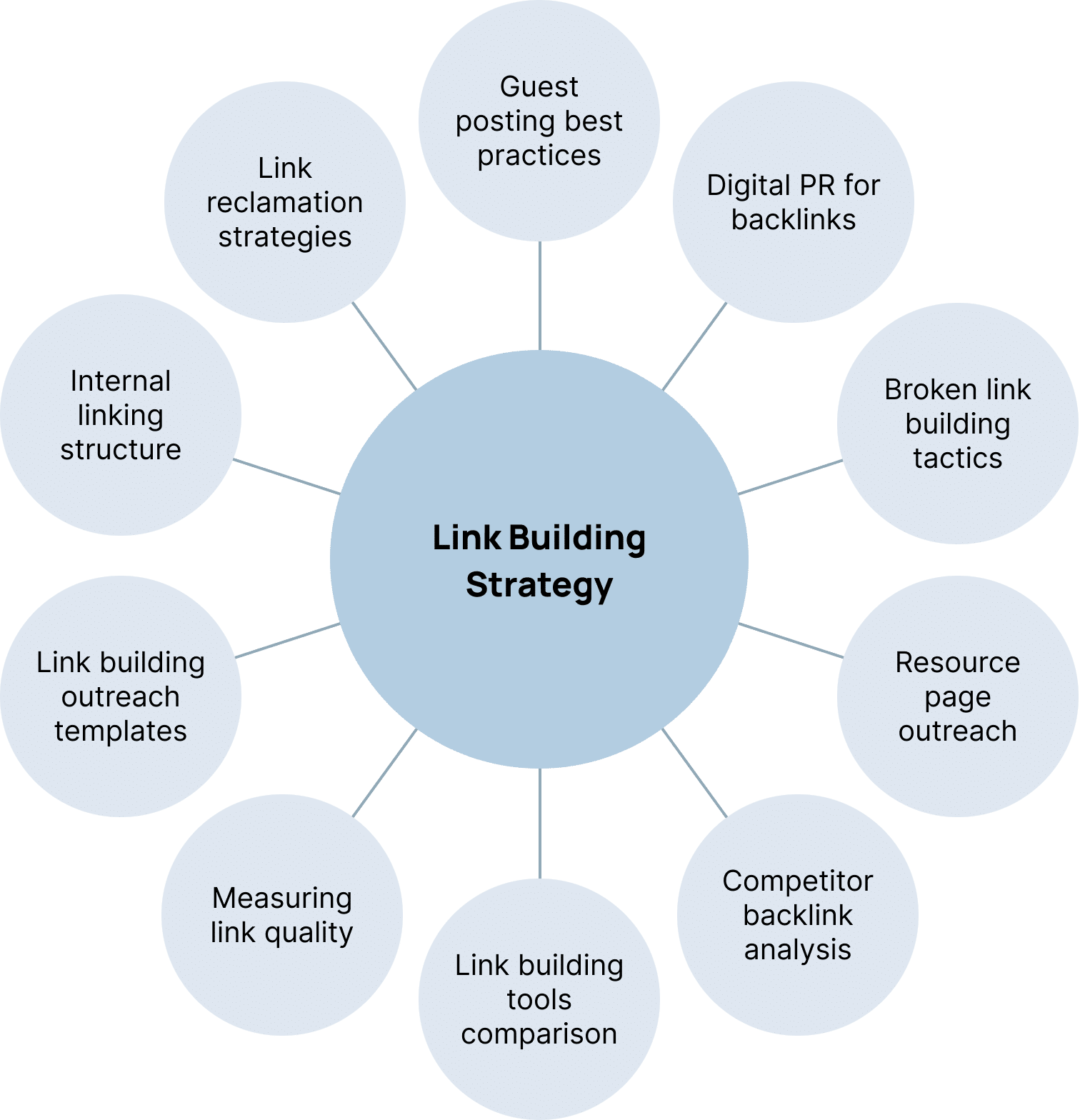
Experience shapes perception long before rankings enter the picture. In practical terms, this is where user experience (UX) and search experience optimization (SXO) converge, shaping how people interact with content and how search systems interpret those interactions.
When content loads quickly, reads clearly, and flows logically, users engage with confidence. Those behaviors generate signals that ripple outward across search systems. Structure plays a central role here. Clear headings support scanning. Thoughtful spacing reduces cognitive load. Consistent formatting helps readers orient themselves as they move through complex topics. And this is just as true for LLMs as it is for human readers.
It may seem strange to suggest that AI would care about design, but it absolutely does. Or, to put it another way, content structure is often among the first signals a system uses to understand the navigability and coherency of the information on the page (even before it evaluates overall subject matter).
As search surfaces continue to prioritize usability, experience becomes inseparable from visibility.
Credibility rarely announces itself directly. It accumulates quietly, through patterns that repeat over time. Readers, on the other hand, pick up on those patterns almost immediately. They notice when content reflects lived experience instead of abstract advice. They notice when examples feel earned, when sources make sense, and when a brand sounds like the same brand from one page to the next. That familiarity builds confidence, even if the reader can’t quite articulate why.
AI systems likewise pay attention to many of the same cues. Authorship, sourcing, topical consistency, and historical performance all influence which information gets prioritized. Content that demonstrates experience and expertise in small, repeatable ways tends to travel even farther in 2026.
This is what Google refers to as E-E-A-T: Experience, Expertise, Authoritativeness, and Trustworthiness — the signals that help determine what content earns visibility. For teams working on evolving SEO strategies, this realigns the focus from chasing isolated wins to building a reputation. Clear authorship, transparent sourcing, and original insight all contribute to that reputation.
Just be aware that this credibility is both cumulative and fragile. Each accurate, useful interaction reinforces the next, creating credibility that’s difficult to fake. But at the same time, when content gets stale or expert advice gives way to generic advice, that credibility quickly and quietly starts to erode.
Discovery rarely happens in a straight line. People don’t sit down, type a query, read one page, and call it a day. They skim an article, review an AI overview, glance at an image, save something for later, and circle back when the timing feels right. Some of those moments happen in long-form content, where depth and detail matter. Others happen through visuals, short videos, structured summaries, or quick references designed to help ideas click faster. Each platform shapes how information is absorbed and remembered, even when the underlying message stays the same.
This shifts how content earns longevity. Ideas that translate across formats tend to stay visible longer because they meet people in different states of attention and curiosity.
For evolving SEO strategies, this flexibility supports consistent presence across a widening ecosystem. Content that travels remains discoverable, recognizable, and useful as platforms and behaviors continue to evolve. Alternatively, non-traveling content puts all its eggs (visibility) into one basket (surface), losing relevance everywhere else as discovery habits shift around it.
Site visitors show up carrying context: how much they already know, how urgent the problem feels, how close they are to making a decision, etc. Sometimes they’re trying to understand a concept for the first time. Other times they’re pressure-testing an option, looking for reassurance, or even just sanity-checking a choice they’ve mostly already made.
Content that works acknowledges those mental states explicitly. It anticipates the questions that naturally follow and answers them in an order that feels intuitive. When that happens, the content feels relevant almost immediately, because it meets readers where they already are instead of asking them to recalibrate.
Early-stage content helps people understand what problem they’re dealing with. Mid-stage content helps them sort through their options. Later-stage content helps them decide what to do next. Together, these pieces form a throughline that reflects how real decisions unfold over time. When intent is baked into structure, it’s easier to read, easier to trust, and easier to decide whether it’s actually useful — both for readers and the systems evaluating how that content performs.
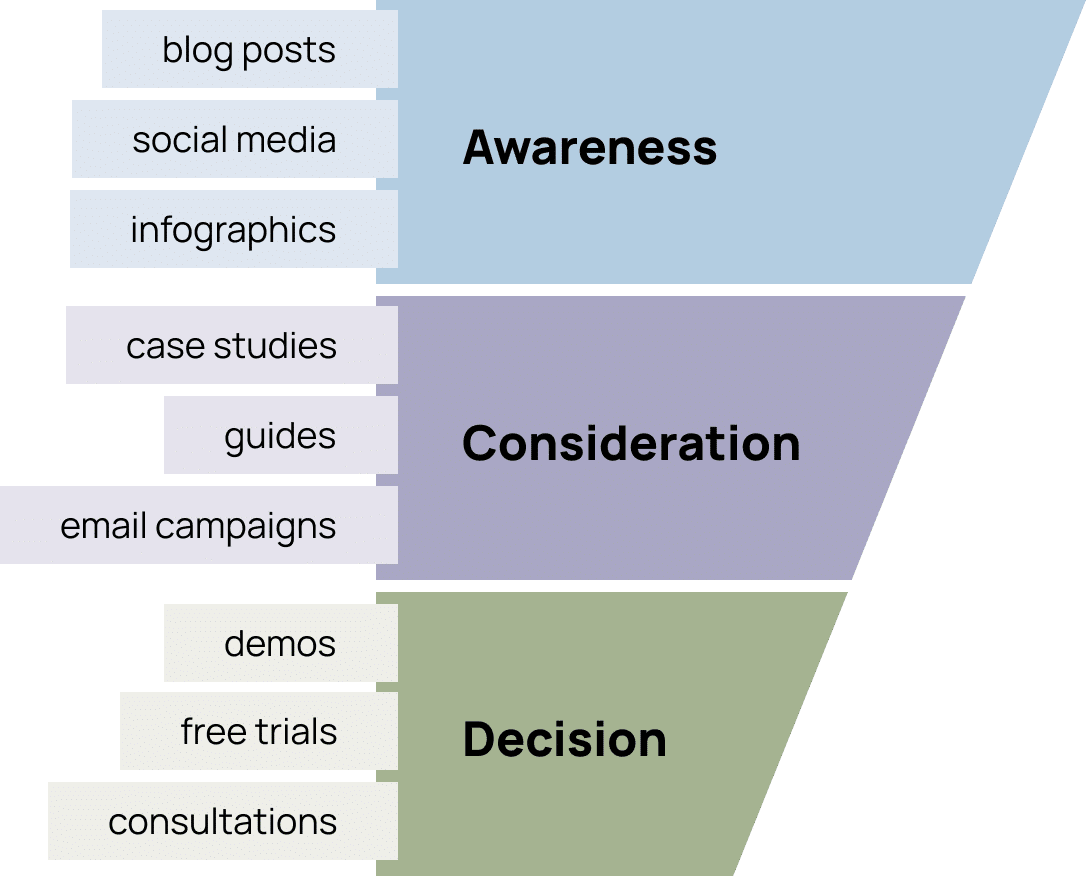
Measurement has gotten messier. Why? Because influence now shows up in more places than a traffic report can easily capture. Modern SEO metrics now include:
When measurement evolves alongside strategy, SEO becomes easier to defend, easier to scale, and easier to integrate with the rest of the business.
So, where are the mistakes happening? As with many roads to hell, these ones are paved in good intentions applied a little too narrowly.
They say that the journey of a thousand miles starts with a single step. We’d suggest that it starts before that step, by taking a look at where you’re standing right now.
At 97th Floor, SEO and AI search solutions are built around how search actually works today, and how it continues to change.
Our SEO services integrate AI search considerations, technical SEO, and content strategy into a unified framework built for modern discovery. The focus stays on building durable authority, improving interpretability across platforms, and aligning search visibility with meaningful business outcomes, all while ensuring that the human element doesn’t get lost along the way.
That work is supported by proprietary frameworks, deep analytics, and close collaboration across SEO, paid media, and measurement teams. The result is a strategy designed to hold up across platforms and continue performing well even as search behavior evolves, making 97th Floor one of the best AI SEO agencies available today.
SEO is changing… and it will keep changing. Our role is to help brands stay visible through that change by building strategies rooted in clarity and adaptability, optimizing for the future of AI search even as we keep sight of those fundamentals that will always remain relevant.
Paid media has grown up.
Does this mean it’s simpler, calmer, or easier to manage? Hahaha. No. Quite the opposite, in fact.
In 2026, paid media lives at the intersection of automation, creative strategy, data interpretation, and business accountability. Platforms move quickly. Interfaces change often. AI touches almost every layer of execution. And budgets feel heavier than they used to, because expectations are heavier too.This is where the role of a PPC agency starts to look very different from what it did even a few years ago. What used to be about keyword bids and ad copy now looks much more like systems thinking, forecasting, and cross-channel coordination. Which is exactly why businesses continue to turn to PPC agencies: for guidance.
At its most basic, a PPC agency manages paid advertising across platforms like Google, Microsoft, Meta, LinkedIn, and emerging discovery environments (such as AI-driven search and retail media networks). That part hasn’t changed.
What has changed is how success gets defined and how work gets organized around it. A modern PPC management agency centers on business outcomes: qualified demand, revenue contribution, and scalable growth. Traffic still matters; it’s just not the only voice in the conversation anymore.Today’s PPC agency operates as a strategic partner. Campaign execution is supported by planning, forecasting, testing frameworks, and measurement models that extend beyond individual platforms. Heading into 2026, PPC agency models reflect this shift. Strategy, interpretation, and optimization layers now carry as much weight as execution itself.
Maybe not a huge surprise in this new era of autonomous, intelligent machines, but the most visible change is automation.
Bidding, targeting, and creative testing increasingly rely on machine learning systems that operate faster than any human team could. That reality shapes how a modern PPC agency adds value. Manual campaign management alone doesn’t always hold up well anymore. The real leverage comes from setting the right guardrails for automation and evaluating its impact. As such, PPC agencies now spend more time interpreting data, defining testing priorities, and connecting performance signals back to business goals.
Data integration plays a major role here. Performance spans analytics tools, CRM systems, lifecycle data, and attribution models rather than living in a single dashboard. A capable PPC agency knows how to connect those inputs so optimization decisions reflect actual business conditions.
No two PPC agencies present their services in exactly the same way. Still, the strongest ones tend to share a common foundation. Each capability reinforces the next, forming an approach designed to work cohesively as campaigns grow and evolve.
The impact of working with a PPC agency is rarely expressed as a single metric. It reveals itself over time, in how efficiently teams operate, how confidently decisions get made, and how resilient paid programs become as complexity increases.
Most teams tend to notice the value of a PPC agency when they suddenly realize that they have a moment to catch their collective breath. Budgets start to feel intentional instead of reactive. Testing moves forward with a clearer sense of purpose. Performance reviews become less about chasing fluctuations and more about understanding patterns. And as campaigns expand across platforms and audiences, that steadiness creates room to scale thoughtfully, without the anxiety-inducing feeling that everything needs to be fixed at once.
Paid platforms are in a constant state of motion, and keeping up with that change is practically a job in itself. Policies update, automation behaves differently, targeting options come and go, and none of it waits for anyone. A PPC agency lives in that reality every day so you don’t have to, tracking changes, pressure-testing assumptions, and making adjustments before small issues turn into expensive ones. That buffer matters most when budgets increase and leadership expects stability along with performance.
For leadership teams, the real value often shows up in how conversations change. Performance stops feeling abstract and starts making sense in the context of revenue targets, pipeline health, and growth plans. A strong PPC agency helps translate what’s happening in the platforms into signals leaders can actually use, whether that’s deciding where to invest next, when to pull back, or how aggressive to be with growth goals. That shared understanding tends to ripple outward, making planning smoother and decisions easier to stand behind.
Competitive markets have a way of exposing weak strategy very quickly. Costs rise, attention fragments, and small inefficiencies stop being small. This is where a modern PPC agency earns trust by bringing discipline, judgment, and a long view to every decision:
In crowded spaces, broad targeting gets expensive fast. Strong PPC agencies spend real time understanding who’s actually worth reaching and what signals indicate readiness. That work goes beyond basic audience definitions and into intent modeling, behavior patterns, and demand quality. Clarity makes budget decisions easier. Spend gets directed toward people who are actually nearing a decision, keeping efficiency from eroding even when competition gets fierce.
Most buying journeys don’t move in a straight line, and competitive markets certainly don’t change that fact. Effective agencies account for that complexity from the start. Awareness, consideration, and conversion campaigns are designed to work together, each playing a role at the right moment instead of fighting for credit. Messaging shifts as people learn more, pause, compare options, and return when the timing feels right.
In competitive auctions, creative fatigue sets in quickly. Ads that worked last quarter start blending into the noise. Strong PPC agencies counter this by treating creative as an ongoing system. Clear messaging frameworks shape what gets tested and why, while performance data guides what gets refined next. Over time, patterns become visible — which ideas consistently resonate, which formats hold attention, and which angles stall out early. That ongoing rhythm keeps accounts healthy and responsive, without forcing teams into constant, exhausting reinvention.
Maybe it goes without saying, but forecasting works best when it reflects how businesses actually operate. The best PPC agencies approach projections by looking at what has happened, what’s changing in the market, and how leadership defines growth. That framing helps teams understand what different budget levels are likely to support and where expectations should sit. This approach makes it easier to have honest conversations about tradeoffs, timing, and risk.
Clicks don’t tell the whole story, especially in competitive markets. But knowing what comes after the click? That’s where things start to get interesting. Context-driven optimization pulls insight from sales feedback, lifecycle data, analytics, and post-click behavior to show how paid traffic actually performs once it leaves the ad platform. That broader view changes decision-making. Keywords get evaluated based on lead quality. Creative gets refined using downstream signals, budgets shift according to what converts, and optimization reflects the kinds of real outcomes that matter.
Now, be aware that at some point, every paid media program hits a crossroads. Performance plateaus, complexity increases, and what once felt manageable starts to feel harder to steer. Choosing a PPC agency at that stage becomes less about day-to-day execution and more about finding a partner who understands how paid media fits into a broader growth system — one that connects strategy, data, and long-term direction.With that in mind, a few criteria tend to separate agencies that simply manage campaigns from those that help businesses grow:
| Strategic depth | Look for teams that can explain why they’re making decisions, not just what they’re doing. Strong strategy shows up in how campaigns are structured, how tradeoffs are discussed, and how priorities get set over time. |
| Transparent, outcome-driven reporting | Clear reporting connects spend to performance in ways leadership can actually use. That means fewer vanity metrics and more insight into efficiency, demand quality, and business impact. |
| Experience across industries and growth stages | Markets behave differently at different scales. Agencies that have seen multiple growth phases tend to anticipate challenges instead of reacting to them. |
| Responsible use of AI and automation | Automation plays a role, but judgment still matters. The right PPC agency knows how to guide and evaluate automated systems so performance stays intentional rather than opaque. |
| Alignment with internal teams | Paid media works best when it doesn’t operate in a silo. Agencies that collaborate closely with analytics, CRO, SEO, and internal stakeholders tend to drive more consistent results and clearer accountability. |
There probably isn’t a single moment when a business suddenly “needs” a PPC advertising agency. It usually shows up as a pattern. A few small frictions pile up. Questions take longer to answer. Confidence in decisions starts to wobble. Often, this is precipitated by symptoms that are worth keeping an eye out for:
At 97th Floor, PPC advertising strategy starts with a simple acknowledgment: paid media lives inside a much bigger system than it once did. Revenue targets, pipeline realities, internal constraints — all of that shapes what paid media can and should do. We take the time to understand those inputs early, because everything downstream works better when the destination is clear.
Paid search and paid social operate within shared frameworks, not separate silos. Insights move between channels, and performance signals actually get used instead of parked in dashboards. AI and automation play their part, but always with human direction. Our teams set guardrails, interpret results, and test assumptions so optimization stays intentional and grounded in outcomes that matter.But let’s be clear about one thing: That work only holds up when collaboration is real. That’s why our PPC teams partner closely with analytics, SEO, and CRO specialists to reflect how users actually move through the journey. Consider our work with JK Moving, where reshaping paid media around demand quality and intent alignment led to more qualified leads and better efficiency in a crowded market. This is what happens when strategy, testing, and cross-team coordination pull in the same direction.
Planning a PPC investment in 2026 requires more than setting a budget and choosing platforms. It starts with understanding where you are today and where paid media fits within your broader growth plans. As you get started, be sure to:
For more than 20 years, 97th Floor has helped enterprise brands grow through constant shifts in how media works — by staying curious, experimental, and deeply invested in what’s changing next. Our PPC management approach blends strategy, data, and execution into systems designed for modern platforms, AI-driven optimization, and the realities of today’s paid media landscape.
So, if you’re ready to build a PPC strategy that supports long-term growth and adapts as paid media continues to evolve, we’re ready to help. After all, paid media has grown up. And with our help, your business can continue to grow right alongside it.
The SEO industry is having an identity crisis.
For two years, marketers have been declaring SEO dead. ChatGPT changed everything. AI overviews replaced organic results. Traffic vanished. The old playbook stopped working.
Eli Schwartz has a different take. As an SEO strategist who's guided companies from startups to enterprise through every major algorithm shift, he's seeing something the death-of-SEO crowd is missing: the role isn't shrinking. It's expanding.
Stop thinking about SEO as just phones and computers.
At CES 2026, Schwartz saw the future: glasses, watches, cars, and robots with AI baked in. These are all search surfaces now. His smart alarm clock just got upgraded to Gemini - now he can have full conversations about what time it will rain and what to wear, not just ask if it's raining.
"The role of SEO should be expanding," Schwartz explains. "SEO is the role of the marketing team that optimizes for searches on every single surface people search on."
Your vacuum cleaner will have search. Your car already does. The number of search interfaces is multiplying, not consolidating.
Apple's announcement that Siri will be powered by Gemini changed the game.
Google now controls the two largest search distribution platforms: Google itself and Apple. ChatGPT, Claude, Perplexity, and Grok will take some market share, but not enough to matter - just like Bing never really mattered.
"Google was the gorilla and they remain the gorilla," Schwartz says. "Search is Google. If you want to optimize for search, you want to pay attention to what Google is doing."
This restores clarity to a fragmented landscape. Use the tools that have always dominated Google: Semrush, Ahrefs, Conductor. You probably don't need another tool that only tracks LLMs.
The one company that could challenge Google? Meta. They have 2 billion daily users across WhatsApp, Facebook, and Instagram. They have the engineering talent (billion-dollar AI engineers working on Llama). And critically, they've solved what OpenAI hasn't: monetization. Meta has a proven ads platform. If they decide AI search is their future, they have the distribution and infrastructure to compete.
But for now, Google dominates.
The 2020 playbook was listicles and thin content. You went to Semrush, found high-volume keywords, wrote generic articles like "Top 10 Winter Vacation Destinations," and ranked.
AI killed that model.
Now when someone asks "where should I go for winter vacation," AI handles the top-of-funnel research. It asks follow-up questions: How much do you want to spend? Do you want to ski or a heated pool? Family trip or solo? Plane or drive?
AI guides users through that discovery phase. By the time they're ready for your content, they're much further down the funnel.
The new playbook: Create specific, emotional, experience-driven content for users who already know what they want.
Don't write "Top Winter Vacations." Write "Why St. George, Utah Is Perfect for Your Budget Family Winter Getaway" - with personal experience, specific recommendations, and clear fit for a defined audience.
This is middle-of-funnel and bottom-of-funnel content. AI brought users to you already qualified. Now convert them.
In the offline world, specificity wins. You go to a pizza shop for great pizza, not a diner. The diner makes pizza, salad, and burgers - but none of them well.
The online world became the diner. Companies tried to rank for everything, sell to everyone, write content for every keyword. That was the incentive structure: high-volume keywords, tons of traffic.
The new reality rewards the pizza shop approach.
If you sell shoes for toddlers, you don't need to compete with Zappos on the keyword "shoes." You need parents of toddlers to find you and know you're the best for their specific needs.
Schwartz worked with an insurance company that said they sold to "everyone in all states." After digging deeper, they discovered 80% of conversions came from women in their 30s living in metro areas. Once they knew that, they could create content for that persona - addressing her specific problems, answering her specific questions.
Know who actually converts. Then optimize for them specifically.
Many companies are reallocating SEO budgets to LLM visibility efforts - buying tools, hiring agencies to optimize for ChatGPT citations.
Schwartz says that's a mistake.
LLM visibility is not directly measurable. You can't track conversions back to being mentioned in a ChatGPT response. Google won't break it out in Search Console because it's expensive and there's no upside for them.
LLM visibility is a brand metric. You want to be visible in AI responses because it's good for your brand - like a billboard, not like a performance marketing channel.
If you're going to invest in LLM optimization, pull budget from brand, not SEO. Your $10,000/month SEO budget should stay $10,000/month. If you want to spend on LLM visibility, find that money elsewhere.
SEO still drives measurable acquisition. LLM visibility builds awareness. They're different channels with different goals.
Schwartz needed to match paint colors for his house. He took pictures and ran them through Gemini, ChatGPT, Claude, and Grok to identify the exact color. Then he went to the store and bought test paint.
AI didn't solve his need to buy paint. It just changed how he researched it. The paint store and the paint brand have no idea AI brought him down the funnel.
"The problem you were Googling for doesn't go away," Schwartz explains. "Just the shape changes."
People still buy running shoes. They just don't search "running shoes" anymore - they get specific about features, use case, and price through AI, then land on a specific product page ready to buy.
Google just announced direct buying in AI responses. They already have Google Pay and Google Shopping - they're not inventing anything new, just moving the transaction into a conversational interface.
The journey became smarter and more organized. But it's still a journey that ends in a purchase.
Your job is to be visible at the right stage of that journey.
If you're Boeing selling F-35 fighter jets, no one is Googling "F-35 near me" or "how much does an F-35 cost."
Should Boeing invest in SEO? Schwartz says it depends on perspective.
If you're a resource-constrained startup, probably not. Invest where your buyers actually are - maybe that's conferences, personal networks, or direct sales.
If you're a multi-billion dollar public company and SEO costs $1 million per year (the electric bill for your factory for one day), then sure, do it. Who cares? Make sure your brand shows up for relevant searches instead of Wikipedia.
The question isn't "should we do SEO?" It's "what's our buyer's journey?"
Schwartz met with a B2B IT company spending $10,000/month on SEO. They had impressive client logos: Dell, Coke, HP, government agencies. When he asked how they got those clients, every single one came from personal connections - a former colleague, a brother who's a VP, a classmate.
"Take all your SEO dollars and invest in more friends," he told them. "Your best clients are coming from your personal network. Nothing is coming from SEO."
Know your actual acquisition channels. Invest accordingly.
SEO isn't dead. It's more complicated.
The game used to be: write content, get traffic, call it success. Now it's: understand your user, know where they are in the journey when they find you, create specific content that converts them.
The measurement is harder. The attribution is messier. The buyer's journey is longer and more fragmented across AI interfaces.
But that makes the work more valuable, not less. You can't outsource this to Upwork anymore. You can't just follow a playbook from 2020.
The marketers who understand user intent, create genuinely helpful content, and optimize across expanding search surfaces will dominate. Those waiting for clarity or clinging to old tactics will fall behind.
The opportunity is still massive. The playing field just shifted.
Sign up for Eli’s newsletter at productledSEO.com
Connect with Eli Schwartz on LinkedIn: https://www.linkedin.com/in/schwartze/
Connect with Paxton on LinkedIn: https://www.linkedin.com/in/paxtongray/
Looking for an agency that'll be worth the investment? 97th Floor creates custom, audience-first campaigns that drive pipeline and conversions. Get started here: https://97staging.com/lets-talk/.
02:03 - SEO is everywhere
03:58 - Why Google won
11:22 - How to invest in SEO in 2026
13:45 - The content playbook shift
19:36 - When NOT to invest in SEO
26:56 - LLM visibility is brand budget
Eli Schwartz is an SEO expert and consultant with over a decade of experience driving SEO and growth programs for B2B and B2C companies.
Eli’s clients have included WordPress, Shutterstock, BlueNile, and Zendesk, all of which he has helped build Global SEO strategies to increase organic conversions at scale.
He is the author of the book Product Led SEO.
Every B2B SaaS company Bill Macaitis advises tells him the same story: great product, happy customers, but dozens of competitors doing the same thing.
Bill Macaitis knows what it takes to break through the noise. As the former growth leader at Slack, Zendesk, and Salesforce, he's seen what separates winners from the rest. His verdict on 2026: the old playbook is dead, and the companies clinging to it are about to get crushed by a wave of lean, AI-powered competitors.
If people don’t know you, everything else gets harder: growth slows, sales cycles lengthen, deals shrink.
AI has lowered the barrier to entry, and funding continues to pour into similar products. Feature advantages vanish quickly. Pricing advantages vanish even faster. Brand is the one thing competitors can’t instantly duplicate.
Yet many B2B companies still treat brand as optional. They don’t measure it. They don’t budget for it. And they wonder why their pipeline feels unpredictable.
When Macaitis joined Slack as CMO with just 50 people, the first thing he did was start tracking brand metrics monthly: aided recall, unaided recall, sentiment, share of voice. Just having the data and graphs gave him ammunition to fight for budget and prove impact.
The insight most marketers underestimate: brand quality directly affects sales velocity. Deals move faster when prospects already trust you. They move slower when your brand is unknown.
The smart play? Run brand campaigns in specific cities while keeping sister cities as control groups. Measure the lift in pipeline, deal size, and velocity.
For many SaaS companies, the real problem begins on the pricing page. High-friction entry points push prospects away before they ever experience the product.
The question Macaitis asks: How do we get our product into as many hands as possible?
The answer often hurts - give away way more than feels comfortable.
"Every free user is a person on my marketing team," Macaitis explains. If you have 5 million free users, you have 5 million marketers spreading the word, bringing the product into new organizations, educating the market.
Slack gave away their core product for free. Then they charged for enterprise requirements - not features. Single sign-on, compliance exports, provisioning and deprovisioning. Things IT departments needed, not users. The users were already hooked. The sale became about upgrading, not convincing.
The second shift: from per-user to outcome-based pricing. Per-user pricing made sense when software replaced people. Now AI makes each user 10x more productive. Charging per seat becomes absurd when one person does the work of ten.
Customer support companies now charge per ticket resolved. AI platforms charge for tokens consumed. This isn't just a pricing tweak - it's a realignment with value. Customers pay for what they get, not what they might use.
Companies confident in their product's value will thrive. Those clinging to guaranteed per-seat revenue will lose to competitors who bet on themselves.
Product-led growth terrifies sales teams. They think it means fewer commissions, smaller deals, or no jobs. They're completely wrong.
Selling to a company already using your product is infinitely easier than cold outreach. Macaitis has run sales teams. He knows the difference between grinding through rejections and expanding active users.
The winning model for 2026 is product-led sales: let users in free, track product-qualified leads, then deploy sales to expand. Free users already in the product become qualified leads based on usage patterns and company firmographics. Sales focuses on expansion, not education.
In this model, sales teams spend less time cold-prospecting and more time expanding accounts with proven engagement and internal champions.
Companies that treat PLG and sales as mutually exclusive strategies will lose to those that integrate both.
B2B marketers are stuck in an old playbook: white papers, analyst relations, events. Meanwhile, buyers are on their phones scrolling LinkedIn, TikTok, Instagram, YouTube, and X.
"Put your marketing where the eyeballs are," Macaitis says. Social, mobile, and increasingly video - that's where the attention is. Not on your blog that nobody visits.
The opportunity is massive because so few B2B companies are doing this. Unlike SEM where you compete with 100 bidders, social and video channels for B2B remain relatively untapped. The targeting has become incredibly precise too - you can reach specific individuals at target accounts, not just spray and pray.
The pushback is always the same: "But we're a serious company. We can't be on TikTok. That's not professional."
Macaitis has heard this objection at Salesforce, Zendesk, and Slack - every time they moved upmarket from SMB to enterprise. His response is simple: buyers are still people.
When you have 20 competitors who all look the same, talk the same, and show up in the same channels, it's nearly impossible to stand out. People develop deep affinity for brands that feel different - that talk differently, look differently, and show up in unexpected places.
The risk-averse playbook is the riskiest playbook now. Create content that makes people laugh. Show up on channels your competitors ignore. Talk like humans talk.
The companies that win won't be the ones playing it safe. They'll be the ones that stopped trying to fit in.
Companies are hitting millions in ARR with five people. Building in months what used to take years. Operating at one-hundredth the cost of traditional SaaS companies.
These aren't anomalies. They're the new normal. AI-native competitors don't need 500-person engineering teams or massive sales floors. Some don't even charge upfront - they just take a cut of the outcomes they deliver.
"This is a huge tidal wave that's coming right now," Macaitis warns. The funding is massive. The builders are smart. The technology enables them to move at speeds traditional companies can't match.
Responding to this shift requires more than adding an AI feature. It requires rethinking your operating model, pricing, and go-to-market strategy to stay competitive in a faster environment.
The comfortable middle is disappearing. On one side, AI-native startups will offer your functionality at a fraction of your price. On the other, established players with strong brands will lock in enterprise accounts.
The companies that survive won't be the ones with the best features or the biggest sales teams. They'll be the ones who build brands people recognize, remove friction from their products, combine PLG with sales, shift to outcome-based pricing, embrace AI tools, stand out from the crowd, and operate with the efficiency of their AI-native competitors.
The playbook Macaitis lays out isn't complex. But it requires abandoning everything that worked for the last decade. For many B2B SaaS companies, that will be the hardest part.
The question isn't whether to change. It's whether you'll change fast enough to matter.
Follow Bill’s YouTube Channel SaaS CMO Pro: https://www.youtube.com/@SaaSCMOPro
Find Bill Macaitis on LinkedIn: https://www.linkedin.com/in/bmacaitis/
Connect with Paxton on LinkedIn: https://www.linkedin.com/in/paxtongray/
Looking for an agency that'll be worth the investment? 97th Floor creates custom, audience-first campaigns that drive pipeline and conversions. Get started here: https://97staging.com/lets-talk/.
01:48 - Brand is your only real moat
04:15 - Measure brand so finance believes it
08:58 - Move B2B marketing to social + video
12:53 - Stop being boring; buyers are people
18:01 - SEO is dying; shift to AIO
21:32 - Use AI imagery when it improves UX
25:10 - Shift pricing to usage/outcomes/freemium
28:34 - Product-led sales makes deals easier
Bill Macaitis has led marketing and growth for the three of the fastest ever growing SaaS companies. At Slack he served as the CRO leading up the marketing, sales, success and support teams. Before that he served as the CMO of Zendesk taking the company through a successful IPO. Before that he served as SVP of Marketing for Salesforce where he helped grow revenues to $3B. Currently, Bill serves as board advisor and independent board member to aspiring unicorns and decacorns.
You’ve probably noticed it already: traffic behaves differently than it did a year ago. Pages that used to rank predictably now earn visibility one week and vanish the next. Meanwhile, AI Overviews, ChatGPT answers, and Perplexity summaries are shaping what people see before they ever reach your site.
That shift is exactly why marketers are rethinking their AI SEO strategy for 2026. How do you get the right consumers to actually engage with your brand, not just the search engine? Your brand needs to be more trustworthy and recognizable, not only to your audience but to search engines themselves.
We’ve spent the last two years running experiments across generative engines, structured data setups, and entity-driven content frameworks. What’s working now is brands that pair technical precision with human expertise. This AI SEO guide breaks down how to build that kind of strategy step-by-step so that your brand is referenced more and seen by the people that matter the most to your business.
An AI SEO strategy is simply a plan for helping both search engines and generative models understand who you are and why your content should be referenced. Instead of worrying only about where a page ranks, you’re thinking about how clearly your brand shows up across topics, how well your expertise is represented, and whether AI systems can confidently pull from your work.
As search shifts toward AI search optimization, engines rely more on clean structure, consistent language, and content that makes your perspective easy to identify. The same applies to generative engine optimization, where models look for reliable patterns, strong entity definitions, and authors who actually know their subject. We have to present our knowledge in a way machines can recognize while still writing for real people.
AI rewired how information gets pulled together. Generative engines break your content into smaller pieces, look for patterns across topics you cover, and compare your explanations against other credible sources. They’re not scanning the page the way a crawler would, but actually interpreting it.
That shift puts more weight on things that used to feel “nice to have.” Topical depth—how thoroughly you cover a subject across multiple pieces—helps models understand your expertise beyond a single URL. Since AI can interpret it now alongside your audience, it matters just as much on the technical side.
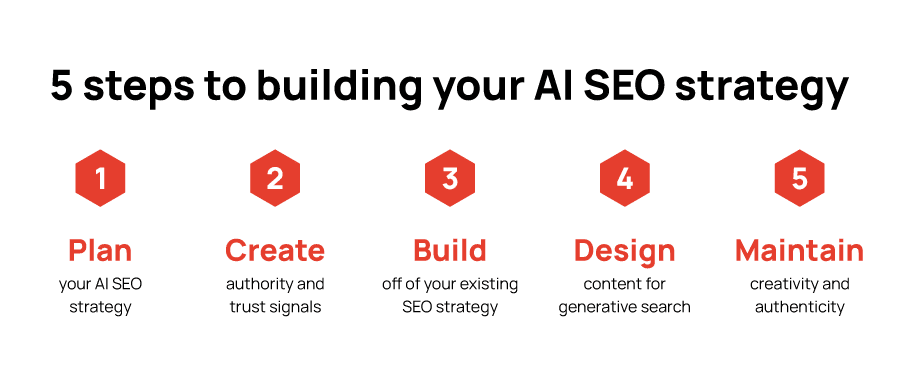
If you know how SEO works, it’s time to revise your playbook with AI in mind. Some teams have strong technical foundations but haven’t mapped their content in a way AI can follow. Others have great material but no clear structure tying their expertise together. These five steps outline the patterns we’ve seen produce meaningful gains as we have learned how to optimize AI SEO.
The first step to your SEO strategy with AI is getting an idea of how your content ecosystem performs when a model tries to interpret it. A standard audit won’t surface everything you need, so an AI-focused review looks at things like entity coverage, schema accuracy, internal connections between pages, and whether your explanations stay consistent across topics.
Ask yourself:
Once you know where things stand, set goals that track both search performance and AI visibility. Rankings matter, of course, but push beyond them, too. You want to see how often your content shows up in AI Overviews and if you’re keeping up with your competitors, especially if they are showing up in the search engine optimizations.
From there, map where your expertise naturally fits within broader topical clusters. This helps you see where you already have momentum and where the gaps are. AI tools can support the analysis, but choosing what to deepen or retire still depends on your priorities, not just what a model suggests. It also helps to take a quick look at how competitors show up in generative engines to spot topics models already associate with others in your space.
Generative engines are trying to decide whose explanation is dependable enough to reuse, and they look for signals that reinforce your expertise across multiple touchpoints and content pushes. As you look at your own content, a few signals often determine whether a model treats your work as dependable:
Make sure your best thinking shows up in places where AI can recognize it: expert-led articles, well-structured pages, digital PR that puts your name in the right conversations, and formatting choices that make your expertise easier to parse.
AI fits naturally into most SEO workflows once you know where it adds real lift. Traditional SEO still does the heavy lifting like crawling, indexing, and information architecture, but AI gives you a faster way to understand how topics connect from a model’s perspective.
Here are the areas where teams tend to see the biggest gains:
AI sharpens what you already do well and reveals opportunities you’d otherwise miss. Your strategy stays intact; your visibility grows because your decisions get better inputs.
Strategy matters, but execution is where most teams either gain leverage or fall behind. The difference often comes down to how you work with AI day-to-day — not just the tools you use, but the way you interact with them. Here’s a quick example of what that collaborative mindset looks like in practice.
AI sharpens what you already do well and reveals opportunities you’d otherwise miss. Your strategy stays intact; your visibility grows because your decisions get better inputs.
Generative tools don’t read your pages front to back. They jump around, grab pieces that answer specific questions, and stitch them together. When your content is organized in a way that gives them strong pieces to pull from, you show up more often and with better representation.
Here are a few patterns we’ve consistently seen help:
When you’re writing and producing an article, ultimately remember that you are giving models well-labeled building blocks that AI wants to use.
However tempting it is to hand everything off to the bots, the human touch really is irreplaceable and still important when it comes to rankings. Original thinking creates ideas and patterns that don’t appear anywhere else, which gives engines something completely unique and distinct to work with.
Here are a few simple things you can do to stay competitive if you do use AI.
When your content reflects the way your team actually thinks, generative engines pick up on that brand and reliability—and your audience does, too.
You need a mix of signals that show how people interact with your pages and how often AI systems lean on your work. Most teams end up watching a handful of KPIs that capture both sides of the picture:
Make sure to review your data so you can spot emerging trends and identify the content that is earning your citations.
The cool part about AI is that it is designed to work with you. You don’t have to throw everything you know and do out of the window. Don’t lose the traction you have gained. Instead, try to show up in generative results by overlapping with strong existing campaigns, PR, and content marketing strategies.
A few areas benefit the most from tighter alignment:
If this seems like a daunting task, an AI SEO agency can help your team bring all this into focus so that you are uniform across the board.
If we’ve learned anything in the past few years, it’s that search won’t settle into one format. Over the next few years, we anticipate that AI summaries, traditional SERPs, voice interfaces, and image-based queries will exist side by side, and brands will need to show up consistently across all of them. Conversations around the future of search already point to a mix of text, visuals, and conversational interfaces shaping how people find information. Teams that adapt early influence how models interpret their space, and those impressions tend to last longer than a single ranking shift.
It’s a new world we’re navigating in AI search, and the brands gaining traction are the ones treating this as an opportunity and not a barrier. Tighten up your messaging, crystallize your structure, and be the voice online that models can learn from. That’s the simple version.
The long version takes a lot of time, analysis, trial and error, and tracking. If you want a partner that can help you get right to the impactful steps, 97th Floor helps teams get a better read on how they appear in generative search and where the strongest opportunities sit. Our AI SEO services give you a practical path to better visibility without overhauling the work you already trust.
Use these free tools to unburden your site of low-value content that prevents an LLM from understanding your brand. Watch your SEO performance skyrocket.
