In the beginning, search marketers could work from a reasonably familiar playbook: publish useful content, optimize the page, build authority, and measure rankings until growth happened.
It was straightforward enough. And for a while, it was good.
But then there was AI. And with AI came AI search/GEO/AEO.
AI search took the playbook and started making edits in the margins. It took a position between the user and the web page, changing how search engines function—summarizing answers, selecting sources, determining which brands deserve mentions, and often turning a traditional search into a zero-click experience. And yes, search was still search. It still took user queries and provided them with answers and direction. It just wasn’t playing by the established rules. From a marketer’s standpoint, it was a lot less predictable, and that made it harder to systematize.
But even if the playbook has changed, it’s still essential. Google’s E-E-A-T framework gives marketers a way to rebuild that system around the thing AI search depends on most: credible, useful, human-validated content that deserves to be seen.
Ask any marketer five years ago about the most important metric in search visibility, and they’d tell you it’s rankings: The top spots get rich, lower ones get bupkis. But modern search doesn’t work quite the same way it used to. In fact, search is moving from a ranking environment to a selection environment.
That may sound like a small distinction, but it is not. A ranking environment gives users a list of options. A selection environment gives users an answer, then decides which sources deserve to support that answer. Now you can be sitting pretty in spot #1, and the majority of relevant searches will still fail to land.
In traditional SEO, weak credibility might mean a lower ranking (hidden, but still findable). In AI-driven results, weak credibility can mean you are not surfaced at all. No honorable mention. No trickle of traffic made up of those who want to see what else is available. Just the silence of your content getting swallowed by the algorithmic void.
It all comes down to the fact that AI systems are no longer trying to improve how users find and connect with pages that can answer their questions; they’re trying to answer those questions directly. And to do that, they need sources they can trust.
Content has to meet a certain credibility threshold before it can be summarized, cited, or recommended. Pages with thin authorship, generic claims, outdated information, flimsy sourcing, (etc.) are at a disadvantage.
And yes, that has always been the case. Bad content digs its own grave. It’s just that AI search gives weak pages fewer places to hide. Instead of slipping into the lower half of a results page and hoping for a wandering click, it may be filtered out before the user ever sees the options.
The Google E-E-A-T framework gives us a useful way to think about content credibility: AI Search makes experience, expertise, authoritativeness, and trustworthiness more visible and less optional. AI search optimization depends on signals that help machines understand whether a source is worth using. Does the author know the subject? Has the brand demonstrated authority over time? Is the content accurate? Is the page structured clearly enough to be understood? In essence, does the content show good quality? Not just in terms of grammar or relevant keywords; usefulness, accuracy, originality, and evidence of real experience are just as important.
E-E-A-T and AI should not be treated as a side quest. They are the plot, belonging inside the broader SEO strategy just as much as content planning, technical SEO, analytics, and conversion strategy.
That is why modern SEO services need to connect credibility signals across the complete digital ecosystem. Content has to be strong. Technical foundations have to be clean. Authority-building has to be intentional. Measurement has to account for search visibility that may not produce a traditional click. Everything has to work together, or it will all fall apart.
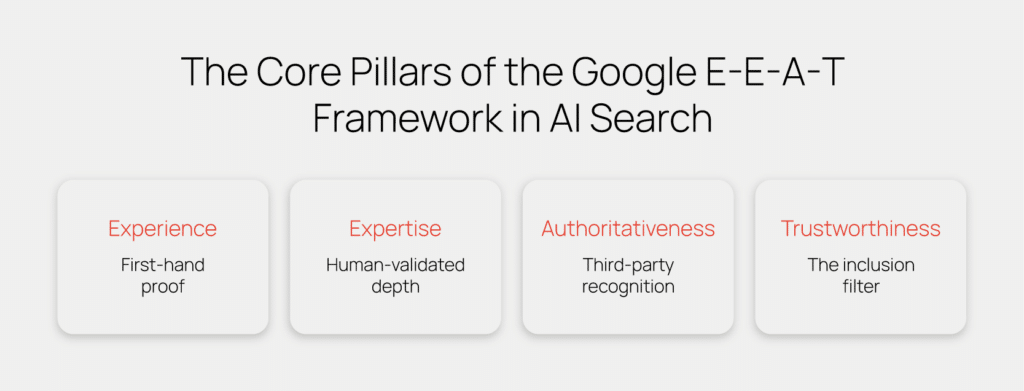
Sound complex? Well, sure. But the Google E-E-A-T framework is useful because it breaks credibility down into bites we can actually chew. Specific trust signals that can be improved, strengthened, and measured over time.
AI can summarize common knowledge quickly. It can explain definitions, reorganize existing information, and produce a perfectly acceptable paragraph that sounds like it was raised in a content farm and taught to roll over on command. What it cannot easily do is recreate real experience. First-hand insights, customer examples, field observations, testing notes, case studies, and lessons learned from actual work all help prove that content is grounded in reality. This gives both users and AI systems something specific to trust.
Experience is the part that says, “We have actually done this,” rather than “We read six similar articles and turned them into soup.”
AI can help teams move faster. It can support research, organize messy notes, generate draft structures, identify gaps, and speed up production. That is useful. But let’s be very clear here: Human expertise still has to steer the ship. I’m reminded of a piece I co-authored back in 2019. This was before modern AI, but its point about not letting data have the final say in strategy is still totally relevant.
A human-in-the-loop AI workflow keeps subject-matter experts involved where they matter most: planning, validation, accuracy, nuance, and final approval. The machine can help build the scaffolding, but a knowledgeable human needs to decide whether the thing is safe to stand on.
This is especially important for topics where the cost of being wrong is high. Medical, financial, legal, technical, and enterprise strategy content all need expert review. But even lower-risk content benefits from human judgment, because credibility is not created by sounding confident.
Domain authority (in AI SEO) is built when other people and systems recognize that your brand knows what it is talking about.
Backlinks are part of this larger authority pattern. Mentions from respected publications, expert contributions, third-party citations, industry partnerships, podcasts, webinars, and strong omnichannel campaigns all help reinforce that your brand belongs in the conversation. AI systems are more likely to trust sources that have already earned recognition across the web. Authority compounds through consistent signals, and those signals become harder for competitors to fake over time.
You can have experience. You can have expertise. You can even have the kind of authority that only comes from years of well-earned recognition. But if your content is inaccurate, outdated, insecure, or weirdly evasive about who is behind it, trust starts leaking out of the page.
Trustworthiness is built through clear authorship, visible credentials, accurate sourcing, updated information, transparent policies, HTTPS, usable site design, and consistency between what your brand says and what it actually does. In terms of E-E-A-T and AI, trust is the inclusion filter. Without it, those other pillars start to wobble.
The problem with AI content is not that AI is in the room. The problem is when everyone else leaves the room.
AI-assisted content can absolutely meet E-E-A-T standards. But it needs strategy, oversight, and a clear reason to exist beyond “we can publish 40 pieces of AI slop before lunch.” AI content quality is built on what humans bring back into the process.
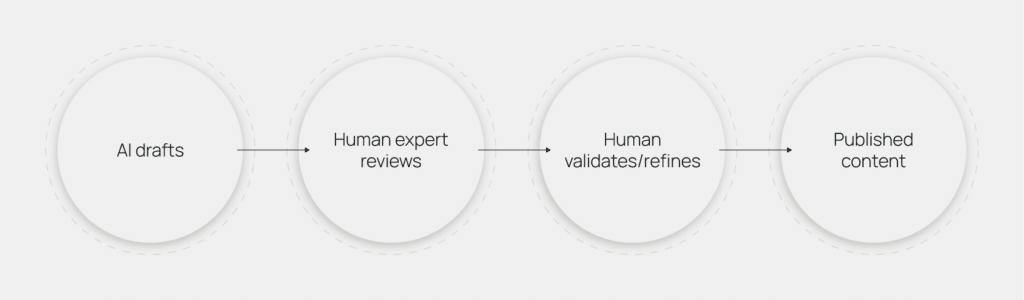
The best model is not human vs. AI. That makes for great movies but it’s just not a good way to approach digital marketing. A better approach is human plus AI, with humans firmly in charge of determining what ‘quality’ means in context.
A human-in-the-loop AI process allows teams to scale production while preserving expertise. AI can help draft outlines, identify related questions, summarize research, suggest structure, and even take a hand in plotting course or suggesting next steps. Humans then refine the argument, add experience, verify claims, sharpen examples, finalize decisions, and make sure the published content sounds like it came from a brand that knows what a heartbeat feels like.
That approach supports E-E-A-T and AI because it combines efficiency with accountability. You get the speed benefits of AI without letting generic content wander onto your website wearing a little name tag that says “thought leadership.”
Everybody likes structure, because everyone likes to see how pieces fit together. But you know who really loves structure? Cold, calculating machines.
Can you blame them? Structure gives AI systems something to follow. Clear headings, direct definitions, focused sections, and logical flow all help the content make sense when it gets parsed, summarized, or divided up. Without that structure, even good information can turn into a junk drawer — useful things are probably in there somewhere, but nobody (not even a machine) wants to go elbow-deep.
This AI search optimization is not a full replacement for traditional search engine optimization. But it is an extension of it. The same content still needs technical accessibility, internal linking, page speed, mobile usability, metadata, topic relevance, and all those elements blogs like this one wouldn’t shut up about just a few years ago.
AI is adept at seeing structure. It’s also pretty good at seeing when something stands out.
Original insights make your content more useful and more defensible. That could mean proprietary data, client learnings, expert interviews, market analysis, custom frameworks, internal benchmarks, or even just a strong point of view. If your content contains something competitors do not have, it becomes more valuable to users and harder for AI systems to treat as interchangeable.
Rome wasn’t built in a single blog post, and neither is authority. It’s built through repeated evidence. AI systems look for patterns. Does this brand cover the topic consistently? Do other trusted sources reference it? Are its authors credible? Does the site maintain accurate, useful content over time?
In other words, an E-E-A-T and AI strategy needs to focus on establishing long-term credibility.
Authority influences whether content is trusted enough to be surfaced, cited, or summarized. High-authority brands have an advantage going in because they have already earned recognition across search engines, publications, users, and industry communities.
That might not seem fair to newcomers, but don’t lose hope. Authority is not permanent. It has to be maintained through ongoing quality and relevance. A strong domain can still lose ground if its content becomes stale, generic, or disconnected from what users actually need. By that same rule, fledgling sites can start strong by building the kind of consistent quality that eventually turns into authority that can then begin to snowball.
Good content marketing is reputation-building that just happens to look like web pages.
When a brand consistently answers important questions, explains complex topics clearly, and brings original perspective to the market, it builds familiarity. Familiarity builds trust. Trust builds authority. And authority gives content a better chance of being selected in AI-driven environments.
It’s probably no surprise that, when it comes to AI, trust has a technical side.
Structured data helps search engines and AI systems understand authorship, organization details, article information, FAQs, products, and relationships between entities. Fast load times improve user experience. Secure browsing protects users. Accessibility makes content available to more people.
None of these elements can replace strong content. Even so, weak technical signals can undercut strong content. If you’ve got everything else in place but the technical signals aren’t up to snuff, it’s like your content is trying to compete with its shoelaces tied together.
By this point, the broad strokes should be clear: AI search rewards content that is credible, specific, structured, and backed by real authority.
Easy enough, right?
Hold up a sec; I have an emoji for this: 😬
No. Easy is obviously not the right word. If it were easy, every brand would already be doing it, and the internet would be a glorious garden of helpful, accurate information.
The challenge is figuring out where your content already demonstrates E-E-A-T and where it still looks a little undercooked. That means evaluating the pieces users can see, the signals AI systems can interpret, and the gaps competitors may already be using to their advantage.
The best place to start is with the content itself:
If the answer is no (or even a very quiet “kind of”), then that content could probably be improved.
The easiest test is this: Strip away your logo, your formatting, and your preferred brand color. Would that piece look just as at home on any competitor’s site? If so, it may be useful, but it is not differentiated.
Next, look at the credibility signals surrounding the content:
The E-E-A-T framework gives you a way to move beyond vague content-quality conversations and ask more practical questions: Who created this, and why should anyone trust it?
Once you’ve looked at content quality and authority, you get to evaluate whether your content is structured for AI readability:
Again, this does not mean you should prioritize writing for machines instead of humans. Please do not do that. Nobody needs more content that reads like a command line. It means creating useful content with enough structure that both humans and AI systems can understand why it deserves attention.
If you’re ready to evaluate your current content, authority signals, expert workflows, and AI search readiness, download the E-E-A-T for AI Search Checklist. Use it to identify where your strategy is strong, where credibility signals are missing, and where your content may need a makeover.
At 97th Floor, E-E-A-T and AI are not treated as separate checklists, and they definitely are not treated as a reason to churn out more generic content at industrial speed.
The goal is not volume for volume’s sake. The goal is visibility that holds up as search changes.
That means building strategies around credibility, authority, structure, and measurable business impact. AI can support that work, but it does not replace the thinking behind it. The brands that win in AI search will be the ones that know what they stand for and can prove it in a way that is accessible.
At 97th Floor, that looks like:
AI search will keep changing. That part is not really up for debate. But the brands that build around credible content, real expertise, technical trust, and long-term authority will be better prepared for whatever search decides to become next. 97th Floor is at the forefront of this shift, helping brands we believe in turn E-E-A-T and AI into a practical strategy for growth.
After all, the playbook may have changed, but trustworthy, high-quality, useful content will always win the game.
E-E-A-T and AI refer to the way experience, expertise, authoritativeness, and trustworthiness influence how content is evaluated in AI-driven search environments. AI systems need trusted sources to generate reliable answers, so credibility signals are becoming central to visibility.
The E-E-A-T framework helps define what high-quality content looks like. It influences the signals search systems use to assess whether content is useful, credible, and trustworthy.
Yes, but only when it is guided and reviewed by humans with real expertise. AI-generated content needs accurate information, original value, expert oversight, clear authorship, and trustworthy sourcing to meet E-E-A-T expectations.
It is a workflow where humans guide, review, and improve AI-assisted work. AI can support efficiency, but human judgment is needed to ensure accuracy, credibility, and brand-specific insight.
Domain authority can influence how likely AI systems are to trust and surface your content. Strong authority signals, including backlinks, brand mentions, and third-party recognition, help reinforce credibility over time.
No. AI search optimization builds on traditional SEO. Technical performance, content quality, authority, internal linking, and user experience still matter. AI search adds new pressure around clarity, credibility, structure, and source selection.
Businesses can improve content quality by combining AI efficiency with expert review, original insights, clear structure, accurate sourcing, and ongoing updates.